
An air freight shipping cost calculator returns one number: chargeable weight multiplied by the applicable rate, plus the surcharges that carrier usually tacks on. That figure follows the IATA volumetric standard, and platforms like Or-ner apply it against live capacity data rather than a static rate card. Treat the output as a screening estimate for budgeting, then request a line-item door-to-door quote before you book, since real-time platforms can undercut published rates by 30 to 50 percent.
TL;DR:
- Chargeable weight is the higher of the actual gross weight or volumetric weight, with the latter calculated using either a 6,000 or 5,000 divisor for volume calculations.
- Online calculators often provide estimates based on live market spot rates, which can be 30 to 50 percent lower than published tariffs but still require a line-item quote for accuracy.
- The final air freight cost includes base rate, fuel surcharges, and security fees but often excludes terminal handling, customs fees, storage, and last-mile delivery charges.
- Proper measurement and packaging can significantly reduce costs, especially by shrinking the bounding box to improve density and lower volumetric weight.
- For precise pricing, request a detailed door-to-door or DDP quote, as self-serve estimates do not include all landing costs or customs procedures.
Table of Contents
- How Do Air Freight Calculators Work?
- What Inputs Does the Calculator Need?
- Walking Through a Real Chargeable Weight Calculation
- What’s Included in the Quote, and What Usually Isn’t
- Why Your Invoice Doesn’t Match the Quote
- Cutting Air Freight Costs at the Calculator Stage
- The Or-ner Perspective: From Estimate to All-In Price
- Get a Verified All-In Air Freight Quote
- Sources
- FAQ
How Do Air Freight Calculators Work?
Every calculator starts with chargeable weight, the greater of your shipment’s actual gross weight or its volumetric weight. The volumetric formula multiplies length by width by height in centimeters and divides by 6,000 for standard air cargo. Express carriers frequently use a 5,000 divisor instead, which produces a lower volumetric weight and, in some cases, a cheaper quote for the exact same box.
Rounding matters more than most shippers expect. Carriers round each piece’s chargeable weight before totaling the shipment, and that per-piece rounding compounds fast across a multi-pallet load.
Once weight is settled, the calculator applies a rate. Two types exist:
- Published (TACT) rates are fixed, published tariffs that change infrequently and tend to run higher than what you’d actually pay.
- Spot rates float with capacity and demand, and digital freight platforms pull these dynamically instead of quoting off a stale rate sheet.
That distinction is why a calculator tied to live market data, rather than a printed rate card, gives you a number closer to what you’ll actually be billed.
What Inputs Does the Calculator Need?
A cargo shipping cost calculator is only as accurate as what you feed it. Garbage dimensions in, garbage quote out. The core inputs are:
- Piece count, since chargeable weight is often calculated per piece, then totaled
- Dimensions, measured at the outermost points of the package, including any pallet or crate overhang
- Gross weight per piece and for the total shipment
- Commodity type or HS code, which affects handling class and customs treatment
- Service level and Incoterm (FOB, CIF, DDP, and so on)
- Origin and destination airports or regions
Unit conversion trips up more shippers than any other input error. Mixing inches and pounds with a calculator expecting centimeters and kilograms produces a chargeable weight that’s off by a wide margin. For irregular shapes, always measure to the widest point on every axis, not the average, since carriers bill on the bounding box, not the actual footprint of the item.
Walking Through a Real Chargeable Weight Calculation
Here’s the sequence a calculator runs behind the scenes:
- Take the outer dimensions and gross weight for each piece.
- Calculate volumetric weight: L × W × H (cm) ÷ divisor.
- Compare volumetric weight to actual gross weight, and take the higher figure as chargeable weight.
- Round the chargeable weight per the carrier’s policy.
- Multiply chargeable weight by the rate per kilogram for that lane and service.
- Add fuel, security, and any applicable surcharges.
Say you’re shipping a single crate measuring 100 x 80 x 60 cm with a gross weight of 150 kg. The volumetric calculation is (100 × 80 × 60) ÷ 6,000, which comes out to 80 kg. Since 150 kg exceeds 80 kg, the actual weight wins, and your chargeable weight is 150 kg. At $6.00/kg, that’s a $900 base freight cost before surcharges.
Where it gets interesting: swap that same crate onto an express service using a 5,000 divisor. Volumetric weight jumps to 96 kg, still under the 150 kg actual weight, so chargeable weight doesn’t change here. But for lighter, bulkier cargo, say a shipment where volumetric weight comes out to 300 kg on a 6,000 divisor versus 360 kg on a 5,000 divisor, that single divisor swing adds 60 kg to the bill. At $6.00/kg, that’s an extra $360 on one shipment, driven entirely by which divisor the carrier applies.

What’s Included in the Quote, and What Usually Isn’t
A calculator’s headline number almost always covers base rate plus fuel surcharge (FSC) and security surcharge (SCC). What it frequently leaves out is where the real budget risk hides:
- Terminal handling charges (THC) at both origin and destination
- Customs clearance and documentation fees
- Destination storage or demurrage if cargo sits before pickup
- Pickup and last-mile delivery fees
Most online calculators quote airport-to-airport, and shippers who plan a budget around that number alone get blind sided. Local charges on either end of the move can represent a meaningful chunk of total landed cost, sometimes reaching 20 to 40 percent depending on the lane and destination country’s fee structure.
Pro Tip: Never treat an instant airport-to-airport quote as your final number. Always request an itemized door-to-door quote, or ask for DDP (Delivered Duty Paid) pricing, so origin and destination charges are locked in before you commit to a booking.
Why Your Invoice Doesn’t Match the Quote
When the carrier invoice lands and the number is higher than expected, work through these before you dispute it:
- Check the rounding policy. A carrier that rounds to the nearest full kilogram, rather than 0.5 kg, adds up fast across a multi-piece shipment.
- Confirm the divisor used. A quote built on 6,000 and an invoice billed on 5,000 (or vice versa) explains most volumetric discrepancies.
- Look for undeclared special handling. Hazmat, temperature control, or oversized-piece fees rarely appear on a self-serve estimate.
- Verify the Incoterm matches what was actually booked; a mismatch between FOB and DDP assumptions shifts who pays which fees.
Ask your forwarder for a per-piece chargeable-weight worksheet showing volumetric and gross weight for every piece. It resolves rounding disputes faster than any phone call.
Cutting Air Freight Costs at the Calculator Stage
The biggest lever you control is packaging. Since chargeable weight rewards density, oversized or poorly packed cargo gets billed on volume, not on what it actually weighs. Right-sizing packaging to shrink the bounding box is often the single highest-leverage move for low-density goods.
Beyond packaging:
- Consolidate smaller shipments to reach lower per-kilogram pricing tiers or qualify for spot-rate access that single-piece shipments don’t get.
- Choose deferred or indirect routing when your timeline allows it, which can trim 15 to 25 percent off an express quote.
- Negotiate pivot weight or flat pallet rates for ULD shipments instead of accepting per-kilogram billing once the pallet clears a weight threshold.
- Lock destination charges up front by negotiating rates and requesting DDP pricing before booking.
Pro Tip: If your product line runs low-density and high-volume (think apparel, home goods, or footwear), packaging redesign usually pays for itself within a few shipments. Run the volumetric math on your current box before you assume the freight rate is the problem.
The Or-ner Perspective: From Estimate to All-In Price
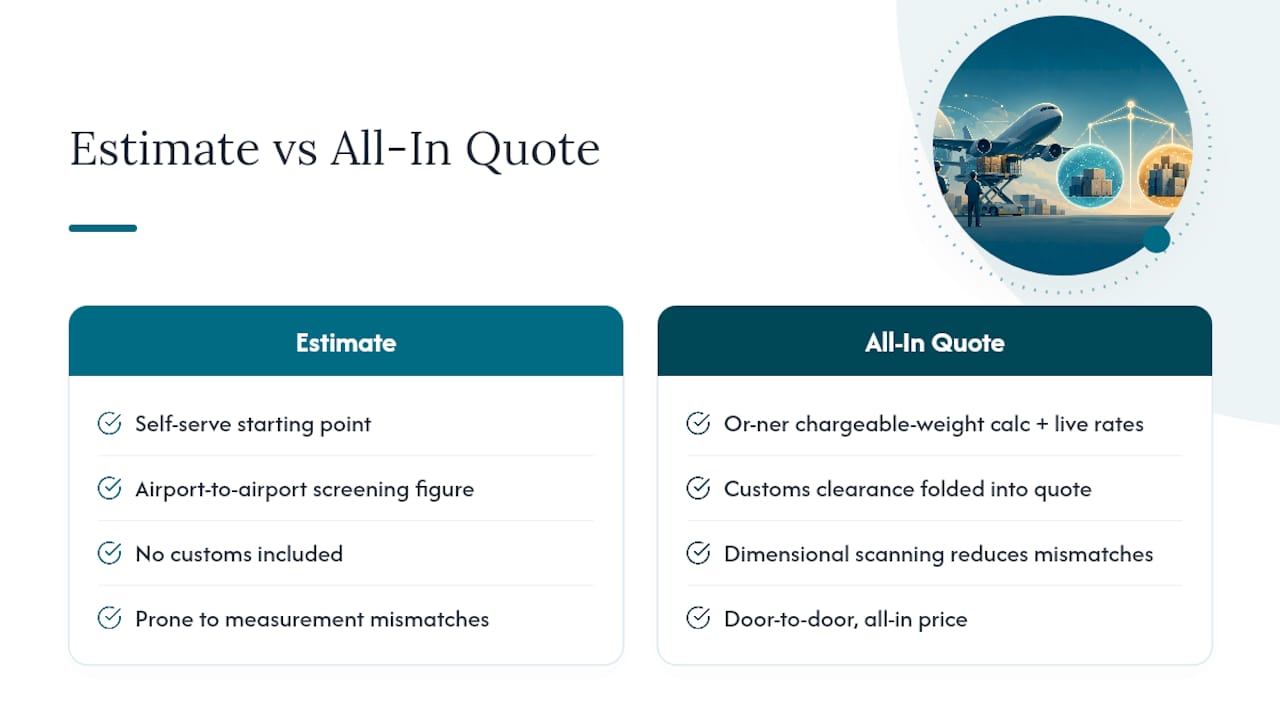
Self-serve calculators are a starting point, not a booking number. Or-ner’s platform runs chargeable-weight calculations against live rate data and integrates customs clearance into the same quote, closing the gap between what a calculator estimates and what a carrier actually bills. Digital tools that fold dimensional scanning directly into booking cut down on the measurement mismatches that cause invoice disputes in the first place.
The trigger for switching from a self-serve estimate to a managed quote is straightforward: complex multi-leg lanes, multi-piece shipments where per-piece rounding adds up, or high-value cargo where a surprise customs delay costs more than the freight itself. That’s where an all-in, door-to-door number beats a rough airport-to-airport screening figure.
— Maayan
Get a Verified All-In Air Freight Quote
Running the numbers yourself is useful for budgeting, but locking in the actual price you’ll pay takes a platform that handles booking, customs clearance, and last-mile delivery under one quote. Or-ner builds that all-in landed price from the same chargeable-weight math covered above, then adds real-time tracking and customs handling so nothing gets added after the fact.

If you’re moving ecommerce inventory, wholesale stock, or manufacturing shipments across borders, start with Or-ner’s courier services to see what a door-to-door quote looks like for your lane. For shippers managing complex international routes, the global freight solutions page walks through how DDP pricing gets locked in before you book, so request a quote and compare it against whatever number your calculator returned.
Sources
- What is dynamic pricing in freight and logistics? | project44
- Air Cargo chargeable weight: A complete guide | Maersk
FAQ
Is It Cheaper to Ship by Air or by Sea?
Ocean freight is almost always cheaper per kilogram, but air freight wins on speed and can be cost-competitive for lighter, high-value, or time-sensitive goods where warehousing and inventory carrying costs offset the higher freight rate.
What’s the Difference Between Chargeable Weight and Actual Weight?
Chargeable weight is whichever is higher: the shipment’s actual gross weight or its calculated volumetric weight. Carriers bill on chargeable weight, so a lightweight but bulky shipment can cost more than its scale weight suggests.
Why Do Two Calculators Give Me Different Quotes for the Same Shipment?
The most common cause is a different volumetric divisor (6,000 versus 5,000), followed by whether the platform pulls published rates or live spot rates from current market capacity.
Does an Online Calculator Include Customs and Delivery Fees?
Most airport-to-airport calculators exclude customs clearance, terminal handling, and last-mile delivery. Request a door-to-door or DDP quote, like those available through Or-ner, to see the full landed cost.
How Do Fuel Prices Affect My Air Freight Quote?
Fuel surcharges (FSC) adjust periodically based on jet fuel prices and are added on top of the base rate, so a quote generated weeks before booking can shift by the time you actually ship.