The air export freight forwarding process is the coordinated sequence of booking, documentation, export compliance, carriage, and customs clearance steps that a freight forwarder and exporter execute together to move cargo internationally by air. Get one step wrong and you are looking at carrier rejection, customs holds, or an enforcement notice from CBP.
Here is the core sequence at a glance:
- Exporter/USPPI: Provides accurate cargo details, commercial invoice, packing list, ECCN/EAR99 classification, and signs the Power of Attorney (POA) authorizing the forwarder to file.
- Freight forwarder (authorized agent): Books space, collects documents, files the Electronic Export Information (EEI) via AES, annotates the air waybill (AWB) with the ITN or exemption legend, and tenders cargo to the carrier.
- Carrier: Accepts cargo, verifies EEI proof of filing, loads, and transports to the destination airport.
- Consignee: Arranges destination customs clearance, pays applicable duties, and takes delivery.
Table of Contents
- What does an air freight forwarder actually do?
- Which air freight service type fits your shipment?
- Step-by-step air export forwarding process you can follow today
- What documents do you need for an air export shipment?
- How chargeable weight and air freight pricing actually work
- U.S. export compliance you cannot skip: EEI, AES, and BIS requirements
- Packaging, labeling, and dangerous goods requirements for air export
- How to choose an air freight forwarder: what actually matters
- Operational tips to reduce air export delays and cost
- Key Takeaways
- What most logistics managers get wrong about air export compliance
- Or-ner makes the air export process easier to manage
- Useful sources and official references
- FAQ
What does an air freight forwarder actually do?
Air freight forwarding is the service of arranging the movement of goods by air on behalf of a shipper, handling everything from carrier booking to customs documentation. The forwarder does not own the aircraft; it acts as the logistics architect between the exporter and the carrier.
Under BIS guidance, the forwarder is the authorized representative of the exporter (USPPI) and carries critical compliance duties, including EEI filing and coordinating ECCN/EAR99 determinations. Responsibility for the accuracy of exporter-provided information, however, stays with the exporter. That split matters when something goes wrong.
Role and responsibility breakdown:
| Party | Primary Responsibilities | Key Documents Owned |
|---|---|---|
| Exporter/USPPI | Provides cargo data, ECCN classification, signs POA, pays freight | Commercial invoice, packing list, export license (if required) |
| Freight forwarder | Books space, files EEI/AES, prepares AWB, coordinates customs | AWB (as agent), EEI/ITN, SLI |
| Carrier | Accepts cargo, verifies EEI annotation, transports, delivers to destination | Master AWB, cargo manifest |
| Consignee | Arranges destination clearance, pays duties, takes delivery | Import entry, delivery receipt/POD |
Core forwarder services in the air export context include:
-
Space booking and rate negotiation with airlines
-
Cargo consolidation (groupage) for smaller shipments
-
Export documentation preparation and review
-
EEI/AES filing and ITN management
-
Dangerous goods (DG) coordination and certification
-
Customs clearance coordination at origin and destination
-
Space booking and rate negotiation with airlines
-
Cargo consolidation (groupage) for smaller shipments
-
Export documentation preparation and review
-
EEI/AES filing and ITN management
-
Dangerous goods (DG) coordination and certification
-
Customs clearance coordination at origin and destination
Which air freight service type fits your shipment?
Pick the service type that matches your speed, cost, and cargo size requirements before you book anything. Choosing the wrong service adds cost and can miss your customer’s delivery window.
- Standard air freight: Full consignments moving on scheduled airline services. Best for shipments that are time-sensitive but not emergency-level, typically 3–7 transit days door-to-door depending on routing. The default choice for most commercial exporters.
- Consolidated/groupage: Your cargo shares space with other shippers’ freight in a single master AWB. Best for smaller shipments (under roughly 100 kg or 0.5 CBM) where you want air speed without paying for a full consignment. Transit adds 1–2 days for consolidation, but the per-kilo rate drops considerably.
- Expedited/express courier: Services like integrator networks move door-to-door in 1–3 days with full tracking. Best for high-value small parcels, urgent samples, or e-commerce fulfillment. Premium pricing, but the all-in rate includes customs brokerage and delivery.
- Charter: The entire aircraft (or a dedicated freighter section) is reserved for one shipper. Best for oversized, time-critical, or politically sensitive cargo where schedule flexibility and cargo control outweigh cost. Rarely used outside of aerospace, defense, or humanitarian logistics.
For most U.S. exporters shipping commercial goods, standard air freight or consolidation covers the majority of shipments. Charter and express are tools for specific situations, not defaults.
Step-by-step air export forwarding process you can follow today
Every air export shipment follows the same operational spine. The steps below form a Master Operating Plan that your team can map against existing SOPs or use to build new ones.
1. Pre-booking and eligibility checks
Responsible: Exporter + Forwarder
Confirm the commodity is not restricted, embargoed, or subject to an export license requirement under the EAR or ITAR. Classify the product with an ECCN or confirm EAR99 status. Check destination country sanctions via OFAC. Do this before anything else — a license determination that surfaces at the airport is a shipment stopper.
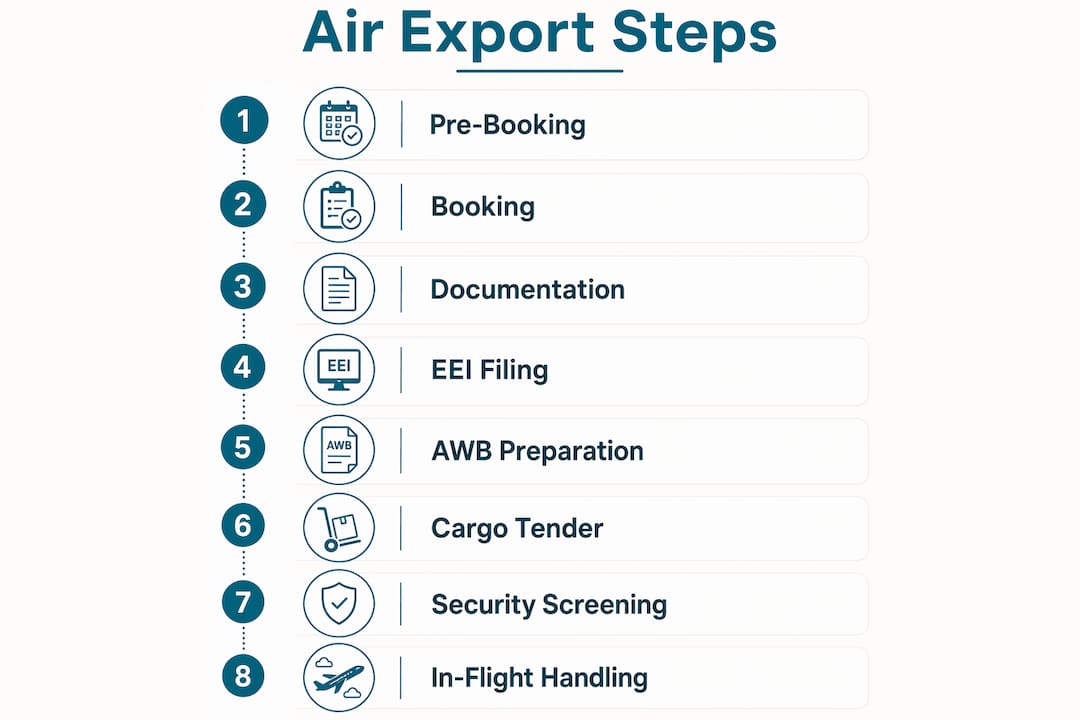
2. Booking and space confirmation
Responsible: Forwarder
Request space from the airline or cargo agent, confirm the flight, and obtain a booking reference. Provide preliminary weight, dimensions, and commodity description. Airlines close cargo acceptance 2–4 hours before departure for most international flights; book at least 24–48 hours ahead for standard freight.

3. Documentation collection
Responsible: Exporter provides; Forwarder reviews
The exporter delivers the commercial invoice, packing list, and any required certificates or licenses. The forwarder reviews for consistency: HS codes, declared values, and shipper/consignee details must match across all documents. Discrepancies here are the single most common cause of customs delays.
Pro Tip: Standardize your commercial invoice and packing list templates so that HS codes, declared values, and ECCN status are pre-populated fields. A one-time setup eliminates the most frequent documentation mismatch errors.
4. EEI/AES filing
Responsible: Forwarder (as authorized agent) or Exporter
File the Electronic Export Information via the Automated Export System (AES). Per 19 CFR § 192.14, the AES Internal Transaction Number (ITN) must be provided to the exporting carrier no later than 2 hours before scheduled aircraft departure for air cargo. AES either returns an ITN on acceptance or a rejection message. No ITN, no loading.
5. AWB preparation and annotation
Responsible: Forwarder
Prepare the air waybill with complete shipper, consignee, commodity, and routing details. Annotate the first page with the ITN or the applicable exemption legend per 15 CFR § 30.7. The AWB is non-negotiable and travels with the shipment as the primary transport contract and tracking document.

6. Cargo tender and acceptance
Responsible: Forwarder tenders; Carrier accepts
Deliver cargo to the airline’s cargo terminal or freight station by the carrier’s cutoff time. The carrier inspects packaging, verifies the AWB annotation, and weighs/measures the shipment. Expect a final chargeable weight determination here — last-minute weight adjustments are common and can affect the freight invoice.
7. Security screening and loading
Responsible: Carrier / Handling agent
All air cargo from the U.S. must pass TSA-mandated security screening before loading. Known shippers and indirect air carriers (IACs) have established screening programs; unknown cargo may face additional delays. The carrier loads confirmed and screened cargo onto the aircraft.
8. In-flight and transfer handling
Responsible: Carrier
For direct flights, this step is straightforward. For multi-leg routing with a transfer hub, the carrier or its handling agent manages the interline transfer. Confirm with your forwarder whether the booking is a direct service or involves a transshipment point, since transfer hubs add 12–24 hours and an additional risk point for mishandling.
9. Arrival and destination formalities
Responsible: Carrier notifies; Consignee/Destination broker acts
The carrier or its ground handler notifies the consignee or their customs broker upon arrival. The consignee (or their import broker) files the destination import entry. For the air import side of this process, Or-ner’s air import forwarding guide covers destination clearance in detail.
10. Customs clearance and delivery
Responsible: Consignee / Destination customs broker
Destination customs assesses duties and taxes, releases the shipment, and the cargo moves to final delivery. Proof of delivery (POD) closes the shipment record. Transit time from wheels-down to POD typically runs 1–3 business days for standard clearance, longer if the destination country requires pre-shipment inspection or additional permits.
Statistic callout: Industry operational guidance consistently identifies last-minute documentation gaps as a leading cause of carrier rejections at the acceptance stage — a problem a pre-tender checklist eliminates in most cases.
What documents do you need for an air export shipment?
Get the paperwork right before you tender cargo. Carrier and customs rejections almost always trace back to a document that is missing, inconsistent, or incorrectly completed.
Trade.gov identifies the air waybill as a required document for all air freight, alongside the commercial invoice and packing list. Beyond those three, the required set expands based on commodity, destination, and value.
| Document | Issued by | When needed | Common errors |
|---|---|---|---|
| Air waybill (AWB) | Forwarder/Carrier | At booking/acceptance | Missing ITN annotation, incorrect consignee details |
| Commercial invoice | Exporter | Before EEI filing | Inconsistent declared value, wrong HS code |
| Packing list | Exporter | Before cargo tender | Weight/quantity mismatch with invoice |
| EEI/ITN or exemption legend | Forwarder/Exporter via AES | No later than 2 hrs before departure | Late filing, missing ECCN, wrong Schedule B |
| Export license (if required) | U.S. government (BIS/State) | Before EEI filing | Not obtained, expired, or wrong license type |
| Certificate of origin | Exporter/Chamber of Commerce | Destination-specific | Incorrect country of origin, missing stamp |
| Special permits/health certs | Relevant authority | Commodity-specific | Missing for regulated goods (food, plants, animals) |
Less common but destination-specific documents include phytosanitary certificates (agricultural products), fumigation certificates, and pre-shipment inspection certificates required by certain importing countries. Consult the foreign buyer early about destination import requirements — this is the single most effective way to avoid a surprise document hold at the destination port.
Common errors that cause delays:
- Incorrect or missing HS/Schedule B code on the commercial invoice
- Declared value on the invoice does not match the AES filing
- Missing or unsigned export license for controlled commodities
- AWB not annotated with ITN or exemption legend before tender
- Packing list quantities that do not match the invoice line items
How chargeable weight and air freight pricing actually work
Chargeable weight is the higher of the shipment’s actual gross weight and its volumetric (dimensional) weight. Carriers bill whichever is greater, so a large, light box will cost more than its scale weight suggests.
The IATA-standard volumetric weight formula for air freight is:
Volumetric weight (kg) = Length (cm) × Width (cm) × Height (cm) ÷ 6,000
Mini calculation example:
A carton measuring 60 cm × 50 cm × 40 cm has a volumetric weight of 60 × 50 × 40 ÷ 6,000 = 20 kg. If the actual gross weight is 14 kg, the carrier bills 20 kg. That 6 kg difference is the gap procurement teams often miss when estimating freight costs.
For shipments measured in inches and pounds, convert dimensions to centimeters first (1 inch = 2.54 cm), or use the equivalent imperial formula your carrier provides.
Air freight rate components:
- Freight charge: The base rate applied to chargeable weight (per kg or per lb)
- Fuel surcharge: Varies by carrier and route; often the largest variable cost component
- Security fee: Mandatory TSA-related charge on U.S. origin shipments
- Terminal handling charges (THC): Origin and destination airport handling fees
- Customs brokerage fee: Charged by the forwarder or broker for clearance services
- Miscellaneous surcharges: Oversize, overweight, remote area, dangerous goods handling
Rate negotiation levers worth knowing: volume commitments unlock contract rates that are significantly lower than spot; consolidating multiple smaller shipments into one master AWB reduces per-unit cost; and booking on less-congested days (typically mid-week) can improve both rate and space availability.
U.S. export compliance you cannot skip: EEI, AES, and BIS requirements
EEI filing via AES is mandatory for most U.S. air exports valued above $2,500 per Schedule B number, or for any shipment requiring an export license regardless of value. This is not optional, and the timing rules are strict.
Per 19 CFR § 192.14, the ITN must reach the exporting carrier no later than 2 hours before scheduled aircraft departure for air cargo. Miss that window and the carrier cannot legally load the shipment.
BIS guidance assigns the forwarder specific compliance duties when acting as the authorized agent: filing EEI, obtaining a POA or Shipper’s Letter of Instruction (SLI) from the exporter, and verifying ECCN/EAR99 determinations. The exporter, however, remains responsible for the accuracy of the information it provides. That shared responsibility is where enforcement risk concentrates.
Compliance checklist for air exports from the U.S.:
- Classify every commodity with an ECCN or confirm EAR99 status before booking
- Screen the consignee and end-user against OFAC, BIS Denied Parties, and Entity List
- Execute a POA or SLI authorizing the forwarder to file EEI on your behalf
- File EEI via AES and obtain the ITN before the 2-hour departure cutoff
- Annotate the AWB with the ITN or applicable exemption legend per 15 CFR § 30.7
- Retain all export records for five years per FTR requirements (15 CFR Part 30)
Routed vs. non-routed transactions: In a routed export transaction, the foreign buyer controls the freight and nominates the forwarder. The U.S. seller can request a copy of the ITN for its own records, but the routed forwarder takes on the filing obligation. Know which type your transaction is before signing the sales contract.
Packaging, labeling, and dangerous goods requirements for air export
Poor packaging and undisclosed dangerous goods are two of the most reliable ways to get a shipment rejected at the cargo terminal. Compliance with IATA Dangerous Goods Regulations (IATA DGR) and carrier-specific rules is mandatory, not advisory.
Packing and labeling checklist:
- Use packaging rated for the combined gross weight of the shipment, including palletization where required
- Cushion fragile items to withstand normal air transport vibration and pressure changes
- Distribute weight evenly across pallets; top-heavy loads fail carrier acceptance inspections
- Label every piece with the shipper’s name and address, consignee’s name and address, and AWB number
- Apply handling marks (Fragile, This Side Up, Keep Dry) where applicable
- Ensure outer carton dimensions match the packing list exactly
Dangerous goods red flags to check before booking:
- Lithium batteries (loose or installed in devices): require IATA DGR Section II or Section IA/IB compliance, UN markings, and carrier pre-approval
- Aerosol containers: classified as flammable or non-flammable aerosols under IATA DGR; quantity limits apply
- Perfumes, alcohol-based products, and paints: flammable liquids with specific packing group requirements
- Magnetized materials: can interfere with aircraft navigation; require compass deviation testing
- Dry ice: regulated as a miscellaneous dangerous good (UN 1845); quantity and labeling rules apply
If any item in your shipment could be classified as dangerous, complete a DG declaration (Shipper’s Declaration for Dangerous Goods) signed by a trained and certified person. Undeclared DG that surfaces during screening results in shipment rejection and potential enforcement action. When in doubt, check the IATA DGR or ask your forwarder before tendering.
How to choose an air freight forwarder: what actually matters
Choose a forwarder based on compliance competence, network coverage, and operational transparency. Rate alone is a poor selection criterion for air exports, where a compliance failure costs far more than the freight savings.
Vetting questions to ask every candidate forwarder:
- Are you a licensed indirect air carrier (IAC) or do you work through one? What is your TSA security program number?
- Can you file EEI/AES directly, and do you have staff trained on FTR (15 CFR Part 30) and EAR requirements?
- What is your process for obtaining ECCN determinations from exporters, and how do you handle controlled commodities?
- Do you have experience with our specific origin/destination lanes and commodity type?
- What are your liability limits, and what cargo insurance options do you offer?
- How do you handle DG shipments, and are your staff IATA DGR certified?
- What is your SLA for documentation submission, and how do you communicate exceptions?
Red flags that should stop the conversation:
- Cannot confirm AES filing capability or does not know what an ITN is
- Vague or missing liability language in the service agreement
- No documented process for ECCN/EAR99 verification
- Inconsistent documentation practices across shipments (different invoice formats, missing packing lists)
- Unwilling to provide references from shippers in your industry or on your lanes
Require the forwarder to provide a sample service agreement that clearly states filing responsibilities, liability limits, claims procedures, and data retention commitments. A forwarder who resists putting these in writing is telling you something important.
Operational tips to reduce air export delays and cost
Documentation accuracy, consolidation, and timing are the three levers that move the needle most on air export cost and reliability. Everything else is secondary.
Practical cost and delay reduction tactics:
- Book space 24–48 hours ahead of the cargo cutoff, not same-day; last-minute bookings pay spot premiums and get bumped first when capacity tightens
- Measure and record carton dimensions accurately before quoting; volumetric weight surprises at the terminal are avoidable
- Consolidate multiple smaller orders destined for the same region into a single master AWB where possible
- Standardize commercial invoice and packing list templates so HS codes, declared values, and ECCN status are consistent across every shipment
- Confirm ECCN/EAR99 classification before booking, not after; a license determination that surfaces at the airport stops the shipment
- Consult the foreign buyer early about destination import requirements to identify required certificates before the cargo is ready
Pro Tip: Negotiate annual volume contracts with your primary carrier or forwarder. Even modest volume commitments unlock contract rates that are materially lower than spot, and they guarantee space during peak season when capacity disappears fast.
Pro Tip: Build a pre-tender checklist that your operations team runs on every shipment: verify HS code matches across invoice and AES filing, confirm ITN is in hand before the 2-hour cutoff, check DG status, and confirm packaging meets carrier requirements. A five-minute check prevents a five-day delay.
For a broader view of logistics challenges that affect air export operations, Or-ner’s analysis of common operational issues covers mitigation tactics that apply across modes.
Key Takeaways
The air export freight forwarding process requires coordinated action from the exporter, forwarder, carrier, and consignee, with EEI/AES compliance and documentation accuracy as the two highest-risk points in the chain.
| Point | Details |
|---|---|
| EEI/AES timing is non-negotiable | The ITN must reach the carrier no later than 2 hours before scheduled aircraft departure for air cargo. |
| Chargeable weight drives cost | Bill on the higher of gross weight or volumetric weight (L × W × H ÷ 6,000 in cm/kg). |
| Documentation consistency prevents holds | HS codes, declared values, and ECCN status must match across the invoice, packing list, and AES filing. |
| DG disclosure is mandatory | Undeclared dangerous goods result in shipment rejection and potential enforcement action under IATA DGR. |
| Or-ner supports the full process | Or-ner’s platform covers freight booking, documentation workflows, EEI filing support, and shipment tracking to reduce manual errors. |
What most logistics managers get wrong about air export compliance
The conventional wisdom is that the freight forwarder “handles compliance.” That framing is dangerous. The forwarder files the EEI and annotates the AWB, but the exporter (USPPI) remains legally responsible for the accuracy of the information it provides. BIS enforcement actions have named exporters, not forwarders, when the underlying commodity data was wrong.
The second thing people underestimate is how much the ITN timing rule actually bites. In practice, documentation collection from the exporter often runs late, which compresses the filing window. By the time the forwarder has a complete and accurate commercial invoice, the departure cutoff is close. The fix is not to rush the AES filing; it is to move documentation collection earlier in the process, ideally 24 hours before the cargo cutoff.
There is also a persistent belief that air freight is inherently faster than ocean, full stop. It is faster in transit, but a shipment that sits at the cargo terminal for two days waiting for a corrected invoice or a missing DG declaration is not faster than a well-managed ocean shipment. Speed is a function of process discipline, not just mode.
The exporters who consistently get shipments out on time are not the ones with the best forwarder relationships. They are the ones with standardized templates, pre-classified commodity lists, and a pre-tender checklist that runs before every booking. The forwarder relationship matters, but it cannot compensate for internal process gaps.
Or-ner makes the air export process easier to manage
Keeping every step of an air export shipment on track, from booking confirmation to ITN annotation to final POD, is genuinely hard to do manually across multiple shipments and lanes. Or-ner’s global logistics platform gives exporters and logistics managers a single place to manage freight booking, documentation workflows, customs clearance support, and real-time shipment tracking.
Where most shippers lose time is in documentation: chasing invoices, reconciling HS codes, and confirming EEI status before the carrier cutoff. Or-ner’s platform addresses that directly with automated document templates, carrier rate access, and exception alerts that flag problems before they become delays. For teams managing cross-border air cargo across multiple destinations, the visibility and workflow tools reduce the manual coordination that drives errors.
Request a quote or book a demo at or-ner.com to see how Or-ner maps to your current air export workflow.
Useful sources and official references
Before each shipment, re-check these primary sources directly. Regulations, filing windows, and country-specific requirements change, and the live agency sites are always more current than any guide.
- U.S. Census Bureau / AES: AESDirect for EEI filing and FTR (15 CFR Part 30) guidance
- Bureau of Industry and Security (BIS): bis.gov for EAR, ECCN classification, and freight forwarder guidance
- U.S. Customs and Border Protection (CBP): cbp.gov for export manifest requirements and port-of-export procedures
- IATA: iata.org for Dangerous Goods Regulations (IATA DGR), air waybill standards, and cargo handling guidelines
- International Trade Administration: trade.gov for common export documents and destination-specific requirements
- Electronic Code of Federal Regulations (e-CFR): ecfr.gov for 15 CFR Part 30 (FTR) and 19 CFR § 192.14 (AES departure timing)
FAQ
What are the main steps in the air export freight forwarding process?
The core steps are pre-booking eligibility checks, space booking, documentation collection, EEI/AES filing, AWB preparation, cargo tender and acceptance, security screening, loading, in-flight transit, destination customs clearance, and final delivery with proof of delivery.
What does an air freight forwarder do?
A freight forwarder acts as the authorized agent of the exporter, handling space booking, documentation preparation, EEI filing via AES, AWB annotation, and cargo coordination with the carrier. Under BIS guidance, the forwarder carries compliance duties but the exporter remains responsible for the accuracy of the information it provides.
What is the EEI filing deadline for air cargo exports from the U.S.?
Per 19 CFR § 192.14, the AES Internal Transaction Number (ITN) must be provided to the exporting carrier no later than 2 hours before scheduled aircraft departure. Missing this window prevents the carrier from legally loading the shipment.
How is chargeable weight calculated for air freight?
Chargeable weight is the higher of the shipment’s actual gross weight and its volumetric weight, calculated as length × width × height (in cm) divided by 6,000. Carriers bill whichever figure is greater, so a large, light shipment will be billed on volumetric weight.
What are the three main types of air freight services?
Standard air freight (full consignments on scheduled services), consolidated/groupage (shared space for smaller shipments), and expedited/express (door-to-door integrator services for urgent or small parcels) cover the majority of commercial air export needs. Charter services are reserved for oversized or time-critical cargo requiring dedicated aircraft capacity.