

Over forty percent of American warehouses report inventory accuracy issues that drive up costs and frustrate supply chains. For ecommerce logistics managers at mid-sized home goods companies, even a single miscount can trigger shipping delays and unnecessary expense. Mastering warehouse inventory control is no longer a luxury but a necessity for staying competitive in the American market. This guide spotlights trusted methods and new technologies proven to help you cut waste and keep operations running smoothly.
Table of Contents
- Warehouse Inventory Control Basics
- Types of Inventory Control Systems
- How Processes Ensure Accuracy and Speed
- Common Mistakes and Risk Factors
- Cost Impact and Optimization Strategies
Key Takeaways
| Point | Details |
|---|---|
| Effective Inventory Control is Essential | Systematic tracking and management of stock are crucial for operational efficiency and cost reduction. |
| Utilize Advanced Technologies | Implementing tools like barcode scanning and RFID helps enhance accuracy in inventory tracking. |
| Choose the Right Inventory System | Select an inventory control method (periodic, perpetual, JIT) based on your business’s transaction volume and operational needs. |
| Continuous Staff Training is Key | Regular training ensures adherence to best practices in inventory management, fostering improved accuracy and efficiency. |
Warehouse Inventory Control Basics
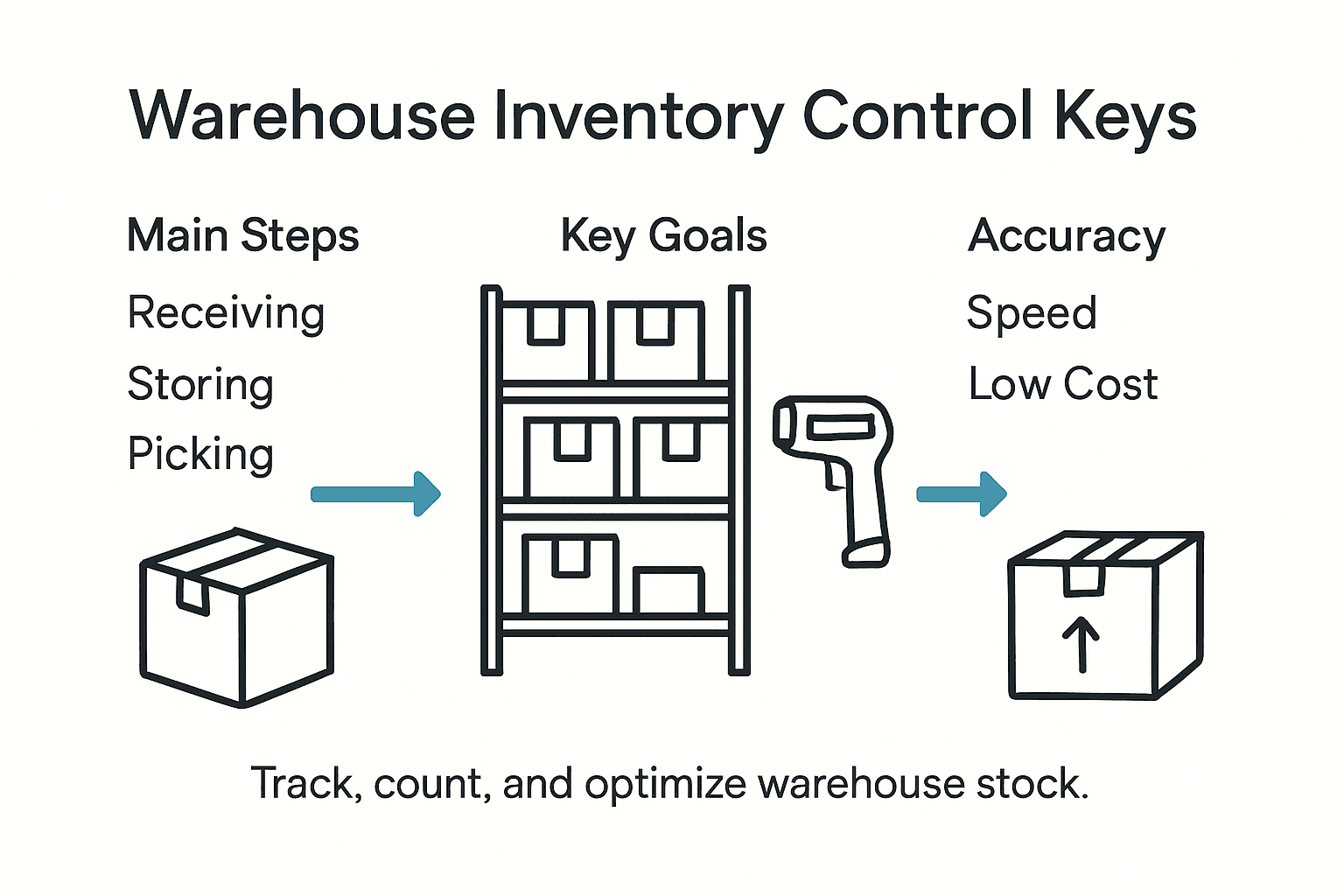
Warehouse inventory control represents a critical operational strategy for managing product stock and ensuring smooth supply chain performance. At its core, inventory control involves systematically tracking, organizing, and maintaining optimal stock levels to meet business demand while minimizing unnecessary costs. Modern warehouses rely on sophisticated techniques to track and manage inventory with precision and efficiency.
Successful inventory control requires understanding several key components. These include demand forecasting, which helps predict future product needs, supply chain management to optimize inventory movement, and financial controls that track inventory value. Advanced warehouses now utilize technologies like barcode scanning and radio frequency identification (RFID) tags to improve accuracy and real-time tracking. These technological solutions enable managers to monitor stock levels, track product locations, and quickly identify potential discrepancies.
The primary goals of warehouse inventory control extend beyond simple stock tracking. Managers aim to strike a delicate balance between maintaining sufficient product quantities to meet customer demand and avoiding excess inventory that ties up financial resources. This involves implementing strategic approaches such as just-in-time inventory management, regular physical audits, and leveraging data analytics to make informed stocking decisions. Effective inventory control can significantly reduce carrying costs, minimize waste, and improve overall operational efficiency.
Pro tip: Implement a periodic cycle counting schedule where different sections of your warehouse are thoroughly inventoried on a rotating basis to maintain continuous accuracy without disrupting daily operations.
Types of Inventory Control Systems
Inventory control systems are critical tools that help warehouses manage stock with varying levels of complexity and precision. Organizations can choose from several primary inventory management approaches designed to meet different operational needs and business scales. The most common systems include periodic, perpetual, and Just-In-Time (JIT) inventory control methods, each offering unique advantages for tracking and managing product stock.
The periodic inventory system represents a traditional approach where warehouse teams conduct physical inventory counts at set intervals, typically monthly or quarterly. This method works well for smaller businesses with limited product ranges and lower transaction volumes. In contrast, the perpetual inventory system leverages advanced technology like barcode scanners and real-time tracking software to provide continuous, up-to-the-minute inventory information. These systems automatically update stock levels with each transaction, enabling more precise and immediate inventory management.
Just-In-Time (JIT) inventory systems offer a strategic approach focused on minimizing inventory holding costs by receiving goods only when they are immediately needed for production or sales. This method requires tight coordination with suppliers and sophisticated demand forecasting. Each inventory control system presents trade-offs between accuracy, cost, and operational complexity. Smaller businesses might prefer periodic systems for their simplicity, while larger enterprises typically benefit from perpetual or JIT approaches that provide more granular inventory insights and reduce unnecessary stock carrying expenses.
Pro tip: Evaluate your warehouse’s specific operational requirements, transaction volumes, and technological capabilities before selecting an inventory control system to ensure the most appropriate and cost-effective approach.
Here’s a comparison of major inventory control system types and their business impacts:
| System Type | Typical Use Case | Technology Level | Impact on Accuracy |
|---|---|---|---|
| Periodic | Small, low-volume | Manual, low-tech | Moderate, risk of delay |
| Perpetual | High-transaction firms | Automated, barcode | High, real-time updates |
| Just-In-Time (JIT) | Lean operations | Advanced, analytics | Very high, minimizes excess |
How Processes Ensure Accuracy and Speed
Warehouse inventory management relies on sophisticated processes designed to maximize both accuracy and operational efficiency. Inventory accuracy is fundamentally measured by the precise tracking and reconciliation of physical stock against digital records, which requires a comprehensive and systematic approach to stock management.

Critical processes that drive inventory accuracy include structured receiving protocols, meticulous product inspection, and systematic recording techniques. Warehouses implement multiple verification steps to minimize errors, such as cross-checking incoming shipments against purchase orders, scanning unique product identifiers, and immediately updating digital inventory systems. Advanced technologies like barcode scanners and radio frequency identification (RFID) tags play a crucial role in automating these verification processes, reducing human error and providing real-time tracking capabilities.
The most effective inventory control strategies incorporate routine cycle counting and continuous monitoring methods. These approaches involve regularly scheduled physical inventory checks that validate digital records, identifying and resolving discrepancies before they become significant issues. By breaking down inventory verification into manageable segments, warehouses can maintain high accuracy levels without disrupting daily operations. Strategic practices like First-In-First-Out (FIFO) inventory management, establishing precise par levels, and implementing robust quality control mechanisms further enhance both the speed and reliability of inventory tracking.
Pro tip: Develop a standardized training program for warehouse staff that emphasizes consistent scanning, documentation, and verification protocols to maintain high inventory accuracy across all operational shifts.
For quick reference, here are common warehouse inventory process improvements and their benefits:
| Process Improvement | Key Benefit | Implementation Requirement |
|---|---|---|
| Cycle Counting | Maintains ongoing accuracy | Routine scheduling |
| Barcode/RFID Scanning | Minimizes manual errors | Technology investment |
| Staff Training | Consistent procedures | Standardized education |
| Quality Control Checks | Reduces product issues | Detailed inspection steps |
Common Mistakes and Risk Factors
Inventory management risks can significantly impact warehouse operational efficiency, with several critical mistakes potentially derailing even well-designed inventory control systems. The most prevalent errors stem from inadequate stock level management, which creates a dangerous cycle of financial and operational challenges that can quickly escalate beyond simple inventory tracking problems.
Key risk factors include improper forecasting, inconsistent inventory counting, and failure to adapt to changing demand patterns. Warehouses often struggle with two extreme scenarios: overstocking, which ties up capital and increases storage costs, and understocking, which leads to lost sales and damaged customer relationships. Advanced inventory management requires sophisticated demand prediction techniques, including analyzing historical sales data, seasonal variations, and market trends to maintain optimal stock levels. Technological solutions like predictive analytics and automated inventory management systems can help mitigate these risks by providing real-time insights and more accurate forecasting.
Poor record-keeping and inadequate tracking mechanisms compound inventory control challenges. Many warehouses fail to implement robust systems that provide comprehensive visibility across multiple storage locations, leading to discrepancies between physical and digital inventory records. This lack of coordination can result in significant financial losses, operational inefficiencies, and reduced ability to respond quickly to market changes. Successful inventory management demands a holistic approach that integrates advanced technologies, systematic verification processes, and continuous staff training to minimize human error and maximize operational accuracy.
Pro tip: Implement a quarterly comprehensive inventory audit process that cross-references digital records with physical stock, using random sampling techniques to identify and address potential systemic tracking issues.
Cost Impact and Optimization Strategies
Effective inventory management represents a critical strategy for minimizing operational costs and maximizing financial performance, requiring a comprehensive approach to inventory control that balances multiple financial considerations. Warehouses must carefully analyze and optimize various cost components, including carrying costs, ordering expenses, and potential stockout impacts.
The primary cost drivers in warehouse inventory management include storage expenses, capital tied up in inventory, and operational inefficiencies. Carrying costs typically represent a significant financial burden, often ranging from 20% to 30% of total inventory value annually. These costs encompass warehouse space, insurance, potential product depreciation, and the opportunity cost of capital investment. Strategic optimization involves implementing precise inventory control techniques such as demand forecasting, safety stock calculations, and just-in-time inventory management to reduce unnecessary stock and minimize associated expenses.
Technological advancements have dramatically transformed cost optimization strategies. Automated inventory management systems, advanced analytics, and real-time tracking technologies enable warehouses to make more precise financial decisions. These solutions provide granular insights into inventory performance, allowing managers to identify inefficiencies, predict demand more accurately, and implement targeted cost-reduction strategies. Emerging technologies like predictive analytics and machine learning algorithms can help warehouses optimize inventory levels, reduce waste, and streamline operational processes, ultimately driving significant cost savings and improving overall financial performance.
Pro tip: Conduct a comprehensive quarterly cost analysis that breaks down inventory-related expenses, identifying specific areas where technological investments or process improvements can generate meaningful financial efficiencies.
Enhance Your Warehouse Accuracy and Cut Costs with Trusted Logistics Solutions
Managing warehouse inventory accurately while controlling costs is challenging. The article highlights key issues like balancing stock levels, reducing carrying costs, and leveraging technologies such as real-time tracking and automated systems to improve precision. You want to avoid common pitfalls like overstocking or inconsistent inventory audits that disrupt your supply chain and drain financial resources.
At or-ner.com, we understand these pain points and offer tailored, end-to-end logistics solutions designed for ecommerce sellers and businesses aiming for flawless inventory control and efficient warehouse management. Our platform integrates reliable courier services with cutting-edge tools for shipment tracking, customs clearance, and fulfillment. Whether you need streamlined workflows, real-time inventory visibility, or scalable warehousing options, we provide the technology and support to help you optimize operations and reduce unnecessary expenses.
Take control of your inventory challenges now and elevate accuracy with the comprehensive solutions at or-ner.com.
[Image:cta_image]
Ready to boost your warehouse efficiency and cut costly errors? Explore premium inventory management and logistics services today at Reliable Courier Services and turn supply chain uncertainty into a competitive advantage.
Frequently Asked Questions
What is warehouse inventory control?
Warehouse inventory control refers to the systematic tracking, organizing, and maintaining of optimal stock levels to meet business demand while minimizing unnecessary costs in a warehouse setting.
How can I improve inventory accuracy in my warehouse?
To improve inventory accuracy, implement structured receiving protocols, utilize barcode or RFID technology, conduct regular cycle counting, and provide standardized training for warehouse staff on inventory verification processes.
What are the different types of inventory control systems available?
The main types of inventory control systems include periodic inventory systems, which involve scheduled physical counts, perpetual inventory systems that provide continuous tracking with technology, and Just-In-Time (JIT) systems that minimize inventory holding by receiving goods only as needed.
Why is demand forecasting important for inventory control?
Demand forecasting is crucial because it helps predict future product needs, enabling warehouses to maintain optimal stock levels, avoid overstocking or understocking, and improve overall operational efficiency.