
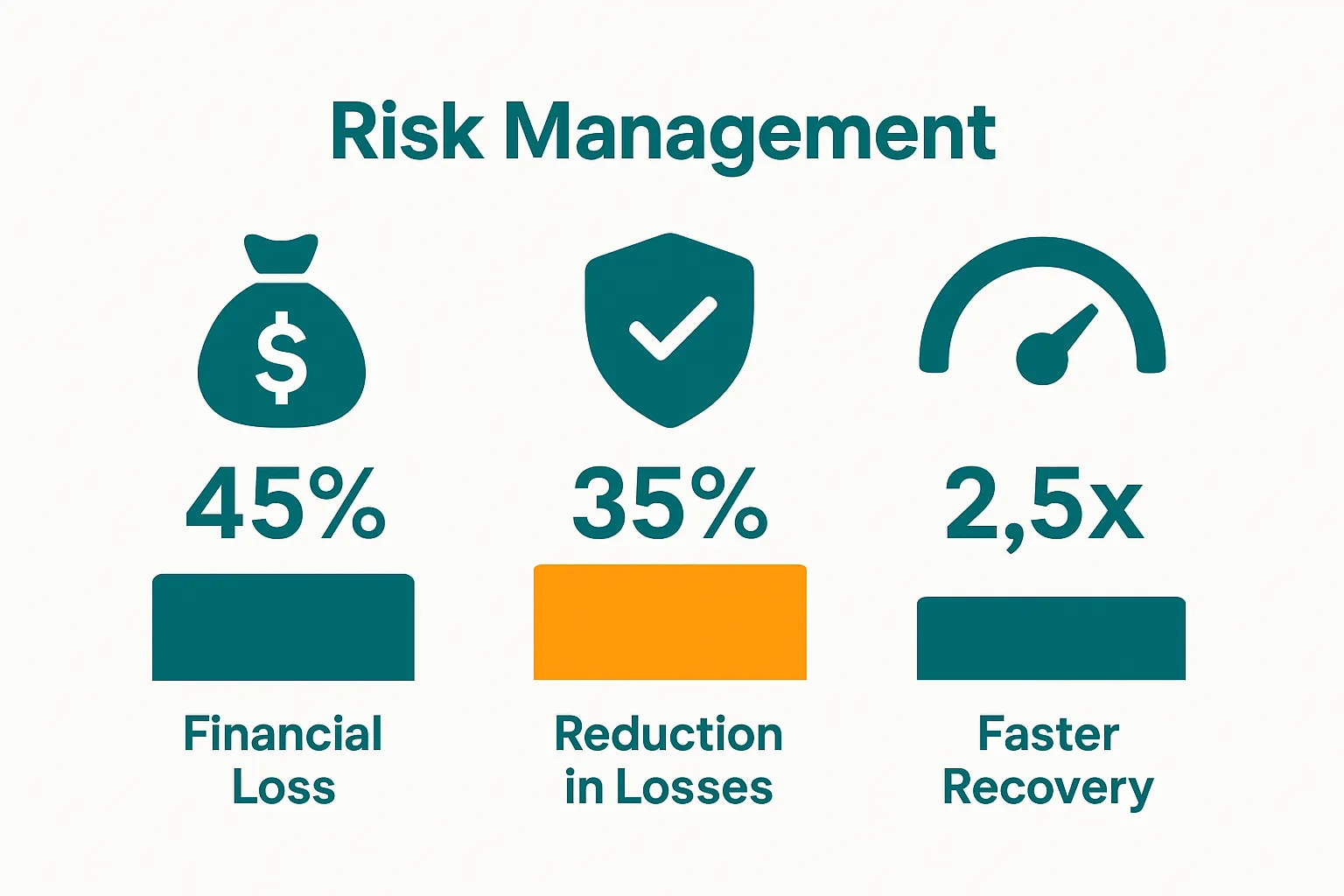
Supply chain risk management sounds complex, but its importance is front and center for companies everywhere. Some industries face potential annual losses of up to 45 percent of one year’s profits due to disruptions. Most people expect technology or global politics to be the biggest hurdles. Turns out, the real challenge is spotting hidden weak spots that can bring business to a halt without warning.
Table of Contents
- What Is Supply Chain Risk Management?
- The Importance Of Supply Chain Risk Management In Business
- Key Components Of Supply Chain Risk Management
- How Supply Chain Risks Are Identified And Assessed
- Real-World Examples Of Supply Chain Risk Management
Quick Summary
| Takeaway | Explanation |
|---|---|
| Identify supply chain vulnerabilities | Recognize geopolitical tensions, financial instability, and environmental risks to manage disruptions effectively. |
| Implement proactive risk management strategies | Develop contingency plans and diversify suppliers to enhance resilience against potential operational interruptions. |
| Quantify risks for better decision-making | Use risk scoring to prioritize threats, enabling focused resource allocation and strategic planning. |
| Leverage technology for advanced risk detection | Utilize predictive analytics and monitoring systems to identify emerging threats in real-time. |
| Enhance supply chain adaptability post-pandemic | Adapt supply chain strategies to respond swiftly to market changes and ensure operational continuity amidst disruptions. |
What is Supply Chain Risk Management?
Supply chain risk management represents a strategic approach that helps businesses identify, assess, and mitigate potential disruptions that could negatively impact their operational performance and financial stability. At its core, this process involves proactively analyzing vulnerabilities within the complex network of suppliers, logistics, production, and distribution systems that constitute a modern supply chain.
Understanding Supply Chain Vulnerabilities
Businesses today operate in an increasingly interconnected global environment where disruptions can emerge from multiple sources. Supply chain risk management recognizes these potential challenges by systematically mapping out potential weak points in an organization’s procurement and logistics processes.
To clarify the types of vulnerabilities businesses might encounter in their supply chains, the table below organizes common supply chain risks and provides brief descriptions of each one.
| Risk Type | Description |
|---|---|
| Geopolitical Tensions | Political disputes or trade wars impacting cross-border sourcing |
| Natural Disasters | Events like earthquakes or floods disrupting production supply |
| Supplier Financial Instability | Suppliers facing bankruptcy or cash flow shortages |
| Cybersecurity Threats | Data breaches or cyber-attacks affecting supply chain operations |
| Transportation Bottlenecks | Delays or disruptions in logistics and freight movement |
| Regulatory Changes | Sudden shifts in laws affecting sourcing, manufacturing, or trade |
Key vulnerabilities typically include:
- Geopolitical tensions affecting international trade
- Natural disasters interrupting production capabilities
- Supplier financial instability
- Cybersecurity threats
- Transportation and logistics bottlenecks
- Sudden changes in regulatory environments
Strategic Risk Mitigation Approaches
Effective supply chain risk management goes beyond merely identifying potential problems. It requires developing comprehensive strategies that create organizational resilience. This involves creating multiple contingency plans, diversifying supplier networks, implementing robust monitoring systems, and building flexibility into operational processes.
Businesses that successfully integrate supply chain risk management can transform potential vulnerabilities into strategic advantages. Proactive risk management allows organizations to anticipate challenges, quickly adapt to changing conditions, and maintain consistent operational performance even during unpredictable market shifts. Research from Deloitte suggests that companies with mature risk management strategies can reduce potential disruption impacts by up to 60% compared to their less prepared counterparts.
The Importance of Supply Chain Risk Management in Business
Supply chain risk management has transformed from a peripheral business function to a critical strategic imperative in today’s complex global marketplace. Organizations that understand and implement robust risk management strategies gain significant competitive advantages, ensuring operational continuity and financial resilience.
Financial Protection and Stability
Businesses face unprecedented economic uncertainties that can dramatically impact their bottom line. According to a study by Resilinc, companies that proactively manage supply chain risks can reduce potential financial losses by up to 35%. These financial protections emerge from systematically identifying and mitigating potential disruptions before they escalate into significant operational challenges.
This table summarizes key financial and strategic benefits that businesses can realize by implementing comprehensive supply chain risk management practices, as supported by industry research cited in the article.
| Benefit | Impact on Business |
|---|---|
| Preventing Unexpected Revenue Losses | Reduces the risk of sudden drops in profit due to delays |
| Reducing Emergency Response Costs | Lowers the expenses of last-minute crisis solutions |
| Maintaining Investor and Stakeholder Confidence | Builds trust by ensuring supply chain reliability |
| Protecting Brand Reputation | Safeguards public image through consistent fulfillment |
| Minimizing Insurance and Compliance Expenses | Lowers risk premiums and legal liabilities |
Key financial benefits include:
- Preventing unexpected revenue losses
- Reducing emergency response costs
- Maintaining investor and stakeholder confidence
- Protecting brand reputation
- Minimizing insurance and compliance expenses
Competitive Advantage Through Resilience
Companies that develop sophisticated supply chain risk management processes can differentiate themselves in competitive markets. Strategic risk management enables organizations to respond quickly to global challenges, adapt to market changes, and maintain consistent performance. Research from Gartner indicates that organizations with mature risk management frameworks are 2.5 times more likely to recover quickly from unexpected disruptions.
By learning more about just-in-time delivery strategies, businesses can further enhance their supply chain risk management capabilities, creating a more responsive and adaptive operational model that anticipates and mitigates potential risks before they significantly impact business performance.
Key Components of Supply Chain Risk Management
Supply chain risk management is a comprehensive approach that requires strategic planning and sophisticated analytical tools. By breaking down this complex process into distinct components, businesses can develop a robust framework to anticipate, assess, and mitigate potential disruptions across their operational landscape.
Risk Identification and Assessment
Systematic risk identification forms the foundational layer of effective supply chain risk management. According to the Government Accountability Office, organizations must conduct thorough assessments that encompass internal and external risk factors. This involves mapping out potential vulnerabilities across multiple dimensions of the supply chain ecosystem.
Key areas of risk identification include:
- Supplier financial health
- Geopolitical instability in sourcing regions
- Transportation infrastructure limitations
- Technology and cybersecurity vulnerabilities
- Regulatory compliance challenges
- Environmental and climate-related risks
Risk Mitigation and Contingency Planning
Once risks are identified, businesses must develop comprehensive strategies to minimize potential impacts. Proactive risk mitigation goes beyond simple reactive measures, requiring organizations to build resilience and flexibility into their supply chain structures. Our comprehensive guide on freight forwarding offers additional insights into creating robust logistics strategies that support risk management efforts.
Effective risk mitigation strategies typically involve:
- Diversifying supplier networks
- Developing alternative sourcing options
- Creating detailed contingency plans
- Implementing real-time monitoring systems
- Establishing clear communication protocols
- Investing in technology-enabled risk tracking
How Supply Chain Risks are Identified and Assessed
Identifying and assessing supply chain risks represents a sophisticated process that requires comprehensive analysis, advanced technological tools, and strategic thinking. Organizations must develop multifaceted approaches that go beyond traditional risk management techniques to create robust, adaptive strategies for navigating complex global business environments.
Advanced Risk Detection Methodologies
Strategic risk identification involves systematic evaluation of potential disruptions across multiple organizational domains. According to the World Economic Forum, businesses must employ comprehensive scanning techniques that capture emerging threats from technological, geopolitical, and environmental perspectives.
Key risk detection methodologies include:
- Predictive data analytics
- Scenario planning and simulation
- Supplier performance monitoring
- Network vulnerability mapping
- Machine learning risk algorithms
- Cross-functional risk assessment workshops
Risk Assessment and Quantification Techniques
Once potential risks are identified, businesses must develop precise quantification methods to understand their potential impact. Risk scoring allows organizations to prioritize and allocate resources strategically, transforming abstract threats into measurable financial and operational considerations. Learn more about the benefits of freight forwarding strategies that can help mitigate potential supply chain vulnerabilities.
Effective risk assessment typically involves:

- Calculating potential financial losses
- Evaluating probability of occurrence
- Determining recovery time and complexity
- Assessing interdependency of risks
- Creating risk probability matrices
- Developing weighted risk impact models
Real-World Examples of Supply Chain Risk Management
Supply chain risk management is not a theoretical concept but a practical necessity demonstrated through numerous high-profile cases where strategic interventions prevented potential operational catastrophes. Understanding these real-world scenarios provides critical insights into the tangible value of proactive risk management strategies.
Technological Disruption and Adaptation
Global technology companies have become prime examples of effective supply chain risk management. According to Harvard Business Review, organizations like Apple and Samsung have developed sophisticated risk mitigation strategies that enable them to quickly adapt to unexpected market changes.
Notable technological supply chain risk management examples include:
- Apple’s diversified manufacturing strategy across multiple countries
- Samsung’s multilayered supplier verification processes
- Semiconductor manufacturers developing alternative production networks
- Technology firms creating redundant sourcing strategies
- Implementing advanced tracking and predictive analytics systems
Pandemic-Driven Supply Chain Transformations
The COVID-19 pandemic exposed significant vulnerabilities in global supply chains, forcing businesses to reimagine their risk management approaches. Strategic resilience became paramount as companies rapidly restructured their operational models. Learn more about freight forwarding strategies that can help businesses navigate complex logistical challenges.
Key pandemic-related supply chain adaptations demonstrated:
- Pharmaceutical companies accelerating vaccine distribution networks
- Automotive manufacturers shifting production to medical equipment
- Retailers developing robust e-commerce and delivery infrastructure
- Companies investing in local and regional supply alternatives
- Enhanced digital collaboration and remote management technologies
Turn Supply Chain Risk Into Opportunity With Reliable Logistics
Are you worried that unexpected disruptions might be harming your business’s cash flow or delivery timelines? As discussed in this article, gaps in supply chain risk management can lead to lost revenue, rising costs, and fragile operations. Many ecommerce sellers and brands struggle to find a dependable partner for complex tasks like real-time shipment tracking, cross-border logistics, and inventory management. The pressure to proactively identify risks and respond quickly can feel overwhelming when your logistics partners disappoint you.

Now is the time to transform your entire supply chain with greater resilience. At or-ner.com, we deliver reliable courier services and end-to-end support to help you overcome uncertainty. Our integrated tools for freight forwarding and shipment tracking put you in control, letting you monitor and address risks long before they disrupt your operations. Take charge of your logistics and protect your growth by partnering with a platform built for business. Get started today and see how simplified workflows and real-time visibility can make your supply chain a true competitive advantage.
Frequently Asked Questions
What is supply chain risk management?
Supply chain risk management is a strategic approach that helps businesses identify, assess, and mitigate potential disruptions within their supply chain, ensuring operational performance and financial stability.
Why is supply chain risk management important for businesses?
It is crucial as it protects businesses from financial losses due to unforeseen disruptions, maintains operational continuity, and enhances competitive advantage through resilience.
How are supply chain risks identified and assessed?
Risks are identified through systematic evaluations that map vulnerabilities across the supply chain and assessed using techniques like risk scoring to determine their potential impact and prioritize resources accordingly.
What are common supply chain vulnerabilities that businesses should watch for?
Common vulnerabilities include geopolitical tensions, natural disasters, supplier financial instability, cybersecurity threats, transportation bottlenecks, and regulatory changes.