TL;DR:
- Global shipping faces increased volatility due to geopolitical disruptions, making resilience more important than efficiency.
- Regional trade growth favors shorter routes and mid-sized vessels, altering traditional shipping patterns and vessel orders.
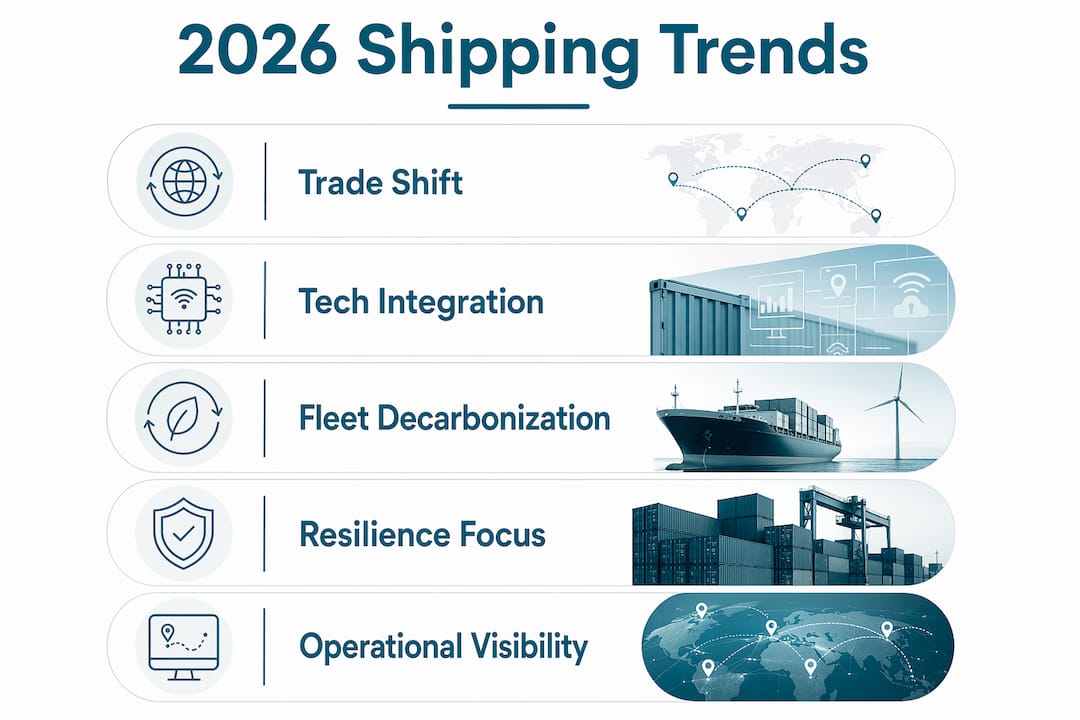
The future of global shipping is defined by volatility, not stability. The ClarkSea Index surged 61% year-on-year to $38,717 per day, driven by geopolitical disruptions including the Strait of Hormuz closure. That number tells supply chain professionals one thing clearly: the era of predictable, low-cost ocean freight is over. Allianz has confirmed what many logistics leaders already feel on the ground. The industry must now build around resilience, not just efficiency. Geopolitical tension, decarbonization mandates, and digital transformation are reshaping every layer of global trade, from vessel design to last-mile delivery.
How are geopolitical shifts reshaping global shipping routes?
Regional trade agreements now account for 60% of global trade in 2026, up from 40% in 1990. That structural shift is redirecting container volumes away from long-haul megaship routes and toward shorter, more frequent regional corridors. Container trade volumes are forecast to expand by 2.5%–3.5% in 2026, with the growth concentrated on intra-regional lanes.
The corridors gaining the most momentum include intra-Asia routes, the Mexico-US nearshoring corridor, and Eastern Europe to EU lanes driven by post-conflict reconstruction demand. These routes favor mid-sized vessels over ultra-large container ships, which explains why 2026 newbuild ordering is running 33% ahead of 2025 pace with a clear tilt toward regional tonnage. Chokepoint vulnerabilities, from the Suez Canal to the Strait of Hormuz, are accelerating this diversification.
For supply chain professionals, the practical implications are significant:
- Route diversification is no longer optional. Single-corridor dependency creates unacceptable exposure to closure risk.
- Nearshoring reduces transit time and customs complexity on the Mexico-US corridor, but requires new carrier relationships.
- Intra-Asia volumes are growing faster than trans-Pacific lanes, rewarding businesses with regional warehouse footprints.
- Eastern Europe-EU freight is expanding as reconstruction spending drives demand for building materials and industrial goods.
| Trade Corridor | Growth Driver | Vessel Type Favored |
|---|---|---|
| Intra-Asia | Regional manufacturing growth | Mid-sized feeder vessels |
| Mexico-US | Nearshoring from Asia | Short-sea and road intermodal |
| Eastern Europe-EU | Reconstruction demand | Breakbulk and general cargo |
| Intra-Americas | Commodity diversification | Handysize bulk carriers |
Pro Tip: Map your top five trade lanes against current chokepoint risk zones every quarter. A single lane closure can add 10–14 days to transit time and erase months of cost savings.
What role does technology play in the future of maritime shipping?

Digital integration is now the baseline requirement for managing modern ship complexity, not a competitive advantage. Traditional design methodologies fail to keep pace with the regulatory and operational demands placed on vessels in 2026. Ship designers and operators are turning to digital twins, simulation tools, and real-time performance monitoring to close that gap.
Digital twins create a virtual replica of a vessel that updates continuously with live sensor data. Naval architects use them to model fuel consumption under different loading conditions, test route scenarios before committing, and predict maintenance needs before failures occur. The result is measurable lifecycle cost control, not theoretical savings.
The maritime cleantech market in 2026 demands verified performance data, which is driving commercial models like pay-as-you-save. Under this model, technology providers are paid from the fuel savings their systems generate. That structure forces vendors to deliver real-world results, not just promising specifications. It also gives shipping companies a lower-risk path to adopting new technology without large upfront capital commitments.
Digital product passports are another technology reshaping operations. Digitally verifiable product identities are becoming mandatory for fast customs clearance, reducing manual inspections and border delays. Businesses that ignore this shift face compounding delays at ports as customs authorities prioritize digitally documented cargo. Platforms like Or-ner already integrate real-time tracking and customs clearance tools that align with this direction, giving ecommerce sellers visibility across the full shipment lifecycle. You can explore the best logistics technologies available to supply chain professionals in 2026 to understand which tools deliver the most impact.
Pro Tip: When evaluating digital tools for your shipping operations, ask vendors for verified performance data from real deployments, not lab benchmarks. Pay-as-you-save contracts are a reliable signal that a vendor believes in their own product.
How is decarbonization influencing fleet renewal and fuel adoption?
IMO carbon regulations now raise shipping costs by $150–$400 per container on key routes. That cost pressure is not abstract. It shows up directly in freight quotes and forces shippers to evaluate whether their carrier partners are investing in compliant fleets or absorbing penalties that will eventually be passed downstream.
Biogas pathway fuels offer the maritime industry the best near-term low-carbon option available today. They work within existing engine infrastructure, which means carriers do not need to retire current vessels to start reducing emissions. That compatibility makes biogas a practical bridge while longer-term infrastructure for hydrogen and ammonia matures.
The challenge is fuel availability. Green fuel supply remains uneven across major ports, creating operational complexity for vessels on multi-port itineraries. Port restrictions on certain fuel types add another layer of planning burden. Carriers managing these constraints are investing in hybrid vessels that can switch between conventional and alternative fuels depending on port availability.
| Fuel Type | Readiness Level | Key Constraint |
|---|---|---|
| Biogas pathway | High, deployable now | Feedstock supply at scale |
| LNG | Moderate, widely available | Carbon intensity still debated |
| Methanol | Growing, limited ports | Infrastructure gaps |
| Ammonia | Low, early stage | Safety protocols, port readiness |
| Hydrogen | Very low, experimental | Production cost, storage |
Fleet renewal is accelerating because the economics now favor it. Older vessels face higher carbon levies, lower charter rates from ESG-conscious shippers, and increasing port surcharges. Investing in cross-border logistics strategies that account for carrier fleet age and fuel type gives businesses a real cost advantage over the next three to five years.
Pro Tip: Ask your freight forwarder for the carbon intensity rating of the vessels on your regular lanes. Carriers with newer, cleaner fleets often offer more predictable pricing as IMO compliance costs stabilize.
Why is resilience replacing efficiency as the core shipping strategy?
Allianz has confirmed that the age of predictable, efficiency-optimized shipping is over. The just-in-time model, which minimized inventory by relying on precise delivery windows, breaks down completely when a single geopolitical event closes a major chokepoint. Supply chain leaders who built their operations around cost-per-container metrics are now rebuilding around continuity.
The just-in-case model replaces tight inventory windows with strategic buffer stock held at regional distribution points. It costs more to carry that inventory, but the cost of a stockout during a disruption is far higher. Experienced logistics professionals now prioritize resilience metrics measuring reroute time and cost over traditional efficiency metrics. Failure to adopt resilience models results in critical stockouts during disruptions, which damages customer relationships and revenue simultaneously.
Resilience-focused supply chain management involves four concrete practices:
- Dual sourcing across at least two geographically separate suppliers for every critical component or product category.
- Pre-negotiated rerouting agreements with carriers that define alternative lanes and pricing before a disruption occurs.
- Regional buffer inventory positioned at distribution centers near key demand markets, not just at origin ports.
- Resilience KPIs tracked alongside cost metrics, specifically reroute time, reroute cost, and days-of-supply coverage.
Or-ner’s platform supports this shift by giving supply chain teams real-time exception management and multi-modal visibility across ocean, air, and land transport. Understanding global supply chain risks and building response plans before disruptions hit is the defining capability that separates resilient operations from reactive ones. You can also explore operations management software options that help smaller businesses apply the same resilience frameworks used by enterprise logistics teams.
Pro Tip: Build your resilience metrics dashboard before the next disruption, not during it. Track reroute time and reroute cost monthly so you have a baseline when you need to make fast decisions under pressure.
Key Takeaways
The future of global shipping requires resilience, digital integration, and decarbonization investment to manage volatility driven by geopolitical shifts and regulatory pressure.
| Point | Details |
|---|---|
| Resilience over efficiency | Shift from just-in-time to just-in-case models to protect against chokepoint closures and supply disruptions. |
| Regional trade corridors | Routes like intra-Asia and Mexico-US are growing faster than long-haul lanes, favoring mid-sized vessels. |
| Decarbonization costs are real | IMO regulations add $150–$400 per container, making carrier fleet age a direct cost factor for shippers. |
| Digital tools are mandatory | Digital twins, product passports, and pay-as-you-save models are now baseline requirements, not optional upgrades. |
| Resilience metrics matter | Track reroute time and cost alongside traditional KPIs to measure supply chain health accurately. |
What I’ve learned watching shipping strategies break under pressure
I’ve spent years watching supply chain teams optimize their way into fragility. The logic always sounds reasonable: cut inventory, tighten carrier contracts, consolidate to fewer lanes for volume discounts. Then a single event, a port closure, a trade restriction, a weather disruption, exposes exactly how brittle that structure is.
The companies that recovered fastest from recent geopolitical shocks were not the ones with the lowest freight costs. They were the ones with pre-built relationships across multiple carriers, buffer stock in regional warehouses, and visibility tools that showed them the problem before it became a crisis. That combination is not expensive to build. It requires discipline and planning, not necessarily a larger budget.
The technology piece is where I see the most hesitation. Leaders understand that digital twins and product passports are coming, but they delay adoption waiting for the market to mature. The problem is that the market is maturing right now. Carriers and customs authorities are already rewarding digitally documented cargo with faster clearance. Waiting another two years means two years of avoidable delays and cost.
My honest recommendation: treat resilience as a capital investment, not an operating cost. The rerouting agreements, the buffer inventory, the digital tools. These are assets that generate returns every time a disruption hits your competitors harder than it hits you. Building a resilient supply chain is not a defensive move. It is a competitive one.
— Maayan
Or-ner’s logistics platform for resilient shipping operations
Global shipping complexity is not slowing down. Supply chain professionals need tools that provide real-time visibility, multi-modal freight options, and customs clearance support across every lane they operate.
Or-ner’s global logistics platform connects ecommerce sellers and businesses to a worldwide network of fulfillment centers, ocean and air freight options, and real-time shipment tracking. The platform handles customs clearance, cross-border documentation, and exception management so your team spends less time chasing shipments and more time making decisions. For businesses that need reliable courier services within the US alongside their international freight operations, Or-ner covers both under one platform.
FAQ
What is causing the most volatility in global shipping right now?
Geopolitical disruptions, including chokepoint closures like the Strait of Hormuz, are the primary driver. The ClarkSea Index surged 61% year-on-year as a direct result of these events.
How do IMO carbon regulations affect shipping costs?
IMO regulations add $150–$400 per container on key routes. Shippers working with carriers that operate older, non-compliant fleets absorb the highest cost increases.
What is a digital twin in maritime shipping?
A digital twin is a virtual replica of a vessel that updates with live sensor data. Ship operators use it to model fuel consumption, test route scenarios, and predict maintenance needs before failures occur.
Why are regional trade corridors growing faster than long-haul routes?
Regional trade agreements now represent 60% of global trade, up from 40% in 1990. That shift drives demand for shorter, more frequent routes that mid-sized vessels serve more efficiently than megaships.
What is the best near-term low-carbon fuel for shipping?
Biogas pathway fuels are the strongest near-term option. They work with existing engine infrastructure, making them deployable without fleet replacement while longer-term alternatives like hydrogen and ammonia mature.