TL;DR:
- Choosing the right USPS service tier and proper packaging can significantly reduce international shipping costs for small businesses. Using online postage, consolidating shipments, and continuously comparing carrier rates help optimize expenses and improve margins. Tailoring delivery speed to customer needs maximizes efficiency and minimizes unnecessary expenses.
Cost-effective international shipping means choosing affordable, reliable options that keep delivery quality high without draining your margins. For e-commerce sellers and small businesses, the difference between a profitable overseas order and a money-losing one often comes down to carrier selection, package weight, and knowing which tools cut costs before checkout. USPS Priority Mail International starts at $32.65 with 6–10 business day transit times, while USPS First-Class Package International Service begins at just $19.40 for packages under 4 lbs. Understanding these options is the foundation of any budget-friendly global shipping strategy.
What are the most cost-effective international shipping options for small businesses?
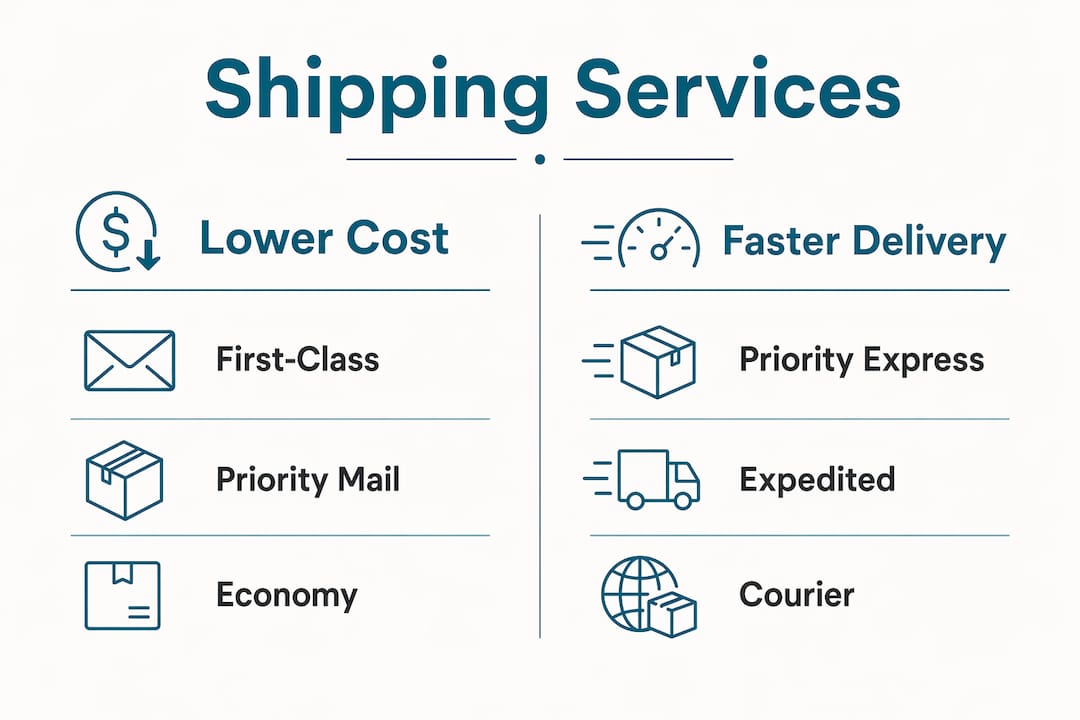
The most affordable global shipping options from the U.S. fall into three USPS tiers, each suited to a different package type and urgency level. Choosing the wrong tier is one of the most common ways small sellers overpay on every shipment.
USPS First-Class Package International Service (FCPIS) is the lowest-cost option for lightweight parcels. It starts at $19.40 and covers packages up to 4 lbs, with a declared value limit of $400. Electronic delivery confirmation is included for select countries. This service works well for jewelry, accessories, small apparel items, and documents that do not require fast delivery.
USPS Priority Mail International covers heavier packages and offers more protection. It includes tracking and $200 insurance for merchandise, with delivery in 6–10 business days. Flat Rate envelopes and boxes are available under this service, which removes the guesswork when you are shipping heavier or oddly shaped items.
USPS Priority Mail Express International is the fastest domestic postal option for overseas delivery. It starts at $62.70 with a 3–5 business day window and an optional money-back guarantee for select destinations. Reserve this tier for time-sensitive orders where a late delivery would cost you a customer.
For the absolute lowest cost on letters and flat documents, First-Class Mail International starts at $1.70 with a Global Forever stamp, reaching roughly 180 countries. This is the best way to ship documents internationally when speed is not a factor.
- FCPIS: packages up to 4 lbs, starting at $19.40, limited value coverage
- Priority Mail International: up to 20 lbs, starting at $32.65, includes $200 merchandise insurance
- Priority Mail Express International: 3–5 business days, starting at $62.70, optional money-back guarantee
- First-Class Mail International: letters and flats, starting at $1.70 per oz
Pro Tip: If your package weighs under 4 lbs and the contents are worth less than $400, FCPIS almost always beats Priority Mail International on price. Run the comparison before you print a label.
How does packaging affect the cost of international shipping?
Packaging is where most small sellers leave money on the table. Carriers calculate shipping charges using either actual weight or dimensional weight, whichever is greater. Dimensional weight pricing means a large, light box can cost as much to ship as a heavy one. Smaller, lighter packages avoid dimensional weight penalties and cut shipping costs directly.

The fix is straightforward: use the smallest box that safely fits your product. Avoid oversized boxes padded with excessive filler. For fragile items, use form-fitting foam inserts or air pillows rather than heavy bubble wrap rolls, which add weight without adding much protection.
USPS Flat Rate boxes are the exception to the dimensional weight rule. Flat Rate envelopes handle up to 4 lbs and Medium and Large Flat Rate Boxes go up to 20 lbs, all priced by container size rather than weight. If your product is dense and heavy, a Flat Rate box will almost always save you money compared to a standard rate calculation.
Consolidation is another underused tactic. If a customer orders multiple items, ship them together in one package rather than separately. A single consolidated shipment costs less than two individual ones, and the customer gets a cleaner unboxing experience.
- Use the smallest box that fits the product safely
- Choose form-fitting inserts over heavy filler materials
- Use USPS Flat Rate boxes for dense or heavy items
- Consolidate multi-item orders into one shipment
- Weigh and measure every package before purchasing postage
Pro Tip: Buy a postal scale and a tape measure for your packing station. Knowing exact dimensions before you book a label prevents surprise surcharges at the post office.
What tools and strategies help you get better international shipping rates?
Retail counter prices are rarely the best prices available. Online postage purchasing and consolidators unlock discounted international shipping rates beyond what you pay at the counter, and this applies across USPS, DHL, FedEx, and UPS shipments. The savings on a single shipment may seem small, but they compound quickly across hundreds of orders per month.
Third-party shipping platforms aggregate rates from multiple carriers and display them side by side. This makes it easy to compare the best value overseas shipping for each specific package without manually checking each carrier’s website. Many platforms also offer pre-negotiated volume discounts that individual small businesses could not access on their own.
Volume is your most powerful negotiating tool. Even modest monthly shipment counts can qualify you for commercial pricing tiers. Or-ner’s courier services for small businesses are built around exactly this dynamic, giving smaller sellers access to rates and logistics infrastructure that would otherwise require enterprise-level volume.
- Purchase postage online rather than at the counter to access commercial rates
- Use a multi-carrier rate comparison tool before booking each shipment
- Track your monthly volume and ask carriers directly about commercial pricing tiers
- Consider a third-party logistics platform to access pre-negotiated bulk discounts
- Review your carrier mix quarterly and compare shipping carriers on cost, transit time, and reliability
Pro Tip: Always add tracking and insurance to higher-value shipments. A single lost package without coverage can wipe out the savings from dozens of cheap labels.
How do you balance delivery speed and cost for international orders?
Speed and cost sit at opposite ends of the same dial. Turning one up forces the other down. The key is matching the service level to what the customer actually needs, not defaulting to the fastest option out of habit.
Choosing slower USPS international options can save substantial money for e-commerce sellers when speed is not critical. A customer buying a $15 phone case does not need Priority Mail Express International. A customer buying a $200 gift for a birthday two days away does. Knowing the difference before you set your shipping policy saves real money at scale.
The table below shows the core tradeoffs across the three main USPS international service levels.
| Service | Starting Price | Transit Time | Insurance Included | Best For |
|---|---|---|---|---|
| First-Class Package International | $19.40 | Varies by country | Up to $400 declared value | Lightweight items under 4 lbs |
| Priority Mail International | $32.65 | 6–10 business days | $200 merchandise | Standard e-commerce orders |
| Priority Mail Express International | $62.70 | 3–5 business days | Varies | Time-sensitive, high-value orders |
Setting clear shipping time expectations on your product pages reduces customer complaints significantly. If you offer FCPIS and it takes three weeks to reach certain countries, say so upfront. Customers who know what to expect rarely complain. Customers who expected two weeks and got four always do.
Understanding the difference between transit time and delivery time also matters here. Transit time is the carrier’s clock. Delivery time includes customs clearance, local postal handoffs, and last-mile delays. Quoting transit time as delivery time sets up false expectations and drives unnecessary support tickets.
Key Takeaways
Cost-effective international shipping requires matching the right USPS service tier to each package’s weight, value, and urgency, then using packaging and purchasing tools to cut every avoidable cost.
| Point | Details |
|---|---|
| Match service to package type | Use FCPIS for items under 4 lbs and Priority Mail International for heavier standard orders. |
| Dimensional weight drives cost | Smaller, lighter packages avoid dimensional weight penalties and reduce shipping charges directly. |
| Online postage saves money | Purchasing labels online unlocks commercial rates unavailable at the retail counter. |
| Speed costs more than most buyers need | Reserve Priority Mail Express International for time-sensitive, high-value orders only. |
| Transparency reduces complaints | Stating accurate delivery windows on product pages cuts customer service issues at no extra cost. |
What I’ve learned about affordable international shipping the hard way
Small sellers almost always focus on the label price and ignore everything around it. That is the wrong frame. The real cost of a shipment includes the time spent reprinting labels, the refunds issued for lost packages, and the customer reviews damaged by late deliveries. I have seen businesses cut their per-label cost by 20% and then spend twice that amount handling the fallout from uninsured lost packages.
The most overlooked cost in cheap international delivery is customs documentation. A missing or incorrect customs form can hold a package for weeks. That delay costs you a customer, a review, and sometimes a chargeback. Spending five extra minutes on accurate HS codes and declared values is the cheapest insurance you can buy.
My other hard-won lesson: do not pick one carrier and stick with it out of loyalty or habit. The best value overseas shipping changes depending on destination country, package dimensions, and time of year. Sellers who audit their carrier mix every quarter consistently outperform those who set it and forget it. Or-ner’s international shipping tips cover this audit process in detail if you want a structured starting point.
The sellers who get this right treat shipping as a product feature, not a cost center. They know their average cost per destination, they track it monthly, and they adjust. That discipline compounds into real margin over time.
— Maayan
Or-ner’s courier services for small businesses that ship globally
Small businesses shipping internationally need more than a rate chart. They need a logistics partner that handles the complexity of cross-border delivery without requiring enterprise-level volume.
Or-ner offers reliable courier services built specifically for e-commerce sellers and small businesses in the USA. The platform covers freight booking, real-time shipment tracking, customs clearance, and multi-carrier rate access in one place. Whether you are shipping lightweight parcels or full boxes to international buyers, Or-ner’s tools give you the visibility and cost controls that turn international shipping from a headache into a repeatable process. Explore Or-ner’s ecommerce shipping tips to see how other small sellers are cutting costs without cutting corners.
FAQ
What is the cheapest way to ship a small package internationally?
USPS First-Class Package International Service starts at $19.40 and covers packages up to 4 lbs, making it the most affordable option for lightweight international parcels from the U.S.
How much does worldwide shipping typically cost for e-commerce orders?
Costs range from $19.40 for lightweight FCPIS shipments to $62.70 and above for Priority Mail Express International. The final price depends on package weight, dimensions, destination country, and the service tier you select.
What is the best way to ship documents internationally on a budget?
First-Class Mail International starts at $1.70 with a Global Forever stamp and reaches roughly 180 countries. For documents that need tracking or faster delivery, FCPIS or Priority Mail International flat rate envelopes are the next step up.
How can small businesses reduce international shipping costs?
Purchasing postage online, using multi-carrier rate comparison tools, consolidating multi-item orders, and choosing the right USPS service tier for each package weight are the most direct ways to lower costs.
Does USPS Priority Mail International include tracking and insurance?
Yes. USPS Priority Mail International includes tracking and up to $200 in insurance coverage for merchandise, with delivery in 6–10 business days starting at $32.65.