TL;DR:
- Effective long-distance freight management relies on optimized routing, demand forecasting, and exception handling to reduce costs and improve service. Using algorithmic models for route planning and proactive capacity management can significantly cut transit times and expenses, while understanding network vulnerabilities enhances resilience. Most teams benefit most from fixing process fundamentals first, especially lane analysis and quick-response exception protocols, before investing heavily in new technology.
Managing long-distance shipments is defined as the coordinated process of planning, executing, and monitoring freight movements across extended geographic distances, covering both domestic and international corridors. Effective long-distance freight management requires route optimization, demand forecasting, carrier contract strategy, and exception handling. Supply chain professionals who master these disciplines cut costs, reduce transit times, and protect service levels even when disruptions hit. This guide covers the methods that deliver measurable results, drawing on 2026 industry benchmarks and algorithmic modeling advances.
What are the best practices for managing long-distance shipments through route planning?
Route optimization is the single highest-leverage activity in long-distance freight management. Advanced algorithmic modeling using reinforcement learning and genetic algorithms reduces transportation time by 28.8%, economic costs by 26.7%, and carbon emissions by 29.2%. Those are not marginal gains. They represent a fundamental shift in what is achievable when you move beyond static lane assignments and manual carrier selection.
Multi-objective optimization is the technique behind these results. It balances three variables simultaneously: time cost, economic cost, and environmental impact. Traditional route planning treats these as separate problems. Algorithmic modeling treats them as one interconnected system, which is why the efficiency gains are so large.
Carrier strategy matters as much as route math. Spot purchasing, where you book freight at market rates without prior agreements, consistently costs more than contracted lanes. Locking in carrier contracts for your highest-volume lanes gives you rate certainty and priority capacity. Reserve spot purchasing for overflow volumes or unusual shipment profiles.
Lane analysis is the foundation of good carrier allocation. Review your freight data by origin-destination pair, volume, weight, and frequency. Identify which lanes carry enough volume to justify dedicated contracts and which are too irregular for fixed commitments. This analysis also reveals consolidation opportunities, where combining smaller shipments into full loads cuts per-unit cost sharply.
- Algorithmic route modeling: Apply reinforcement learning or genetic algorithm tools to your top lanes before negotiating carrier contracts. The output gives you defensible cost benchmarks.
- Multi-objective scoring: Evaluate every route on time, cost, and carbon impact together, not separately.
- Contract vs. spot allocation: Commit contracts to lanes with predictable weekly volume. Use spot markets only for irregular or overflow freight.
- Consolidation analysis: Identify lanes where you can combine LCL (less-than-container-load) shipments into FCL (full-container-load) to reduce per-unit cost.
- Lane performance reviews: Audit carrier performance quarterly. Replace underperforming carriers before contract renewal, not after.
Pro Tip: When negotiating carrier contracts, bring lane-level volume data and algorithmic cost benchmarks to the table. Carriers respond to specifics. Vague volume promises produce vague rate offers.
How does demand forecasting and capacity management enhance shipment efficiency?
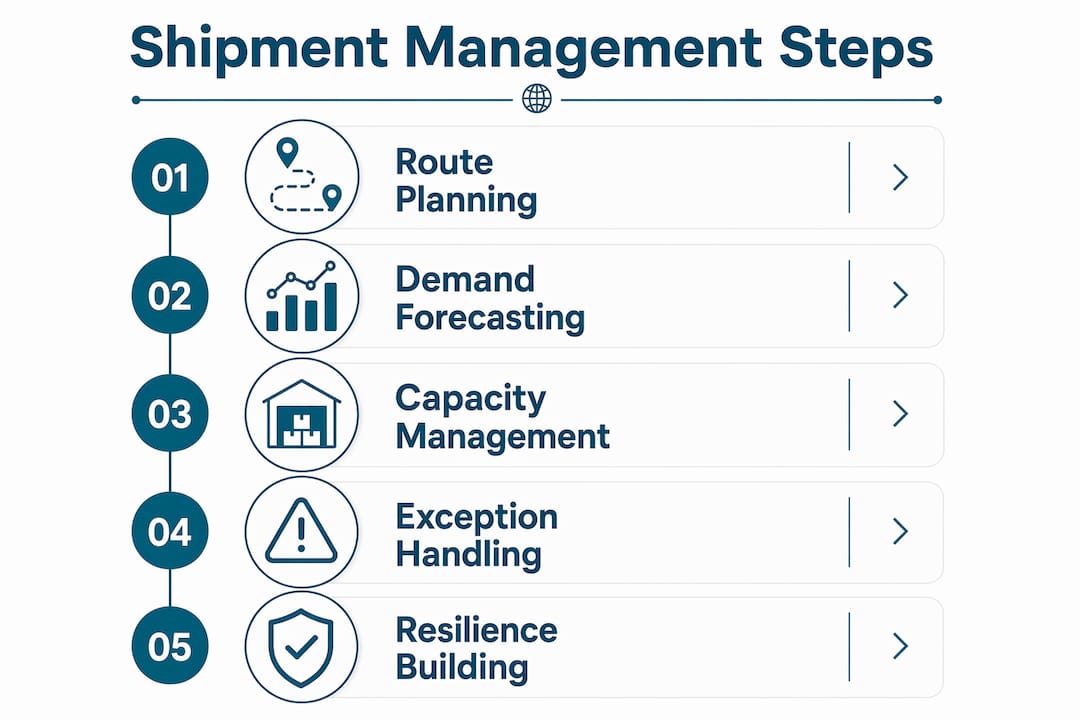
Demand forecasting in logistics is the practice of predicting future freight volumes using historical data, sales pipelines, and seasonal patterns. Accurate forecasting lets you pre-book carrier space, staff warehouses appropriately, and avoid the premium costs that come with last-minute decisions. Logistics planners who move from reactive spot purchasing to contract-based forecasting save 15%–30% on freight costs. That range is wide because the savings depend on how much spot purchasing you currently do.

Capacity management is the operational output of good forecasting. When you know a volume surge is coming four weeks out, you can reserve carrier space at contracted rates, scale temporary warehouse staffing, and pre-position inventory closer to demand centers. Proactive capacity management avoids last-minute surcharges and protects delivery timelines during peak periods.
The practical steps for building a forecasting-driven capacity process are:
- Collect baseline data. Pull 12–24 months of shipment history by lane, weight class, and product category. Identify seasonal peaks and troughs.
- Build volume projections. Use sales pipeline data and historical growth rates to project freight volumes by quarter. Involve the commercial team, not just logistics.
- Pre-book carrier capacity. Share volume projections with your top carriers 6–8 weeks before peak periods. Negotiate capacity guarantees in exchange for volume commitments.
- Align warehouse staffing. Use the same volume projections to plan temporary staffing needs. Warehouse bottlenecks cause shipment delays just as often as carrier failures.
- Monitor forecast accuracy. Track actual volumes against projections weekly. Adjust carrier bookings and staffing plans when variance exceeds 10%.
Transportation management systems, known as TMS platforms, are the practical tool for executing this process at scale. Modern TMS platforms automate routine freight tasks, flag exceptions, and generate the performance data you need to refine forecasts over time. Without a TMS, forecasting remains a spreadsheet exercise that breaks down under volume pressure.
Which strategies improve supply chain resilience for long-distance shipments?
Supply chain resilience is not just about having backup suppliers. Resilience depends on identifying system-critical network nodes beyond trade volume alone. A small regional carrier acting as the only connector between two distribution points carries as much systemic risk as a large high-volume partner. Most logistics teams miss this because they focus on spend, not network topology.
The practical implication is that your risk map needs to reflect connectivity, not just cost. Identify every node in your freight network where a single failure would block multiple lanes. Those are your critical points, and they need redundancy plans regardless of their dollar value.
| Approach | Response time | Cost impact | Risk outcome |
|---|---|---|---|
| Reactive (no plan) | Days to weeks | High: spot rates, expediting fees | Service failures, customer churn |
| Proactive (exception management) | Hours | Low: pre-negotiated alternatives | Minor delays, contained impact |
| Structural (network redesign) | Months | Medium to high upfront | Long-term resilience improvement |
Quick wins like route optimization and carrier reallocation deliver measurable savings within weeks. Structural changes, such as facility closures or new distribution center leases, require 2–6 months of analysis and follow-up. Start with the quick wins. Use the savings to fund the structural work.
Exception management is where most logistics teams leave money on the table. Clear escalation paths and communication protocols are the difference between a minor delay and a total service failure. Speed of response matters more than the size of the disruption. A one-hour delay in escalating a missed pickup can cascade into a three-day delivery failure.
Pro Tip: Build a two-tier escalation protocol. Tier one handles routine exceptions like missed pickups or documentation errors at the operations level. Tier two escalates to management only when a shipment risks missing a customer commitment. This keeps your team focused and prevents alert fatigue.
International shipment management adds regulatory complexity to every resilience calculation. Customs delays, documentation errors, and cross-border compliance failures are among the most common causes of long-distance shipment disruptions. Build compliance checkpoints into your exception management process, not as an afterthought.
What cost-effective shipping solutions can logistics professionals apply?
Cost control in long-distance logistics comes from discipline in four areas: consolidation, mode selection, timing, and technology. None of these require large capital investment. All of them require consistent execution.
- Consolidation: Switching from LCL to FCL on high-volume lanes saved one company $400,000 annually. The math works because FCL rates per cubic meter are lower than LCL rates once you fill more than roughly 60% of a container. Run the numbers on your top five lanes before your next contract cycle.
- Mode selection: Rail and intermodal freight cost less per mile than over-the-road trucking for shipments moving more than 500 miles. Ocean freight is the lowest-cost option for non-urgent international volumes. Match the mode to the urgency and distance, not to habit or convenience.
- Timing and scheduling: Peak congestion at major ports and distribution hubs follows predictable patterns. Scheduling pickups and deliveries outside peak windows reduces dwell time and accessorial charges. For cross-border routes, check freight booking timing against customs clearance windows to avoid weekend holds.
- Technology for tracking: TMS platforms generate the shipment performance data you need to identify cost leaks. Tracking long-distance packages in real time also lets you intervene before a delay becomes a missed delivery commitment.
- Carbon cost reduction: Algorithmic route modeling cuts carbon emissions by nearly 30% alongside economic savings. For teams with sustainability reporting requirements, this is a direct cost and compliance benefit. Intermodal and rail modes carry lower carbon intensity than full truckload for long-haul distances.
- Carrier diversification: Relying on one or two carriers for your entire freight volume creates both cost and resilience risk. A diversified carrier base gives you negotiating leverage and backup options when capacity tightens.
For teams managing cross-border logistics, the cost-effective approach also includes pre-clearing customs documentation and using bonded warehouse facilities to reduce duty exposure on high-value goods. These tactics require upfront process investment but pay back quickly on high-volume international lanes. You can also explore logistics workforce considerations when planning staffing for peak freight periods, particularly for third-party logistics operations.
Key Takeaways
Effective long-distance freight management requires combining algorithmic route planning, proactive demand forecasting, and structured exception management to cut costs and protect delivery performance.
| Point | Details |
|---|---|
| Route optimization delivers fast results | Algorithmic modeling cuts time, cost, and emissions by over 26% each without infrastructure changes. |
| Forecasting reduces freight spend | Moving from spot purchasing to contracted lanes saves 15%–30% on freight costs. |
| Resilience requires network mapping | Identify system-critical nodes by connectivity, not just spend, to build effective redundancy plans. |
| Exception management prevents failures | Clear escalation protocols contain disruptions before they cascade into service failures. |
| Consolidation drives unit cost down | Switching LCL lanes to FCL where volume justifies it produces significant annual savings. |
Why I think most logistics teams fix the wrong things first
After working across freight operations for years, the pattern I see most often is teams investing in new technology before fixing their process fundamentals. A TMS will not save you if your carrier contracts are poorly structured or your demand forecasts are built on gut feel. The technology amplifies whatever process you already have, good or bad.
The teams that improve fastest start with lane analysis and carrier reallocation. These are low-cost, high-return changes that produce visible results within a quarter. That credibility then funds the harder structural work: network redesign, new distribution points, or cross-border compliance upgrades.
Exception management is the area I see under-invested most consistently. Teams build transportation plans and then assume execution will follow the plan. It rarely does. The real competitive advantage in long-distance freight is how fast you respond when things go wrong, not how well you planned when things were calm.
My honest recommendation: map your critical network nodes before your next carrier negotiation cycle. You will almost certainly find one or two connectors you had not identified as high-risk. Fixing those gaps costs far less than recovering from a failure.
— Maayan
Or-ner’s freight and courier solutions for long-distance shipping
Long-distance freight management works best when your booking, tracking, and exception management tools operate from a single platform.
Or-ner provides end-to-end logistics support for ecommerce sellers and businesses managing high-volume freight across domestic and international corridors. The platform covers freight booking, real-time shipment tracking, customs clearance, and cross-border fulfillment in one place. For teams looking to move from reactive spot purchasing to contract-based planning, Or-ner’s reliable courier services give you the carrier network and data visibility to execute that shift. The platform integrates with major ecommerce operators and supports ocean, air, and land transport modes across a global warehouse network.
FAQ
What is the most effective way to reduce long-distance freight costs?
Consolidating shipments from LCL to FCL on high-volume lanes and securing carrier contracts instead of relying on spot purchasing are the two highest-impact cost reduction tactics. One company saved $400,000 annually by switching to FCL on key lanes.
How does demand forecasting improve long-distance shipment management?
Demand forecasting lets logistics teams pre-book carrier capacity and staff warehouses before volume surges hit, avoiding last-minute surcharges. Planners who shift from spot purchasing to forecast-driven contracts save 15%–30% on freight costs.
What tools support tracking long-distance packages in real time?
Transportation management systems automate shipment tracking, flag exceptions, and audit freight invoices. Real-time visibility lets teams intervene before a delay escalates into a missed delivery commitment.
How should logistics teams prioritize resilience improvements?
Start with route optimization and carrier reallocation for quick wins, then move to structural changes like network redesign. Structural changes require 2–6 months of analysis, so fund them with savings from the faster wins.
What makes exception management critical in long-distance logistics?
Speed of response to disruptions determines whether a delay stays minor or cascades into a service failure. Clear escalation paths and communication protocols are the core of effective exception management in any transportation plan.