Managing logistics teams for an American apparel brand can feel like juggling shifting priorities and urgent shipments. Collaboration often stalls when individual roles are unclear or skill gaps go unnoticed. Addressing these challenges starts with a thorough assessment of your team’s abilities and logistics needs. This article highlights practical strategies for identifying strengths, defining roles, and implementing high-performing team assessment frameworks to elevate teamwork and operational success.
Table of Contents
- Step 1: Assess Team Strengths And Logistics Needs
- Step 2: Define Clear Roles And Shared Objectives
- Step 3: Implement Targeted Collaboration Activities
- Step 4: Integrate Tech Tools For Streamlined Workflows
- Step 5: Evaluate Results And Optimize Team Performance
Quick Summary
| Key Insight | Explanation |
|---|---|
| 1. Assess team skills holistically | Map existing skills and identify gaps using structured evaluation frameworks for enhanced performance. |
| 2. Define roles and objectives clearly | Establish explicit responsibilities and metrics to align individual efforts with team goals. |
| 3. Implement targeted collaboration activities | Create structured interactions to enhance communication and teamwork efficiency across logistics teams. |
| 4. Integrate technology effectively | Use digital tools to streamline workflows, support real-time data sharing, and enhance decision-making. |
| 5. Evaluate performance continuously | Develop a systematic approach for regular performance measurement to drive team improvement. |
Step 1: Assess team strengths and logistics needs
To optimize your logistics operations, you’ll need to conduct a comprehensive assessment of your team’s current capabilities and identify potential skill gaps. This critical first step helps you understand exactly where your team excels and where targeted improvements can drive performance.
Start by mapping out your team’s existing skill sets using a structured evaluation framework. High-performing team assessment approaches recommend examining multiple dimensions of team effectiveness:
- Technical expertise in logistics software and systems
- Problem-solving capabilities for complex shipping challenges
- Interpersonal communication skills
- Adaptability to changing supply chain dynamics
- Leadership potential within different operational roles
A strategic team assessment reveals not just individual strengths, but the collaborative potential of your entire logistics unit.
Utilize both quantitative metrics and qualitative observations to create a holistic view. Team performance measurement tools suggest combining performance data, peer evaluations, and skills inventories to gain nuanced insights into your team’s operational readiness.
Pro Tip: Schedule quarterly skills assessments to continuously track team development and emerging logistical competencies.
Step 2: Define clear roles and shared objectives
Establishing crystal-clear roles and unified objectives is fundamental to transforming your logistics team from a collection of individuals into a high-performing collaborative unit. This step involves creating a precise roadmap that aligns individual responsibilities with overarching team goals.
Start by clarifying team roles and responsibilities through a structured approach. Break down your team’s workflow into specific components and assign responsibilities that leverage each team member’s strengths:
- Identify individual skill sets and match them to specific logistics functions
- Document explicit expectations for each role
- Create accountability matrices showing who owns specific tasks
- Define performance metrics for each team member
- Establish communication protocols for task handoffs and collaboration
When every team member understands their precise role, operational efficiency dramatically improves.
Successful team dynamics depend on shared commitment and transparent role assignments. This means developing a collaborative framework where team members understand not just their individual responsibilities, but how their work connects to broader team objectives.

Regular communication and periodic role reviews will help ensure that your team’s structure remains flexible and responsive to changing logistics challenges.
Pro Tip: Create a visual team role diagram that maps individual responsibilities and interconnections to reinforce understanding and alignment.
Step 3: Implement targeted collaboration activities
Transforming your logistics team’s collaboration requires strategic, intentional activities that break down communication barriers and create synergistic working relationships. This step focuses on designing purposeful interactions that enhance team connectivity and operational efficiency.
Collaborative team strategies involve creating structured opportunities for cross-functional engagement. Consider implementing these targeted collaboration activities:
- Cross-departmental problem-solving workshops
- Shared digital collaboration platforms
- Regular interdepartmental knowledge-sharing sessions
- Team rotation programs
- Joint performance review processes
Effective collaboration is less about individual brilliance and more about collective intelligence and synchronized effort.
AI-powered collaboration techniques can further enhance your team’s connectivity. Leverage technology to create seamless communication channels, track collaborative metrics, and identify potential optimization opportunities in real-time.
Encourage an environment where open communication, mutual respect, and shared goals are paramount. This means creating psychological safety where team members feel empowered to share ideas, ask questions, and contribute meaningfully to collective objectives.
Pro Tip: Implement a monthly “collaboration challenge” that rewards team members for cross-functional problem-solving and innovative teamwork.
Step 4: Integrate tech tools for streamlined workflows
Transforming your logistics operations requires strategic technology integration that bridges human expertise with cutting-edge digital solutions. This step focuses on selecting and implementing technological tools that enhance communication, visibility, and operational efficiency across your entire logistics ecosystem.
Intelligent workflow strategies reveal three critical stages of digital transformation that can revolutionize your logistics performance:
- Digitization of existing paper-based processes
- Digital platform integration for real-time data sharing
- Advanced AI-powered analytics and predictive modeling
Technology is most powerful when it amplifies human capabilities rather than replacing them.
AI-driven logistics optimization can dramatically improve route planning, safety monitoring, and supply chain adaptability. Focus on tools that provide comprehensive visibility, automate repetitive tasks, and enable data-driven decision making.
Here’s a comparison of traditional and AI-driven logistics optimization methods:
| Method | Key Advantage | Implementation Challenge |
|---|---|---|
| Traditional Approaches | Well-understood, predictable steps | Slower response to changes |
| AI-Driven Optimization | Real-time insights and flexibility | Requires advanced tech adoption |
Prioritize solutions that offer seamless integration, user-friendly interfaces, and scalable functionality. This means selecting platforms that can grow with your organization and provide intuitive dashboards that make complex logistics data immediately understandable.
Pro Tip: Conduct a thorough pilot test of any new technology, involving team members from multiple departments to ensure comprehensive evaluation and user acceptance.
Step 5: Evaluate results and optimize team performance
Measuring your logistics team’s performance is a critical ongoing process that transforms raw data into actionable insights for continuous improvement. This final step focuses on creating a systematic approach to performance evaluation that drives strategic enhancements and team growth.
Performance evaluation strategies require a comprehensive approach that goes beyond simple numerical metrics. Develop a multi-dimensional assessment framework that captures both quantitative and qualitative aspects of team performance:
- Quantitative performance indicators
- Qualitative behavioral assessments
- 360-degree feedback mechanisms
- Individual and team goal tracking
- Comparative benchmarking against industry standards
Effective performance optimization is about understanding nuanced team dynamics, not just tallying numbers.
Global logistics performance benchmarks provide valuable context for evaluating your team’s effectiveness. Consider comparing your team’s performance across critical dimensions such as efficiency, communication, technological adaptation, and problem-solving capabilities.
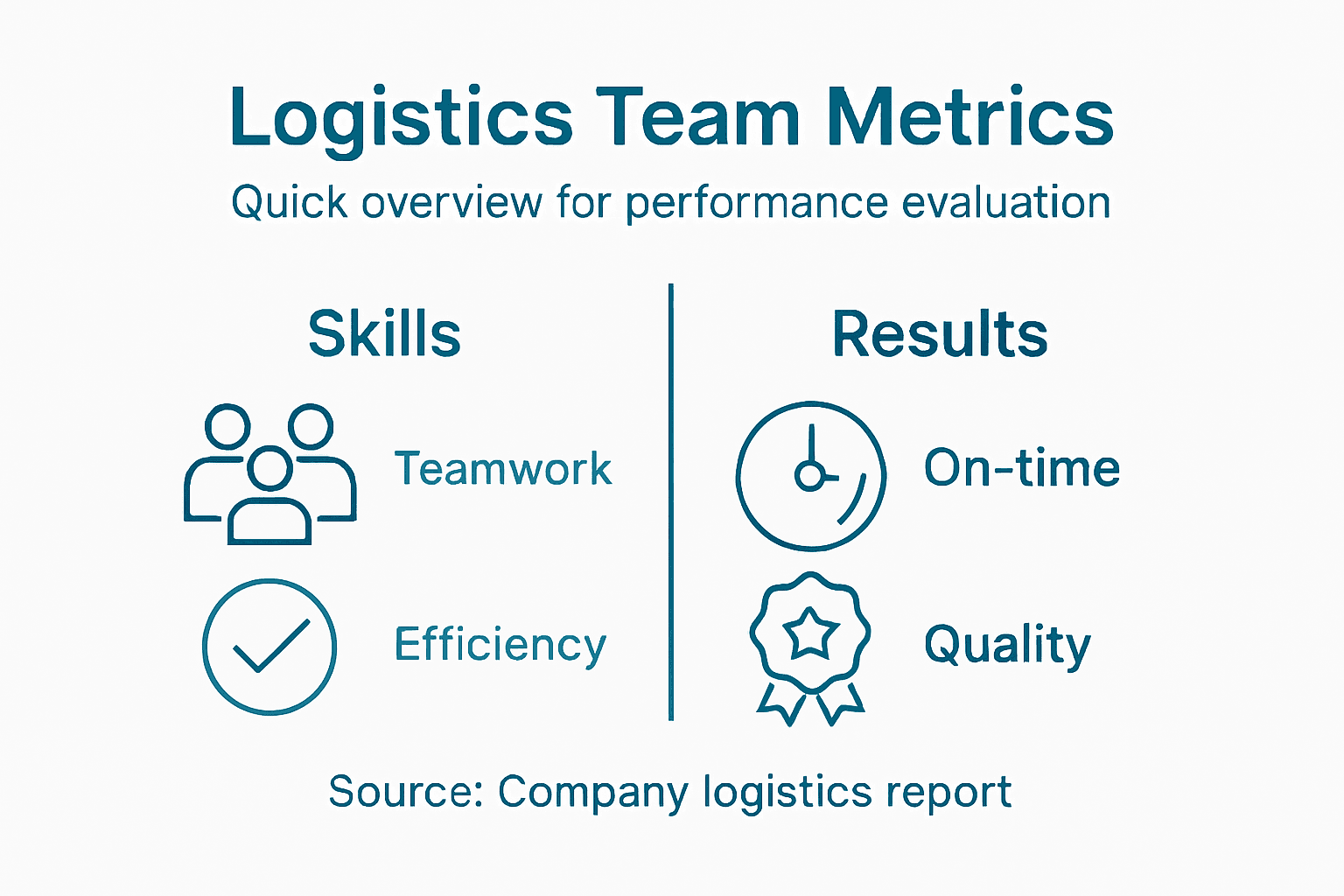
The following table summarizes essential metrics for evaluating logistics team performance:
| Metric Type | Example Metric | Insight Provided |
|---|---|---|
| Quantitative | On-time delivery rate | Measures efficiency and reliability |
| Qualitative | Team collaboration feedback | Gauges teamwork and communication quality |
| Benchmarking | Industry efficiency ranking | Compares against top-performing peers |
Regular performance reviews should be constructive dialogues that celebrate achievements, identify growth opportunities, and align individual development with broader organizational objectives. Implement a continuous feedback loop that encourages transparent communication and mutual learning.
Pro Tip: Create a standardized performance dashboard that visualizes key metrics and trends, making complex evaluation data immediately understandable for team members.
Strengthen Your Logistics Team with Reliable Courier Services and Seamless Collaboration
Building a high-performing logistics team starts with clear roles, effective communication, and integrated technology. If your company struggles with fragmented workflows or unclear responsibilities, these challenges can slow down operations and hurt customer satisfaction. The article “Team Building for Companies: Boost Logistics Collaboration” highlights how assessing team skills, defining accountability, and using targeted collaboration activities are key to unlocking your team’s full potential.
At or-ner.com, we understand that collaboration extends beyond your team to your entire logistics chain. Our platform offers reliable courier services combined with real-time shipment tracking and integrated inventory management to give you full visibility and control. This eliminates guesswork and enables your team to focus on problem-solving and strategic tasks rather than firefighting daily issues. Whether you handle ecommerce orders, wholesale shipments, or cross-border logistics, our end-to-end solutions empower your team for greater efficiency and faster delivery.
Boost your logistics collaboration today by leveraging technology designed to streamline workflows and enhance team accountability. Explore how reliable courier services and our scalable platform can transform your supply chain. Visit https://or-ner.com and take the next step toward building a logistics team that delivers results you and your customers can trust.
Frequently Asked Questions
How can I assess my logistics team’s current strengths and areas for improvement?
To assess your logistics team’s strengths and skill gaps, conduct a comprehensive evaluation of their existing capabilities. Map out skill sets using a structured framework and utilize both quantitative metrics and qualitative observations. Aim to complete this assessment within 30 days to establish a clear understanding of your team’s operational readiness.
What steps should I take to define clear roles and objectives for my logistics team?
To define clear roles and objectives, break down the workflow into specific components and assign responsibilities based on individual strengths. Document explicit expectations for each role, and create an accountability matrix that highlights who owns specific tasks to improve operational efficiency.
How can I encourage collaboration within my logistics team?
Encourage collaboration by implementing targeted activities such as cross-departmental workshops and shared digital collaboration platforms. Prioritize regular knowledge-sharing sessions to strengthen team connectivity and enhance collective problem-solving capabilities over the next quarter.
What technology tools can I integrate to streamline logistics workflows?
To streamline logistics workflows, consider integrating technology solutions that support real-time data sharing and automate repetitive tasks. Identify tools that offer user-friendly interfaces and ensure they can scale with your organization, aiming for implementation within 60 days to enhance operational efficiency.
How do I evaluate the performance of my logistics team effectively?
Evaluate your logistics team’s performance by developing a multi-dimensional assessment framework that captures both quantitative performance metrics and qualitative feedback. Conduct regular performance reviews that celebrate achievements and identify growth opportunities, establishing a continuous feedback loop for improvement.
What metrics should I use to benchmark my logistics team’s performance against industry standards?
To benchmark your logistics team’s performance, focus on key metrics such as on-time delivery rates and team collaboration feedback. Regularly compare these metrics against industry standards to gain insights into your team’s efficiency and areas that require attention.
Recommended
- Top Benefits of Freight Forwarding for Growing Businesses 2025 – ORNER
- What Is Freight Forwarding? Guide for Modern Supply Chains 2025 – ORNER
- Reliable Courier Services in the USA – ORNER
- Just in Time Delivery: Essential Guide for 2025 Success – ORNER
- Beneficios Del Taxi Para Empresas: Guía Completa – Mallorcab