TL;DR:
- Supply chain visibility tools enable real-time tracking and management of shipments across complex networks. They integrate diverse data sources to provide actionable insights and reduce costs through proactive exception handling. The most successful implementations focus on data aggregation, cross-functional protocols, and aligning technology with organizational processes.
Supply chain visibility tools are software and hardware systems that enable real-time tracking and management of products, shipments, and inventory across complex supply chains. Known formally as supply chain visibility platforms, these systems aggregate fragmented data from GPS telematics, carrier APIs, EDI feeds, ERP systems, and IoT sensors into a single operational view. Logistics managers who use them shift from reactive status checks to proactive exception management, catching disruptions before they become costly delays. The result is measurable: visibility programs target a 10–20% reduction in inventory carrying costs. That number reflects what happens when you stop chasing loads and start managing by exception.
What types of supply chain visibility tools exist?
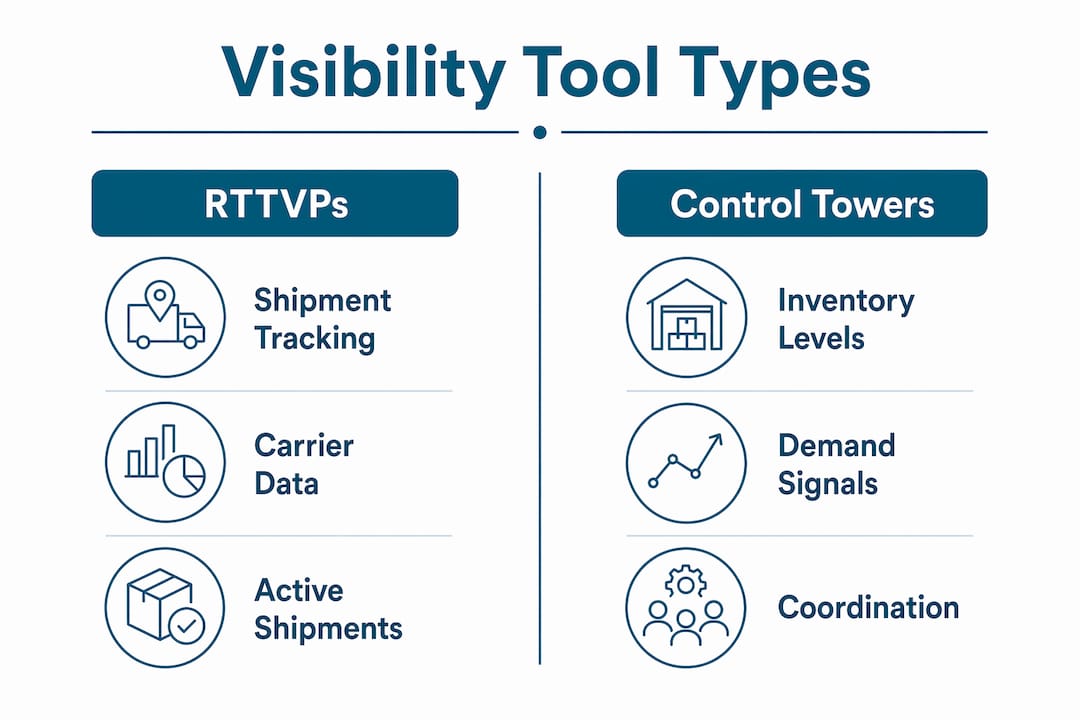
Three distinct categories define the visibility tool market: real-time transportation visibility platforms (RTTVPs), supply chain control towers, and multi-enterprise network platforms. Each serves a different operational scope, and choosing the wrong category for your complexity level is one of the most common and expensive mistakes in logistics technology.

Real-time transportation visibility platforms focus on active shipment tracking. They pull location data from carrier APIs, GPS devices, and EDI feeds to give you a live map of in-transit freight. These platforms work best for operations where transportation is the primary blind spot.
Supply chain control towers go further. They link inventory levels, demand signals, and transportation data into a coordinated response layer. A control tower does not just tell you where a shipment is. It tells you what that delay means for your warehouse stock and customer commitments.
Multi-enterprise network platforms connect data across suppliers, contract manufacturers, freight forwarders, and logistics partners. They are built for organizations with complex, multi-tier supply chains where a disruption at a Tier 2 supplier can ripple forward invisibly.
| Tool type | Primary data sources | Best use case |
|---|---|---|
| Real-time transportation visibility | Carrier APIs, GPS, EDI | Active freight tracking, carrier performance |
| Supply chain control tower | ERP, TMS, demand signals | Coordinated inventory and transport response |
| Multi-enterprise network | Supplier portals, partner APIs | Multi-tier supplier and partner visibility |
Pro Tip: Match the tool category to your actual complexity. A mid-size ecommerce operation rarely needs a full multi-enterprise network. Start with an RTVP and add control tower capabilities as your data maturity grows.
How do visibility tools integrate diverse data sources?
Visibility software integrates GPS telematics, carrier API and EDI feeds, and ERP inventory data to produce a unified operational view. The integration layer is where most implementations succeed or fail. Getting data into one place sounds straightforward. In practice, every carrier, warehouse, and freight forwarder uses different formats, update frequencies, and data standards.
The most dangerous outcome of poor integration is what practitioners call “silent zones.” These are gaps in tracking coverage that occur during carrier handoffs, cross-border transfers, or warehouse dwell periods. Software-only visibility relying on carrier data is prone to these silent zones, whereas hardware-enabled trackers provide continuous, ground-truth visibility. A GPS tracker attached to a pallet does not care which carrier has custody. It reports location and condition regardless.
The architecture of a well-built visibility platform has three layers. The first layer collects raw data from GPS devices, IoT sensors, and carrier feeds. The second layer normalizes and deduplicates that data. The third layer presents it as predictive ETAs, exception alerts, and performance dashboards. Most logistics managers only see the third layer. Understanding what sits beneath it explains why two platforms with similar dashboards can produce wildly different data quality.
Real-time GPS and sensor tracking combined with carrier data provides the strongest operational picture and regulatory compliance for high-value or sensitive shipments. For cold chain, pharmaceutical, or electronics freight, hardware tracking is not optional. It is the only way to prove condition compliance at delivery.
Pro Tip: Before selecting a platform, audit your current data sources. List every carrier, warehouse, and ERP system that touches your freight. A platform that cannot connect to your existing EDI infrastructure will create new blind spots, not eliminate them.
What are the financial benefits of supply chain visibility tools?
The financial case for visibility tools is direct and measurable. Visibility programs target a 10–20% reduction in inventory carrying costs through better lane benchmarking and lower expedite charges. Carrying costs include warehousing, capital tied up in stock, insurance, and obsolescence. Cutting them by even 10% on a $10 million inventory base frees $1 million in working capital.
Visibility tools should provide insights into financial exposure, including inventory holding costs and emergency freight spend, not just location data. This distinction matters. A platform that shows you where a shipment is but cannot connect that location to downstream inventory impact gives you half the picture. The operations teams that extract the most value from visibility tools are the ones that tie location alerts directly to financial thresholds.
The operational benefits compound the financial ones. Key gains include:
- Reduced load chasing: Automated status updates replace manual carrier calls, freeing staff for higher-value work.
- Fewer stockouts: Predictive ETAs let procurement teams reorder before a delay becomes a shortage.
- Lower emergency freight spend: Early disruption alerts create time to reroute or expedite at standard rates rather than crisis rates.
- Better carrier accountability: Lane benchmarking data gives you objective performance metrics for contract negotiations.
- Faster exception resolution: Exception-based workflows replace reactive status checks, so teams act on problems rather than discover them.
The shift from reactive to proactive is the most undervalued benefit. When your team stops spending half its day asking “where is my freight,” it starts spending that time on decisions that actually move the business forward. You can read more about how supply chain analytics compounds these gains over time.
Common mistakes in implementing visibility tools
The biggest implementation mistake is treating visibility tools as plug-and-play solutions. True visibility requires aggregating data from carriers, warehouses, and freight forwarders, not just connecting one API and calling it done. Organizations that skip the data aggregation layer end up with a dashboard that looks impressive and delivers incomplete information.
The second mistake is ignoring cross-functional coordination. A visibility platform generates alerts. Those alerts are worthless without defined protocols for who acts on them and how fast. Successful implementation requires defined cross-functional coordination protocols for acting on exception signals, or those signals become ignored digital to-do lists. This is an organizational problem, not a technology problem.
The third mistake is selecting a platform based on demo quality rather than integration depth. A polished interface built on shallow carrier data will underperform a less attractive platform with deep ERP and TMS connectivity. Evaluate platforms on the number and quality of their data integrations, not their dashboards.
Common implementation mistakes to avoid:
- Skipping a data audit before vendor selection.
- Failing to define exception ownership and escalation paths before go-live.
- Choosing a platform that cannot integrate with your existing TMS or ERP.
- Deploying across all lanes simultaneously instead of piloting on critical routes first.
- Treating the platform as an IT project rather than an operations change initiative.
Reviewing common logistics challenges before you start a visibility implementation will help you anticipate the organizational friction that derails most projects.
How to select and implement visibility tools effectively
Platform selection starts with a clear map of your supply chain’s data gaps. Identify the lanes, handoff points, and supplier tiers where you have the least visibility today. That map becomes your requirements document. Any platform you evaluate should demonstrate coverage of those specific gaps, not just general capability.
The highest ROI comes from integrating visibility signals into existing ERP and TMS workflows rather than rip-and-replace approaches. This is the single most important principle in platform selection. Replacing your TMS to gain visibility is expensive, disruptive, and unnecessary. The best visibility platforms act as an intelligence layer on top of what you already have.
Key criteria for evaluating platforms:
- Data source coverage: Does it connect to your specific carriers, warehouses, and ERP systems?
- Exception management: Does it support configurable alert thresholds and escalation routing?
- Financial integration: Can it link shipment delays to inventory holding cost calculations?
- Hardware compatibility: Does it support IoT and GPS tracker integration for ground-truth data?
- Deployment model: Does it offer phased rollout or require full implementation before going live?
Run a live pilot on your two or three highest-volume or highest-risk lanes before committing to full deployment. A pilot gives you real performance data, exposes integration gaps, and builds internal confidence. It also gives you the empirical ROI numbers you need to justify broader investment to leadership.
Defined escalation paths and clear role assignments for exception handling are not optional. Build them before go-live, not after. The technology works on day one. The process alignment takes longer, and it determines whether the investment pays off.
Pro Tip: Combine software feeds with hardware tracking on your highest-value lanes from day one. Hardware-enabled tracking eliminates silent zones and provides the compliance documentation that software-only platforms cannot generate.
Key Takeaways
Effective supply chain visibility requires integrating hardware tracking, ERP data, and defined exception protocols, not just connecting a carrier API to a dashboard.
| Point | Details |
|---|---|
| Match tool type to complexity | RTTVPs suit freight tracking; control towers add inventory coordination; multi-enterprise platforms serve multi-tier supply chains. |
| Hardware closes data gaps | Software-only platforms create silent zones during handoffs; GPS and IoT trackers provide continuous, ground-truth location and condition data. |
| Financial impact is measurable | Visibility programs target a 10–20% reduction in inventory carrying costs through lane benchmarking and lower expedite charges. |
| Integration beats replacement | Deploy visibility tools as an intelligence layer over existing ERP and TMS systems for the highest return on investment. |
| Protocols convert alerts to action | Define cross-functional exception ownership and escalation paths before go-live, or alerts become ignored notifications. |
The part most teams get wrong about visibility
The technology conversation around visibility tools almost always focuses on data quality and platform features. After watching teams implement these systems across different supply chain environments, the pattern that stands out is this: the technology rarely fails. The process does.
Teams invest months selecting the right platform, negotiating integrations, and building dashboards. Then they go live and discover that nobody agreed on who owns a late shipment alert at 6 PM on a Friday. The alert fires. Nobody acts. The disruption becomes a crisis. The platform gets blamed.
The shift from reactive to proactive supply chain management is not a software feature. It is a cultural change that the software enables. The organizations that extract the most value from visibility tools are the ones that redesigned their exception management workflows before the platform went live, not after.
My strongest recommendation is to spend as much time on your escalation matrix as you do on your vendor evaluation. Map every exception type your platform will generate. Assign an owner. Define a response time. Test it in your pilot. If your team cannot respond to a simulated alert in under two hours during the pilot, the problem is not the platform.
The other thing I have seen teams underestimate is the value of connecting visibility data to financial exposure. Most teams celebrate when they can see where their freight is. The real win comes when a delay alert automatically calculates the holding cost impact and flags it for the procurement team. That is when visibility stops being a tracking tool and starts being a decision support system. Or-ner’s approach to real-time logistics data reflects exactly this principle.
— Maayan
Or-ner’s platform for end-to-end supply chain visibility
Or-ner gives logistics managers and ecommerce operations a single platform for freight booking, real-time shipment tracking, customs clearance, and inventory management across ocean, air, and land transport modes.
The platform integrates with major ecommerce operators including Amazon and supports cross-border logistics across a global warehouse and fulfillment network. Exception management, real-time communication, and data analytics are built into the core workflow, not added as afterthoughts. For teams that need reliable courier services and end-to-end visibility without stitching together multiple point solutions, Or-ner’s global logistics platform covers the full operational stack. You can also explore Or-ner’s shipment tracking tools to see how real-time data integrates across your fulfillment operations.
FAQ
What are supply chain visibility tools?
Supply chain visibility tools are software and hardware systems that aggregate real-time data from carriers, warehouses, ERP systems, and IoT sensors into a unified operational view. They enable logistics teams to track shipments, manage exceptions, and make proactive decisions across the supply chain.
What is the difference between an RTVP and a control tower?
A real-time transportation visibility platform tracks active shipments using carrier APIs and GPS data. A supply chain control tower links that transportation data to inventory levels and demand signals, enabling coordinated responses across the full supply chain.
How much can visibility tools reduce supply chain costs?
Visibility programs target a 10–20% reduction in inventory carrying costs through better lane benchmarking and lower emergency freight spend. The actual savings depend on current data maturity and how well exception protocols are implemented.
Why do software-only visibility platforms have data gaps?
Software-only platforms rely on carrier API and EDI feeds, which stop reporting during handoffs and dwell periods. Hardware trackers attached to shipments provide continuous location and condition data regardless of which carrier has custody.
What is the biggest mistake in implementing visibility tools?
The biggest mistake is treating visibility tools as plug-and-play solutions without building the data aggregation layer and cross-functional exception protocols first. True visibility requires aggregating data from every carrier, warehouse, and freight forwarder in your network before the platform can deliver accurate insights.