Retailers are facing a supply chain revolution in 2025 and it is reshaping everything from technology to ethics. Demand forecasting no longer means guessing trends by gut and instead relies on AI algorithms that can predict demand with over 90 percent accuracy. Most assume automation is the biggest challenge now but it turns out that human expertise still drives the most crucial decisions behind the scenes. The real secret to successful supply chains in this new era is the way technology and people work together to create smarter, faster, and more sustainable networks.
Table of Contents
- What Makes Up A Modern Supply Chain
- Key Stages In The Supply Chain Process
- Common Challenges And Smart Solutions
- Tips To Streamline Your Supply Chain Operations
Quick Summary
| Takeaway | Explanation |
|---|---|
| Leverage advanced technology for efficiency | Utilize AI, machine learning, and automation to streamline operations and improve visibility. |
| Focus on sustainable practices throughout the supply chain | Incorporate ethical sourcing, carbon reduction, and renewable energy into operational strategies for resilience. |
| Emphasize human expertise alongside technology | Combine advanced tools with skilled professionals to interpret data and drive innovation in supply chain management. |
| Adopt data-driven decision-making | Implement systems for real-time tracking and analytics to enhance visibility and responsiveness across all stages. |
| Continuous improvement should be a priority | Regularly review processes to identify bottlenecks and enhance efficiency, ensuring supply chain effectiveness remains dynamic. |
What Makes Up a Modern Supply Chain
The supply chain landscape in 2025 represents a complex ecosystem of interconnected technologies, strategies, and human expertise that extends far beyond traditional logistics. Modern supply chains have transformed from linear operational processes into dynamic, intelligent networks that respond with unprecedented speed and precision.
Technology as the Core Infrastructure
At the heart of contemporary supply chain management lies advanced technological infrastructure. Explore our guide on cutting-edge logistics systems that reveal how artificial intelligence, machine learning, and digital technologies are revolutionizing traditional supply chain frameworks. According to research from BSR, the widespread adoption of automation technologies is creating unprecedented levels of operational visibility and efficiency.
Key technological components now include:
- Artificial Intelligence (AI) algorithms that predict demand
- Machine Learning systems for real-time decision making
- Blockchain platforms ensuring transparent transactions
- Digital Twin technologies for scenario planning
To help retailers quickly grasp the essential technologies shaping modern supply chains in 2025, the following table summarizes the key technical components, their purposes, and the benefits they bring.
| Technology | Purpose | Key Benefit |
|---|---|---|
| Artificial Intelligence | Predict demand | Over 90% demand accuracy |
| Machine Learning | Real-time decision making | Faster, more responsive operations |
| Blockchain | Ensure transparent transactions | Enhanced trust and traceability |
| Digital Twin | Enable scenario planning and simulation | Better risk management |
Sustainability and Resilience
Modern supply chains are no longer solely focused on moving products from point A to point B. They have evolved into comprehensive systems that prioritize environmental sustainability, ethical practices, and strategic resilience. According to a comprehensive study on supply chain trends, organizations are increasingly integrating sustainability metrics directly into their operational strategies.
This holistic approach encompasses multiple dimensions:
- Carbon footprint reduction strategies
- Ethical sourcing practices
- Renewable energy integration
- Circular economy principles
Human Expertise and Strategic Intelligence
Despite technological advancements, human expertise remains crucial. The most sophisticated supply chains combine cutting-edge technology with strategic human intelligence. Large language models and advanced analytics provide powerful tools, but human professionals interpret complex data, make nuanced decisions, and drive innovation.
The modern supply chain professional must now possess a diverse skill set that bridges technology, strategy, and interpersonal capabilities. They are no longer just logistical managers but strategic architects who understand how to leverage technological tools to create competitive advantages.
By 2025, successful supply chains will be characterized not by their ability to move goods, but by their capacity to adapt, predict, and create value across increasingly complex global networks.
Key Stages in the Supply Chain Process
The supply chain process in 2025 represents a sophisticated, interconnected journey that transforms raw materials into delivered products while maintaining strategic efficiency and adaptability. Understanding these critical stages helps retailers optimize their operational performance and create value across their entire ecosystem.
Strategic Planning and Demand Forecasting
Planning serves as the foundational stage where organizations map their entire supply chain strategy. Learn more about strategic logistics management to understand how critical this initial phase becomes. According to research from Ivalua, strategic planning now involves complex predictive modeling that goes far beyond traditional forecasting.
Key planning components include:
- Advanced demand prediction using AI algorithms
- Risk assessment and mitigation strategies
- Resource allocation optimization
- Comprehensive scenario planning
Sourcing and Procurement Dynamics
Sourcing represents the critical phase where organizations identify, evaluate, and establish relationships with suppliers. The modern procurement process is no longer about finding the cheapest option but about creating strategic partnerships that drive innovation and sustainability. According to the Supply Chain Operations Reference (SCOR) model, sourcing now encompasses comprehensive supplier evaluation across multiple dimensions.
Modern sourcing strategies prioritize:
- Supplier diversity and ethical practices
- Technological compatibility
- Collaborative innovation potential
- Sustainability credentials
Manufacturing and Delivery Execution
The final stages of manufacturing and delivery transform strategic plans into tangible products and customer experiences. This phase integrates complex technological systems to ensure precision, speed, and reliability. Retailers must now view manufacturing and delivery as interconnected processes that directly impact customer satisfaction and brand reputation.
Successful execution requires:
- Real-time production tracking
- Flexible manufacturing capabilities
- Efficient logistics networks
- Seamless last-mile delivery solutions
By 2025, the most effective supply chains will not just move products but create integrated, intelligent systems that anticipate market needs, adapt quickly, and deliver exceptional value across every stage of the process.
Common Challenges and Smart Solutions
The supply chain landscape of 2025 presents a complex array of challenges that demand innovative and adaptive solutions. Retailers and logistics professionals must navigate an increasingly intricate global environment where technological disruption, sustainability demands, and operational complexity intersect.
Technological Integration and Complexity
Learn about advanced risk management strategies that address technological challenges. According to research from BSR, technological adoption presents both opportunities and significant implementation challenges. The primary obstacles include legacy system compatibility, data integration, and workforce training.
Key technological challenges include:
- Seamless software platform integration
- Cybersecurity vulnerabilities
- Data privacy and protection
- Skill gap in emerging technologies
Smart solutions involve developing comprehensive digital transformation strategies that prioritize modular, adaptable technological frameworks. Artificial intelligence and machine learning can help organizations bridge technological gaps by providing intelligent integration tools and predictive analytics.
Sustainability and Ethical Supply Chain Management
Sustainability has transformed from a optional consideration to a critical operational requirement. Research from ADEC ESG highlights the increasing complexity of maintaining ethical and environmentally responsible supply chains.
Critical sustainability challenges include:
- Carbon emissions tracking
- Ethical sourcing verification
- Waste reduction strategies
- Transparent supplier accountability
Innovative solutions involve implementing blockchain technologies for supply chain transparency, developing comprehensive sustainability scorecards, and creating collaborative ecosystems that prioritize environmental and social governance.
Human Rights and Global Risk Management
As supply chains become increasingly global, managing human rights risks and operational complexities has become paramount. According to Reuters, artificial intelligence is emerging as a powerful tool for identifying and mitigating potential human rights violations within complex global supply networks.
Key risk management strategies include:
- Advanced AI-powered supplier screening
- Real-time compliance monitoring systems
- Comprehensive global risk assessment frameworks
- Proactive intervention mechanisms
By 2025, successful organizations will view these challenges not as obstacles but as opportunities for innovation, differentiation, and creating more resilient, responsible supply chain ecosystems. The most effective approach combines technological intelligence, human expertise, and a commitment to continuous adaptation and learning.
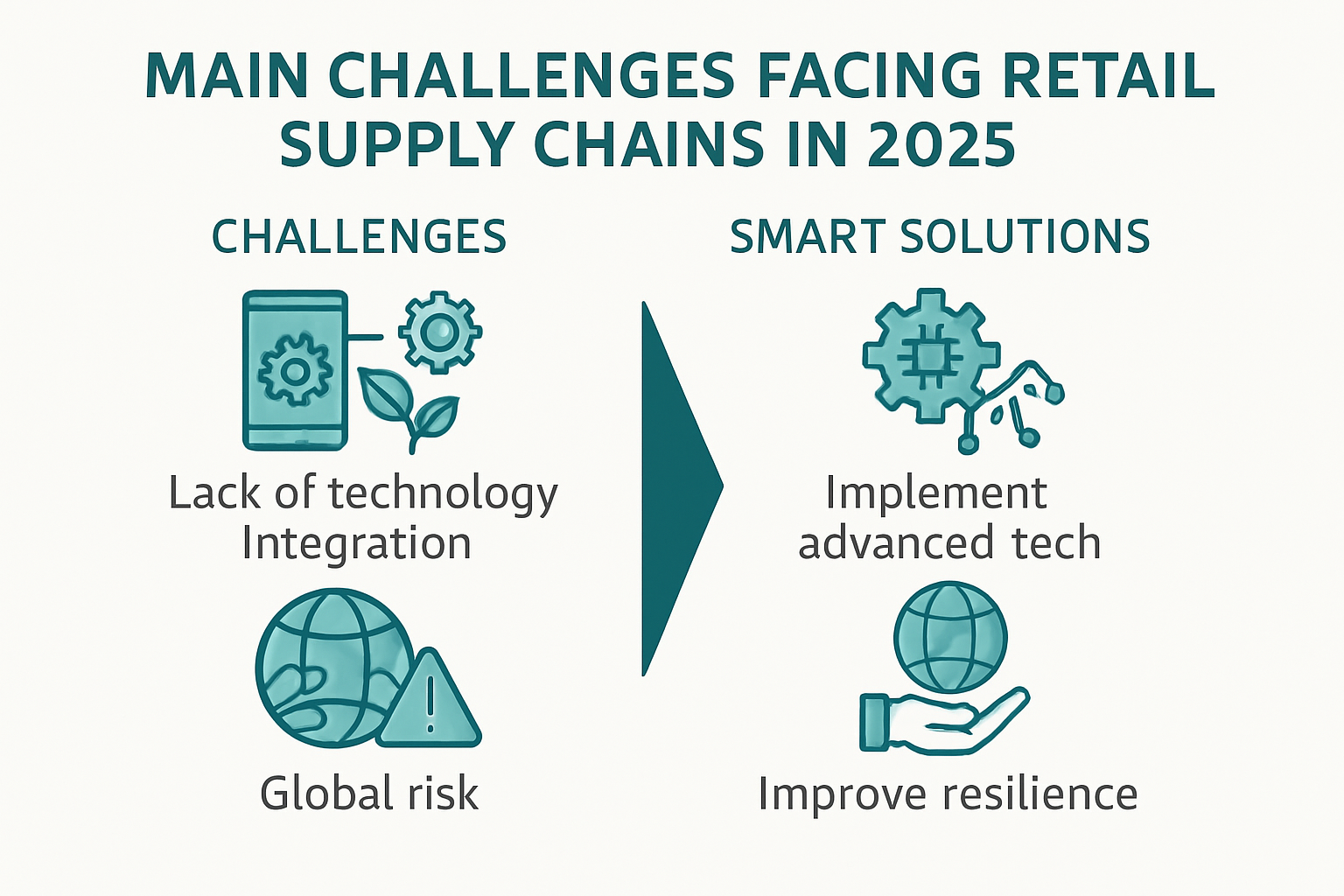
The table below breaks down the main challenges retailers face in supply chain management in 2025 alongside smart solutions mentioned in the article to address each challenge.
| Challenge | Example Problems | Smart Solution |
|---|---|---|
| Technological Integration and Complexity | Legacy systems, cybersecurity gaps | Modular platforms, AI-powered integration |
| Sustainability and Ethical Supply Chain Mgmt | Emissions tracking, ethical sourcing | Blockchain, sustainability scorecards |
| Human Rights & Global Risk Management | Supplier violations, global risks | AI screening, real-time compliance monitoring |
Tips to Streamline Your Supply Chain Operations
Streamlining supply chain operations requires a strategic approach that combines technological innovation, process optimization, and continuous improvement. By implementing targeted strategies, organizations can enhance efficiency, reduce costs, and create more responsive and resilient supply chain ecosystems.
Leverage Advanced Technology and Automation
Explore our guide on optimizing logistics performance to understand technological transformation. According to the Operations Council, automation represents a critical pathway to operational excellence. Modern supply chain professionals must integrate sophisticated software tools that can automate complex tasks and provide real-time insights.
Key technological optimization strategies include:
- Implementing AI-driven inventory management systems
- Utilizing predictive analytics for demand forecasting
- Deploying machine learning algorithms for route optimization
- Integrating cloud-based collaboration platforms
Process Mapping and Continuous Improvement
Research from the World Economic Forum emphasizes the importance of systematic process review and documentation. Successful organizations treat supply chain optimization as an ongoing journey rather than a one-time project. This approach requires comprehensive process mapping, identifying bottlenecks, and developing targeted improvement strategies.
Effective process improvement techniques involve:
- Regular performance benchmarking
- Cross-functional collaboration
- Lean management principles
- Standardized workflow documentation
Data-Driven Decision Making and Visibility
According to Inbound Logistics, transparency and data-driven insights are fundamental to modern supply chain management. Organizations must develop robust data collection and analysis capabilities that provide comprehensive visibility across all operational stages.
Strategies for enhancing supply chain visibility include:
- Implementing end-to-end tracking systems
- Creating real-time performance dashboards
- Developing comprehensive supplier scorecards
- Establishing cross-platform data integration
By 2025, successful supply chain operations will be characterized by their ability to rapidly adapt, leverage intelligent technologies, and maintain a continuous improvement mindset. The most effective organizations will view their supply chain not as a static process but as a dynamic, intelligent ecosystem capable of anticipating and responding to complex global challenges.

Frequently Asked Questions
What are the key technologies transforming supply chains in 2025?
Key technologies include artificial intelligence (AI) for demand prediction, machine learning for real-time decision making, blockchain for transaction transparency, and digital twin technologies for scenario planning.
How can retailers enhance sustainability in their supply chains?
Retailers can enhance sustainability by adopting carbon footprint reduction strategies, incorporating ethical sourcing practices, integrating renewable energy, and following circular economy principles.
Why is human expertise still important in modern supply chains?
Human expertise is crucial as it allows professionals to interpret complex data, make nuanced decisions, and drive innovation, complementing the advanced tools provided by technology.
What are some common challenges in supply chain management today?
Common challenges include technological integration complexity, maintaining sustainability and ethical practices, and managing human rights risks in global supply chains.
Master Your Retail Supply Chain With End-To-End Confidence
The rapid changes outlined in “Supply Chain Basics in 2025: Essential Guide for Retailers” highlight some of the biggest headaches in ecommerce supply chain management. If you are struggling with unpredictable demand, lack of real-time shipment visibility, or the challenge of integrating sustainable logistics while keeping your customers happy, you are not alone. Retailers today face the pressure to deliver fast and reliably while managing everything from inventory uncertainty to cross-border complexity. What you need is a partner who can help you adapt quickly, automate processes, and keep you in control at every stage.
Now is the time to upgrade with reliable courier services that handle not just delivery but warehousing, customs, inventory, and global fulfillment. Build strategic resilience, boost your operational visibility, and support your business growth with a comprehensive platform designed for ecommerce success. Discover how we can help streamline your entire supply chain by visiting or-ner.com today.
Recommended
- Why Logistics Is Important: Key Benefits for 2025 Success – ORNER
- What Is Logistics Management? A 2025 Guide for Retailers – ORNER
- Top Sustainable Logistics Solutions for 2025: Guide for Retailers and Brands – ORNER
- What is Ecommerce Logistics? Key Insights for 2025 – ORNER
- Odoo Auto Vendor Lead Time Calculation Module.
- What Is Operational Excellence? 2025 Guide for Agencies – Business Coach For Digital Marketing Companies, SEO, Social Media Agencies