
Most businesses rely on a complex web of suppliers to keep operations running smoothly, yet studies show that nearly 60 percent face serious challenges when managing these critical relationships. The way a company interacts with its suppliers can mean the difference between steady growth and unexpected disruption. Understanding supplier relationship management unlocks practical strategies for building resilient partnerships, reducing risks, and driving mutual success across the entire supply chain.
Table of Contents
- Defining Supplier Relationship Management Fundamentals
- Types of Supplier Relationships in Logistics
- Key Processes and Best Practice Approaches
- Risks, Challenges, and Mitigation Strategies
- Leveraging Technology for SRM Success
Key Takeaways
| Point | Details |
|---|---|
| Strategic Approach | Supplier Relationship Management (SRM) transforms vendor interactions into collaborative partnerships focused on mutual growth and supply chain efficiency. |
| Types of Relationships | Different supplier engagement levels—transactional, operational, strategic, and integrated—impact overall supply chain performance and require tailored management strategies. |
| Core Processes | Effective SRM relies on strategic alignment, performance management, risk management, and continuous improvement to foster long-term partnerships. |
| Technology Integration | Leveraging technologies like AI, blockchain, and IoT is essential for optimizing supplier interactions and achieving data-driven SRM strategies. |
Defining Supplier Relationship Management Fundamentals
Supplier Relationship Management (SRM) represents a strategic approach that transforms traditional vendor interactions into collaborative partnerships. According to Wikipedia, SRM is “the systematic, enterprise-wide assessment of suppliers’ strengths, performance, and capabilities with respect to overall business strategy.”
At its core, SRM goes beyond transactional exchanges. It involves comprehensive planning and execution of interactions designed to maximize value across the entire supplier ecosystem. Key objectives include:
- Identifying and developing strategic supplier relationships
- Optimizing supplier performance and capabilities
- Reducing operational and financial risks
- Creating mutual growth opportunities
- Enhancing overall supply chain efficiency
Research from Preprints underscores the critical importance of SRM in modern global supply chains, highlighting three foundational elements: trust, collaboration, and mutual benefit. These principles transform suppliers from simple vendors into true strategic partners. By implementing a robust SRM strategy, organizations can create resilient, adaptive supply networks that respond dynamically to changing market conditions and business requirements.
Successful SRM requires a holistic approach that integrates technological tools, data analytics, communication protocols, and strategic alignment.
 It demands continuous evaluation, open dialogue, and a commitment to shared success that extends far beyond traditional procurement practices.
Types of Supplier Relationships in Logistics
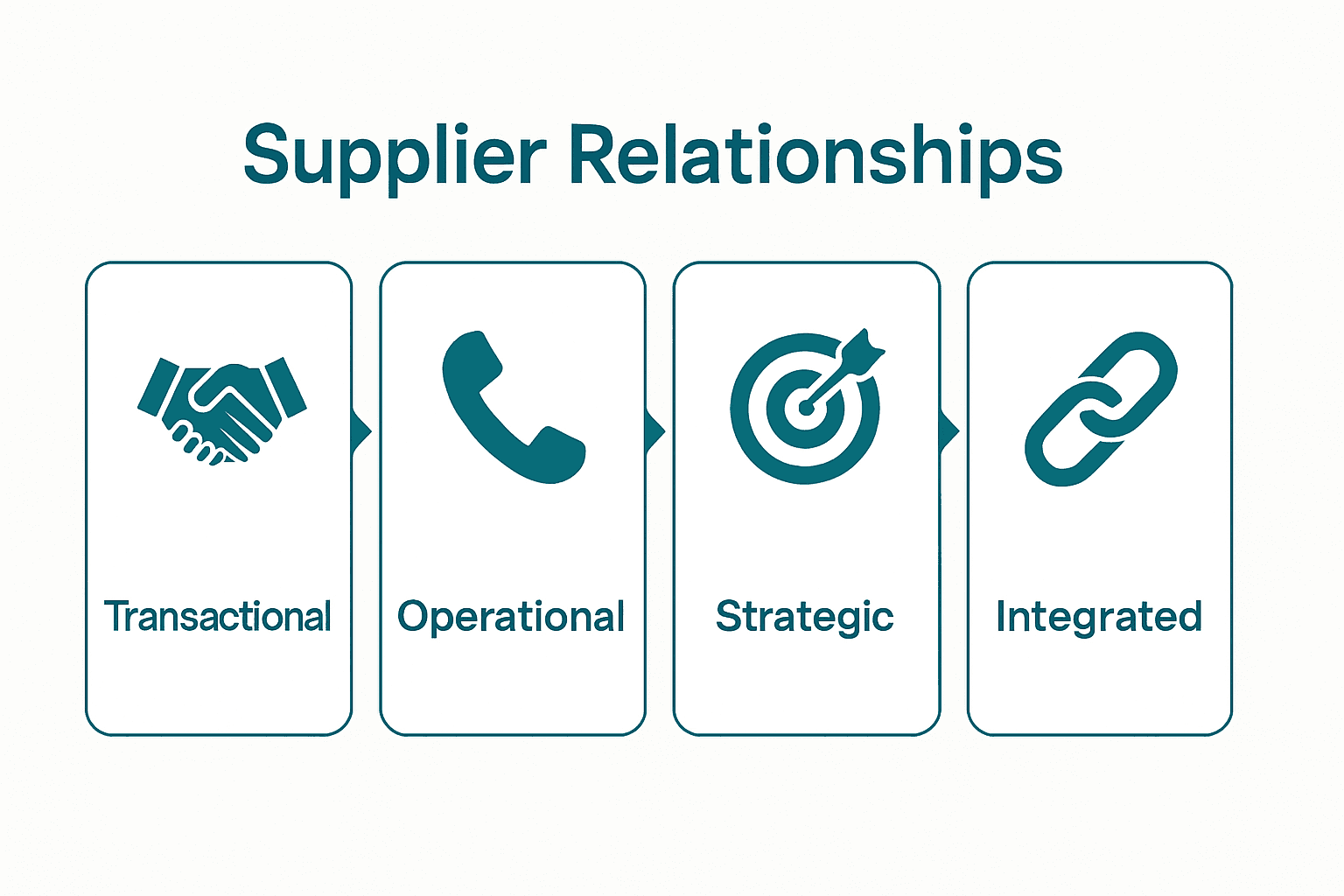
In the complex world of logistics and supply chain management, supplier relationships are not one-size-fits-all. According to research from Revistaespacios, different researchers have classified partnerships between clients and suppliers based on varying degrees of commitment and engagement.
Primary Types of Supplier Relationships include:
- Transactional Relationships
- Minimal interaction
- Price-driven exchanges
- Short-term, low-commitment interactions
- Operational Partnerships
- Regular communication
- Shared operational goals
- Basic performance metrics tracking
- Strategic Alliances
- Deep collaborative engagement
- Joint planning and development
- Long-term mutual growth objectives
- Integrated Partnerships
- Maximum collaboration
- Shared technology and systems
- Comprehensive risk and reward sharing
Research from MDPI highlights that the type of relationship significantly impacts overall supply chain performance. Successful logistics organizations strategically select and nurture relationships that align with their specific business objectives, understanding that each relationship type offers unique advantages and challenges.
The evolution from transactional to strategic partnerships requires continuous investment in communication, trust-building, and mutual understanding. Logistics professionals must carefully assess their supplier ecosystem, recognizing that relationship complexity directly correlates with potential value generation and operational efficiency.
Key Processes and Best Practice Approaches
Supplier Relationship Management (SRM) demands a strategic and systematic approach to building and maintaining effective partnerships. According to research from MDPI, key processes in successful supply chain relationships revolve around critical elements of trust, communication, and collaboration.
Core Processes in Supplier Relationship Management:
- Strategic Alignment
- Define shared business objectives
- Develop mutual performance expectations
- Create integrated strategic roadmaps
- Performance Management
- Establish clear Key Performance Indicators (KPIs)
- Implement regular performance evaluations
- Create transparent feedback mechanisms
- Risk Management
- Identify potential supply chain vulnerabilities
- Develop mitigation strategies
- Create contingency planning frameworks
- Continuous Improvement
- Regular capability assessments
- Joint innovation initiatives
- Adaptive learning and development programs
Research from Preprints emphasizes that strategic SRM practices are crucial for achieving resilience and efficiency in global supply chains. Successful organizations view supplier relationships not as transactional interactions, but as dynamic, collaborative partnerships that require ongoing investment and strategic nurturing.
Implementing these best practices requires a holistic approach. Logistics professionals must cultivate an environment of mutual respect, transparent communication, and shared value creation. This means moving beyond traditional procurement models and embracing a more integrated, relationship-driven strategy that recognizes suppliers as critical strategic partners in achieving organizational excellence.
Risks, Challenges, and Mitigation Strategies
Supplier Relationship Management (SRM) is inherently complex, fraught with potential risks that can significantly disrupt supply chain operations. According to research from ArXiv, organizations must develop sophisticated mathematical models and strategic approaches to manage probabilistic supplier disruptions effectively.
Primary Risks in Supplier Relationships:
- Supply Chain Volatility
- Unpredictable market fluctuations
- Sudden demand or capacity changes
- Geopolitical and economic uncertainties
- Operational Risks
- Quality inconsistencies
- Delivery timeline breaches
- Technology compatibility challenges
- Financial Risks
- Supplier financial instability
- Currency exchange fluctuations
- Unexpected cost escalations
- Compliance and Regulatory Risks
- Varying international trade regulations
- Ethical sourcing requirements
- Intellectual property protection
Research from ArXiv highlights the importance of developing cooperative processes based on simulation and decision theory to manage these risks proactively. Successful mitigation requires a multifaceted approach that combines predictive analytics, strategic planning, and adaptive response mechanisms.
Effective risk management in supplier relationships goes beyond traditional reactive strategies. Organizations must cultivate resilient, flexible partnerships that can quickly adapt to changing circumstances. This involves continuous monitoring, transparent communication, diversifying supplier portfolios, and implementing robust contingency plans that protect operational continuity and minimize potential disruptions.
Leveraging Technology for SRM Success
In the rapidly evolving landscape of supply chain management, technology has become a critical enabler of strategic supplier relationships. According to research from Preprints, emerging technologies like blockchain, artificial intelligence, and the Internet of Things are transforming how organizations monitor, analyze, and optimize supplier interactions.
Key Technological Innovations in SRM:
- Artificial Intelligence and Predictive Analytics
- Real-time performance forecasting
- Advanced risk prediction models
- Automated supplier evaluation systems
- Blockchain Technology
- Enhanced transparency
- Immutable transaction records
- Secure multi-party collaboration
- Internet of Things (IoT)
- Real-time tracking and monitoring
- Automated inventory management
- Performance data collection
- Advanced Data Analytics
- Comprehensive supplier scorecards
- Predictive cost optimization
- Strategic decision support systems
Research from ArXiv proposes sophisticated optimization frameworks that utilize mixed integer linear programming to reduce procurement costs and streamline complex multi-tier supply networks. These technological solutions enable organizations to move beyond traditional transactional approaches, creating data-driven, intelligent supplier relationship management strategies.
Successful technology integration requires more than just implementing tools. Organizations must develop a holistic approach that combines technological capabilities with strategic vision, ensuring that digital solutions are aligned with broader business objectives and create tangible value across the entire supplier ecosystem.
Elevate Your Supplier Relationships with Seamless Logistics Solutions
Managing complex supplier relationships and mitigating risks is critical for resilient supply chains. This guide to Supplier Relationship Management highlights challenges like performance optimization, risk management, and strategic collaboration. At or-ner.com, we understand the need for reliable courier services and end-to-end supply chain visibility to support these goals. Our platform offers tools for real-time shipment tracking, inventory management, and integrated communication that empower you to build strategic partnerships backed by data-driven decisions.
Don’t let supply chain disruptions slow your business growth. Discover how comprehensive logistics solutions from or-ner.com enable trusted supplier collaboration through streamlined operations and cutting-edge technology. Act now to enhance supplier performance and safeguard your operations with our scalable services designed for ecommerce sellers and global brands. Start improving your SRM efforts today by visiting our platform and unlocking smarter, more reliable logistics.
Frequently Asked Questions
What is Supplier Relationship Management (SRM)?
Supplier Relationship Management (SRM) is a strategic approach designed to transform traditional vendor interactions into collaborative partnerships, focusing on maximizing value across the supplier ecosystem.
What are the key objectives of Supplier Relationship Management?
Key objectives of SRM include identifying and developing strategic supplier relationships, optimizing supplier performance, reducing operational and financial risks, creating mutual growth opportunities, and enhancing overall supply chain efficiency.
How can organizations leverage technology for effective Supplier Relationship Management?
Organizations can leverage technologies like artificial intelligence, blockchain, and the Internet of Things (IoT) to optimize supplier interactions, allow real-time performance tracking, and enhance transparency in the supply chain.
What are the different types of supplier relationships in logistics?
The primary types of supplier relationships include transactional relationships, operational partnerships, strategic alliances, and integrated partnerships, each varying in terms of commitment, collaboration, and engagement.