TL;DR:
- Effective logistics supplier onboarding involves structured stages, verified documentation, automation, and integration with performance management. Proper process design prevents errors, reduces activation time, and improves supply chain reliability. Automating and monitoring onboarding ensures ongoing supplier quality and strategic relationship development.
Supplier onboarding in logistics is defined as the structured process of integrating new suppliers into a company’s procurement, compliance, and operational systems before any freight moves. The process covers data collection, risk screening, contract setup, and system activation. Done well, it cuts delays, reduces compliance exposure, and builds the foundation for reliable logistics vendor relationships. Done poorly, it creates duplicate records, lost documents, and costly activation failures. The difference between those two outcomes is almost always process design, not supplier quality.
What are the critical stages of supplier onboarding in logistics?
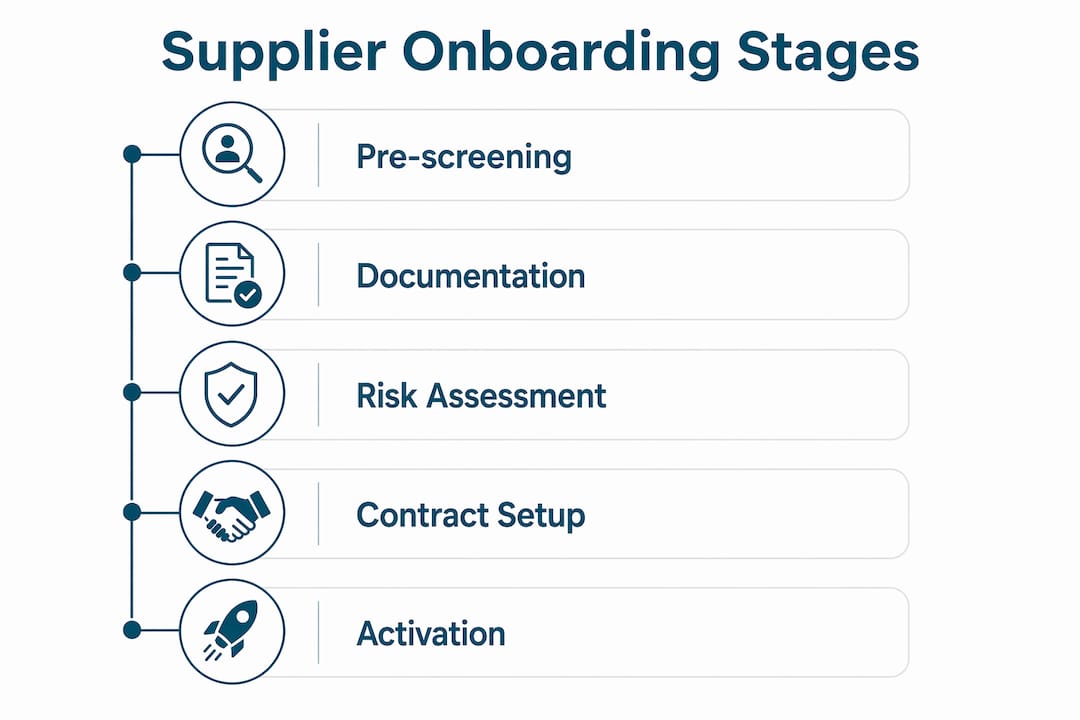
A five-stage onboarding process covers pre-screening, documentation collection, risk assessment, contract setup, and final activation, taking 8–20 business days in total. Each stage has a distinct gate. A supplier does not move to risk assessment until documentation is complete. A supplier does not get activated until the contract is signed and verified.
The timeline varies significantly by operation size. Small operations with 20 trucks process onboarding packets in 2–4 hours, while larger operations with 200 trucks take 1–3 business days. That gap reflects the volume of verification touchpoints, not just paperwork volume.
The type of supplier relationship also shapes the process. A spot freight carrier needs a minimum viable packet: a carrier setup form, a certificate of insurance (COI) naming your company as certificate holder, a W-9, a rate confirmation, and payment terms. A contracted lane partner requires a deeper review, including financial stability checks, capacity commitments, and performance benchmarks written into the agreement. Treating both with the same process wastes time on one end and creates risk on the other.
Pro Tip: Build two distinct onboarding tracks from day one. One for spot freight, one for contracted partners. The documents overlap, but the depth of review and the contract terms do not.
| Stage | Typical duration |
|---|---|
| Pre-screening | 1–2 business days |
| Documentation collection | 2–5 business days |
| Risk assessment | 2–5 business days |
| Contract setup | 2–5 business days |
| Final activation | 1–3 business days |
How does automation transform the vendor onboarding process?
Manual onboarding takes 2–6 weeks. Automated onboarding compresses that to 24–48 hours. That is an 80% reduction in time, and the speed gain is only part of the story.

The deeper benefit of automation is consistency. Automation creates governed, auditable onboarding environments where every supplier goes through the same qualification steps, regardless of which procurement officer handles the file. In port logistics, this matters for regulatory compliance. In ecommerce freight, it matters for insurance and liability coverage. The standard does not slip because someone is busy or new to the role.
Automation also frees procurement teams from administrative work. When document collection, status tracking, and compliance checks run through a platform rather than an inbox, procurement professionals shift their attention to supplier strategy, rate negotiation, and performance management. That shift is what procurement logistics integration is designed to produce: sourcing decisions tied directly to inbound delivery performance.
The practical benefits of automation in supply chain onboarding include:
- Standardized qualification checklists applied to every supplier without exception
- Automated compliance alerts when certificates expire or documents go missing
- Centralized audit trails that satisfy regulatory and insurance requirements
- Faster supplier activation, which reduces gaps in carrier coverage
- Reduced manual data entry errors that cause duplicate vendor records
Pro Tip: When evaluating onboarding platforms, test the compliance alert function first. A system that does not flag an expired COI before a shipment moves creates more risk than a manual process.
For teams managing carrier networks, fleet onboarding standards also intersect with documentation and evidence management, particularly when incident records need to connect back to a specific vendor’s onboarding file.
What documents are required for effective supplier onboarding?
The minimum viable document set for a spot freight carrier includes a carrier setup form, a COI naming your company as certificate holder, a W-9, a rate confirmation, and written payment terms. That clean onboarding packet supports efficient activation and gives your finance and compliance teams what they need to verify the vendor independently.
For contracted partners, the document set expands. Add operating licenses, proof of authority (for motor carriers), surety bonds, and any sector-specific certifications required by your freight type. International suppliers need additional layers, including customs registration numbers and country-specific trade compliance documents. Or-ner’s guide on international shipping documents covers the full set for cross-border vendor integration.
Two failure points appear repeatedly in logistics vendor onboarding. First, fragmented email communication causes lost attachments and broken document chains. Moving suppliers to a dedicated portal at the start of the process eliminates this. Second, duplicate vendor records create payment errors and compliance gaps. The fix is straightforward: create master vendor entries only after finance and compliance independently verify tax and banking data through secure, direct channels, not through documents the supplier submits.
The verification step that most teams skip is direct insurance confirmation. Do not rely on the COI alone. Call the supplier’s insurance agent directly to confirm coverage dates, limits, and named insured status. That single call prevents the most common and most costly onboarding error in freight logistics.
| Document | Purpose | Verification method |
|---|---|---|
| Certificate of insurance | Confirms liability coverage | Direct call to insurance agent |
| W-9 | Tax identification for payments | Finance team cross-check |
| Operating license | Confirms legal authority to operate | State or federal registry lookup |
| Rate confirmation | Documents agreed freight rates | Countersigned by both parties |
| Surety bond | Financial guarantee for contracted work | Bond issuer confirmation |
How to integrate onboarding with supplier relationship management?
Onboarding is the entry point to a managed supplier relationship, not a one-time administrative task. The data collected during onboarding, including compliance status, insurance limits, and contract terms, feeds directly into ongoing supplier evaluation. Effective supplier management post-onboarding improves on-time delivery and reduces supply risks by over 10%, with strategic supplier focus as the key driver. That improvement does not happen automatically. It requires connecting onboarding records to performance tracking systems.
Supplier management has shifted from a transaction focus to strategic relationship development, driven by granular data and standardized processes. That shift starts at onboarding. The supplier profile built during activation becomes the baseline against which performance is measured at 30, 90, and 180 days. Teams that treat onboarding as a standalone event lose that baseline and have no structured way to evaluate whether a supplier is improving or declining.
The key areas to track from onboarding through the full supplier lifecycle include:
- On-time pickup and delivery rates against contracted benchmarks
- Compliance status for insurance, licenses, and certifications
- Claims frequency and resolution time
- Invoice accuracy and payment cycle adherence
- Capacity reliability during peak demand periods
Digital tools that connect onboarding data to performance dashboards make this tracking practical at scale. Or-ner’s supplier relationship management guide covers how to structure post-contract governance so that onboarding data does not sit in a file and go stale. The supply chain risk assessment framework from Or-ner also provides a structured approach to evaluating supplier risk continuously, not just at activation.
Integrating onboarding with performance management also changes how contract renewals work. Teams with complete onboarding records and continuous performance data negotiate from a position of fact. Teams without that data negotiate from memory and relationship, which consistently produces worse commercial outcomes.
Key Takeaways
Effective supplier onboarding in logistics requires structured stages, verified documentation, automation, and direct integration with ongoing performance management to reduce risk and improve supply chain reliability.
| Point | Details |
|---|---|
| Use a five-stage process | Pre-screening through activation takes 8–20 business days and prevents costly activation errors. |
| Automate to cut time and errors | Automated onboarding reduces timelines from weeks to 24–48 hours and enforces consistent standards. |
| Verify documents directly | Call insurance agents directly and use independent finance checks to prevent duplicate records and coverage gaps. |
| Build two onboarding tracks | Spot freight and contracted partners need different document depths and review processes. |
| Connect onboarding to performance data | Onboarding records become the baseline for supplier evaluation, contract renewal, and risk management. |
What I’ve learned from watching onboarding break at the worst moments
The most expensive onboarding failures I’ve seen share one trait: the team treated activation as the finish line. A carrier gets approved, the file gets closed, and nobody looks at it again until something goes wrong. By then, the COI has expired, the rate confirmation is three versions out of date, and the procurement officer who ran the original onboarding has moved to a different role.
The fix is not more paperwork. The fix is treating onboarding as the opening chapter of a supplier relationship, not a compliance checkbox. That means building expiration alerts into your system for every time-sensitive document. It means scheduling a 90-day performance review as part of the activation workflow, not as an afterthought. And it means using a dedicated portal from day one, not email. Dedicated portals prevent lost documents and create a single record of truth that both parties can access.
The automation argument is also stronger than most procurement teams realize. The 80% time reduction is compelling, but the standardization benefit is what actually changes outcomes. When every supplier goes through the same qualification steps, you get comparable data. Comparable data lets you make better sourcing decisions. Better sourcing decisions reduce supply risk. That chain of cause and effect starts at onboarding, and it only works if the process is consistent.
My honest recommendation: audit your current onboarding process against the five-stage framework. Identify where documents get stuck, where verification steps get skipped, and where the handoff from onboarding to performance management breaks down. Fix those three points before adding any new technology. The technology works better when the process underneath it is sound.
— Maayan
How Or-ner supports your logistics operations
Or-ner’s platform is built for ecommerce sellers and logistics teams that need reliable courier services and end-to-end supply chain visibility without the operational drag of fragmented vendor management. The platform integrates freight booking, real-time shipment tracking, customs clearance, and warehousing into a single workflow, which means your supplier and carrier network operates from one source of data rather than a collection of disconnected systems. For teams scaling cross-border operations, Or-ner’s reliable courier services connect supplier integration directly to last-mile delivery performance. If you manage freight across multiple modes, the freight booking process guide from Or-ner gives you a practical starting point for aligning supplier activation with shipment execution.
FAQ
What is supplier onboarding in logistics?
Supplier onboarding in logistics is the process of integrating a new supplier into a company’s procurement, compliance, and operational systems before freight activity begins. It covers data collection, risk screening, contract setup, and system activation.
How long does the vendor onboarding process take?
A standard five-stage onboarding process takes 8–20 business days. Automated systems can compress this to 24–48 hours, compared to 2–6 weeks for fully manual processes.
What documents are required for freight carrier onboarding?
A spot freight carrier needs a carrier setup form, a COI naming your company as certificate holder, a W-9, a rate confirmation, and payment terms. Contracted partners require additional licenses, surety bonds, and sector-specific certifications.
How does automation improve supply chain onboarding?
Automation enforces consistent qualification standards across all suppliers, reduces manual data entry errors, and triggers compliance alerts when documents expire. It frees procurement teams to focus on supplier strategy rather than administrative tracking.
How does onboarding connect to ongoing supplier performance management?
Onboarding data, including compliance records, contract terms, and insurance details, becomes the baseline for supplier performance evaluation. Teams that connect onboarding records to performance dashboards improve on-time delivery and reduce supply risk by over 10%.