Running an ecommerce business means juggling relentless order deadlines, unpredictable supply chain setbacks, and the ever-present challenge of separating work from personal life. For many American entrepreneurs, mental health is the foundation that keeps daily operations and decision-making on track. With 92 percent of professionals recognizing psychological well-being as crucial in their workplace, business owners are realizing that lasting success depends on strategies that support both business growth and personal resilience.
Table of Contents
- Defining Mental Health For Business Owners
- Common Mental Health Risks In Logistics
- Stressors Unique To Ecommerce Operations
- Building Support Networks And Outsourcing
- Proven Strategies To Prevent Burnout
Key Takeaways
| Point | Details |
|---|---|
| Mental Health is Essential for Entrepreneurs | Understanding and managing mental health is crucial for sustainable business performance among ecommerce business owners. |
| Identifying Unique Stressors | Ecommerce operators face unique psychological challenges, including digital overwhelm and constant connectivity, which require proactive management strategies. |
| Utilizing Support Networks | Building professional support networks is vital for mitigating mental health risks, helping entrepreneurs navigate challenges and reduce isolation. |
| Implementing Burnout Prevention Strategies | Proactively establishing boundaries and employing recovery techniques can significantly enhance resilience and prevent burnout among business owners. |
Defining Mental Health For Business Owners
Mental health is more than a buzzword for ecommerce entrepreneurs—it’s the critical foundation of sustainable business performance. Recent workplace research reveals that 92% of professionals consider psychological well-being essential in their professional environment, highlighting the profound importance of understanding mental wellness specifically for business owners.
For ecommerce business owners, mental health encompasses several interconnected dimensions that directly impact operational effectiveness and personal resilience. These dimensions include:
- Emotional Regulation: Managing stress responses during supply chain disruptions
- Cognitive Flexibility: Adapting quickly to market changes and customer demands
- Psychological Resilience: Maintaining decision-making capacity during challenging business periods
- Work-Life Integration: Balancing entrepreneurial responsibilities with personal well-being
Academic studies on business mental health define mental health conditions as clinically significant disturbances impacting cognitive function, emotional stability, and behavioral patterns. For online business owners, these disturbances can manifest as persistent anxiety about inventory management, overwhelming stress from customer interactions, or decision fatigue from constant strategic planning.
Understanding mental health isn’t about identifying weaknesses—it’s about recognizing the unique psychological demands of entrepreneurship. Business owners navigate complex emotional landscapes, managing not just products and processes, but their own internal responses to constant uncertainty.
Mental health in business is not a luxury—it’s a critical operational strategy for sustainable success.
Pro tip: Schedule weekly 30-minute reflection sessions to assess your mental and emotional state, treating your psychological well-being as systematically as you manage your business metrics.
Common Mental Health Risks In Logistics
Logistics professionals face a unique constellation of mental health challenges that can significantly impact their psychological well-being and professional performance. Detailed industry research reveals a complex landscape of stressors that create substantial mental health risks for those managing complex supply chain operations.
The primary mental health risks in logistics can be categorized into several critical dimensions:
- Chronic Stress: Constant pressure from tight deadlines and operational demands
- Physical Exhaustion: Long hours and physically demanding work environments
- Social Isolation: Limited interpersonal interactions during extended work periods
- Decision Fatigue: Continuous problem-solving in high-stakes logistics scenarios
- Performance Anxiety: Persistent worry about meeting complex operational targets
Ongoing industry analyses highlight that prolonged exposure to these stressors can lead to significant psychological challenges. Ecommerce logistics professionals particularly experience heightened mental strain due to the unpredictable nature of online retail, where customer expectations, shipping complexities, and rapid technological changes create constant psychological pressure.

The most concerning mental health risks emerge from the intersection of high-pressure work environments and limited psychological support systems. Business owners and logistics managers often internalize stress, believing that displaying vulnerability might compromise their professional credibility. This approach can lead to escalating mental health challenges, including burnout, depression, and chronic anxiety.
To clarify how business owners and logistics professionals experience mental health risks differently, see this comparison:
| Aspect | Business Owners | Logistics Professionals |
|---|---|---|
| Main Stress Source | Uncertainty in markets | High workload and deadlines |
| Isolation Factor | Digital, work-from-home | Extended on-site hours |
| Recovery Challenge | Blurred boundaries | Lack of support systems |
| Impact on Decisions | Decision fatigue | Performance anxiety |
Mental health risks in logistics are not individual weaknesses, but systemic challenges requiring comprehensive organizational support.
Pro tip: Implement a monthly mental health check-in process, treating psychological wellness with the same systematic approach you apply to inventory management and operational efficiency.
Stressors Unique To Ecommerce Operations
Psychological research on entrepreneurs reveals that ecommerce operators experience a distinct set of mental health challenges that differentiate them from traditional business models. The digital marketplace creates a complex psychological landscape where uncertainty, constant connectivity, and rapid technological changes intersect to generate unprecedented levels of professional stress.
The primary stressors unique to ecommerce operations include:
- Digital Overwhelm: Constant technological updates and platform changes
- Financial Volatility: Unpredictable revenue streams and market fluctuations
- Customer Expectation Pressure: 24/7 demand for immediate responsiveness
- Technology-Induced Isolation: Limited face-to-face interactions
- Performance Metrics Anxiety: Continuous tracking of real-time business indicators
Recent stress surveys highlight the compounded psychological impact of post-pandemic economic uncertainties on ecommerce professionals. Online business owners now navigate an environment where digital performance metrics, customer reviews, and instantaneous global competition create a perpetual state of heightened psychological strain.
The most profound stressor emerges from the blurred boundaries between personal and professional life. Ecommerce entrepreneurs often work from home, creating an environment where work can consume every waking moment. This constant connectivity leads to chronic stress, with little distinction between professional responsibilities and personal time, ultimately compromising mental health and long-term business sustainability.
Ecommerce stress is not just about workload—it’s about managing an ever-shifting digital ecosystem that demands constant psychological adaptability.
Pro tip: Establish strict digital boundaries by creating dedicated work hours and using technology management tools to prevent constant work intrusion into personal spaces.
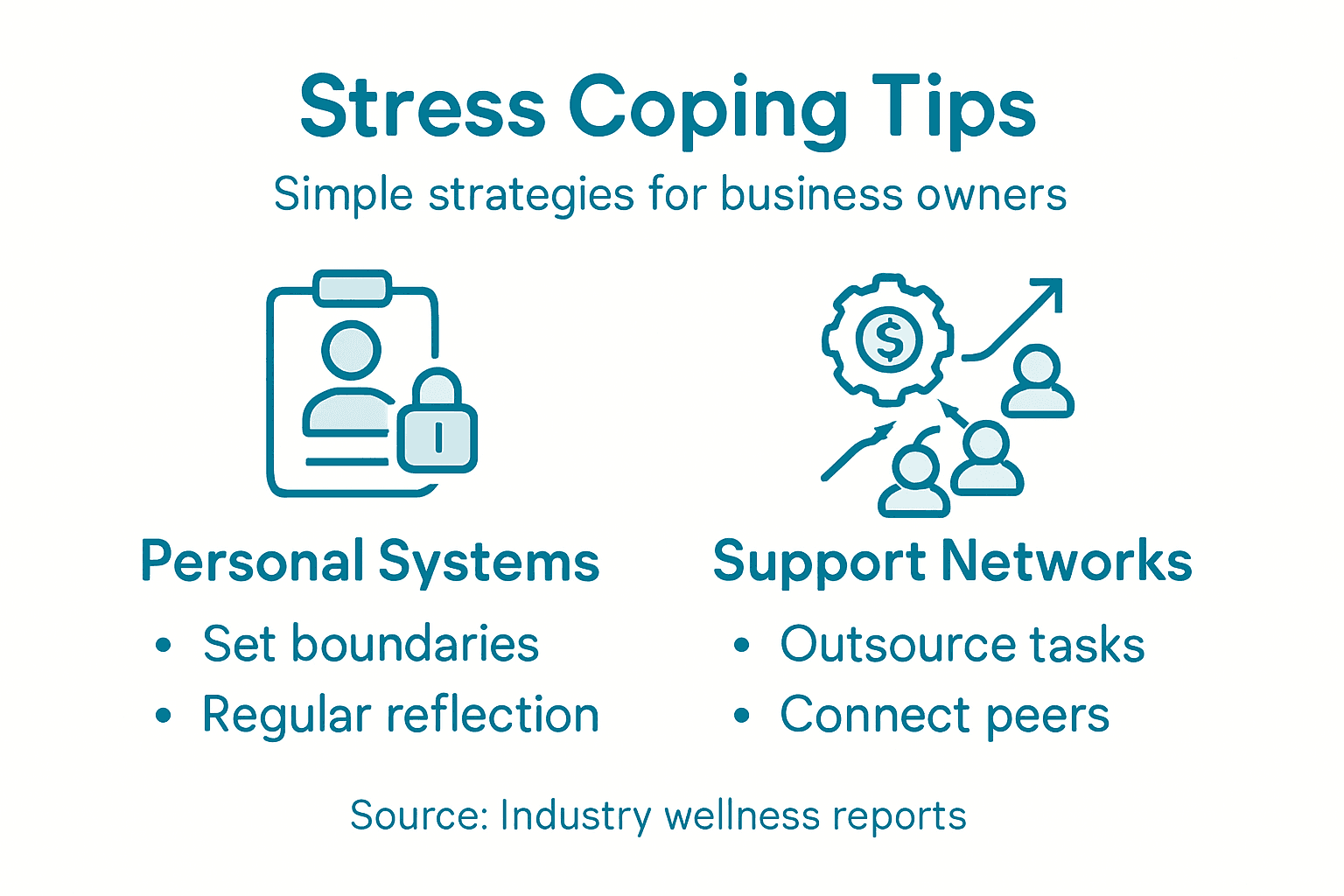
Building Support Networks And Outsourcing
Social support networks play a critical role in mitigating the psychological challenges faced by ecommerce entrepreneurs. Working in digital isolation can create significant mental health risks, making deliberate network building and strategic outsourcing essential for sustainable business and personal well-being.
Effective support network strategies include:
- Professional Peer Groups: Joining online communities of similar entrepreneurs
- Mentorship Programs: Connecting with experienced business leaders
- Virtual Mastermind Networks: Regular digital meetups for shared problem-solving
- Mental Health Coaching: Working with professionals who understand business stress
- Outsourcing Critical Functions: Delegating tasks to reduce personal workload
Intermediary organizational research demonstrates that coordinated external supports can significantly improve mental health outcomes for small business owners. These supports bridge critical gaps by providing resources and training that individual entrepreneurs might struggle to access independently, creating a more resilient professional ecosystem.
The most effective support networks transcend traditional professional boundaries, offering holistic assistance that addresses both operational challenges and psychological well-being. By creating multidimensional support systems, ecommerce entrepreneurs can develop robust mechanisms for managing stress, preventing burnout, and maintaining long-term business sustainability.
Support networks are not a luxury—they are a fundamental infrastructure for mental health and business resilience.
Pro tip: Allocate at least 3-4 hours monthly to actively cultivate and engage with professional support networks, treating these connections as critical business development investments.
Proven Strategies To Prevent Burnout
Entrepreneurial burnout prevention strategies require a holistic approach that addresses both psychological and operational challenges unique to ecommerce business owners. Understanding burnout as a systemic issue rather than an individual weakness is the first critical step toward developing sustainable professional practices.
Key strategies for preventing entrepreneurial burnout include:
- Boundary Setting: Establishing clear work-life separation
- Stress Management: Regular mindfulness and relaxation techniques
- Task Delegation: Systematically offloading non-core business responsibilities
- Performance Monitoring: Creating realistic performance metrics
- Recovery Planning: Intentional periods of professional disconnection
Research on daily recovery experiences highlights that entrepreneurs require specialized approaches to managing work-related stress. Small business owners often struggle with detachment due to deep professional engagement, making purposeful recovery strategies essential for maintaining psychological resilience.
Successful burnout prevention demands a proactive, multifaceted approach. This means developing personalized systems that recognize individual stress triggers, implementing structured recovery protocols, and continuously reassessing professional boundaries. By treating mental health as a strategic business asset, ecommerce entrepreneurs can create sustainable performance models that protect both personal well-being and business effectiveness.
Here is a summary of proven strategies and their business impact:
| Strategy | Key Benefit | Long-Term Impact |
|---|---|---|
| Boundary Setting | Reduces chronic stress | Sustains work-life balance |
| Task Delegation | Frees up owner time | Enhances productivity |
| Recovery Planning | Prevents burnout | Maintains resilience |
| Performance Monitoring | Sets realistic goals | Improves business focus |
Burnout is not a sign of weakness, but an indicator that your current operational systems require recalibration.
Pro tip: Create a weekly ‘systems audit’ where you intentionally review and adjust your professional boundaries, workload, and personal energy management strategies.
Strengthen Your Ecommerce Mental Health with Reliable Logistics Support
Entrepreneurship in ecommerce demands more than skill and dedication—managing mental health amid stressors like decision fatigue and blurred work-life boundaries is vital. The article highlights how chronic stress and performance anxiety uniquely challenge business owners and logistics professionals alike. Simplifying your logistics operations can significantly reduce these psychological pressures so you focus on growing your business with peace of mind.
Reliable courier services from Or-Ner provide comprehensive logistics solutions designed to ease your operational burdens. With real-time shipment tracking, inventory management, and seamless integration with ecommerce platforms like Amazon, you gain clarity and control that helps prevent burnout and decision overload. Embrace automated workflows and a global network of warehouses to create space for recovery and strategic thinking.
Take control of your mental well-being by partnering with a logistics platform that understands ecommerce stress and delivers end-to-end support. Explore Or-Ner today and discover how simplifying your supply chain with trusted, reliable courier services transforms your business and safeguards your health. The time to act is now—build resilience with logistics designed for your success.
Frequently Asked Questions
What are the key mental health risks for business owners?
Mental health risks for business owners include stress from market uncertainties, decision fatigue, and difficulties balancing work-life integration. It’s crucial to recognize these factors as they can significantly impact both personal well-being and business success.
How can I manage stress as a business owner?
Effective stress management strategies for business owners include setting clear boundaries between work and personal life, practicing mindfulness techniques, and regularly assessing your emotional state. Additionally, delegating tasks and building a support network can help reduce stress levels.
What strategies can help prevent burnout in entrepreneurship?
Preventing burnout in entrepreneurship involves establishing work-life boundaries, managing stress through relaxation techniques, monitoring performance realistically, and planning for intentional periods of disconnection from work to recharge mentally and emotionally.
Why is mental health important for ecommerce business owners?
Mental health is crucial for ecommerce business owners as it directly affects decision-making, resilience, and overall operational effectiveness. Understanding and prioritizing mental wellness can lead to sustainable business practices and improved personal well-being.
Recommended
- Understanding Supply Chain Risk Management for Businesses – ORNER
- Supply Chain Risk Assessment: Minimizing Disruption Impact – ORNER
- Global Supply Chain Risks: Challenges and Smart Solutions – ORNER
- Sustainability in Business Operations: Real Impact for Ecommerce – ORNER
- Corporate Wellness Programs: Boosting Team Health in Lisbon