A real time tracking package is the operational layer that turns raw GPS pings, carrier updates, and IoT sensor readings into decisions your team can act on before a shipment becomes a problem. Its main job isn’t showing a dot on a map. It’s flagging exceptions early enough that dispatch, warehouse, and customer service teams can reroute, rebook, or communicate before a delay turns into a penalty or a support ticket. As Supply Chain Management Review puts it, visibility only pays off when it’s embedded into daily operating systems, not just displayed on a screen.
TL;DR:
- Real-time tracking integrates multiple data sources, including GPS, telematics, sensors, and carrier APIs, requiring normalization and enrichment for accurate visibility.
- Early detection of exceptions like delays or temperature excursions reduces detention costs and improves customer satisfaction by enabling proactive action.
- Rolling out the system gradually with focused pilots and clear playbooks is more effective than attempting full network deployments immediately.
- Key KPIs such as OTIF, exception rate, detention costs, and support ticket volume measure the effectiveness of real-time visibility efforts.
- Exposure of operational inefficiencies through real-time data should inform process improvements rather than blame, emphasizing exception management.
Table of Contents
- What Does a Real Time Tracking Package Actually Include?
- What Operational Benefits Does Real Time Tracking Deliver?
- How Does Real Time Tracking Work Technically?
- How Do You Roll Out a Real Time Tracking Package?
- Which KPIs Prove Real Time Tracking Is Working?
- What I’ve Learned Watching These Rollouts Play Out
- See How Or-ner Handles Real Time Shipment Visibility
- Sources
- FAQ
What Does a Real Time Tracking Package Actually Include?
Strip away the marketing language and a real time tracking package is a stack of data sources feeding a platform layer that makes sense of them. On the data side, you’re pulling from GPS and ELD feeds on trucks, carrier telematics from ocean and air partners, IoT sensors for temperature or shock, RFID tags at dock doors, EDI messages for order and status updates, and direct carrier APIs.
The platform layer is where the real work happens:
- Ingestion: pulling every feed into one system regardless of format or carrier
- Normalization: converting inconsistent carrier milestones into a common status language
- Enrichment: overlaying weather, port congestion, or traffic data onto raw location pings
- Predictive ETA: forecasting arrival based on historical patterns, not just the carrier’s last update
- Anomaly detection: flagging a stalled truck or a temperature excursion automatically
This is a different animal from consumer parcel tracking, which just answers “where’s my package” for one recipient checking one order. Operational tracking answers “which of my 4,000 active shipments needs intervention right now,” and that distinction shapes everything about how the system is built and used.
What Operational Benefits Does Real Time Tracking Deliver?
The payoff shows up first in on-time-in-full (OTIF) rates and fulfillment speed. When routing logic pulls from real-time inventory and location data instead of static rules, merchants have cut delivery times by shipping from the nearest available node and avoiding split shipments, according to Shopify’s research on integrated logistics.
Detention and demurrage costs are where the numbers get harder to ignore. Shippers without real-time visibility routinely eat avoidable detention fees because nobody caught a delay early enough to adjust appointments. DataNetIoT’s analysis of shipment visibility points to cases where poor visibility drove millions in lost fees and unnecessary expedite costs across a shipper’s network.
The bigger picture: visibility gaps don’t just cost money in penalties. They cost time in customer service, since a shipper without live status data can’t answer a “where is it” ticket without calling the carrier first.
Other measurable gains include:
- Fewer inbound support tickets because customers get proactive delay notices instead of filing complaints
- Better available-to-promise (ATP) accuracy since inventory in transit counts toward what you can sell
- Lower rush-freight spend because exceptions get caught while there’s still time for a cheaper fix
How Does Real Time Tracking Work Technically?
Data enters the system through several paths at once. Carrier APIs push milestone events, EDI transactions carry structured order and shipment data, GPS and ELD units stream continuous location from trucks, and IoT devices report condition data like temperature or humidity for sensitive freight. None of these feeds speaks the same language natively, which is why the normalization layer matters as much as the data collection itself.
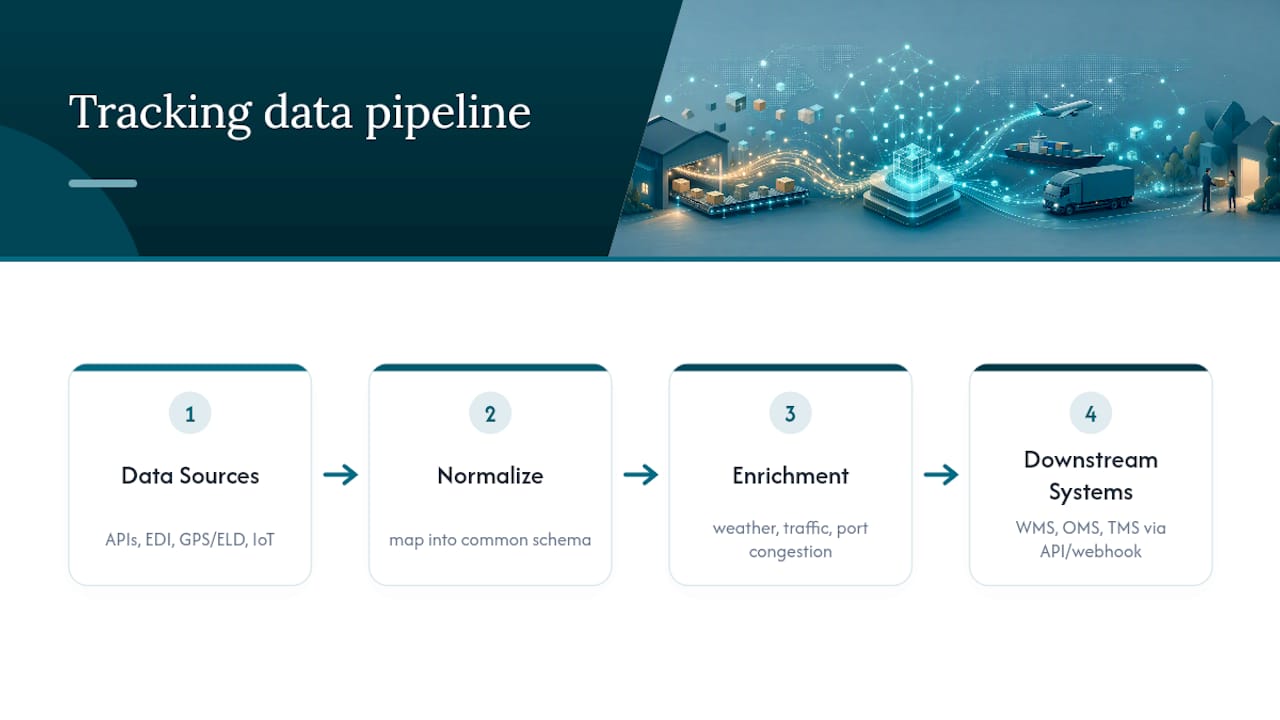
Once ingested, the platform enriches raw location data with third-party context: weather patterns that might delay a lane, port congestion reports, or live traffic conditions. This enrichment is what separates a predictive ETA model from a simple “last known location” display. Supply Chain Desk notes that ETAs built on historical shipment patterns and enriched external data consistently outperform carrier milestone updates alone, because milestones only tell you where a shipment was at the last scan, not where it’s headed.
From there, events get pushed into your WMS, OMS, or TMS through APIs and webhooks, so a delay flagged in the tracking platform shows up automatically in the warehouse team’s dashboard or the customer service rep’s queue. NetSuite describes this as the core function of integrated logistics: connecting ERP, WMS, and carrier systems so fulfillment steps happen without someone manually checking three different portals.
Telemetry accuracy varies by mode, and that matters for planning. Road freight benefits most from GPS and ELD data paired with short-horizon predictive ETAs. Ocean freight needs AIS feeds and port congestion data, with ETA windows measured in days rather than hours. Air freight requires flight data integration and tighter handling protocols given shorter transit windows. A system tuned for trucking won’t automatically work well for ocean without adjusting the enrichment sources.
How Do You Roll Out a Real Time Tracking Package?
Rolling out real-time visibility works best as a sequence, not a single big-bang deployment. Jumping straight to a full network rollout without validating the approach on a smaller scale is the single most common way these projects stall.
- Map your value stream first. Identify where decisions actually change when you get earlier data. A lane where nobody acts on delay alerts isn’t worth prioritizing yet, even if it’s high-volume.
- Design a tight pilot. Pick two or three lanes or a single mode, define success criteria (detention cost reduction, OTIF improvement, ticket volume drop), and set a review date before you start.
- Build the integration checklist. Confirm WMS/ERP/OMS connector availability, carrier API coverage for your top shipping partners, device coverage for any sensor-based tracking, and webhook support for pushing exceptions into existing dashboards.
- Build exception playbooks before go-live. Define what happens when a shipment triggers a delay flag: who gets notified, what the escalation path looks like, and how often KPIs get reviewed.
Supply Chain Management Review’s guidance on this is blunt: connected systems that don’t change how decisions get made deliver limited value no matter how good the data feed looks.
Pro Tip: Build your first pilot around specific exception types, like a customs hold or a carrier hub stall, rather than just a geographic lane. Playbooks built around exception types generalize across lanes and modes much faster than lane-specific rules do.
For a deeper walkthrough of tracking rollouts across warehouses and carriers, see Or-ner’s guide to tracking shipments efficiently.
Which KPIs Prove Real Time Tracking Is Working?
Five metrics tell you whether the investment is paying off, and they map cleanly to the numbers your finance team already tracks.
| KPI | What it measures | Why it matters |
|---|---|---|
| OTIF (on-time-in-full) | Percentage of orders delivered complete and on schedule | Direct measure of fulfillment reliability |
| Exception rate | Share of shipments triggering a delay or anomaly flag | Shows how often intervention is needed |
| Detention/demurrage cost | Fees paid for late pickup or drop-off | Directly reduced by early alerts |
| Mean time to detect/resolve | How fast a flagged exception gets addressed | Measures playbook effectiveness |
| Support ticket volume | Inbound “where’s my order” tickets | Drops when proactive alerts replace reactive lookups |
Short-term ROI comes from comparing detention fees, expedited freight spend, and support labor hours before and after the pilot. Report these weekly to operations, biweekly to logistics leadership, and monthly to customer service leads so each team sees the numbers that matter to their function.
What I’ve Learned Watching These Rollouts Play Out
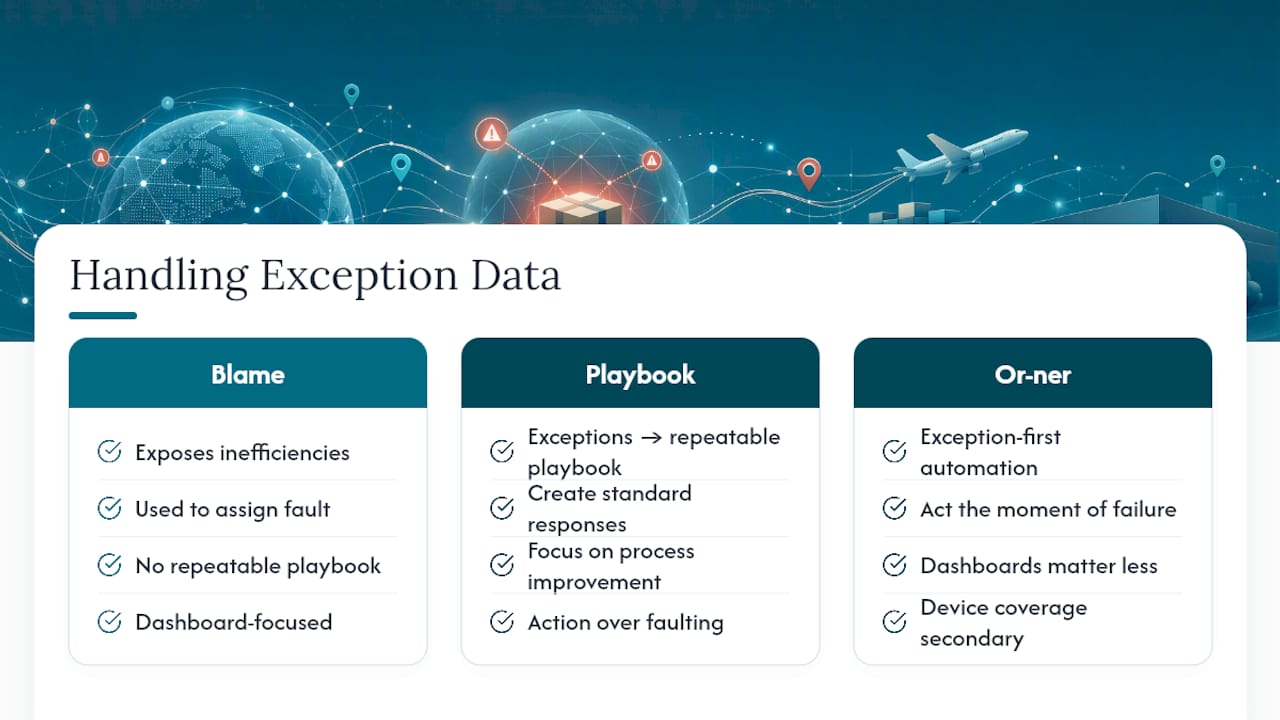
Real-time visibility has an uncomfortable side effect: it exposes inefficiencies that were previously invisible, and the instinct in a lot of organizations is to treat that exposure as a blame exercise. It shouldn’t be. The teams that get the most value treat exception data as the basis for a repeatable playbook, not a scorecard for who dropped the ball.
Or-ner’s approach leans into exception-first automation for exactly this reason: dashboards and device coverage matter less than what happens the moment something goes wrong.
— Maayan
See How Or-ner Handles Real Time Shipment Visibility
Or-ner is built for exactly the operational problem this article covers: turning scattered carrier updates and warehouse data into one system that flags exceptions before they cost you money. The platform connects real-time shipment tracking with warehousing, inventory management, and analytics, so a delay on an inbound freight lane shows up in the same dashboard your customer service team already uses.
For sellers moving high volume through the US market, reliable courier services pages typically walk through coverage and integration options. If you’re planning a pilot, that’s the right place to start: request a walkthrough of the API coverage, confirm which carriers and modes are supported for your lanes, and request a quote tailored to your shipment volume. For teams also evaluating broader platform fit across ocean, air, and land modes, the global logistics platform overview covers integration depth and enterprise features in more detail.
Sources
- How Do You Really Do It: Implement real-time visualization in a way that impacts results – Supply Chain Management Review
- What Is Integrated Logistics? | NetSuite
- Real-Time Shipment Visibility: The Cost of $10M in Lost Fees
- Real-Time Supply Chain Visibility – Supply Chain Desk
- Integrated logistics for ecommerce – Shopify
FAQ
How Is Real Time Tracking Different From Parcel Tracking?
Consumer parcel tracking shows one recipient the status of one package. A real time tracking package monitors thousands of shipments across modes and triggers automated exception alerts that feed directly into warehouse and dispatch workflows.
How Long Does Integration Typically Take?
Timelines depend on carrier API coverage and existing WMS/ERP complexity, but a scoped pilot covering two or three lanes can usually go live in weeks rather than months once connectors are confirmed.
What’s the Minimum Data Needed for a Useful Pilot?
A workable pilot needs at least carrier API or EDI status feeds plus GPS data for one mode, enough to test predictive ETAs and exception alerts before adding IoT or RFID layers.
Does Real Time Tracking Help With Inventory Accuracy?
Yes. Counting in-transit inventory toward available-to-promise figures, as supported by platforms like Or-ner’s real-time order tracking tools, reduces overselling and improves fulfillment planning.
What’s the Biggest Implementation Mistake Teams Make?
Rolling out full network coverage before validating that teams will actually act on the alerts. A tight, exception-focused pilot almost always outperforms a broad rollout with no defined playbook.