An ocean freight bill of lading (B/L) is simultaneously a carrier’s receipt for your goods, the contract of carriage governing how they move, and — when issued in negotiable form — a document of title that controls who can claim the cargo at destination. Your first move before any shipment: confirm whether the trade requires a negotiable original B/L or whether a non-negotiable sea waybill will do.
That single decision shapes everything downstream — payment security, cargo release, and your bank’s willingness to process a Letter of Credit. As the B/L Primer from China Business Limited notes, the B/L performs all three legal functions at once, and conflating them is where most documentation errors begin.
The one-line rule: If your buyer’s bank is involved (Letter of Credit), you almost certainly need a negotiable original B/L with a “shipped on board” notation. If you’re shipping to a trusted partner on open account, a sea waybill or telex release is usually faster and cheaper.
Pro Tip: Confirm consignee wording with your buyer and their bank before the freight forwarder drafts the B/L. Changing it after issuance costs time and, on some routes, a formal amendment fee.
For a broader look at ocean freight shipping before diving into documentation specifics, Or-ner’s practical guide covers the full picture.
Key Takeaways
The ocean freight bill of lading is a legal instrument that controls cargo release, payment, and liability — getting even one field wrong can stall a shipment or void a Letter of Credit.
| Point | Details |
|---|---|
| Confirm B/L type first | Decide between negotiable OBL, straight B/L, or sea waybill before booking; the choice drives everything downstream. |
| Consignee wording is critical | For L/Cs, the consignee is often the issuing bank, not the buyer — getting this wrong is the most common rejection cause. |
| On-board notation is mandatory for L/Cs | Banks require a “shipped on board” date; a “received for shipment” B/L alone will be rejected under most documentary credits. |
| Carrier liability is capped | Under COGSA, carrier liability defaults to $500 per package — declare a higher value or insure separately for high-value cargo. |
| Or-ner covers the full workflow | Or-ner’s platform handles freight booking, B/L review, customs clearance, and tracking to reduce first-submission discrepancies. |
Table of Contents
- What does an ocean freight bill of lading actually do?
- Which type of B/L does your shipment actually need?
- Who issues the B/L, and when?
- What fields must appear on the B/L?
- How to complete an ocean B/L without causing delays
- How cargo gets released: originals, endorsements, and electronic options
- Carrier liability, standard clauses, and how to file a claim
- Or-ner’s annotated B/L sample and shipper checklist
- The part of B/L management most shippers underestimate
- Or-ner handles the documentation so your shipment doesn’t stall
- Sources
- FAQ
What does an ocean freight bill of lading actually do?
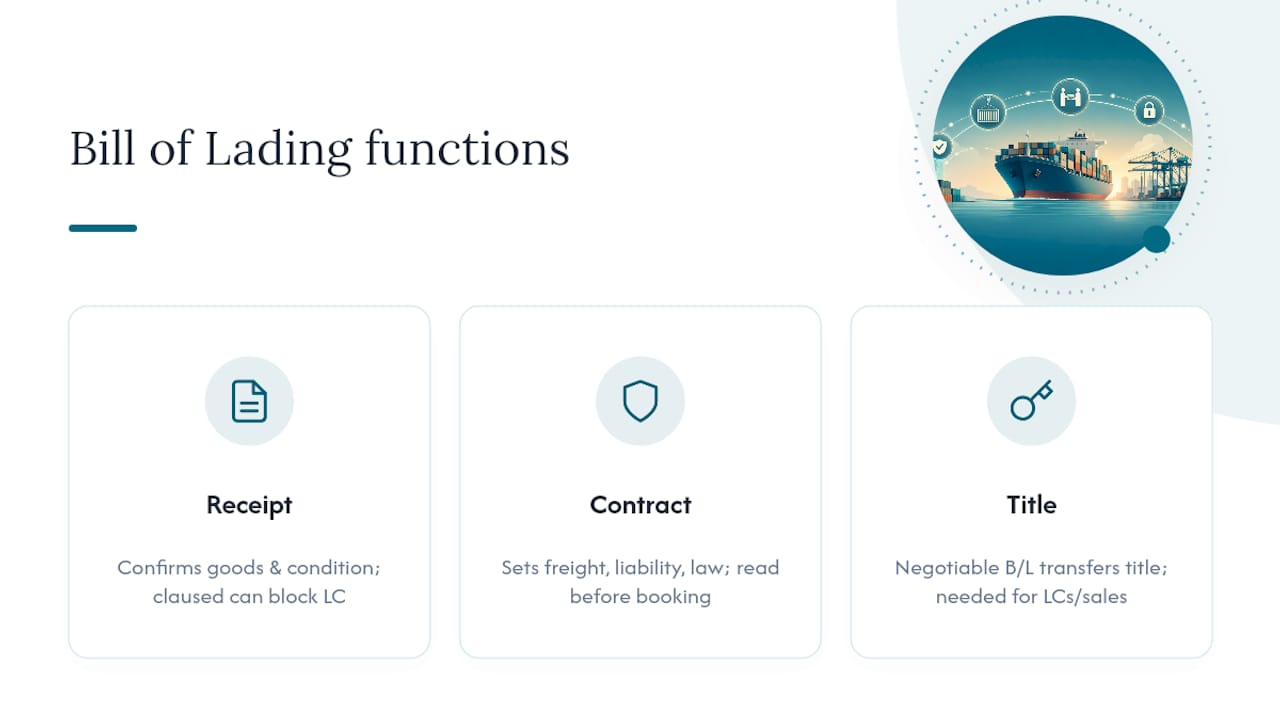
The three functions are not just legal theory — each one has direct, practical consequences for payment, delivery, and risk.
Receipt of goods. When the carrier signs the B/L, they’re confirming what they received and its apparent condition. A “clean” B/L means no visible damage or shortage. A “claused” or “dirty” B/L carries remarks — “cartons wet,” “one pallet short” — and banks will typically reject it under a documentary credit. That rejection isn’t just an inconvenience; it can delay payment by weeks and trigger disputes with your insurer.
Contract of carriage. The B/L’s reverse side (or an incorporated tariff) contains the carrier’s terms: freight rates, liability limits, governing law, and port obligations. This is where disputes about damaged cargo, missed delivery windows, or demurrage charges get resolved — or litigated. Read those terms before you sign off on a booking, not after something goes wrong.
Document of title. This is the function that sets the original B/L apart from every other shipping document. A negotiable B/L can be endorsed and transferred, meaning whoever holds the original can claim the goods. That’s what makes it useful for Letters of Credit and for selling cargo while it’s still at sea. Remove the negotiability — by issuing a straight B/L or a sea waybill — and you remove the title function entirely.
Pro Tip: Always request a draft B/L from your carrier or forwarder before the vessel sails. Catching a wrong consignee name or port spelling at draft stage costs nothing. Catching it after the ship departs can cost hundreds of dollars in amendment fees and days of delay.
Which type of B/L does your shipment actually need?
The choice of B/L type is not a formality — it determines who controls the cargo, whether a bank will accept the documents, and how fast the consignee can get a delivery order.
Original negotiable B/L (OBL)
Issued as a set, commonly three originals. Each original has equal legal force; presenting any one of them at destination releases the cargo. The carrier surrenders the goods only against an original, which is why banks hold them under Letters of Credit. Use an OBL when the trade involves an L/C, when goods are being sold in transit, or when the buyer requires title security.
Straight (non-negotiable) B/L
Names a specific consignee who cannot be changed by endorsement. Negotiable “to order” B/Ls permit endorsement chains and title transfer; straight B/Ls do not. Faster and simpler for trusted trading partners on open account, but useless if the cargo needs to change hands before arrival.
To-order and bearer B/Ls
A “to order” B/L is made out to the order of the shipper or a named bank, then endorsed over to the buyer. A blank endorsement — signing the back without naming a new holder — converts it into a bearer bill, meaning whoever physically holds it can claim the cargo. That’s a significant fraud risk; avoid blank endorsements unless your trade finance structure specifically requires them.
Sea waybill
Non-negotiable by design. The consignee named on the waybill collects the cargo without presenting any original document — they just prove their identity. Sea waybills eliminate the need for presenting originals at destination and cut demurrage risk on short-sea routes. The catch: banks generally won’t accept them under Letters of Credit because there’s no title document to hold as security.
Telex / express release
The shipper surrenders the originals at the port of loading, and the carrier sends an electronic release instruction to the destination agent. Functionally similar to a sea waybill for release purposes, but it starts life as an OBL. Confirm bank and buyer acceptance before surrendering originals — some L/Cs explicitly prohibit it.
Master B/L (MBL) vs. House B/L (HBL)
The carrier issues the MBL to the freight forwarder. The forwarder then issues an HBL to the actual shipper. For ocean freight forwarding arrangements, the HBL governs the shipper’s contractual relationship, while the MBL governs the forwarder’s relationship with the carrier. In a dispute, knowing which document controls which leg matters.
Who issues the B/L, and when?
The carrier (or their agent) issues the Master B/L. A freight forwarder acting as a non-vessel operating common carrier (NVOCC) issues a House B/L. The distinction matters because the HBL holder’s recourse runs against the forwarder, not the ocean carrier directly.
Timing follows a two-step sequence:
- “Received for shipment” — issued when the carrier takes custody of the goods, before loading. Banks under most L/Cs will not accept this alone.
- “Shipped on board” notation — added (or the B/L reissued) once the cargo is physically loaded onto the named vessel. Banks and documentary credits typically require this notation; missing or backdated on-board dates are among the most common L/C discrepancies.
The on-board date must fall within the L/C’s latest shipment date. If the vessel is delayed and the on-board date slips past that deadline, the L/C is in discrepancy — even if the goods are physically on the ship.
Pro Tip: Request the on-board B/L the same day the vessel sails. Don’t wait for the forwarder to send it automatically — follow up directly, because L/C presentation deadlines run from the on-board date, not from when you receive the document.
What fields must appear on the B/L?
Every field on the B/L must match the commercial invoice, packing list, and — when applicable — the Letter of Credit, character for character. Small discrepancies in port names, consignee spelling, or dates commonly cause documentary holds. “Port of Busan” and “Busan, Korea” are not the same string to a bank examiner.
The mandatory fields for U.S.-relevant shipments are:
| Field | What to verify |
|---|---|
| Shipper | Full legal name and address, matching the commercial invoice exactly |
| Consignee | Wording required by the L/C or buyer (“To order of [Bank]” vs. named party) |
| Notify party | Agent or buyer contact at destination; often the customs broker |
| Carrier name | Full legal carrier name, not an abbreviation |
| Vessel and voyage | Vessel name and voyage number as booked |
| Port of loading (POL) | Exact port name matching the L/C |
| Port of discharge (POD) | Exact port name matching the L/C |
| Place of receipt / delivery | Required for multimodal or door-to-door shipments |
| Cargo description | Specific enough for customs; not “general cargo” or “freight all kinds” |
| Number of packages | Count matching packing list |
| Gross weight | Matching packing list and commercial invoice |
| Container and seal numbers | Verified against the equipment interchange receipt |
| Freight terms | Prepaid or collect — must match Incoterms and L/C |
| On-board date | Date cargo was loaded; must precede L/C latest shipment date |
| Carrier signature | Signed by or on behalf of the carrier or master |
Optional but useful: HS code, marks and numbers, packaging type, and place of delivery for multimodal carriage. For a complete picture of which international shipping documents must cross-reference the B/L, Or-ner’s document guide covers the full set.
How to complete an ocean B/L without causing delays
Work through this in order. Skipping steps or filling fields from memory is how discrepancies happen.
- Confirm Incoterms and freight payment. Who pays freight — shipper or consignee? This determines whether freight is “prepaid” or “collect” on the B/L. Mismatch here triggers a carrier hold at destination.
- Pull the L/C and read the transport document clause. Note the exact consignee wording, the latest shipment date, the port names, and any special B/L requirements (e.g., “full set of 3/3 originals,” “freight prepaid”).
- Complete the shipper field. Use the exact legal name and address from the commercial invoice. No abbreviations.
- Complete the consignee and notify party. For L/Cs, the consignee is often “To order of [Issuing Bank]” — not the buyer’s name. The buyer appears as notify party. Getting this backward is one of the most common and costly errors.
- Enter carrier name and agent. Full legal name of the ocean carrier, not the booking agent’s name.
- Fill vessel, voyage, POL, and POD. Copy from the booking confirmation. Verify port names against the L/C word for word.
- Describe the cargo specifically. Match the commercial invoice description. “500 cartons of men’s cotton T-shirts, HS 6109.10” beats “apparel” every time — for customs and for claims.
- Enter packages, weight, and volume. Cross-check against the packing list. Rounding weight up or down even slightly can create a mismatch.
- Add container and seal numbers. Pull from the equipment interchange receipt or the carrier’s booking system.
- Set freight terms. Prepaid or collect, matching the Incoterms agreed with the buyer.
- Specify number of originals. Typically 3/3. State this on the face of the B/L.
- Confirm the on-board notation. Date, vessel name, and carrier signature must all be present.
Common mistakes to fix before submission:
- Consignee wording doesn’t match the L/C (most frequent L/C rejection cause)
- On-board date missing or later than the L/C’s latest shipment date
- Carrier signature shows the agent’s name without “as agent for [Carrier]”
- Cargo description is vague or differs from the commercial invoice
- Port names abbreviated differently than the L/C specifies
Practical checklists and annotated B/L samples consistently reduce first-submission discrepancies. Use one every time, not just for complex shipments.
Pro Tip: Under UCP 600 and ISBP 745 guidance, the carrier’s name must appear on the face of the B/L and the signature must identify the signatory’s capacity — “signed by [Name] as master” or “as agent for [Carrier Name].” A signature without that identification is a discrepancy.
How cargo gets released: originals, endorsements, and electronic options
Carriers commonly issue a set of three original B/Ls. Presenting any one original at destination — properly endorsed if the B/L is negotiable — triggers issuance of a delivery order. The carrier destroys or marks the remaining originals void.
Endorsement mechanics
For a “to order” B/L, the shipper endorses the back to transfer title. A specific endorsement names the new holder (“Endorse to [Buyer Name]”). A blank endorsement leaves the holder line empty, making it a bearer instrument — whoever holds it can claim the cargo. Banks in L/C transactions typically endorse the B/L over to the buyer only after payment or acceptance of drafts.
Telex and express release
The shipper surrenders all originals at the port of loading. The carrier’s origin office sends a release message to the destination agent, who releases the cargo to the named consignee without requiring a physical original. Fast and practical for short routes and trusted partners. Not compatible with most L/Cs unless the bank explicitly agrees in writing.
Electronic B/Ls (eB/L)
Platforms like WAVE, Bolero, and essDOCS issue legally binding electronic originals that can be transferred digitally. Legal acceptance in the U.S. has grown, particularly after the UNCITRAL Model Law on Electronic Transferable Records (MLETR) gained traction, but acceptance still depends on the carrier, the bank, and the importing country’s legal framework. Before committing to an eB/L, confirm that your buyer’s bank and the destination customs authority will accept it. The upside — no courier risk, no lost originals, faster release — is real, but the compatibility check is non-negotiable.
Carrier liability, standard clauses, and how to file a claim
Carrier liability on ocean shipments is not unlimited. The B/L’s terms and conditions (usually on the reverse) incorporate liability limits, often by reference to the Carriage of Goods by Sea Act (COGSA) for U.S. trades, which caps carrier liability at $500 per package unless a higher value is declared. That figure hasn’t changed since 1936 — it covers almost nothing for high-value cargo.
Scan the B/L’s face and reverse for:
- The governing convention or law (COGSA, Hague-Visby Rules, Hamburg Rules)
- Package or weight-based liability limits
- Time bars for claims (typically one year under COGSA)
- Definitions of “package” — a container can be treated as one package if not itemized on the B/L
- Terminal handling charges, freight prepaid/collect status, and any carrier lien clauses
Claims procedure — act fast:
- Inspect on arrival. Note any visible damage before signing the delivery receipt. A clean delivery receipt makes a cargo claim much harder to win.
- Obtain terminal damage notes. Get written confirmation from the terminal or carrier’s agent of any damage or shortage.
- Notify the carrier in writing. For non-apparent damage, COGSA requires written notice within three days of delivery.
- Assemble your claim package. You need the original B/L, commercial invoice, packing list, surveyor’s or damage report, and photos.
- File within the time bar. One year from delivery (or scheduled delivery) under COGSA. Missing this deadline extinguishes the claim entirely.
Pro Tip: Declare a higher cargo value on the B/L if your goods exceed $500 per package in value. The carrier will charge an ad valorem surcharge, but it raises their liability ceiling — and it’s far cheaper than absorbing an uninsured loss.
Or-ner’s annotated B/L sample and shipper checklist
A filled, annotated sample B/L is one of the fastest ways to cut first-submission discrepancies. The annotations below map directly to the fields covered in the completion checklist above, flagging which items are L/C-critical.
L/C-critical fields (flag these on every shipment):
- Consignee wording (“To order of [Bank]” vs. named party)
- On-board date and vessel name
- Carrier name and signature with capacity identified
- Port names matching the L/C exactly
- Number of originals issued (e.g., “3/3”)
Downloadable checklist — what it covers:
- Pre-issue: Incoterms confirmed, L/C transport clause reviewed, consignee wording verified
- Field completion: all mandatory fields per the table in the previous section
- Post-issue: draft B/L reviewed against commercial invoice and packing list, on-board notation confirmed, originals tracked
Pro Tip: Map the B/L fields side-by-side with your L/C’s transport document clause before you send the draft to the carrier for signature. A concise annotated sample B/L mapped to the L/C and commercial invoice is one of the fastest ways to reduce first-time documentary discrepancies.
For a complete walkthrough of the freight forwarding documentation process, Or-ner’s step-by-step guide covers the full document workflow from booking to customs clearance.
The part of B/L management most shippers underestimate
Documentation errors on ocean shipments are rarely about ignorance of the rules. Most shippers know the fields. The problem is coordination: the freight forwarder drafts the B/L from the booking data, the shipper reviews it against the commercial invoice, and the bank checks it against the L/C — three separate parties, often in three time zones, working from documents that were created at different moments.
The gap between “we know what the B/L should say” and “the B/L actually says it” is where discrepancies live. A consignee field filled from last month’s shipment. An on-board date that reflects when the forwarder sent the draft, not when the vessel sailed. A port name abbreviated the way the carrier’s system formats it, not the way the L/C specifies it.
The fix isn’t more knowledge — it’s a tighter review loop. Treat the draft B/L as a document to be audited, not approved. Cross-reference every field against the L/C and commercial invoice simultaneously, not sequentially. And build the on-board date follow-up into your shipment calendar as a hard task, not a passive wait.
Or-ner handles the documentation so your shipment doesn’t stall
Getting the B/L right the first time means your cargo moves, your payment clears, and your customer receives on schedule. Or-ner gives shippers a direct line to freight booking, B/L preparation review, customs clearance, and real-time shipment tracking — all in one platform built for ecommerce sellers and logistics teams managing cross-border volume.
Where most shippers piece together a forwarder, a customs broker, and a document courier, Or-ner handles the full documentation workflow: draft B/L review against your L/C, on-board date tracking, express release coordination, and customs filing. The result is fewer discrepancies on first submission and less time chasing corrections across time zones.
Start with Or-ner’s freight booking step-by-step guide to see how the booking and documentation process works end to end, or reach out directly to request a documentation review before your next shipment.
Sources
- B/L Primer – China Business Limited
- How to Create a Bill of Lading: Complete Guide – ovrseas
- Bill of Lading Complete Guide – Types, Fields & Common Errors – Hansatic
- What Is an Ocean Bill of Lading and How Does It Work? – LegalClarity
FAQ
What is an ocean freight bill of lading?
An ocean freight bill of lading is a legal document that serves three simultaneous functions: a carrier’s receipt for the goods, the contract of carriage, and (when negotiable) a document of title that controls who can claim the cargo at destination.
What’s the difference between a negotiable and a non-negotiable B/L?
A negotiable (“to order”) B/L can be endorsed and transferred, allowing title to change hands before the cargo arrives. A straight (non-negotiable) B/L names a fixed consignee and cannot be endorsed — the named party collects the goods, period.
Why do banks reject bills of lading under Letters of Credit?
Banks reject B/Ls when fields don’t match the L/C exactly — wrong consignee wording, missing “shipped on board” notation, abbreviated port names that differ from the L/C, or a carrier signature that doesn’t identify the signatory’s capacity. Under UCP 600, even minor discrepancies are grounds for refusal.
When should I use a sea waybill instead of an original B/L?
Use a sea waybill when you’re shipping to a trusted partner on open account, the route is short, and no bank is holding the documents as security. Sea waybills release cargo faster because no original needs to be presented, but they’re generally not accepted under Letters of Credit.
What happens if an original B/L is lost?
A lost original B/L is a serious problem — the carrier will typically require a letter of indemnity (LOI) from the shipper and their bank before releasing the cargo without the original. The process can take days and usually requires bank guarantees, so tracking originals carefully from issuance to presentation is worth the effort.