
Stockouts and overstock pileups can disrupt even the most efficient American supply chains, leaving logistics managers scrambling to meet shifting demand. Accurate inventory forecasting has become essential as e-commerce volumes grow, markets shift rapidly, and operational costs rise. From AI-powered prediction models to robust statistical approaches, this guide highlights advanced methods that help United States logistics professionals minimize warehouse lags and keep fulfillment moving smoothly.
Table of Contents
- Inventory Forecasting Methods In Ecommerce Logistics
- Key Quantitative And Qualitative Approaches
- How Ai And Predictive Analytics Improve Accuracy
- Common Pitfalls And How To Avoid Them
- Choosing The Right Method For Your Operations
Key Takeaways
| Point | Details |
|---|---|
| Utilizing Advanced Forecasting Models | Employ a combination of quantitative methods and machine learning techniques to enhance inventory prediction accuracy. |
| Incorporating AI for Enhanced Precision | Leverage AI-driven analytics to improve responsiveness and adaptability in managing inventory requirements. |
| Addressing Common Pitfalls | Establish robust data governance and regularly validate forecasting models to avoid inaccuracies and inefficiencies. |
| Selecting Appropriate Methods | Choose forecasting methods based on operational context and business objectives to optimize inventory management effectiveness. |
Inventory Forecasting Methods in Ecommerce Logistics
E-commerce logistics demand accurate inventory forecasting to minimize stock inefficiencies and optimize supply chain performance. With increasingly complex global markets, businesses require sophisticated approaches to predict inventory needs precisely. Predictive data models are transforming how online retailers manage stock levels and reduce operational costs.
Modern inventory forecasting encompasses multiple advanced methodologies that leverage cutting-edge technologies:
-
Quantitative Forecasting Methods
- Time series analysis
- Statistical regression models
- Moving average calculations
- Exponential smoothing techniques
-
Machine Learning Approaches
- Neural network predictions
- AI-driven demand forecasting
- XGBoost algorithmic modeling
- Real-time data processing
Advanced e-commerce logistics increasingly rely on AI-powered solutions that provide dynamic inventory insights. Intensive data forecasting frameworks enable businesses to address common challenges like bullwhip effect, dramatically improving inventory planning accuracy and reducing unnecessary warehouse storage costs.
Understanding these forecasting methods allows e-commerce businesses to develop strategic inventory management processes that balance customer demand with efficient stock maintenance. By implementing intelligent predictive models, companies can significantly reduce overstock and stockout risks while maintaining optimal supply chain flexibility.
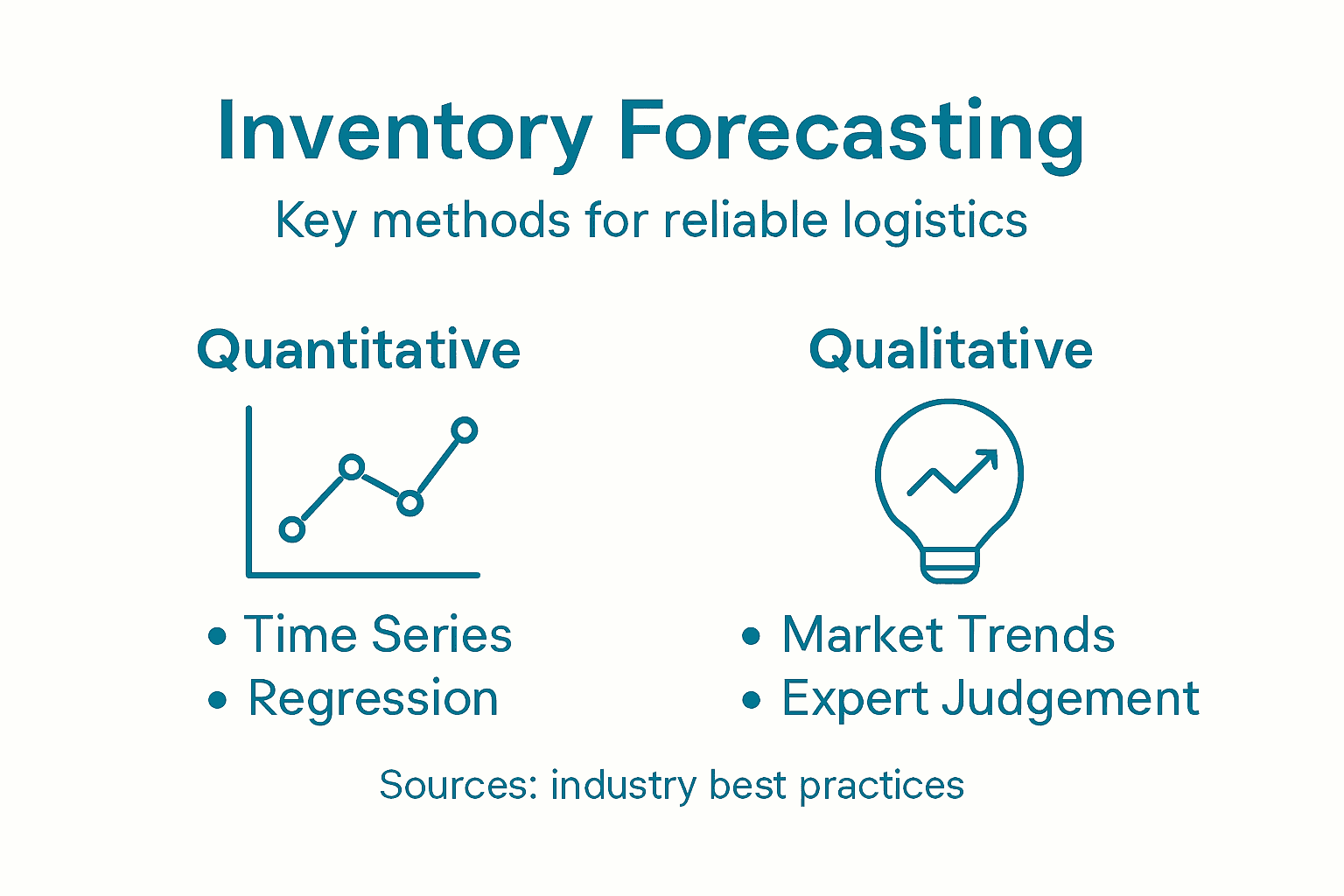
Here’s a quick comparison of popular inventory forecasting methods and their ideal business scenarios:
| Method Type | Best For | Main Advantage |
|---|---|---|
| Time Series Analysis | Stable, recurring demand patterns | Simple, interpretable |
| Machine Learning | Complex, volatile market conditions | Captures hidden patterns |
| Hybrid Approaches | Dynamic, multi-channel logistics | Maximizes forecast accuracy |
| Qualitative Insights | New products, emerging trends | Incorporates expert input |
Pro tip: Combine multiple forecasting methods and continuously validate prediction models against actual sales data to improve long-term accuracy.
Key Quantitative and Qualitative Approaches
Inventory forecasting in e-commerce logistics requires a comprehensive approach that blends both quantitative and qualitative methods. Comprehensive demand forecasting integrates advanced statistical techniques with nuanced market insights to deliver precise inventory predictions.
Quantitative forecasting methods provide critical numerical foundations for inventory planning:
-
Quantitative Statistical Models
- ARIMA (Autoregressive Integrated Moving Average)
- SARIMA (Seasonal ARIMA)
- Exponential smoothing
- Time series regression analysis
-
Machine Learning Forecasting Techniques
- Random Forest algorithms
- XGBoost predictive modeling
- Neural network predictions
- Regression-based machine learning approaches
Effective inventory forecasting requires balancing mathematical precision with contextual market understanding.
Qualitative approaches complement these data-driven techniques by incorporating external factors that numeric models might overlook. Inventory management research emphasizes the importance of integrating market trends, consumer behavior patterns, and strategic business insights into predictive models.
Successful e-commerce logistics demand a holistic approach that synthesizes quantitative data with qualitative market intelligence. By combining advanced algorithmic techniques with strategic business insights, companies can develop robust inventory forecasting systems that adapt to dynamic market conditions.
Pro tip: Develop a hybrid forecasting model that weights both quantitative data and qualitative market insights to create more resilient inventory predictions.
How AI and Predictive Analytics Improve Accuracy
Artificial Intelligence is revolutionizing inventory forecasting by introducing unprecedented levels of precision and adaptability. AI-driven demand forecasting represents a transformative approach that goes beyond traditional statistical methods, enabling businesses to predict inventory needs with remarkable accuracy.
Key technologies driving this innovation include:
-
Neural Network Capabilities
- Deep learning algorithms
- Pattern recognition systems
- Complex data integration
- Real-time predictive modeling
-
Advanced Analytical Techniques
- Automated machine learning
- Predictive robotic processing
- External factor incorporation
- Dynamic replenishment strategies
AI transforms raw data into actionable inventory intelligence, bridging the gap between historical patterns and future predictions.
Predictive analytics models dramatically enhance inventory management by incorporating multiple external factors such as seasonal trends, promotional activities, and market fluctuations. These sophisticated systems can analyze complex datasets exponentially faster than traditional human-driven approaches, identifying nuanced patterns that manual forecasting might miss.

The integration of AI into inventory systems represents a paradigm shift in logistics management. By automating complex analytical processes and providing real-time insights, these technologies enable businesses to develop more responsive, efficient, and adaptive inventory strategies that minimize stockouts and optimize resource allocation.
Pro tip: Invest in continuous training for your AI models, regularly updating them with new data to maintain and improve forecasting accuracy.
Common Pitfalls and How to Avoid Them
Inventory forecasting presents numerous challenges that can significantly undermine operational efficiency. Data governance challenges represent critical obstacles that e-commerce businesses must strategically address to maintain accurate predictive models.
Common forecasting pitfalls include:
-
Data-Related Issues
- Incomplete historical datasets
- Inconsistent data collection methods
- Lack of data preprocessing
- Ignoring external market influences
-
Methodological Limitations
- Over-reliance on past trends
- Model overfitting problems
- Insufficient validation processes
- Rigid forecasting frameworks
Successful inventory forecasting demands continuous learning and adaptive strategies.
Comprehensive data preprocessing is crucial for developing reliable predictive models. E-commerce logistics managers must implement robust data cleaning techniques, integrate qualitative insights, and create dynamic feedback loops that allow forecasting systems to adapt to changing market conditions.
Mitigating forecast risks requires a multifaceted approach that combines technological sophistication with strategic human oversight. Organizations must invest in ongoing training, maintain flexible forecasting frameworks, and develop comprehensive data governance protocols that prevent common predictive modeling errors.
Pro tip: Implement a quarterly model review process that systematically evaluates forecast accuracy and adjusts predictive algorithms based on real-world performance.
Choosing the Right Method for Your Operations
Inventory forecasting methods are not one-size-fits-all solutions for e-commerce logistics. Strategic method selection requires careful evaluation of specific operational characteristics and business objectives.
Key considerations for selecting the right forecasting approach include:
-
Operational Context Factors
- Product category
- Inventory complexity
- Market volatility
- Data availability
- Computational resources
-
Forecasting Method Characteristics
- Predictive accuracy
- Computational requirements
- Adaptability
- Implementation complexity
- Cost-effectiveness
Successful forecasting strategies balance technological sophistication with practical business requirements.
Hybrid forecasting approaches have emerged as powerful solutions that combine traditional statistical techniques with advanced machine learning models. These integrated strategies allow businesses to leverage the interpretability of classic methods while benefiting from the predictive power of AI-driven algorithms.
Effective method selection demands ongoing assessment and flexibility. E-commerce logistics managers must develop adaptive forecasting frameworks that can evolve with changing market dynamics, technological capabilities, and organizational needs. This requires a commitment to continuous learning, regular model validation, and willingness to experiment with emerging predictive technologies.
Use this table to identify key factors to consider when selecting a forecasting method:
| Factor | Why It Matters | Typical Impact on Selection |
|---|---|---|
| Data Availability | Higher data enables accuracy | Favors advanced machine learning |
| Market Volatility | Requires model adaptability | Prefers hybrid and AI approaches |
| Inventory Complexity | Increases computational demand | May need specialized algorithms |
| Implementation Cost | Limits resource investment | Influences method choice |
Pro tip: Conduct periodic performance audits of your forecasting methods, comparing predicted outcomes against actual results to drive continuous improvement.
Enhance Your Inventory Forecasting with Reliable Courier Services and Integrated Logistics Solutions
Accurate inventory forecasting can be challenging when you face data inconsistencies and fluctuating market demand. The article highlights the importance of combining quantitative methods with AI and qualitative insights to reduce stockouts and overstock risks. Imagine having a logistics partner who not only supports your advanced forecasting models but also delivers seamless end-to-end services like freight booking, real-time shipment tracking, and warehousing tailored for ecommerce. At Or-Ner, we understand that boosting reliability means empowering your supply chain with flexible fulfillment and efficient courier services that adapt as your inventory needs evolve.
Ready to transform your inventory challenges into competitive advantages? Discover how our platform’s global network and automation tools can strengthen your forecasting accuracy and logistics responsiveness today. Visit Or-Ner to explore comprehensive reliable courier services and intelligent inventory management designed for growing ecommerce businesses. Take the first step toward smarter logistics now.
Frequently Asked Questions
What are the main types of inventory forecasting methods used in eCommerce logistics?
Inventory forecasting methods in eCommerce logistics include quantitative methods like time series analysis, statistical regression models, exponential smoothing techniques, and machine learning approaches such as neural networks and AI-driven demand forecasting.
How can machine learning improve inventory forecasting accuracy?
Machine learning improves accuracy by analyzing large datasets to identify complex patterns that traditional methods may overlook, allowing for more precise predictions and better adaptation to market fluctuations.
What factors should be considered when choosing an inventory forecasting method?
Key factors to consider include product category, inventory complexity, market volatility, data availability, computational resources, and the adaptability of the forecasting method.
How can businesses avoid common pitfalls in inventory forecasting?
To avoid pitfalls, businesses should implement comprehensive data governance, address data-related issues, validate predictive models regularly, and maintain flexibility in their forecasting frameworks.
Recommended
- Just in Time Delivery: Essential Guide for 2025 Success – ORNER
- Top Benefits of Freight Forwarding for Growing Businesses 2025 – ORNER
- What Is Freight Forwarding? Guide for Modern Supply Chains 2025 – ORNER
- Demand Forecasting in Logistics: Complete Guide – ORNER
- Group Shuttle Logistics: Complete Guide for NC Events – Ashe County Livery blog