
International shipping sounds like a golden ticket to global markets and bigger profits. Yet almost 30% of disputes in global trade come from documentation mistakes, stalling shipments and souring business deals. Most people think paperwork is the easy part but in reality the real challenge is getting every document exactly right to avoid hidden risks that can cost you weeks and thousands of dollars.
Table of Contents
- Key International Shipping Documents Explained
- How to Prepare Shipping Documentation
- Common Mistakes and Solutions in Documentation
- Best Practices for Hassle-Free Global Shipping
Quick Summary
| Takeaway | Explanation |
|---|---|
| Thorough documentation is crucial for successful shipping | Accurate shipping documents prevent delays and legal issues in international trade. Each document plays a unique role in compliance and efficiency. |
| Invest in technology for document management | Utilizing digital systems streamlines the preparation process and minimizes human errors, enhancing overall shipping efficiency. |
| Engage with buyers early on documentation needs | Open communication with foreign buyers helps clarify necessary paperwork, ensuring compliance with both export and import regulations. |
| Regularly train staff on shipping regulations | Keeping logistics teams updated on changing laws reduces errors related to incorrect product classification and valuation. |
| Implement verification checks to avoid mistakes | Establishing a multi-stage review process for documentation ensures accuracy and prevents costly shipping errors and complications. |
Key International Shipping Documents Explained
International shipping documentation serves as the critical foundation for seamless global trade, enabling businesses to navigate complex cross-border transactions with precision and legal compliance. These essential documents not only facilitate the movement of goods across international borders but also protect the interests of all parties involved in the shipping process.
Commercial Documents: The Business Foundation
Commercial documents represent the financial and transactional backbone of international shipping. The commercial invoice stands as the primary document, detailing the transaction between the exporter and importer. According to International Chamber of Commerce, this document must comprehensively describe the goods, their value, and the terms of sale. It serves multiple crucial functions including customs clearance, determining duties and taxes, and providing proof of transaction.
Another critical commercial document is the proforma invoice, which acts as a preliminary bill of sale. World Trade Organization highlights that this document provides an estimated cost of goods and shipping, helping importers understand potential expenses before finalizing the transaction. It becomes particularly important when negotiating international sales contracts and securing necessary financial approvals.
Shipping and Logistics Compliance Documents
Shipping compliance documents ensure that international shipments meet regulatory requirements and can legally cross borders. The bill of lading emerges as a paramount document in this category. This legal document serves three critical functions: it acts as a receipt for shipped goods, a contract of carriage, and a document of title. Maritime Law Association emphasizes that the bill of lading determines ownership transfer and provides crucial evidence of shipping terms.
The packing list complements these documents by providing a detailed inventory of the shipment. It specifies the number, type, and packaging of items being transported, which is essential for customs officials and logistics providers. This document helps verify that the actual shipment matches the commercial invoice and supports accurate customs declaration.

Regulatory and Customs Clearance Documents
Customs and regulatory documents represent the final critical layer of international shipping documentation. The certificate of origin plays a vital role in determining product eligibility for preferential trade agreements and calculating appropriate tariffs. World Customs Organization notes that this document verifies the country where goods were manufactured, which can significantly impact import duties and trade compliance.
Additionally, exporters must prepare export declarations that provide comprehensive details about the shipment to government authorities. These documents ensure that exports comply with national regulations and international trade restrictions. Learn more about navigating these complex requirements in our comprehensive guide on international shipping protocols.
Successful international shipping hinges on meticulous documentation. Each document serves a unique purpose, working together to create a transparent, legally compliant, and efficient global trade ecosystem. Businesses must invest time in understanding and correctly preparing these documents to minimize risks, avoid costly delays, and ensure smooth cross-border transactions.
Here is a summary table outlining the main types of international shipping documents, their purposes, and where they are required. This table helps clarify the distinct roles of each document in the shipping process.
| Document Type | Main Purpose | Where Required |
|---|---|---|
| Commercial Invoice | Details goods, value, and terms; proof of transaction | Customs, buyers, banks |
| Proforma Invoice | Preliminary bill; estimated costs for buyer | Preliminary negotiations |
| Bill of Lading | Receipt, carriage contract, and title of goods | Carrier, customs, consignee |
| Packing List | Inventory of shipment, packaging details | Customs, logistics |
| Certificate of Origin | Verifies manufacturing country; trade agreements | Customs, trade authorities |
| Export Declaration | Provides shipment details to authorities | Exporting government |
How to Prepare Shipping Documentation
Preparing accurate and comprehensive shipping documentation requires systematic approach and meticulous attention to detail. Businesses engaged in international trade must develop robust processes to ensure all necessary paperwork is completed correctly, minimizing potential customs delays and legal complications.
Gathering Essential Information
The foundation of effective shipping documentation begins with collecting precise information about the shipment. According to the U.S. Department of Commerce, businesses must compile detailed data including product descriptions, quantities, weights, values, and specific shipping parameters. This process involves coordinating between multiple departments such as sales, logistics, and compliance to ensure comprehensive and accurate documentation.
Key information gathering steps include:
- Product Classification: Obtain accurate Harmonized System (HS) codes for each item
- Valuation Details: Determine exact commercial value of goods
- Packaging Specifications: Document precise weight, dimensions, and packaging materials
- Consignee Information: Collect complete recipient details including address, contact information, and tax identification numbers
Document Preparation and Verification
Once essential information is collected, businesses must meticulously prepare required shipping documents. Brown University’s research office emphasizes the importance of cross-referencing documentation to prevent errors. This stage involves creating multiple critical documents including commercial invoices, packing lists, and certificates of origin.
Critical verification steps include:
- Cross-checking Data: Compare information across different documents
- Compliance Review: Ensure documents meet both export and import country regulations
- Digital and Physical Copies: Maintain both electronic and physical documentation
Technology and Professional Support
Modern businesses increasingly leverage technology to streamline shipping documentation processes. Explore our comprehensive guide on international shipping protocols for advanced documentation strategies. Digital documentation management systems can significantly reduce human error and accelerate document preparation.
Professional strategies for efficient documentation include:
- Utilizing Specialized Software: Implement documentation management platforms
- Regular Training: Keep logistics teams updated on changing international regulations
- Consulting Experts: Work with international shipping consultants for complex shipments
Successful shipping documentation requires a proactive, detail-oriented approach. By developing systematic processes, leveraging technology, and maintaining rigorous verification standards, businesses can navigate the complex landscape of international shipping documentation with confidence and precision. The investment in thorough preparation pays dividends through smoother customs clearance, reduced shipping delays, and minimized legal risks.
Below is a process table summarizing key steps required for accurate shipping documentation preparation. This will help you visualize which actions to prioritize at each stage for compliance and efficiency.
| Step | Description |
|---|---|
| Gather Essential Information | Compile product, value, packaging, and consignee details |
| Product Classification | Assign proper Harmonized System (HS) codes to each item |
| Valuation Details | Accurately determine value of goods |
| Prepare Documents | Create commercial invoices, packing lists, certificates, and other paperwork |
| Cross-Check Data | Compare details across all documents to ensure consistency |
| Compliance Review | Verify adherence to both export and import regulations |
| Maintain Copies | Store digital and physical copies for reference and compliance checks |
Common Mistakes and Solutions in Documentation
International shipping documentation demands precision and careful attention to detail. Even minor errors can result in significant financial losses, customs delays, and complicated legal challenges for businesses engaged in global trade.
Incorrect Product Classification and Valuation
Product classification and valuation represent critical areas where businesses frequently encounter documentation mistakes. World Customs Organization reports that approximately 30% of international shipping disputes originate from incorrect product classification or valuation. These errors can trigger substantial penalties, shipment holds, and potential legal complications.
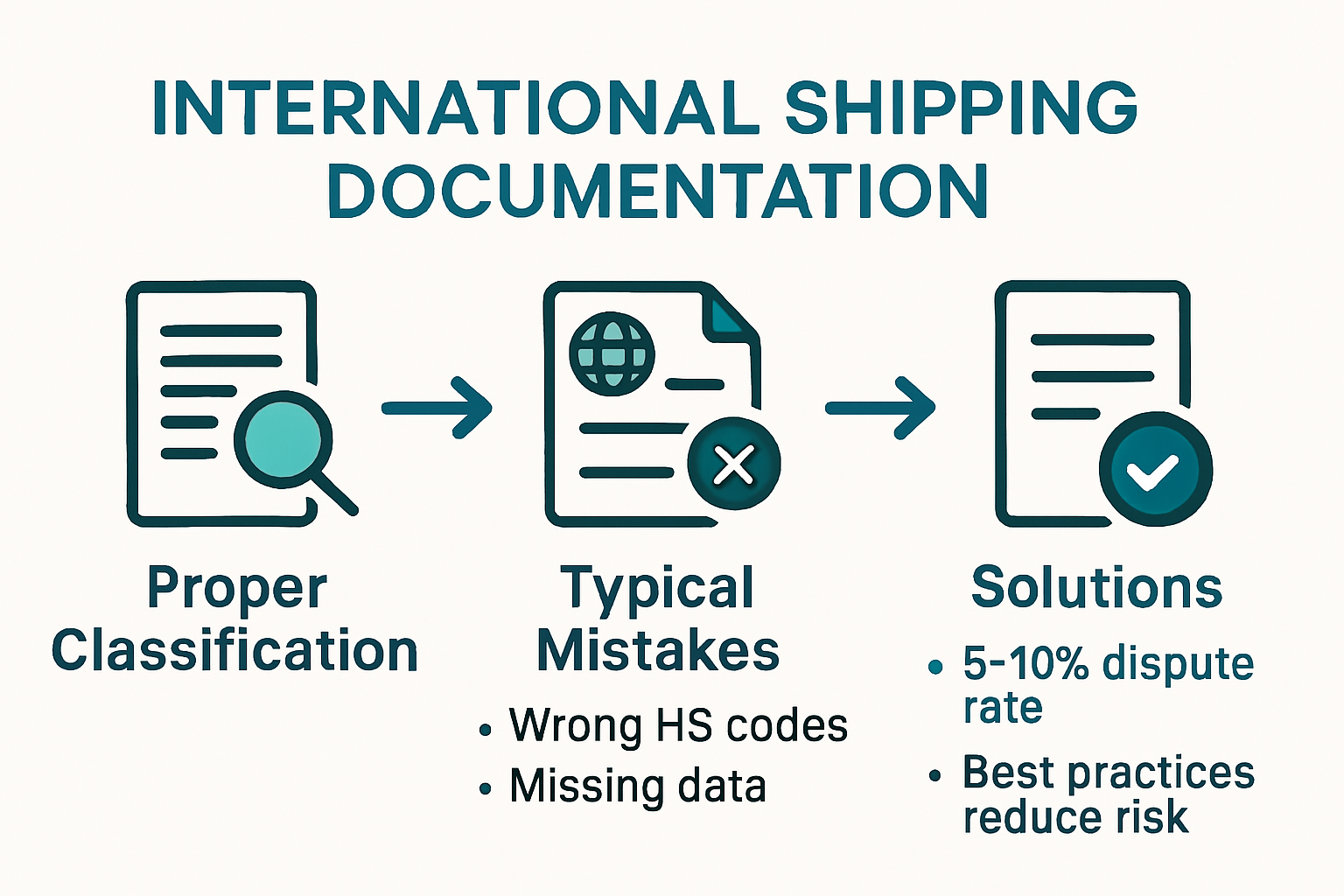
Common classification mistakes include:
- Misidentifying HS Codes: Selecting incorrect product codes
- Undervaluing or Overvaluing Goods: Inaccurate price reporting
- Incomplete Product Descriptions: Insufficient technical details
Solutions involve comprehensive product documentation, regular staff training, and leveraging specialized classification software that updates regulatory requirements in real time.
Documentation Incompleteness and Inconsistency
Incomplete or inconsistent documentation creates significant logistical challenges. International Chamber of Commerce emphasizes that documentation errors can delay shipments by weeks and incur substantial additional costs. Businesses must ensure that every document contains accurate, matching information across all shipping paperwork.
Key strategies to prevent documentation inconsistencies include:
- Standardized Documentation Processes: Create clear internal guidelines
- Digital Documentation Management: Use integrated tracking systems
- Regular Internal Audits: Implement periodic documentation reviews
Regulatory Compliance and Risk Management
Navigating complex international shipping regulations requires sophisticated documentation strategies. Explore our comprehensive guide on international shipping protocols for advanced compliance techniques. Businesses must stay updated on evolving global trade regulations, which can change rapidly based on geopolitical developments.
Effective risk management approaches include:
- Continuous Compliance Training: Keep logistics teams informed
- Engaging Compliance Experts: Consult international trade specialists
- Implementing Robust Verification Protocols: Develop multi-stage document checking systems
Successful international shipping documentation requires a proactive, strategic approach. By understanding common mistakes, implementing robust verification processes, and maintaining a commitment to accuracy, businesses can minimize risks and optimize their global trade operations. The investment in meticulous documentation preparation translates directly into smoother shipping experiences, reduced financial exposure, and enhanced operational efficiency.
Best Practices for Hassle-Free Global Shipping
Successful international shipping requires a strategic approach that goes beyond basic documentation. Businesses must develop comprehensive strategies to navigate the complex landscape of global logistics, minimizing risks and optimizing operational efficiency.
Proactive Compliance and Communication
Effective global shipping begins with proactive compliance and clear communication. According to the U.S. Department of Commerce, consultation with foreign buyers is crucial to determine precise documentation requirements. This approach helps businesses anticipate potential challenges and prepare comprehensive shipping documentation that meets both export and import country regulations.
Key communication strategies include:
- Early Buyer Engagement: Discuss specific documentation requirements before shipment
- Transparent Information Sharing: Provide detailed product and shipping information
- Regulatory Compliance Verification: Confirm documentation meets all international standards
Technology and Documentation Management
Modern businesses can significantly streamline global shipping through advanced technological solutions. Learn more about optimizing international logistics to enhance your shipping processes. Digital platforms offer sophisticated tools for documentation management, real-time tracking, and compliance monitoring.
Technology-driven approaches include:
- Integrated Documentation Systems: Implement comprehensive digital tracking platforms
- Automated Compliance Checks: Use software that updates regulatory requirements
- Cloud-Based Document Storage: Maintain secure, accessible documentation archives
Risk Mitigation and Continuous Improvement
Brookhaven National Laboratory emphasizes the critical importance of documentation accuracy to avoid potential legal complications. Businesses must develop robust risk mitigation strategies that go beyond initial documentation preparation.
Risk management best practices include:
- Regular Compliance Training: Keep logistics teams updated on international regulations
- Periodic Documentation Audits: Implement systematic review processes
- Expert Consultation: Engage international trade specialists for complex shipments
Successful global shipping is an ongoing process of learning, adaptation, and precision. By implementing comprehensive strategies that combine proactive communication, advanced technology, and continuous improvement, businesses can transform international shipping from a potential challenge into a competitive advantage. The key lies in viewing documentation not as a bureaucratic requirement, but as a strategic tool for global business success.
The most successful organizations approach international shipping as a holistic process. They invest in technology, prioritize clear communication, and maintain a commitment to ongoing learning and improvement. This approach minimizes risks, reduces potential delays, and creates a smooth pathway for global trade operations.
Frequently Asked Questions
What are the essential documents required for international shipping?
The key documents for international shipping include the commercial invoice, bill of lading, packing list, certificate of origin, and export declaration. Each serves a distinct purpose in facilitating the shipment and ensuring compliance with regulations.
How can I prepare accurate shipping documentation for international trade?
To prepare accurate shipping documentation, gather essential information about the products (like descriptions, quantities, and values), ensure correct product classification and valuation, and cross-check information across all documents to prevent errors.
What common mistakes should I avoid in international shipping documentation?
Common mistakes include incorrect product classification, incomplete documentation, and inconsistencies across various shipping documents. To avoid these, ensure thorough staff training and establish standardized documentation processes.
How can technology help in managing international shipping documentation?
Technology can streamline international shipping documentation by using digital management systems that reduce errors, automate compliance checks, and enable real-time tracking of documents, which enhances efficiency and accuracy.
Streamline Your Shipping Documents with Reliable Courier Services
Paperwork mistakes and compliance challenges can stall any global shipment, putting your business at risk of expensive delays and broken trust with partners. If you are feeling overwhelmed by the complexity of international shipping documentation and tired of juggling manual processes that can lead to critical errors, there is a better way. Or-ner.com empowers you with reliable courier services and a single platform that covers every step of your shipping journey, from real-time shipment tracking to seamless customs clearance and automated document management. Our solution means no more missed details or hidden risks. You gain full control and peace of mind whether you are moving home goods, fashion, or specialized products worldwide.
Ready to minimize documentation errors and ship with confidence? Take the next step to protect your business and unlock fast, scalable global logistics. Discover how or-ner.com solves the toughest shipping challenges and brings compliance, automation, and real-time visibility directly to your workflow. Your international shipments deserve the support of a true partner. Start optimizing your shipping process now and experience what hassle-free global trade really feels like.