
Global trade moves fast and every company wants their shipments to arrive on time, without surprise fees or customs headaches. Yet, delays still happen and paperwork mistakes can cost thousands. Here is the surprise: over 50% of international shipments are held up because of incomplete or inaccurate documentation. What most companies miss is that mastering logistics is less about moving boxes and more about unlocking the right systems, technology, and forward planning. That’s where the real gains start.
Table of Contents
- Understanding Import Export Logistics Fundamentals
- Key Steps In The Import Export Logistics Process
- Common Challenges And Solutions In Global Logistics
- Best Practices For Efficient Supply Chain Management
Quick Summary
| Takeaway | Explanation |
|---|---|
| Understand core logistics components. | Master the essential elements like documentation and regulatory compliance for better international trade outcomes. |
| Prioritize strategic logistics planning. | Effective planning includes selecting transport modes and managing risks to optimize cost and efficiency. |
| Navigate customs clearance properly. | Accurate documentation and professional expertise are needed to ensure smooth customs processes and avoid delays. |
| Leverage technology for logistics efficiency. | Utilize advanced digital platforms for real-time tracking and data integration, enhancing communication and decision-making. |
| Adopt sustainability in supply chains. | Implement eco-friendly practices to improve operational efficiency and brand reputation while reducing environmental impact. |
Understanding Import Export Logistics Fundamentals
Import export logistics represents the complex network of processes that enable global trade to function smoothly. These operations involve intricate coordination of transportation, documentation, regulatory compliance, and strategic planning to move goods across international borders.
Core Components of Import Export Logistics
At its foundation, import export logistics encompasses multiple critical elements that businesses must navigate to successfully conduct international trade. The process begins with understanding the fundamental requirements and systems that govern cross-border commerce.
Documentation plays a crucial role in international shipping. Learn more about freight forwarding processes that help businesses manage these complex paperwork requirements. Companies must prepare precise documents including commercial invoices, bills of lading, certificates of origin, and export licenses. According to the World Trade Organization, accurate documentation reduces potential delays and prevents costly customs complications.
Regulatory compliance represents another essential aspect of import export logistics. Different countries maintain unique trade regulations, export control restrictions, and customs protocols. The United States Department of Commerce’s Bureau of Industry and Security (BIS) requires specific export licenses for goods classified as sensitive technologies or dual-use items. Businesses must thoroughly research and understand these requirements to ensure seamless international transactions.
Strategic Logistics Planning
Successful import export logistics demands comprehensive strategic planning. This involves selecting appropriate transportation modes, understanding international shipping routes, managing potential risks, and optimizing cost-efficiency. Companies must consider factors like shipping costs, transit times, cargo safety, and potential geopolitical disruptions.
Technology has transformed import export logistics, enabling real-time tracking, automated documentation, and enhanced communication between global stakeholders. Advanced logistics platforms now provide integrated solutions that streamline complex international shipping processes. These digital tools help businesses reduce manual errors, improve transparency, and accelerate global trade operations.
Risk management forms another critical component of import export logistics. Businesses must develop robust strategies to mitigate potential challenges such as currency fluctuations, customs delays, transportation disruptions, and regulatory changes. Comprehensive insurance coverage and thorough contingency planning become essential for maintaining smooth international trade operations.
Understanding these fundamentals allows businesses to develop effective strategies for navigating the complex world of global commerce. By mastering import export logistics, companies can expand their market reach, optimize supply chains, and create sustainable international business relationships.
Key Steps in the Import Export Logistics Process
The import export logistics process involves a systematic sequence of critical steps that transform international trade from a complex challenge into a streamlined operation. Each stage requires meticulous planning, precise execution, and strategic decision making to ensure goods move efficiently across global borders.
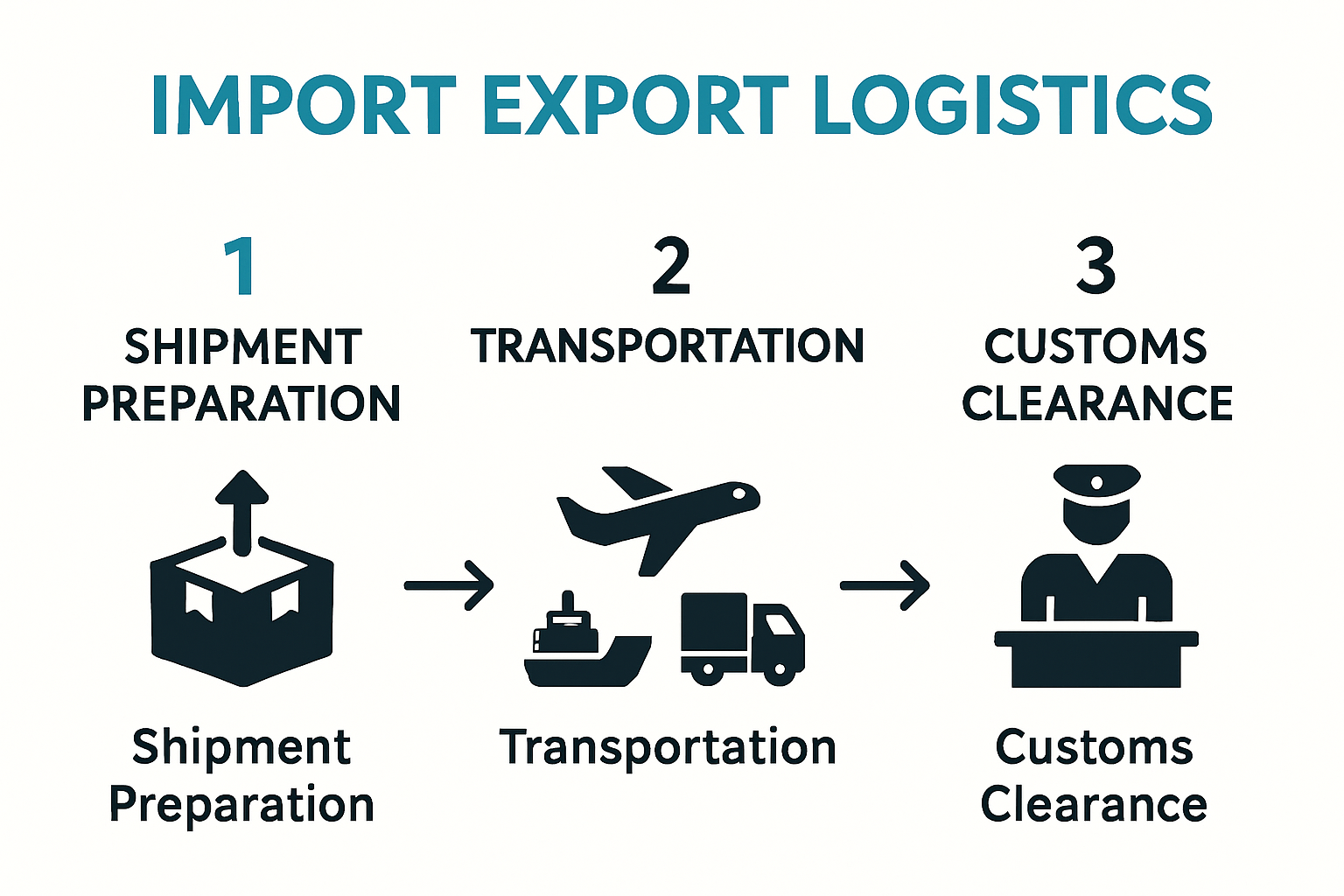
To help visualize the main stages of the import export logistics process, the following table outlines each step and its primary activities.
| Step | Main Activities |
|---|---|
| Shipment Preparation & Documentation | Prepare accurate commercial invoices, packing lists, certificates of origin, export licenses; classify goods using HS codes |
| Transportation & Shipping Logistics | Select transport mode (ocean, air, land), evaluate cost and speed, optimize routes, use real-time tracking |
| Customs Clearance & Final Delivery | Submit documentation, pay duties/taxes, comply with regulations, leverage brokers, manage inspections, arrange final delivery |
Shipment Preparation and Documentation
Initial logistics stages demand comprehensive preparation and accurate documentation. Explore detailed ocean freight documentation strategies that can help businesses navigate this complex landscape. According to U.S. Customs and Border Protection, companies must compile essential documents including commercial invoices, packing lists, certificates of origin, and export licenses. These documents serve as the legal and financial foundation for international shipments.
Accurate classification of goods becomes paramount during this phase. Businesses must determine precise Harmonized System (HS) codes that define product categories for customs purposes. These codes directly impact duty calculations, potential tariffs, and regulatory compliance. Incorrect classification can result in significant delays, financial penalties, or shipment rejection.
Transportation and Shipping Logistics
Selecting appropriate transportation modes represents a critical decision in the import export process. Companies must evaluate multiple factors including cost, transit time, cargo volume, and destination infrastructure. Ocean freight, air freight, and land transportation each offer unique advantages and challenges.
Ocean freight remains the most cost-effective method for large volume shipments, while air freight provides speed for time-sensitive cargo. Intermodal transportation solutions increasingly offer flexibility by combining multiple transport methods. Advanced logistics platforms now provide real-time tracking and optimization tools that help businesses make informed shipping decisions.
For quick reference, the following table compares key features of different shipping modes discussed in this section.
| Mode of Transport | Cost Efficiency | Speed of Delivery | Suitable Shipments | Key Advantages |
|---|---|---|---|---|
| Ocean Freight | High (Cost-Effective) | Slow | Large volumes, non-urgent | Low cost for bulk, global reach |
| Air Freight | Low (Expensive) | Fast | Urgent, high-value, perishable | Speed, reliability, minimal handling |
| Land Transport | Moderate | Moderate | Regional, door-to-door | Flexible for local/regional shipments |
| Intermodal | Flexible | Variable | Versatile, mixed cargo types | Combines strengths of multiple modes |
Customs Clearance and Final Delivery
Customs clearance represents the most complex stage of import export logistics. Businesses must navigate intricate regulatory environments, pay applicable duties and taxes, and ensure complete compliance with international trade regulations. Customs authorities conduct detailed inspections to verify shipment contents, validate documentation, and assess potential risks.
Professional freight forwarders and customs brokers play a crucial role in streamlining this process. They possess specialized knowledge of regulatory requirements, can anticipate potential challenges, and help businesses avoid costly mistakes. Advanced digital platforms now offer automated customs documentation and pre-clearance services that significantly reduce processing times.
Successful import export logistics requires a holistic approach that integrates careful planning, technological innovation, and deep understanding of global trade dynamics. By mastering each step of this complex process, businesses can unlock unprecedented opportunities for international growth and expansion.
Common Challenges and Solutions in Global Logistics
Global logistics presents a complex landscape of challenges that demand innovative solutions and strategic thinking. Businesses engaged in international trade must continuously adapt to dynamic economic, regulatory, and technological environments to maintain competitive advantage.
Financial and Regulatory Complexities
Financial risks represent a significant challenge in global logistics. Learn about comprehensive logistics risk management strategies that can help mitigate potential financial uncertainties. According to industry research, import and export executives face substantial challenges including currency exchange rate volatility and unpredictable trade sanctions.
Currency fluctuations can dramatically impact profit margins. A seemingly minor change in exchange rates can transform a profitable shipment into a financial loss. Companies must develop sophisticated hedging strategies and utilize financial instruments that protect against sudden monetary shifts. Advanced treasury management systems now offer real-time currency tracking and automated risk mitigation tools.
Regulatory and Compliance Hurdles
Navigating the intricate web of international trade regulations demands exceptional expertise. Non-tariff barriers create significant operational challenges for businesses. According to research, administrative and bureaucratic delays at borders increase inventory maintenance costs and introduce substantial uncertainty into supply chains.
Customs compliance represents another critical challenge. Regulations vary dramatically across different jurisdictions, requiring businesses to maintain comprehensive understanding of local and international trade laws. Misclassification of goods, incomplete documentation, or failure to meet specific regulatory requirements can result in substantial financial penalties, shipment delays, or potential legal complications.
Technological and Operational Challenges
Technological integration emerges as a pivotal challenge in modern global logistics. Businesses must invest in robust digital infrastructure that enables seamless communication, real-time tracking, and efficient data management across complex international networks. Legacy systems and fragmented technological platforms can create significant operational bottlenecks.
Supply chain disruptions have become increasingly prevalent, highlighted by recent global events. Geopolitical tensions, natural disasters, and unexpected economic shifts can dramatically impact logistics operations. Companies must develop agile, flexible strategies that allow rapid adaptation to changing circumstances. This includes maintaining diverse transportation routes, developing robust contingency plans, and leveraging advanced predictive analytics.
Successful navigation of global logistics challenges requires a holistic approach. Businesses must combine technological innovation, financial strategy, regulatory expertise, and operational flexibility. By developing comprehensive risk management frameworks and maintaining adaptable logistics ecosystems, companies can transform potential challenges into opportunities for growth and competitive differentiation.
Best Practices for Efficient Supply Chain Management
Efficient supply chain management represents a critical competitive advantage in today’s global business landscape. Organizations must develop sophisticated strategies that integrate technology, data analytics, and strategic planning to optimize their logistics operations.
Technology and Digital Integration
Discover key logistics benefits for modern businesses that highlight the transformative power of technological solutions. Digital transformation has become fundamental in supply chain management, enabling real-time tracking, predictive analytics, and automated decision-making processes.
Advanced Enterprise Resource Planning (ERP) systems and cloud-based logistics platforms now provide unprecedented visibility across entire supply chain networks. These technologies allow businesses to monitor inventory levels, predict potential disruptions, and optimize routing in real-time. Machine learning algorithms can analyze historical data to forecast demand, identify potential bottlenecks, and recommend proactive interventions.
Strategic Inventory and Procurement Management
Successful supply chain management demands a sophisticated approach to inventory control. Just-in-time (JIT) inventory strategies have evolved to become more flexible and responsive to market dynamics. Companies must balance maintaining adequate stock levels with minimizing carrying costs and reducing potential waste.
Procurement strategies now emphasize diversification and risk mitigation. Businesses are developing multiple supplier networks to reduce dependency on single sources. This approach helps organizations maintain operational continuity during potential disruptions, whether caused by geopolitical events, natural disasters, or unexpected market shifts.
Sustainability and Operational Efficiency
Sustainability has transitioned from a peripheral consideration to a core strategic imperative in supply chain management. Modern organizations recognize that environmental responsibility directly correlates with operational efficiency and brand reputation. Explore sustainable logistics solutions that can help businesses reduce their carbon footprint while maintaining competitive performance.
Implementing green logistics practices involves multiple strategic approaches. This includes optimizing transportation routes to reduce fuel consumption, investing in energy-efficient warehousing, utilizing recyclable packaging materials, and developing circular supply chain models that minimize waste. Advanced carbon tracking technologies now enable businesses to measure and report their environmental impact with unprecedented accuracy.
Collaborative strategies have emerged as a critical best practice in modern supply chain management. Organizations are breaking down traditional silos, creating integrated ecosystems that facilitate seamless information exchange between manufacturers, suppliers, logistics providers, and customers. This approach requires robust communication platforms, shared digital infrastructure, and a commitment to transparency.
Companies that successfully implement these best practices can transform their supply chains from traditional cost centers into strategic competitive advantages. By embracing technological innovation, maintaining operational flexibility, and prioritizing sustainability, businesses can create resilient, efficient logistics networks capable of navigating increasingly complex global markets.

Frequently Asked Questions
What are the core components of import export logistics?
The core components of import export logistics include accurate documentation, regulatory compliance, strategic planning, transportation selection, and risk management. Mastering these aspects is essential for smooth international trade operations.
How can businesses navigate customs clearance effectively?
Businesses can navigate customs clearance effectively by preparing accurate documentation, working with professional freight forwarders or customs brokers, and ensuring compliance with international trade regulations to avoid delays and costly penalties.
What technology solutions are beneficial for import export logistics?
Beneficial technology solutions for import export logistics include advanced digital platforms for real-time tracking, automated documentation processes, and integrated supply chain management systems that enhance communication and decision-making across global networks.
What are some common challenges in global logistics?
Common challenges in global logistics include financial and regulatory complexities, technological integration, and ensuring compliance with varying trade laws. Companies must develop flexible strategies to address these issues and maintain efficient operations.
Ready to Transform Your Import Export Logistics Experience?
Are you frustrated by delayed shipments, missing paperwork, or high customs fees that drain your profits? This article made it clear that many global businesses struggle with complex documentation, lack of real-time tracking, and customs compliance—issues that cost money and time. No matter if you sell home goods, apparel, toys, or musical instruments, these challenges hold your business back from real growth.
Take control with a solution built for all your logistics demands. At or-ner.com, you get more than just reliable courier services. You gain access to end-to-end support, from freight booking and real-time tracking to streamlined customs clearance and cross-border delivery. Powerful automation tools, dedicated support, and transparent workflows help you avoid common mistakes and speed up every shipment. Join a platform trusted by global brands and ecommerce sellers who want fast, scalable logistics—without the headaches.
Let today be the day you upgrade. Visit or-ner.com now to power your import export business for 2025 and beyond.