
TL;DR:
- Regularly evaluate courier performance using data on on-time delivery claims and return rates.
- Match courier services to specific product needs and shipping routes for optimal results.
- Continuous monitoring and testing help ecommerce businesses build resilient, cost-effective logistics partnerships.
Every ecommerce seller has lived through it: a customer emails asking where their order is, and the tracking page just says “in transit” for five days straight. Late deliveries cost U.S. retailers an estimated $197 billion annually in lost sales and customer churn. That number stings even more when the root cause is simply choosing the wrong courier. Picking reliable courier services is not a one-time decision you make at launch and forget. This guide walks you through a structured, field-tested process to define your needs, evaluate performance data, run pilots, and avoid the mistakes that quietly drain your margins.
Table of Contents
- Define your shipping needs and constraints
- Evaluate courier performance metrics and reputation
- Test and monitor couriers before committing
- Avoid common courier selection mistakes
- Our perspective: What most ecommerce businesses get wrong about courier selection
- Find the right courier solution for your ecommerce business
- Frequently asked questions
Key Takeaways
| Point | Details |
|---|---|
| Map your requirements | Define exactly what you need—product types, order volumes, and service levels—before reviewing couriers. |
| Benchmark performance | Compare couriers using OTD, claims rates, and real customer feedback for a full picture. |
| Test and monitor | Run real shipment trials and use clear KPIs to track which courier truly fits your business. |
| Continuous review | Regularly revisit and retest couriers as your needs evolve, not just at contract renewal time. |
Define your shipping needs and constraints
Before you compare a single courier, you need a clear picture of what you are actually shipping. Skipping this step is how businesses end up paying express rates for products that could travel economy, or using a general carrier for items that need temperature control.
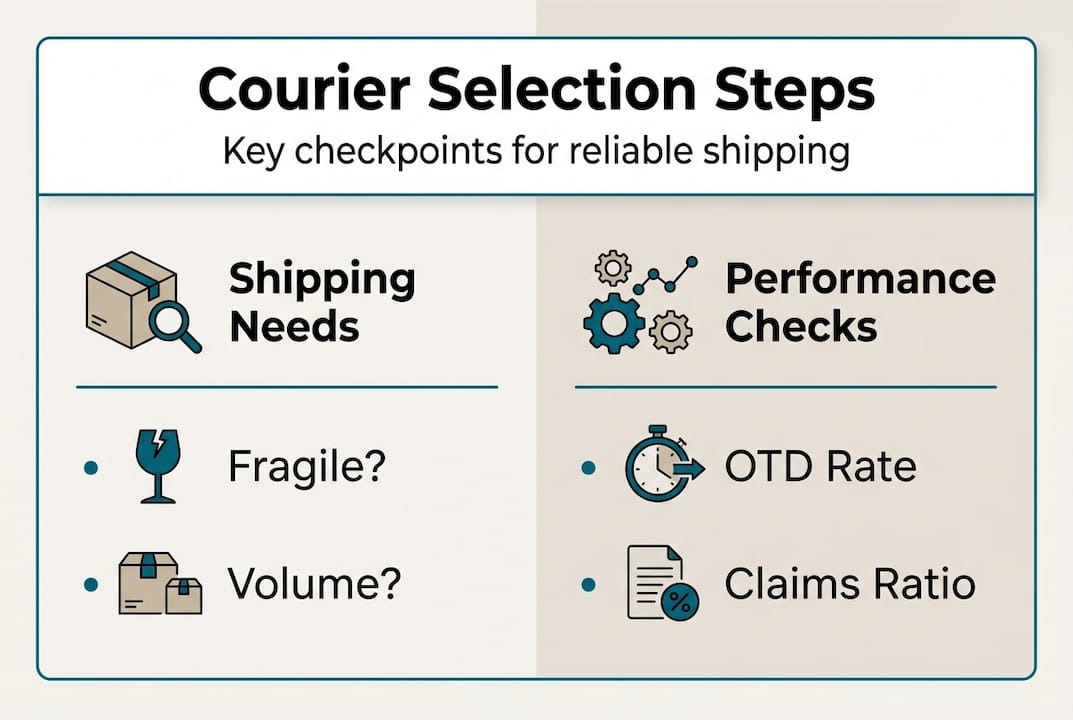
Start by mapping these core variables:
- Product type: Is it fragile, perishable, oversized, or a standard parcel?
- Order destinations: Domestic only, regional, or cross-border?
- Average order volume: How many shipments per day, week, or month?
- Peak demand windows: Do you spike during holidays or sales events?
- Delivery speed expectations: Same-day, next-day, or standard 3-5 business days?
- Return volume: What percentage of orders come back?
Fragile and perishable goods require specialized handling that most standard couriers do not provide by default. Learning shipping fragile items best practices before you shortlist carriers can save you a lot of claims headaches later. Similarly, oversized items often trigger dimensional weight pricing that catches sellers off guard on their first invoice.
International shipping adds another layer entirely. Customs documentation, duties, and country-specific restrictions vary widely. A courier that excels at domestic delivery may fumble on cross-border routes. Understanding the full range of types of courier services helps you match the right carrier to each lane.
Peak surges deserve special attention. Scalable courier networks that use AI-driven allocation outperform manual systems when order volume spikes suddenly. A carrier that handles your average volume smoothly may collapse under a Black Friday surge.
| Shipping need | What to look for in a courier |
|---|---|
| Fragile goods | Specialized packaging, low claims ratio |
| Perishables | Temperature-controlled transit options |
| Oversized items | Freight or LTL capability |
| International orders | Customs clearance support, global network |
| High volume peaks | Scalable capacity, AI allocation tools |
| Fast delivery | Guaranteed next-day or same-day options |
Pro Tip: Before you shortlist any courier, write down your non-negotiable must-haves. If a carrier cannot check those boxes, remove them from consideration immediately, regardless of price.
Evaluate courier performance metrics and reputation
Once your needs are mapped, start reviewing how various couriers actually measure up. Reputation and brand recognition are not the same as performance. You need numbers.
Three metrics matter most:
- On-Time Delivery (OTD): The percentage of shipments delivered by the promised date. This is your primary quality signal.
- Claims ratio: The percentage of shipments that result in a damage or loss claim. Lower is better.
- Return-to-Origin (RTO) rate: How often packages fail to reach the customer and come back. High RTO means wasted cost and unhappy buyers.
Here is how major carriers compare on OTD performance:
| Courier | Reported OTD rate |
|---|---|
| DHL | 98.8% |
| UPS | 96.5% |
| FedEx | 91.8% |
| USPS | 90.4% |
| Industry average | 88 to 91% |
The industry OTD average sits between 88 and 91%, while the top quartile of ecommerce stores achieves 97% or higher. If a courier you are evaluating cannot demonstrate rates above 93%, that is a red flag worth taking seriously.
Beyond the numbers, check third-party reviews on platforms like Trustpilot or G2. Pay attention to patterns in negative reviews, not individual complaints. If dozens of sellers mention the same issue, such as poor communication on delays or damaged goods, that pattern is reliable signal.

When choosing a courier partner for your ecommerce operation, build a simple scorecard. Rate each candidate on OTD, claims ratio, RTO, technology integration, and customer support responsiveness. Assign weights based on your priorities.
Pro Tip: Ask couriers directly for their OTD data segmented by route or region. A carrier with 96% national OTD might only hit 88% in the specific zones you ship to most. Regional performance data is far more useful than a national average.
Understanding how to approach choosing shipping carriers with a data-first mindset separates businesses that grow their fulfillment efficiency from those that keep repeating the same costly mistakes.
Test and monitor couriers before committing
Now, move from research to real validation of your finalists. A courier that looks great on paper may underperform in practice, and the only way to find out is to test with real shipments.
Here is a step-by-step pilot process:
- Shortlist two to three candidates based on your scorecard from the evaluation phase.
- Run 50 to 100 trial shipments per carrier across your most common routes and product types.
- Track KPIs actively during the trial: OTD rate, claims filed, RTO incidents, and customer complaints.
- Evaluate customer feedback separately. Survey buyers about their delivery experience during the pilot period.
- Compare total cost including base rates, surcharges, and any claims costs incurred.
- Review integration performance. Did the courier’s tracking data sync cleanly with your systems?
Monitoring KPIs like OTD and claims ratio during real trials gives you data no sales pitch can replicate. A transportation management system (TMS) makes this process far easier by automating carrier allocation and pulling performance data into a single dashboard.
Using shipment tracking software during your pilot also helps you catch exceptions early, before a small delay turns into a customer escalation.
Test before you commit. Ongoing monitoring outperforms static choices every time.
Pro Tip: Do not end your evaluation after the pilot. Set a quarterly review cadence where you revisit KPIs for every active courier. Markets shift, carrier capacity changes, and a courier that was excellent six months ago may have quietly declined.
Following efficient courier service tips during your pilot phase helps you structure the test properly and avoid drawing conclusions from too small a sample.
Avoid common courier selection mistakes
Pilot testing delivers insights, but don’t overlook frequent missteps companies make. Even experienced logistics teams fall into traps that cost them money and customer satisfaction.
Here are the most common mistakes to watch out for:
- Choosing on price alone. The cheapest courier rarely delivers the best value. A low base rate combined with a high claims ratio or poor OTD will cost more in the long run through refunds, reshipping, and lost customers.
- Ignoring peak surge capacity. A courier that handles your average volume well may not scale during Q4 or major sales events. Always ask about capacity guarantees during peak periods.
- Not reviewing claims data. Many sellers never look at their claims ratio until it becomes a crisis. Track it from day one.
- Skipping software compatibility checks. A courier that cannot integrate with your order management system or TMS creates manual work and errors. Compatibility is not optional.
- Relying on untested couriers for critical shipments. Never route your highest-value or most time-sensitive orders through a carrier you have not piloted.
- Ignoring contract fine print. Service exclusions, fuel surcharges, and dimensional weight rules can quietly inflate your actual cost per shipment.
Data-driven scorecards and ongoing monitoring are what separate businesses that scale their logistics from those that keep firefighting the same problems. Static decisions made once at launch rarely survive contact with real growth.
Understanding the courier vs. freight distinction also matters here. Using a courier service for shipments that should move as freight, or vice versa, is a structural mismatch that no amount of optimization will fix.
Pro Tip: Before signing any courier contract, request a full rate card including all surcharges. Compare the all-in cost per shipment, not just the headline rate. Hidden fees on residential delivery, address corrections, and fuel adjustments can add 20 to 30% to your actual bill.
Our perspective: What most ecommerce businesses get wrong about courier selection
Here is something most logistics articles will not say plainly: the biggest courier selection mistake is treating it as a one-time decision.
Businesses spend weeks evaluating carriers at launch, pick a name they recognize, and then never revisit the choice. Meanwhile, their OTD rates drift, claims pile up, and customer reviews quietly worsen. The problem is not the courier. The problem is the “set and forget” mindset.
The businesses that consistently outperform on fulfillment do not have secret access to better carriers. They simply review courier performance on a regular schedule, keep scorecards updated, and are willing to switch providers when the data says to. They also resist the temptation to pick a single carrier for everything. Matching the right courier to each shipping lane, product type, or delivery speed tier is how you build a resilient logistics operation.
Industry reputation is a starting point, not a guarantee. A carrier ranked highly nationally may underperform on your specific routes. Real results come from choosing a courier for ecommerce based on your own tracked data, not someone else’s case study.
Find the right courier solution for your ecommerce business
Putting this framework into practice takes time, but you do not have to build it alone.
At ORNER, we help ecommerce sellers identify, test, and optimize reliable courier services that fit their specific product mix, destinations, and growth targets. Whether you are shipping domestically or managing cross-border fulfillment, our platform gives you the tracking, analytics, and carrier management tools to make data-driven decisions with confidence. We also offer dedicated support for businesses scaling their operations, including resources designed specifically as courier services for small businesses. If you are ready to stop guessing and start optimizing your courier partnerships, we are here to help you take that next step.
Frequently asked questions
What are the most important courier KPIs to track?
Focus on On-Time Delivery (OTD), claims ratio, and return-to-origin (RTO) rates for a clear view of courier performance. Tracking these KPIs with real shipment data gives you the most reliable picture of how a carrier performs on your routes.
How can I check if a courier handles fragile or perishable items well?
Look for specialized services and ask about claims rates for fragile or perishable shipments before you commit. Specialized handling requirements for these product types are distinct from standard parcel delivery and should be verified directly with the carrier.
What’s a good On-Time Delivery benchmark for ecommerce?
OTD rates above 95% are top-tier; the industry average OTD is around 91%. Aim to work with carriers that consistently hit or exceed 95% on your specific shipping lanes.
How do I minimize courier switching risks?
Always run several trial shipments and use ongoing scorecards to compare performance before full rollout. Data-driven scorecards reduce the guesswork and give you a defensible basis for any carrier change you make.
Recommended
- How to Choose Shipping Carriers for Reliable Delivery – ORNER
- How to choose a courier partner for ecommerce – ORNER
- How to Choose a Courier Partner for Ecommerce Success – ORNER
- 7 Best Courier Service Tips for Efficient Ecommerce Shipping – ORNER
- Types of moving services: choose the best option for 2026