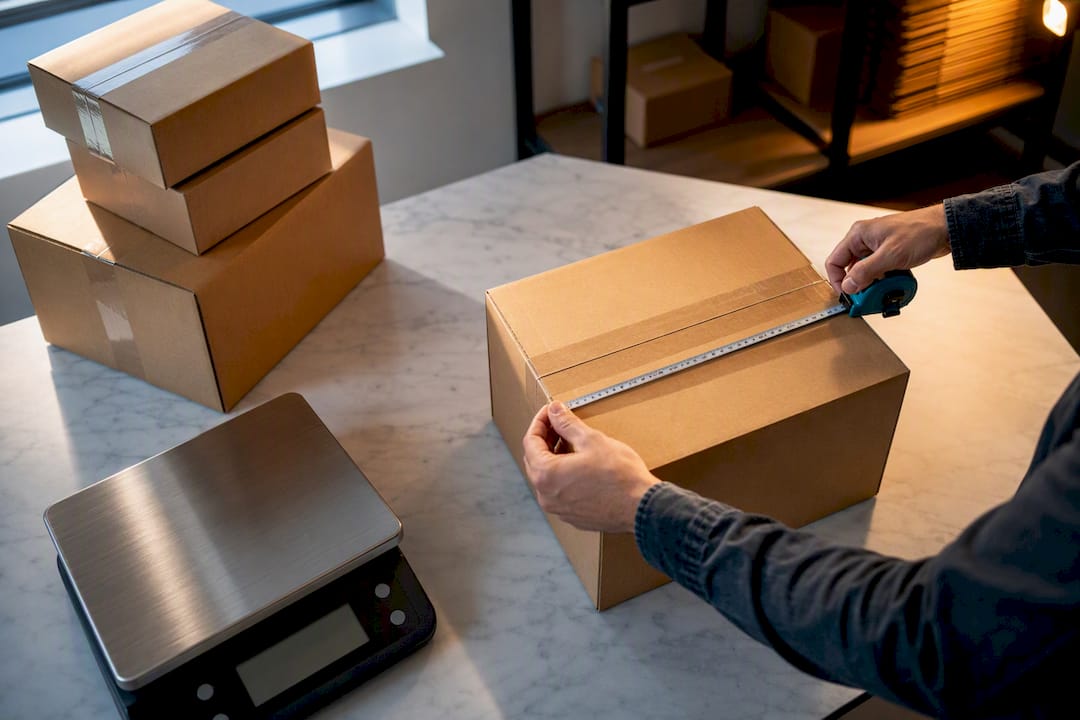
Your all-in shipping cost per order equals billable weight (actual or dimensional, whichever is greater) charged by the carrier, plus packaging materials, plus pick-and-pack labor, plus surcharges, plus an insurance and returns allowance. Start by weighing and measuring the packed box, not the empty one, then run that number through a carrier rate calculator for your service level. For light, bulky items, dimensional weight will likely set your bill, not the number on the scale.
TL;DR:
- Dimensional weight often exceeds actual weight for large, lightweight packages, increasing shipping costs significantly if not properly measured and packaged snugly.
- Carrier surcharges such as fuel, residential delivery, and peak-season fees can cause final invoices to differ widely from quotes, so including buffers in estimates is essential.
- Shipping costs for a typical domestic order usually range from $5 to $12 when all variables, including surcharges and labor, are accounted for accurately.
- Using a consistent process of measuring packed dimensions and calculating billable weight helps identify cost drivers and optimize packaging before adjusting pricing strategies.
- Small businesses should focus on right-sizing packaging, comparing carrier rates, and tracking costs monthly to reduce expenses, with outsourcing considered at higher volumes or international expansion.
Table of Contents
- How to Calculate Shipping Costs for a Small Business: The Core Inputs
- What Is the Step-by-Step Process for Calculating Shipping Cost?
- How Does Dimensional Weight Affect What You Pay?
- What Is the Full Formula for Total Shipping Cost Per Order?
- Should You Charge Flat-Rate, Calculated, or Free Shipping?
- How Can a Small Business Reduce Shipping Costs?
- Which Tools Help You Calculate and Automate Shipping Costs?
- When Does Outsourcing Shipping Make Sense?
- What Should You Prioritize First?
- Get Help Turning These Numbers Into a Working Shipping Strategy
- Sources
- FAQ
How to Calculate Shipping Costs for a Small Business: The Core Inputs
Every shipping quote comes down to four things: what the package weighs, how big it is, how far it travels, and how fast you want it there. Miss one of these and your estimate will be wrong before you even factor in fees. Squarespace’s guidance on shipping estimates confirms these four inputs (dimensions, weight, distance, and speed) as the baseline carriers use to generate a quote.
Measure the packed box, not the product. A candle that weighs 8 ounces might ship in a box that adds a pound of padding, cardboard, and tape. Carriers charge based on what crosses their scale and scanner, so guessing at “product weight” instead of “shipped weight” is the single most common reason small business shipping estimates come in low.
Dimensional weight is where a lot of sellers get caught off guard. Carriers calculate it by multiplying length times width times height and dividing by a DIM factor, then they bill whichever is greater: that calculated number or the actual scale weight. A large, lightweight box (think a lampshade or a stack of foam yoga blocks) can rack up a DIM weight far above its actual weight, and Shopify’s breakdown of dimensional weight notes this is often the biggest surprise for merchants shipping bulky-but-light goods.
Shipping zones matter almost as much as weight. Carriers divide the country into zones based on distance from the origin ZIP code, and a package traveling coast to coast costs meaningfully more than one traveling three states over, even at identical weight and size. Add service level on top: overnight or two-day shipping can run two to four times the cost of ground for the same box.
Then come the surcharges, and this is where quoted prices and actual invoices start to diverge. Watch for:
- Fuel surcharges that adjust monthly based on oil prices
- Residential delivery fees for shipments to homes instead of businesses
- Oversized or additional handling fees for boxes that exceed standard dimensions
- Address correction fees when a customer’s shipping address is incomplete or wrong
- Peak-season surcharges stacked on top of standard rates from roughly October through January
Shipware’s guide to shipping cost calculation points out that these fees are exactly why a carrier’s quoted rate rarely matches the final invoice. Build them into your estimate up front instead of discovering them after the fact.
What Is the Step-by-Step Process for Calculating Shipping Cost?
Once you understand the inputs, the calculation itself is a five-step sequence. Run through it once per SKU or shipment profile, and you will have a number you can actually trust.
- Weigh and measure the packed parcel. Use a shipping scale (not a kitchen scale) and record length, width, and height in inches, rounded up to the nearest whole number. Write this down per product or per common packaging profile.
- Calculate DIM weight and determine billable weight. Multiply length by width by height, divide by your carrier’s DIM factor, then compare that result to the actual scale weight. Whichever number is higher is what you get billed for.
- Look up a carrier rate for your chosen service and route. Plug the billable weight, origin ZIP, destination zone, and service level (ground, two-day, overnight) into a carrier’s online calculator to get a base rate.
- Add surcharges, insurance, and a returns allowance. Layer in expected fuel and residential fees, plus a coverage cost if you insure shipments, plus a small buffer for the returns and exceptions that inevitably happen.
- Add packaging and labor cost to reach your total. Tally the box, tape, and void fill, then add the labor minutes it takes someone to pick, pack, and label the order, multiplied by a loaded hourly wage.
That fifth step gets skipped more than any other. Packing an order isn’t free labor. If it takes four minutes to pick, wrap, and label a box, and your effective labor cost is $18 an hour, that’s $1.20 in labor alone, before a single carrier fee applies.
Carriers adjust fuel surcharges monthly, and unpredictable fees like address corrections hit often enough that a flat “no buffer” estimate will quietly erode your margin over a few months of orders.*
Once you run this five-step sequence for a handful of representative products, a pattern emerges: your true per-order shipping cost for domestic ecommerce commonly lands in a moderate range once you have accounted for the carrier label, packaging, labor, and surcharges together, according to True Margin’s ecommerce shipping cost research. That general range moves depending on your product size, carrier mix, and packing complexity, but it gives you a sanity check. If your calculation comes out well outside that band, something in your inputs is probably off, whether that’s an underestimated box size or a missed surcharge.
How Does Dimensional Weight Affect What You Pay?
The DIM weight formula is straightforward: multiply length times width times height in inches, then divide by the carrier’s DIM factor. The result, rounded up to the next whole pound, is compared against the actual scale weight, and the carrier bills whichever number is bigger.
DIM factors vary by carrier and service tier. FedEx and UPS commonly use a DIM factor of 139 for many business and commercial rates, while USPS retail domestic services often use 166, a detail confirmed in Shopify’s dimensional weight guide. A lower DIM factor produces a higher DIM weight for the same box, so the carrier you choose can change your bill even when the package itself never changes.
Here’s how that plays out with a real box. Say you ship a 16 by 12 by 10 inch carton weighing 4 pounds on the scale.
| Calculation | FedEx/UPS (DIM factor 139) | USPS (DIM factor 166) |
|---|---|---|
| Volume (L × W × H) | 1,920 | 1,920 |
| DIM weight | 1,920 ÷ 139 = 13.8 lbs, rounds to 14 lbs | 1,920 ÷ 166 = 11.6 lbs, rounds to 12 lbs |
| Actual scale weight | 4 lbs | 4 lbs |
| Billable weight (greater of the two) | 14 lbs | 12 lbs |
That’s the gap that catches sellers off guard: a 4-pound item billed as if it weighs 12 to 14 pounds, purely because of box size. The fix isn’t complicated. Right-size your packaging so there’s minimal empty space, switch to a low-volume void fill like paper instead of oversized air pillows, and test whether a slightly smaller, snugger box still protects the product. Every inch you shave off length, width, or height compounds in the volume calculation, since it’s a cubic relationship, not a linear one.
Pro Tip: Before you commit to a box size for a new product, run the DIM math on two or three candidate boxes side by side. A box that looks only “slightly bigger” can push your billable weight into a different price bracket entirely.
What Is the Full Formula for Total Shipping Cost Per Order?
The complete formula ties every piece together: carrier charge (based on billable weight) + packaging materials + pick-and-pack labor + surcharges + insurance and returns allowance = total shipping cost per order. Every input you’ve calculated so far feeds into this one number, and that number is what you should be comparing against your product margin, not just the sticker price a carrier quotes you.
Two worked examples show how differently this plays out depending on what you’re shipping.
Scenario A: lightweight, bulky item (DIM-driven). A seller ships a decorative throw pillow in a 14 by 14 by 10 inch box weighing 2 pounds actual. DIM weight at a 139 factor comes out to roughly 14 pounds, so the carrier bills for 14 pounds, not 2. Ground shipping at that billable weight to a mid-distance zone runs around $11. Add $0.80 in packaging, $1.50 in labor, $1.20 in average surcharges, and $0.50 for a returns allowance, and the total lands near $15 per order.
Scenario B: dense, heavy item (actual-weight-driven). A seller ships a cast iron skillet in an 8 by 8 by 6 inch box weighing 6 pounds actual. DIM weight at that same factor comes out below the actual weight, so the carrier bills for the 6 pounds. Ground shipping at 6 pounds to the same zone runs around $9. Add $0.60 in packaging, $1.20 in labor, $0.90 in surcharges, and $0.50 for returns, and the total lands near $12.20 per order, despite the heavier physical weight.

The lesson: box size can cost you more than actual weight does. That’s precisely why measuring the packed parcel, not guessing, is step one.
To make this repeatable, build a simple spreadsheet with one row per product or shipping profile:
- Columns: SKU name, packed dimensions, actual weight, DIM weight, billable weight, carrier rate, packaging cost, labor cost, surcharge estimate, returns allowance, total cost
- Update the carrier rate column whenever you check current pricing, since fuel surcharges shift monthly
- Group similar products into 3 to 6 shipment profiles instead of calculating every single SKU individually, which Mercury’s cost-reduction research recommends as a way to speed up quoting without sacrificing accuracy
For a deeper walkthrough of the inputs that shape your landed cost per SKU, Or-ner’s guide to the seven inputs behind small business shipping breaks down each variable in more depth.
Should You Charge Flat-Rate, Calculated, or Free Shipping?
There’s no universally correct answer here, only tradeoffs between simplicity and accuracy. Flat-rate shipping is easy for customers to understand and easy for you to advertise, but it can quietly bleed margin on heavy or distant orders while overcharging light, nearby ones. Calculated shipping (showing the customer the real carrier cost at checkout) protects your margin precisely, but the number can shock a customer mid-checkout and drive cart abandonment. Free-shipping thresholds split the difference: you absorb cost below a target order size and offer “free” above it, usually by building the cost into your product pricing.
To set a free-shipping threshold, start with your average order value (AOV) and your target margin. If your AOV is $45 and your average shipping cost is $9, set your free-shipping threshold at $55 to $65. That nudges customers to add one more item to qualify, while keeping your effective shipping cost as a percentage of order value roughly where it was before.
- Flat-rate: simplest for customers, riskiest for margin on outlier orders
- Calculated: most accurate, but exposes customers to real-time price swings
- Free-shipping threshold: balances both, if your AOV and margin support it
High shipping costs shown late in checkout are consistently cited as a top reason shoppers abandon their carts, according to Statista’s checkout abandonment research. That’s the strongest argument for testing your pricing presentation rather than assuming one method works for every product line.
Pro Tip: Track shipping cost as a percentage of average order value every month. If it creeps above 10 to 12%, that’s usually your signal to revisit your threshold, your packaging, or your carrier mix before it starts eating into profit.
How Can a Small Business Reduce Shipping Costs?
Cutting cost per order comes down to a handful of levers, and most of them don’t require negotiating anything on day one.
Start with packaging. Right-sizing boxes, testing different packing patterns, and cutting excess void fill directly reduces both material cost and DIM weight. Pressing Issues’ guide on lowering shipping costs recommends smaller boxes and lighter packing materials as one of the fastest, lowest-effort wins available to any seller shipping physical goods.
Next, look at carrier mix. Don’t default to one carrier for everything. USPS often wins on lightweight parcels and residential delivery, UPS and FedEx tend to be more competitive on heavier or business-to-business shipments, and regional carriers can undercut national ones in dense metro areas. Matching each shipment profile to its cheapest viable carrier, rather than picking one default, adds up fast across volume.
- Right-size packaging and cut void fill on every SKU you can
- Compare rates across at least two or three carriers for your top shipping profiles
- Track packed dimensions and weight per SKU so you’re not re-measuring every time
- Revisit your carrier agreements at least once a year as volume shifts
When you’re ready to negotiate, bring data, not just a request for a discount. Carriers respond to shipment volume, consistent weekly or monthly package counts, and average zone distribution. If you can show a carrier rep six months of shipment history, you have real leverage. Or-ner’s guide to negotiating shipping rates walks through what data to bring and how those conversations typically go.
At a certain volume, it’s also worth evaluating a third-party logistics (3PL) partner. If your order volume is climbing past a few hundred shipments a month, or you’re expanding into new regions, a 3PL can often access negotiated rates you wouldn’t qualify for alone, plus take packing and labor off your plate entirely.
Which Tools Help You Calculate and Automate Shipping Costs?
You don’t need to run every calculation by hand once you know the formula. Carrier calculators from USPS, UPS, and FedEx give you spot quotes for free, though keep in mind that retail rates (what you’d pay walking into a shipping counter) run higher than negotiated account rates available once you’re shipping regularly through a business account.
Multi-carrier shipping platforms pull live rates from several carriers at once, letting you compare options for each order before printing a label. Many integrate directly with ecommerce platforms, which saves the manual lookup step entirely and can shave real dollars off your average cost by automatically routing each shipment to its cheapest eligible carrier.
- Use carrier-native calculators for occasional spot checks on individual shipments
- Adopt a multi-carrier tool once you’re shipping consistently across more than one carrier
- Keep a standing shipping-cost spreadsheet even if you use software, since it’s the fastest way to model “what if” margin scenarios
- Track average carrier cost, packaging spend, labor minutes per order, and how often surcharges hit, reviewed monthly
Regular audits matter more than the tool you pick. A quarterly look at these four data points tells you whether your shipping strategy is holding up or quietly drifting against your margin. For a closer look at how current carrier pricing structures affect these calculations, Or-ner’s rundown of shipping rate structures covers what’s changed heading into 2026.
When Does Outsourcing Shipping Make Sense?
Running these calculations yourself works well until volume, complexity, or international orders start eating your operational bandwidth. That’s usually the point where a logistics partner starts paying for itself instead of adding cost.
Or-ner operates as an end-to-end logistics and supply chain platform built for ecommerce sellers who need reliable courier and fulfillment support without building an in-house logistics team. The platform covers freight booking, real-time shipment tracking, customs clearance, cross-border logistics, warehousing, and inventory management, all from one system rather than a patchwork of carrier accounts and spreadsheets.
Three situations tend to trigger this shift. First, clustered demand: if your order volume spikes seasonally or geographically, a partner with existing warehouse and carrier relationships can flex faster than you can alone. Second, international expansion: once you’re managing duties, customs paperwork, and cross-border carrier relationships on top of domestic shipping, the calculation complexity multiplies. Third, high return rates: returns processing eats labor hours that a fulfillment partner can absorb more efficiently at scale.
If you’re not there yet, keep running your own numbers. Or-ner’s breakdown of shipping rate inputs for ecommerce sellers is a solid next stop for sharpening your DIY calculations before you consider handing any of it off.
What Should You Prioritize First?
Start small. Pick five or six of your best-selling SKUs, measure and weigh the packed box for each, and run the DIM and cost calculations before you touch anything else. Trying to model every product you sell on day one is how this project stalls out.
Packaging and data capture come before pricing changes. You can’t fix your shipping strategy with numbers you haven’t measured yet, and a spreadsheet with real packed dimensions beats a gut-feel estimate every time.
Iterate internally as long as your volume and complexity stay manageable. The moment international orders, return volume, or shipment count start outpacing what you can track in a spreadsheet, that’s your signal to look at a partner instead of adding more manual work.
*— Maayan
Get Help Turning These Numbers Into a Working Shipping Strategy
Running the formula yourself gets you an accurate number. Turning that number into consistently lower costs, especially once you’re juggling multiple carriers, international orders, or a return rate that’s eating into labor hours, is a different job entirely. Logistics partners work with ecommerce sellers to secure negotiated carrier rates, manage fulfillment end to end, and handle the cross-border complexity that trips up most small teams trying to do it all in-house.
If you’ve run through the calculations in this guide and your shipping costs still feel out of line with your margins, that’s usually a sign your carrier mix or fulfillment setup needs a second look, not your formula. Check out Or-ner’s courier services built for small businesses to request a tailored rate audit and see where a logistics partner could tighten your per-order cost without you having to renegotiate every carrier contract yourself.
Sources
- What Is Dimensional Weight? DIM Weight Calculator and Guide (2025) – Shopify
- How to Calculate Shipping Costs for Ecommerce (2026 Guide) | True Margin
- How to Calculate Shipping Costs: A Step-by-Step Guide – Shipware
- How to Estimate Shipping Costs for Small Businesses – Squarespace
- Reasons for abandonment during checkout (Statista)
FAQ
How much should I charge for shipping as a small business?
Base your price on your calculated all-in cost, which commonly falls between about $5 and $12 per domestic order once you include the carrier rate, packaging, labor, and surcharges, according to True Margin’s ecommerce cost research. From there, decide whether to pass that cost directly to customers, build it into product pricing with a free-shipping threshold, or absorb part of it to stay competitive.
How do small businesses calculate shipping costs?
Small businesses calculate shipping by weighing and measuring the packed box, determining whether actual or dimensional weight is higher, checking a carrier rate for that billable weight and service level, then adding packaging, labor, surcharges, and a returns allowance to get the total per-order cost.
What is the formula for calculating shipping costs?
The full formula is: carrier charge (based on billable weight) + packaging materials + pick-and-pack labor + surcharges + insurance and returns allowance = total shipping cost per order. Billable weight itself is whichever is greater between actual scale weight and dimensional weight, calculated as length times width times height divided by the carrier’s DIM factor.
How do I calculate a delivery fee for my small business?
Calculate your delivery fee by first finding your true per-order shipping cost using the full formula above, then deciding how much of that cost to pass to the customer versus build into your product price. Many sellers set a delivery fee slightly below their actual cost and recover the difference through a free-shipping threshold on larger orders.
Does dimensional weight always apply to my shipments?
Dimensional weight applies whenever a carrier’s calculated DIM weight, using their specific DIM factor like 139 or 166, exceeds the package’s actual scale weight, which happens most often with large, lightweight items rather than small, dense ones.