
Expedited shipping is a priority delivery service that compresses standard transit into 1 to 3 business days, sometimes hours, to hit a deadline you can’t miss. Use it when the cost of missing that deadline (a canceled contract, a stalled production line, a furious customer) exceeds the premium the carrier charges. If the delay is merely inconvenient, standard shipping is almost always the cheaper call.
TL;DR:
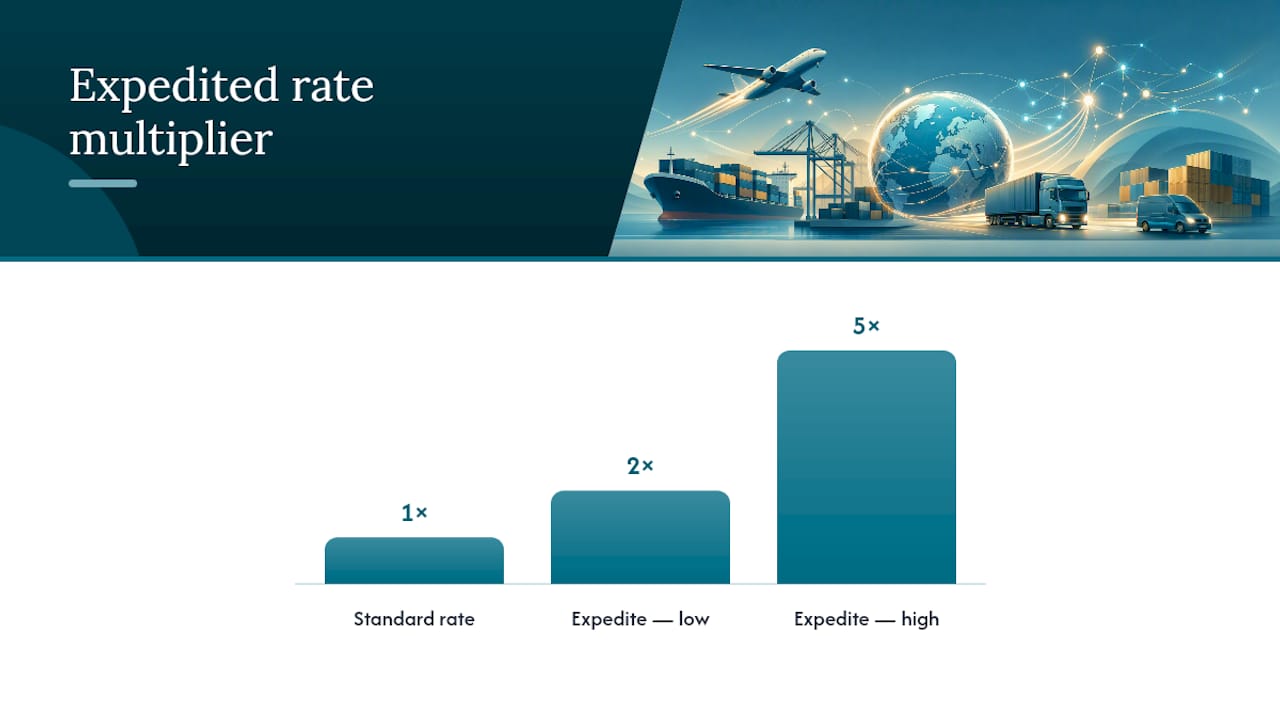
- Expedited shipping rates typically range from two to five times higher than standard rates, depending on the mode, distance, and notice time.
- Matching the shipping mode—air, ground, or LTL—accurately to your deadline can significantly reduce costs and prevent overpaying for speed.
- Having a pre-negotiated contingency route and real-time milestone tracking can prevent delays and reduce emergency costs.
- Cross-border shipments require accurate customs documentation submitted in advance to avoid additional delays at border crossings.
- Building a formal, pre-planned expedited shipping playbook improves response times and lowers costs during urgent situations.
Table of Contents
- What Does an Expedited Shipping Service Actually Cover?
- What Are the Main Expedited Shipping Modes?
- When Is Expedited Shipping Worth the Cost?
- How Do You Choose an Expedited Shipping Provider?
- What Should You Know About Cross-Border Expedited Shipments?
- What Does a Resilient Expedited Shipping Playbook Look Like?
- How Should You Track Expedited Shipments?
- What Drives Expedited Shipping Costs?
- The Bottom Line on Choosing Expedited Shipping
- Why Expedited Shipping Deserves a Permanent Playbook
- Get Expedited Shipping Support Built for Volume
- Sources
- FAQ
What Does an Expedited Shipping Service Actually Cover?
Standard shipping typically runs 3 to 7 business days, depending on distance and mode. Expedited shipping shrinks that window to 1 to 3 business days, and some services deliver same-day or next-day. The gap between those two numbers is the entire reason expedited service exists.
Carriers break expedited service into a few common tiers. Same-day delivery works for local or regional moves where a courier can complete pickup and drop-off within hours. Next-day covers overnight delivery service across longer distances, usually with a cutoff time for pickup. 2 day expedited shipping is the middle ground: fast enough for most urgent business needs, cheaper than overnight, and widely available across ground and air networks. Time-definite service adds a guaranteed delivery window (say, by 10:00 AM) rather than just a day.
Matching the tier to the actual deadline matters more than defaulting to the fastest option. A contract due Friday at 5:00 PM doesn’t need same-day service on Tuesday. It needs a reliable 2 day expedited shipping rate booked with enough buffer to absorb one bad weather day. Overpaying for speed you don’t need is the single most common expedited shipping mistake businesses make.
What Are the Main Expedited Shipping Modes?
Once you know your deadline, the next question is which physical mode gets you there. Expedited freight isn’t one product. It’s a menu, and the right choice depends on delivery window, shipment size, and route.
- Air freight and charter: fastest option for long-distance or international moves; charter flights bypass commercial cargo schedules entirely when the shipment justifies the cost.
- Ground expedite: sprinter vans, straight trucks, and dedicated drivers for regional same-day or next-day runs, often the most cost-effective expedited option under 500 miles.
- Expedited LTL (less-than-truckload): priority handling for palletized freight that doesn’t need a full trailer, moved through a carrier’s fastest lane rather than a standard consolidated route.
- Hot-shot and dedicated truckload: a single truck assigned to one shipment with no stops, used when even one extra handoff risks the deadline.
- Specialized transport: temperature-controlled trailers, oversized load permits, and final-mile expedited delivery for shipments standard equipment can’t handle.
A smarter expedited strategy weighs these against each other instead of jumping straight to air freight. Mixing modes based on cost, distance, and business impact can cut expedited spend substantially while still hitting the deadline.
When Is Expedited Shipping Worth the Cost?
The decision comes down to one comparison: what does missing the deadline cost you, versus what does the carrier charge to prevent that?
Scenarios that typically justify the expense include a factory line waiting on one missing part, a retailer needing inventory before a launch date, a legal filing with a hard cutoff, or a customer relationship at risk over a late gift. Personal shipments (medical documents, a forgotten passport before travel) fall into the same bucket when the stakes are high enough.
Run the math with three steps:
- Estimate the dollar cost of the delay (lost sale, contract penalty, idle labor, reputational damage).
- Get the expedited quote and compare it directly against that number.
- Choose the cheapest mode that still meets the deadline, not the fastest one available.
Quick example: A manufacturer needs a $400 replacement part or its line idles for a full shift, costing roughly $6,000 in lost output. A next-day ground expedite quote runs $180. The math isn’t close. But if that same part only saves two hours on a line with slack capacity, paying a $180 premium to save $200 in downtime barely breaks even.
Cost drivers worth knowing before you get a quote: how much notice you give the carrier, the mode selected, total distance, accessorial fees (liftgates, inside delivery, weekend service), and available capacity on that lane. Expedited rates can run 2 to 5 times standard pricing depending on how tight the window is, so the delay-cost comparison isn’t optional. It’s the whole decision.
How Do You Choose an Expedited Shipping Provider?
Not every carrier that advertises “fast shipping options” can actually deliver under pressure. The providers worth trusting share a specific set of capabilities, and you can test for most of them before you ever book a shipment.
Look for these core signals:
- Rapid quoting: a provider that can price a shipment in minutes, not hours, when your clock is already running.
- Multimodal capacity: access to air, ground, and LTL options so they’re not forced into the most expensive mode by default.
- Real-time visibility: milestone tracking, not just a single “delivered” update at the end.
- Customs expertise: relevant the moment a shipment crosses a border, covered in more detail below.
- 24/7 support and documented contingency routing: someone answers the phone at 2:00 AM, and they already have a backup plan mapped out.
- SLA or guaranteed windows: a written commitment, not a verbal “should be fine.”
Before booking, ask directly: What’s your contingency plan if the primary route fails? Can you show me tracking milestones, not just a tracking number? What happens to my rate if capacity tightens on this lane? Providers with volume commitments and established carrier relationships tend to get priority slots during high-demand periods, which matters most exactly when you need it most.
Pro Tip: Ask a prospective provider for one real example of a shipment they rerouted mid-transit. Their answer tells you more about actual capability than any brochure claim.
What Should You Know About Cross-Border Expedited Shipments?
Customs clearance is the single most common place where an expedited shipment loses all the time it gained in transit. A package can fly overnight and still sit for two extra days at a border because paperwork wasn’t ready.
Pre-clearing cargo before it lands solves most of this. That means submitting an electronic air waybill (e-AWB), an accurate commercial invoice, and correct HS codes ahead of arrival, so customs officers process the shipment instead of holding it for review. Missing or mismatched documentation is the top cause of cross-border expedited delays, full stop.
For recurring international volume, a customs broker or bonded storage arrangement adds a real speed advantage, letting goods move through clearance faster and sit in duty-deferred storage when a shipment arrives before the buyer is ready. When you’re evaluating express courier solutions for international lanes, ask specifically about their cross-border track record, not just their domestic speed.
What Does a Resilient Expedited Shipping Playbook Look Like?
The businesses that handle urgent freight well don’t improvise. They run a documented playbook, and the core of it is a three-layer routing model: a primary route, a contingency route, and a recovery route, each mapped out before the shipment ever leaves the dock. Attached to that model are fixed decision windows, specific points in time where a manager checks status and decides whether to stay the course or switch routes. Pre-defining these decision points stops teams from reacting to a crisis after it’s already too late to fix cheaply.
Three metrics worth watching in real time:
- Dwell time at transfer points, which tends to predict downstream delays before they show up as a missed appointment.
- Capacity utilization on your regular lanes, an early signal that rates or availability are about to shift.
- Disruption alerts tied to weather, port congestion, or carrier capacity crunches.
This is where an integrated platform earns its keep. Or-ner’s tracking, automation, and warehousing tools let a logistics manager watch dwell time and utilization across a shipment’s full route, rather than piecing together updates from three separate carrier portals.
Pro Tip: Set your contingency decision window at the halfway point of transit, not at the deadline itself. By the time you’re checking status an hour before delivery, every backup option is already gone.
How Should You Track Expedited Shipments?
Milestone-level tracking (pickup confirmed, in transit, at facility, out for delivery) tells you where a problem is happening while there’s still time to act. A single final “delivered” update tells you nothing until it’s too late.
Set this up through API or EDI integration with your transportation or warehouse management system, so alerts land in the tools your team already watches. At minimum:
- Confirm the provider offers milestone tracking, not just end-point confirmation.
- Set automated alerts for missed milestones, not just delivery.
- Have a named escalation contact on file before the shipment ships, not after it stalls.
Real-time visibility into parts and inventory availability matters just as much on the receiving end, particularly for time-critical manufacturing inputs.
What Drives Expedited Shipping Costs?
Expedited rates swing widely, and the reasons are predictable once you know what to look for: transport mode, distance, package dimensions and weight, accessorial charges, seasonal demand, and how much notice you give the carrier.
Notice time deserves special attention. A shipment booked with 24 hours’ lead time often costs meaningfully less than the same shipment booked with two hours’ notice, because the carrier has room to plan the route instead of scrambling for capacity. As a rough guide, expedited rates commonly run 2 to 5 times standard shipping rates, with same-day and hot-shot service at the top of that range and 2 day expedited shipping toward the bottom.
You can limit these costs with volume contracts that lock in expedited rates ahead of need, and by pre-approving contingency capacity with a provider so you’re not negotiating price during an actual emergency.
The Bottom Line on Choosing Expedited Shipping
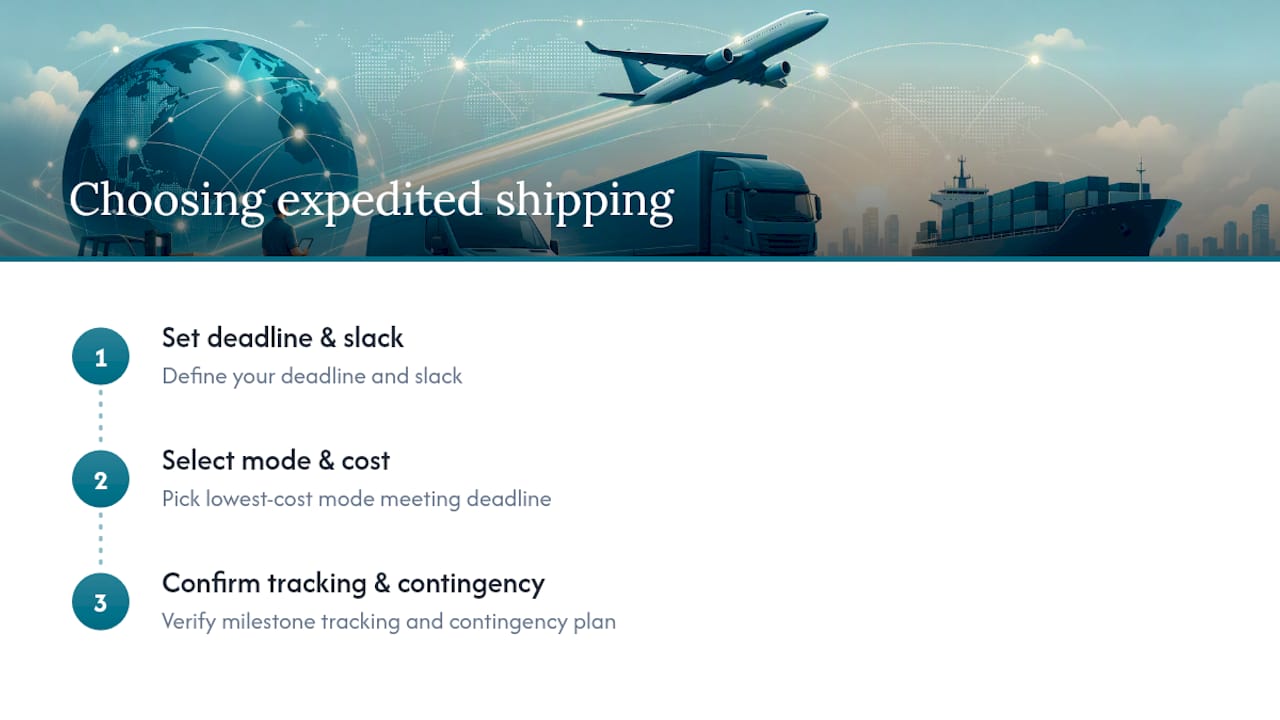
The decision rule stays simple: compare the cost of the delay to the expedite premium, and only pay for speed when the math favors it. Three steps get you there. Define your deadline and how much slack you actually have. Pick the mode that meets it at the lowest reasonable cost. Confirm milestone tracking and a contingency plan before you book. Providers with rapid quoting and real visibility make every one of those steps faster.
Why Expedited Shipping Deserves a Permanent Playbook
Most companies treat expedited shipping as a fire drill, something you figure out mid-crisis when a customer is already angry. That’s backward. The businesses that handle urgent freight well decided their routing rules, decision windows, and provider relationships months before they needed any of it.
The gap between those two approaches shows up in the invoice. A team with a pre-negotiated contingency lane pays a fraction of what a team scrambling at 4:00 PM pays for the same shipment on the same day. Expedited shipping isn’t really a shipping problem. It’s a planning problem wearing a shipping costume.
Build the playbook before the emergency, not during it.
— Maayan
Get Expedited Shipping Support Built for Volume
Or-ner gives you what a single carrier’s hotline can’t: rapid quoting across air, ground, and LTL options in one place, so you’re comparing real prices instead of waiting on callbacks while your deadline shrinks. Multimodal capacity means you’re not stuck paying air freight prices for a shipment that ground expedite could handle just as well.
Milestone tracking and warehousing tools give you visibility into a shipment’s actual status, not just a promise it’s “on the way,” and that visibility is what lets you catch a delay early enough to reroute instead of apologize. For U.S. businesses moving urgent freight regularly, Or-ner’s courier services are built around exactly this kind of pressure. If you’re running frequent expedited volume, start with a freight booking walkthrough to see how the quoting and tracking flow fits your current process, then request a quote for your next time-sensitive shipment.
Sources
For readers who want to go deeper on transit windows, mode selection, and provider practices covered in this guide, these sources back the specific claims made above:
- What Is Expedited Shipping? (Shopify blog)
- Beyond speed: Building a smarter expedited freight strategy | C.H. Robinson
- Expedited shipping benefits and best practices (DAT Resources)
- Expedited Freight: The Complete Guide for Shippers and Managers | Load One
FAQ
What Is an Expedited Shipping Service?
An expedited shipping service is a priority delivery option that shortens standard transit, typically to 1 to 3 business days or faster, to meet a specific deadline. It costs more than standard shipping in exchange for guaranteed or near-guaranteed faster delivery.
Who Has the Fastest Expedited Shipping?
Speed depends more on mode and route than on any single provider. Air freight and charter service offer the fastest long-distance transit, while ground expedite and hot-shot trucking often beat air on regional routes once you factor in airport handling time. A provider offering multimodal options, like Or-ner, can match the fastest realistic mode to your specific route rather than defaulting to the most expensive one.
How Much Does Expedited Shipping Cost Compared to Standard Shipping?
Expedited rates commonly run 2 to 5 times standard shipping rates, with same-day service at the higher end and 2 day expedited shipping toward the lower end of that range. The exact premium depends on mode, distance, notice time, and accessorial fees.
When Should I Choose Expedited Shipping Over Standard?
Choose expedited shipping when the financial or operational cost of missing your deadline exceeds the shipping premium, such as a stalled production line, a contract deadline, or a time-sensitive customer commitment. If the delay is only an inconvenience, standard shipping is almost always the better value.
What Documents Do I Need for an Expedited International Shipment?
Cross-border expedited shipments need an accurate commercial invoice, correct HS codes, and ideally an electronic air waybill (e-AWB) submitted before the shipment arrives so customs can pre-clear it instead of holding it for review.