
TL;DR:
- Effective team meetings require clear purpose, right-sized attendance, and disciplined closing routines. Leaders must set specific goals, classify meeting types, and prepare agendas to optimize productivity and accountability. Regularly auditing meetings helps eliminate unnecessary sessions and maintains a focused, efficient meeting culture.
Efficient team meetings are structured gatherings with a clear purpose, right-sized attendance, and outcomes that drive real decisions. Most managers inherit meeting habits rather than design them, which is why so many teams sit through sessions that produce nothing but a follow-up email. The industry term for what most leaders are chasing is “meeting effectiveness,” a standard that covers purpose clarity, participant fit, and accountability after the room clears. Get those three elements right, and productive team discussions replace the kind of meetings people dread. This guide gives you the specific frameworks, timing rules, and closing routines that separate high-performing teams from ones stuck in calendar gridlock.
What are the essential purposes and types of team meetings?
Classifying meeting types prevents agenda drift and supports appropriate participant selection. Without that classification, leaders pile three different goals into one session and wonder why nothing gets resolved.
Every meeting falls into one of three categories:
- Updating. The goal is information transfer. One person or group shares status, numbers, or news. Participants listen and ask clarifying questions. A weekly logistics update or a project status check fits here. The risk is over-inviting people who only need the written summary.
- Discussing and aligning. The goal is shared understanding. The team works through a problem, explores options, or builds consensus. A product roadmap review or a cross-department planning session belongs in this category. These meetings need the right voices in the room, not every voice.
- Deciding. The goal is a clear resolution. A smaller group evaluates options and commits to a path. Decision meetings fail when too many people attend and no one has authority to close the conversation.
Mixing these types in a single meeting is the most common source of wasted time. A team that spends 40 minutes updating each other and then tries to make a major budget call in the last five minutes will make a poor decision or defer it entirely. Label the meeting type in the invite so every participant knows what role they play before they walk in.
How to prepare for an efficient team meeting
Preparation is the single biggest predictor of meeting quality. A meeting without a shared agenda is a conversation without a destination.
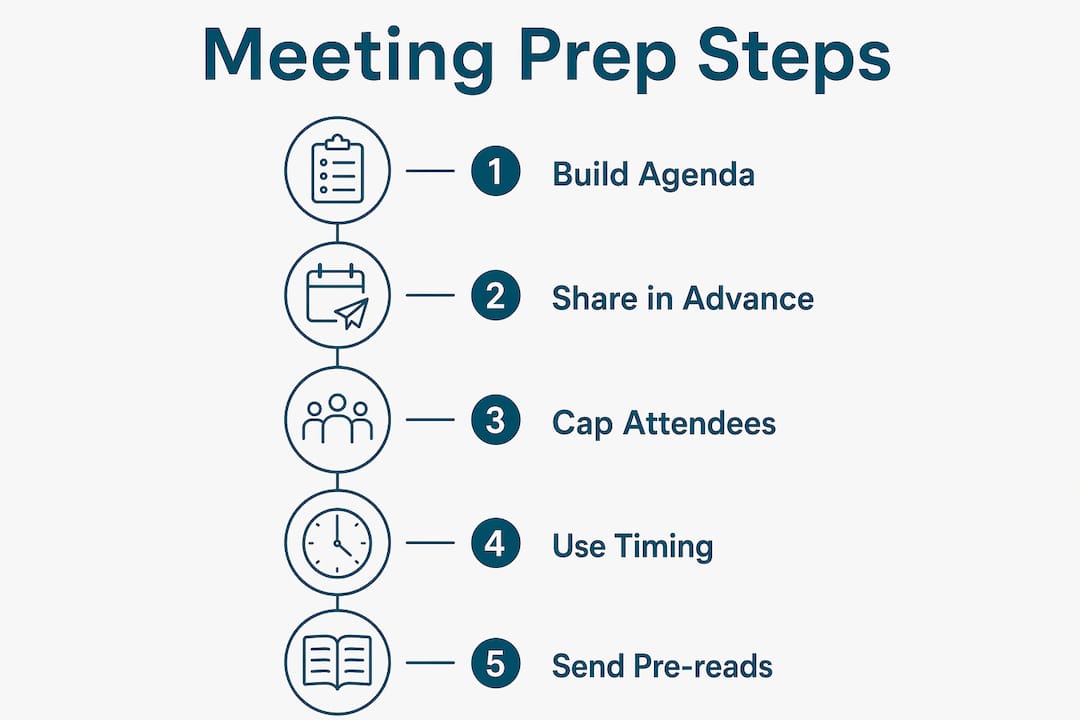
Build and share the agenda in advance. List each topic with a time allocation and a clear goal. “Q3 shipping update: 10 minutes, for information” tells attendees exactly what to expect. Send it at least 24 hours before the meeting so participants can prepare questions or data.
Cap your attendee list. Industry standards recommend capping meeting sizes at 6–8 participants for optimized engagement. Fewer people means more accountability and less social loafing. The Amazon two-pizza rule applies the same logic: if two pizzas cannot feed everyone in the room, the meeting is too large. Apply it literally when you are building your invite list.

Use non-standard meeting durations. Scheduling meetings at 25, 50, or 75 minutes instead of 30, 60, or 90 creates a natural buffer for bio breaks and mental transitions. That buffer reduces fatigue and means participants arrive at their next commitment on time and focused.
The table below shows how to match meeting type, duration, and attendee cap:
| Meeting type | Recommended duration | Attendee cap |
|---|---|---|
| Updating | 25 minutes | Up to 8 |
| Discussing and aligning | 50 minutes | 5–8 |
| Deciding | 25–50 minutes | 3–6 |
| Problem-solving workshop | 75 minutes | 4–8 |
Good time management practices apply directly here. Treat meeting time as a budget. Every minute spent in a poorly prepared session is a minute pulled from execution.
Pro Tip: Send a one-sentence “pre-read” with each agenda item. A single sentence explaining the context cuts the first five minutes of every meeting, which is usually spent getting everyone up to speed.
What are best practices for running a productive meeting?
The way a meeting opens sets the tone for everything that follows. Starting with a positive or relevant story increases engagement and synchronizes team focus. This does not mean a forced icebreaker. It means sharing a recent win, a customer story, or a piece of context that makes the meeting’s purpose feel real. Wharton research confirms that positive priming at the start of a session sets a tone that measurably improves outcomes.
Here is a step-by-step sequence for running the meeting itself:
- Open with a 60-second frame. State the meeting type, the goal, and the time available. “We have 50 minutes to align on the Q3 fulfillment plan. We are not making final decisions today.” That one sentence eliminates confusion about what the group is there to do.
- Flatten the hierarchy. Leaders must instill norms that guarantee psychological safety and equal input opportunities. In virtual settings, this means calling on quieter participants by name, using polls or chat for initial input, and explicitly inviting disagreement before moving to consensus.
- Separate thinking aloud from deciding. Leaders who explicitly state when they are thinking aloud versus deciding encourage team members to contribute without fear. Say “I’m still working this out, I want your input” before sharing a half-formed idea. Say “I’ve made this call, here’s the reasoning” when the decision is final.
- Keep discussions on the agenda. When a topic runs long, call it. Either allocate more time by cutting something else or park the topic for a follow-up. Do not let one agenda item consume the session.
- Pause before decisions. Before closing any decision, ask the room: “Does anyone see a risk we have not discussed?” That pause takes 30 seconds and prevents the kind of post-meeting hallway conversations that reopen settled questions.
Pro Tip: In virtual meetings, use a shared document as a live agenda. Everyone sees the same screen, which reduces side conversations and keeps the group anchored to the current topic.
Strong team collaboration skills make every one of these steps easier. Teams that already communicate well outside meetings bring that clarity into the room.
How to close meetings to ensure accountability
The closing routine is where most meetings fail. Teams reach the end of the session, run out of time, and leave without clear ownership of next steps. That gap is why the same issues resurface in the next meeting.
A five-question closing framework solves this. Every meeting must end with a review that defines who does what by when. Work through these five questions in the last five minutes of every session:
- What decisions did we make today?
- Who owns each action item?
- What is the deadline for each item?
- What does the team need to prepare before the next meeting?
- Who will communicate the outcomes to people who were not in the room?
Document the answers in a shared note immediately after the meeting, not the next day. Memory degrades fast, and a 24-hour delay turns “I thought you were handling that” into a missed deadline.
Post-meeting communication matters as much as the notes themselves. Send a summary to all stakeholders within two hours. Keep it to three sections: decisions made, actions assigned, and open questions. Anything longer than one page will not be read.
Pro Tip: Assign a rotating “closer” role to a team member who is not the meeting leader. That person owns the five-question review and sends the summary. It builds accountability across the team and takes the administrative load off the manager.
What common challenges affect meeting efficiency?
Even well-designed meetings break down under pressure. Recognizing the warning signs early lets you correct course before a single bad session becomes a bad habit.
Common signs that a meeting culture needs attention:
- Participants arrive unprepared or multitask throughout
- Discussions circle back to topics already decided
- The same people dominate every session
- Decisions get made but never executed
- Meetings keep growing in length and attendee count
Over-controlling the meeting room under pressure suppresses input and stalls decisions. Leaders under stress tend to talk more, listen less, and signal that disagreement is unwelcome. The result is a room full of people who have stopped contributing. MIT Sloan research shows that effective leaders anticipate how pressure distorts their communication style and build safeguards to maintain clarity.
Regularly reviewing meeting frequency and attendee lists maintains relevance and efficiency over time. A quarterly audit of your recurring meetings is a practical habit. Cancel any meeting that cannot answer the question: “What decision or alignment does this produce?”
“The most expensive meeting is the one that happens every week because it always has. Audit your calendar the way you audit your budget. If a recurring meeting cannot justify its cost in outcomes, cancel it.”
Strong business communication skills reduce the number of meetings a team needs in the first place. When written updates are clear and timely, updating-type meetings often become unnecessary.
Key Takeaways
Efficient team meetings require purpose clarity, right-sized attendance, structured preparation, inclusive facilitation, and a disciplined closing routine that assigns ownership before the room clears.
| Point | Details |
|---|---|
| Define the meeting type | Label every meeting as updating, discussing, or deciding before sending the invite. |
| Cap attendance at 6–8 | Smaller groups produce higher engagement and clearer accountability. |
| Use non-standard durations | Schedule 25, 50, or 75-minute meetings to build in buffers and reduce fatigue. |
| Close with five questions | Confirm decisions, owners, deadlines, prep needs, and who communicates outcomes. |
| Audit recurring meetings | Cancel any standing meeting that cannot justify its outcomes on a quarterly review. |
Why I think most meeting advice misses the real problem
Most articles on meeting effectiveness focus on tactics: use an agenda, start on time, end with action items. That advice is correct, but it treats the symptom rather than the cause. The real problem is that most leaders have never been explicitly taught what a meeting is for.
I have watched highly capable managers run meetings that were technically well-organized but produced nothing, because the leader had not decided whether the session was for information, alignment, or a decision. The team picked up on that ambiguity and filled the vacuum with tangents.
The fix is not a better agenda template. The fix is a leader who walks into the room knowing exactly what outcome they need and communicates that in the first 60 seconds. Structure follows clarity. Once the purpose is obvious, the right participants, the right duration, and the right closing routine all fall into place naturally.
The other thing most advice ignores is the emotional register of the room. Wharton’s research on positive priming is not soft science. Teams that start meetings in a defensive or anxious state make worse decisions. A 60-second acknowledgment of a recent win costs nothing and changes everything. That is the kind of small design choice that separates managers who run meetings from managers who lead them.
— Maayan
How Or-ner supports teams that need to move fast
Efficient meetings keep your internal team aligned. But when your business depends on logistics execution, alignment has to extend beyond the conference room to your courier and fulfillment partners.

Or-ner gives ecommerce teams and logistics managers a single platform for freight booking, real-time shipment tracking, and cross-border fulfillment. When your back-office and field teams share the same operational data, fewer meetings are needed to chase status updates. Or-ner’s reliable courier services reduce the coordination overhead that fills calendars with reactive check-ins. For small business teams managing high order volumes, Or-ner’s courier solutions for small businesses cut the communication gaps that slow fulfillment and drain meeting time.
FAQ
What makes a team meeting efficient?
An efficient team meeting has a defined purpose (updating, discussing, or deciding), a capped attendee list of 6–8 people, a shared agenda sent in advance, and a closing routine that assigns ownership of every action item.
How long should a team meeting be?
Non-standard durations of 25, 50, or 75 minutes work better than standard 30, 60, or 90-minute blocks. The shorter buffer gives participants time to transition and reduces back-to-back fatigue.
How many people should attend a team meeting?
Industry standards recommend a maximum of 6–8 participants for optimized engagement. The Amazon two-pizza rule offers a practical shortcut: if two pizzas cannot feed the group, the meeting is too large.
How do you close a meeting effectively?
Use a five-question framework in the last five minutes: confirm decisions made, assign owners, set deadlines, identify preparation needed for the next meeting, and designate who communicates outcomes to absent stakeholders.
What should you do when meetings keep losing focus?
Audit your recurring meetings quarterly and cancel any that cannot justify their outcomes. Label the meeting type in the invite, and open every session with a 60-second frame that states the goal and the time available.