TL;DR:
- Ecommerce logistics in 2025 is shifting to resilient, distributed networks that adapt to geopolitical and labor challenges. AI tools like agentic AI and digital twins automate and optimize workflows, while human expertise guides complex decisions. Workforce development and data literacy are critical for successfully integrating these technological advancements.
Ecommerce logistics in 2025 is defined by a permanent structural reset, not a temporary disruption cycle. The 2026 State of Logistics Report confirms that companies must redesign their operating models entirely rather than wait for old conditions to return. Global ecommerce sales reached $6.8 trillion, carrier costs climbed roughly 5.9% plus fuel surcharges, and AI tools like agentic AI and digital twins moved from pilot programs into live operations. For supply chain leaders, the ecommerce logistics trends 2025 brought into focus are not optional upgrades. They are the new baseline for staying competitive.
What are the key ecommerce logistics trends shaping supply chains in 2025?
The dominant shift in ecommerce supply chain 2025 strategy is the move away from efficiency-first models toward resilience-first models. Geopolitical volatility, trade policy swings, and persistent labor shortages forced this change. Companies that built lean, single-source networks found themselves exposed. The ones that built modular, distributed networks absorbed the shocks.
Four trends define this new operating environment:
- AI-driven demand forecasting and fulfillment. Top-performing organizations use AI more than twice the rate of average companies. That gap translates directly into lower stockout rates and faster order cycles.
- Micro-fulfillment centers replacing mega-warehouses. Urban-embedded fulfillment nodes reduce last-mile costs and cut delivery windows to hours rather than days.
- Sustainability as an operational requirement. Circular logistics, low-emission delivery fleets, and recyclable packaging moved from marketing claims to procurement criteria for major retail partners.
- Human-in-the-loop exception management. Automation handles routine tasks. Humans handle edge cases, supplier disputes, and complex rerouting decisions.
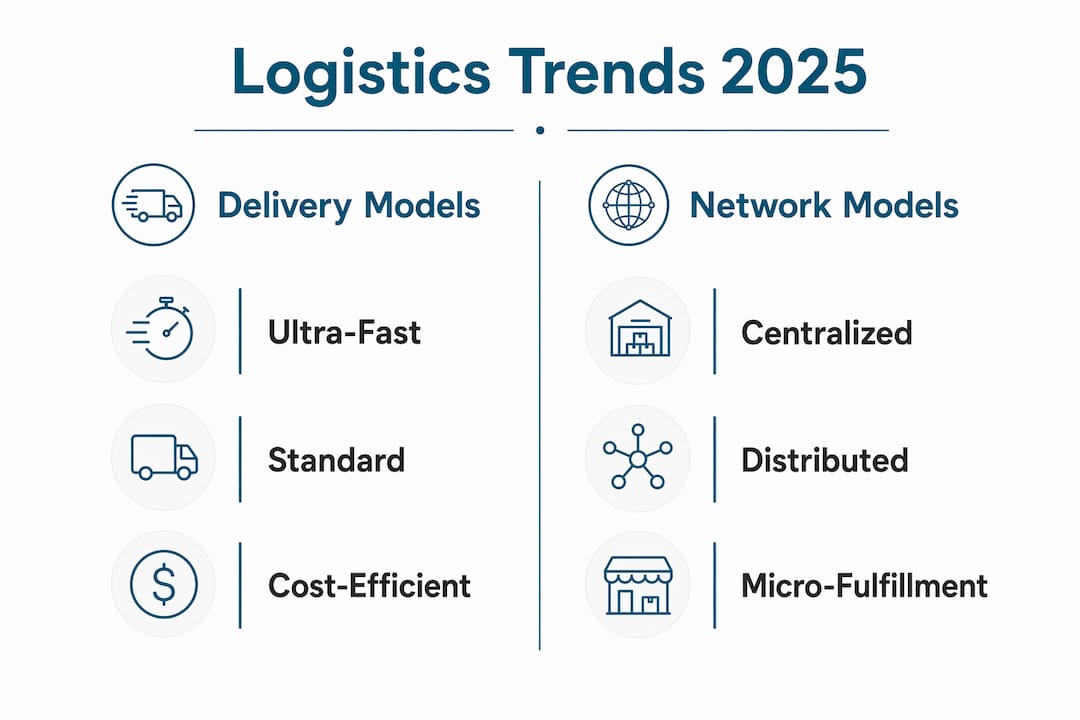
The last-mile delivery market now splits into two distinct models. Here is how they compare:
| Delivery model | Speed | Cost profile | Best fit |
|---|---|---|---|
| Ultra-fast premium | Same day or next day | High carrier cost plus surcharges | High-margin goods, urban markets |
| Low-cost regional | 3–5 business days | Consolidated routes, lower per-unit cost | Bulky items, price-sensitive segments |
The $1.23 trillion U.S. ecommerce market supports both models simultaneously. Choosing the wrong one for your product category is a margin problem, not just a logistics problem.
Pro Tip: Map your SKU catalog against delivery speed sensitivity before committing to a carrier contract. High-velocity consumables and fashion items usually justify premium last-mile spend. Furniture and home goods rarely do.
How is AI transforming ecommerce logistics, and what role do humans play?
Agentic AI is the specific technology reshaping logistics automation trends in 2025. Unlike traditional rule-based automation, agentic AI systems monitor end-to-end logistics workflows, detect errors in real time, and make corrections without waiting for human input. Think of it as a logistics coordinator that never sleeps and processes thousands of variables simultaneously.

Digital twins are the companion technology. Digital twin adoption in supply chains is projected to grow at a CAGR of 25.7% over 2025–35. That growth rate reflects how quickly companies are moving from descriptive analytics (what happened) to prescriptive analytics (what to do next). A digital twin of your warehouse network can simulate the impact of a port closure before it happens, not after.
The human role is shifting in a specific direction. Logistics professionals are moving from operator roles to architect roles. An operator executes a process. An architect designs the system that executes the process and monitors it for failures. This distinction matters because hybrid human-AI models consistently outperform pure automation in complex, high-variability environments like cross-border ecommerce.
Practical AI applications already in use across leading logistics operations include:
- Demand forecasting: AI models analyze sales history, weather, social trends, and supplier lead times to generate replenishment signals.
- Warehouse orchestration: Robotics guided by AI pick, sort, and stage orders with minimal human intervention on standard SKUs.
- Route planning: Dynamic routing algorithms adjust delivery sequences in real time based on traffic, weather, and driver availability.
Pro Tip: Before investing in AI tooling, audit your data quality. AI forecasting is only as accurate as the historical data it trains on. Garbage in, garbage out applies here more than anywhere else in logistics.
What workforce strategies should logistics leaders adopt for 2025 challenges?
Labor shortages represent one of the top logistics challenges 2025 operations must solve. Projections point to a gap of up to 1.9 million workers by 2033. Automation reduces the severity of that gap but does not eliminate it. The companies that treat workforce development as a technology problem will underinvest in the human side and pay for it in capability gaps.
Here is a practical four-step framework for building a resilient logistics workforce:
- Audit current skill gaps against your automation roadmap. Identify which roles will shift from execution to oversight within 24 months and plan training accordingly.
- Invest in AI fluency, not just AI tools. Staff who understand how AI systems make decisions can catch errors and improve outputs. Staff who only know how to click buttons cannot.
- Build exception management protocols. Define clearly which decisions require human judgment. Customs disputes, supplier failures, and major rerouting events should always have a named human owner.
- Create career pathways for logistics architects. Retaining experienced staff means showing them a future in the organization. The architect role is that future.
Companies ignoring workforce development risk serious capability gaps even after heavy automation investment. A warehouse full of robots still needs engineers, data analysts, and exception managers who understand the full supply chain picture.
Pro Tip: Partner with community colleges and trade programs to build a pipeline for logistics technology roles. These partnerships are faster and cheaper than competing for the same data science talent as every other industry.
Which logistics network models are most effective for ecommerce in 2025?
The centralized mega-warehouse model built for the 2010s is losing ground to distributed micro-fulfillment networks. The shift is driven by three forces: consumer delivery speed expectations, urban real estate economics, and geopolitical supply chain fragmentation. Companies that relied on two or three massive distribution centers found their entire network vulnerable to a single regional disruption.
Micro-fulfillment centers embedded in urban areas reduce last-mile costs by up to 30%. They use robotics within small footprints to enable multiple drop-offs within a 5-kilometer radius. For ecommerce sellers serving dense metro markets, this model changes the unit economics of same-day delivery from a premium service to a standard offering.
Here is how the two primary network models compare across key operational dimensions:
| Dimension | Centralized mega-warehouse | Distributed micro-fulfillment |
|---|---|---|
| Throughput capacity | Very high | Moderate per node, high in aggregate |
| Last-mile delivery cost | Higher due to distance | Lower due to proximity |
| Resilience to disruption | Low (single point of failure) | High (distributed risk) |
| Sustainability profile | Higher transport emissions | Lower transport emissions |
| Setup cost | High upfront | Lower per node, higher total count |
The distributed model also supports urban logistics solutions that align with city-level emissions regulations, which are tightening in major markets across Europe and North America. That regulatory pressure will accelerate the shift away from centralized models over the next three years.
Key factors to evaluate when designing your network:
- Inventory positioning: Which SKUs need to be closest to the customer? Fast-moving, high-frequency items belong in micro-fulfillment nodes.
- Carrier partnerships: Distributed networks require more carrier relationships. Consolidate where possible to maintain negotiating leverage.
- Technology integration: Each node needs real-time inventory visibility connected to your central order management system.
Key takeaways
Resilient ecommerce logistics in 2025 requires distributed networks, hybrid AI-human operating models, and deliberate workforce investment working together, not separately.
| Point | Details |
|---|---|
| Structural reset is permanent | Redesign operations for resilience now; waiting for old conditions to return is not a viable strategy. |
| AI adoption gap is widening | Top organizations use AI more than twice the rate of peers, creating a compounding competitive advantage. |
| Labor shortages require dual investment | Automation and workforce upskilling must advance together to close the projected 1.9 million worker gap by 2033. |
| Micro-fulfillment cuts last-mile costs | Urban fulfillment nodes reduce last-mile delivery costs by up to 30% compared to centralized warehouse models. |
| Network design determines resilience | Distributed micro-fulfillment networks absorb disruptions that centralized mega-warehouses cannot survive. |
What I have learned about balancing AI and human judgment in logistics
The conversation around logistics automation tends to split into two camps. One side treats AI as the solution to every operational problem. The other side worries that automation will eliminate the human expertise that actually holds complex supply chains together. Both camps are wrong in the same way: they treat this as a binary choice.
What I have seen consistently is that the companies making real progress in future logistics strategies are the ones that treat AI as a decision-support layer, not a decision-replacement layer. They use AI to surface the right information at the right moment. Then they put a trained human in front of that information to make the call that matters. That combination outperforms pure automation in every high-variability scenario I have observed.
The harder truth is that most organizations are not ready for this model because they have underinvested in workforce development for years. You cannot hand someone an AI-powered logistics platform and expect them to use it well if they have never been trained to think analytically about supply chain tradeoffs. The technology investment and the people investment have to move together. When they do not, you get expensive tools that nobody trusts and workarounds that defeat the purpose.
My honest recommendation: before you buy the next automation platform, spend 90 days mapping how your current team makes decisions. Find the gaps. Then build the technology around the people, not the other way around.
— Maayan
How Or-ner helps you act on these logistics shifts
The trends covered in this article require more than awareness. They require execution tools that connect freight booking, shipment visibility, and inventory control into one workflow.
Or-ner is built specifically for ecommerce sellers and supply chain teams who need to move fast without losing control. The freight booking step-by-step guide walks you through the full process from carrier selection to customs documentation, with checklists designed for cross-border and domestic shipments. Or-ner also provides real-time shipment tracking tools that give your team the visibility needed to manage exceptions before they become customer complaints. If you are rethinking your network design or carrier mix for 2025, Or-ner’s platform gives you the data and the workflows to do it without starting from scratch.
FAQ
What is the biggest logistics challenge for ecommerce in 2025?
The biggest challenge is the combination of persistent labor shortages and rising carrier costs, with projections showing a gap of up to 1.9 million logistics workers by 2033. Companies must address both workforce development and automation investment simultaneously to maintain operational capacity.
How do micro-fulfillment centers reduce ecommerce shipping costs?
Micro-fulfillment centers embedded in urban areas reduce last-mile delivery costs by up to 30% by enabling multiple drop-offs within a 5-kilometer radius using robotics and automation in small-footprint facilities.
What does agentic AI do in logistics operations?
Agentic AI monitors end-to-end logistics workflows in real time, detects errors, and makes corrections automatically without waiting for human input. It is used for demand forecasting, warehouse orchestration, and dynamic route planning.
Should ecommerce businesses use centralized or distributed fulfillment networks?
Distributed micro-fulfillment networks offer stronger resilience and lower last-mile costs for urban markets, while centralized mega-warehouses offer higher throughput for bulk or slow-moving inventory. Most mid-to-large ecommerce operations benefit from a hybrid approach that positions fast-moving SKUs in urban nodes.
How can logistics teams prepare for AI-driven supply chain tools?
Teams should prioritize data literacy and AI fluency training before deploying new platforms. The top logistics challenges 2025 operations face are compounded when staff cannot interpret or act on AI-generated insights effectively.