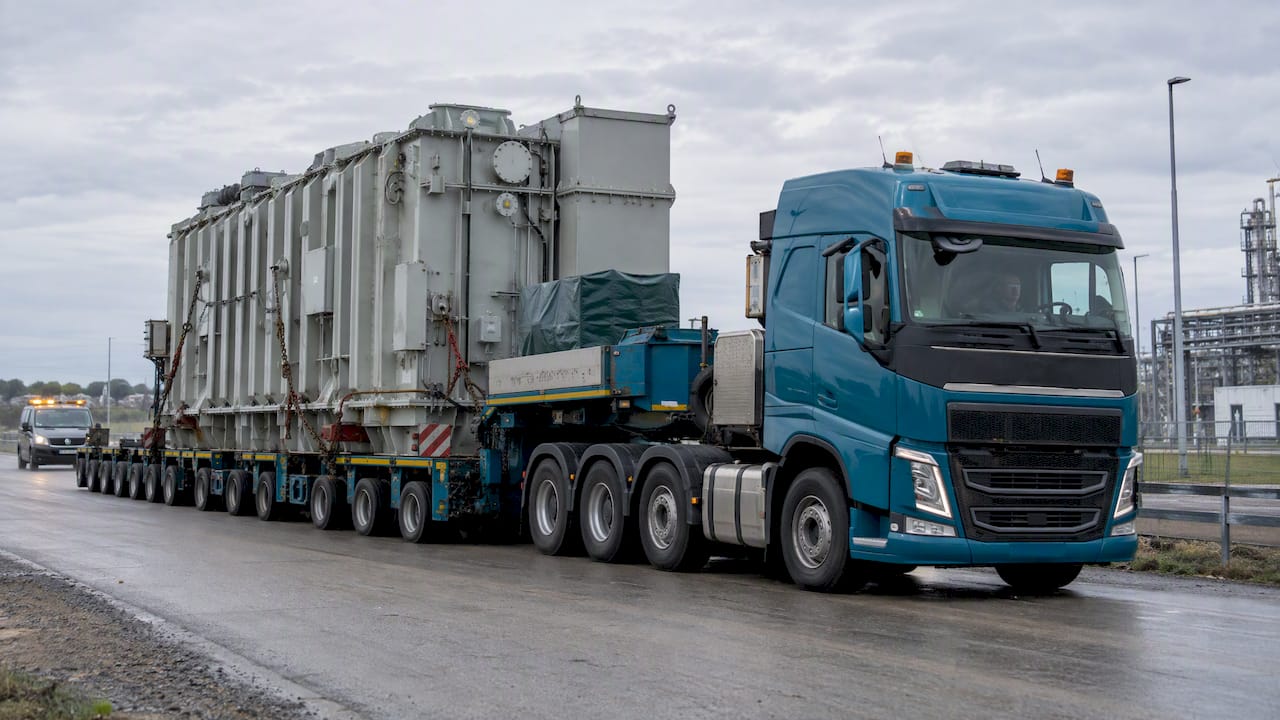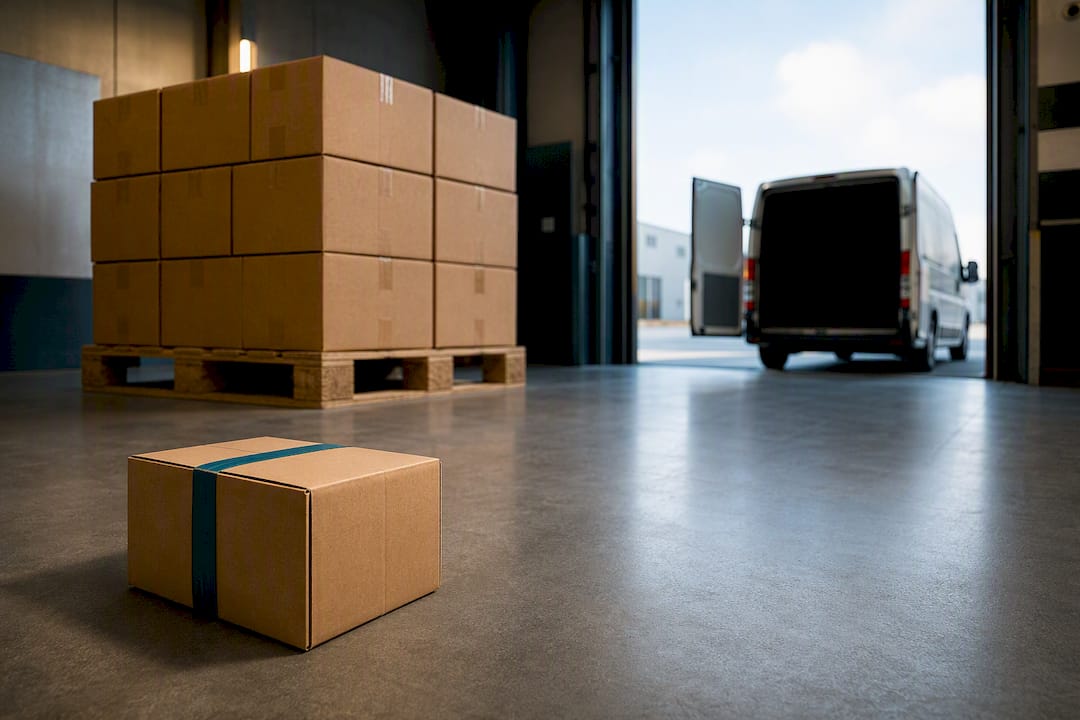
A courier handles small, urgent shipments door to door, usually under 30 kg, while cargo (freight) moves larger or bulk loads by pallet, container, or CBM through air, sea, or road networks. The quick rule: if it fits in a van and needs to arrive fast, book a courier. If it’s palletized, oversized, or you’re shipping in volume, you’re in freight territory, and price runs by weight or volume instead of a flat parcel rate.
TL;DR:
- Shipments under 30 kg usually cost less and arrive faster via courier, especially for urgent, small-volume deliveries.
- Cargo shipping becomes more economical than courier services when shipping large volumes, oversize loads, or exceeding around 30 kg per shipment.
- Air freight offers a middle ground for mid-size, urgent bulk shipments between three days and a week, while sea freight is best for larger, non-urgent loads, taking several weeks.
- Customs clearance is bundled and simplified in courier services but requires more paperwork and planning in freight, impacting lead times and costs.
- Smaller, irregular, or high-value goods often justify courier, whereas recurring, heavy, or oversized shipments are better suited to freight options.
Table of Contents
- What Is a Courier Service, and When Does It Make Sense?
- What Is Cargo Shipping? Freight Modes and Why Businesses Use Them
- Courier vs. Cargo: A Side-by-Side Comparison
- How to Choose Between Courier and Cargo: A Quick Checklist
- What Actually Drives the Final Price and Delivery Date
- Customs, Paperwork, and Who’s Liable if Something Goes Wrong
- How Or-ner Handles Both Courier and Cargo Bookings
- Three Mistakes I See Constantly, and a Checklist to Avoid Them
- Get a Courier or Cargo Quote Through Or-ner
- Sources
- FAQ
What Is a Courier Service, and When Does It Make Sense?
A courier operates on an integrated, door-to-door model: one company picks up your package, moves it through its own network, and hands it directly to the recipient, often with a signature and a tracking number the whole way. This is the reliable courier services model most people picture when they think of shipping. It’s built for speed and accountability, not scale.
Typical courier shipments include documents, sample products, single e-commerce orders, and anything under roughly 30 kg. Couriers usually offer tiered service levels: same-day for local urgent runs, next-day for regional or domestic, and standard (2 to 5 days) for everything else.
- Bundled customs clearance on cross-border parcels, so you rarely deal with a separate broker
- Real-time tracking baked into the service, not an add-on
- Simple, predictable per-parcel pricing
- Weak economics once volume or weight climbs past a few dozen kilograms
Pro Tip: If you’re shipping the same product repeatedly for an e-commerce business, track your average parcel weight for a month. That number alone tells you whether you’re still in courier range or should be pricing out freight.
What Is Cargo Shipping? Freight Modes and Why Businesses Use Them
Cargo, or freight, is the movement of goods in bulk, typically by air, sea, or road, and it usually runs through a freight forwarder or consolidator rather than a single integrated carrier. Where a courier owns the whole trip, cargo shipping stitches together multiple legs: trucking to a port or airport, the main transport leg, then last-mile delivery on the other end.
Shipments here are measured in pallets, cubic meters (CBM), or full containers rather than individual parcels. A single pallet might run 200 to 500 kg; a full container load (FCL) can carry tens of thousands of kilograms. Global goods movement still runs overwhelmingly through maritime cargo, which is why sea freight remains the default for anything bulky that isn’t time-critical.
- Air cargo: faster, pricier, best for mid-size urgent bulk shipments
- Sea freight (LCL/FCL): cheapest per unit for large or heavy loads, the slowest transit
- Road/rail cargo: regional bulk moves, often feeding into port or air hubs
- Requires more paperwork and lead time than a courier booking
The tradeoff is straightforward: cargo gets dramatically cheaper per kilogram as volume rises, but it demands more planning, more documentation, and a tolerance for slower timelines.
Courier vs. Cargo: A Side-by-Side Comparison
| Factor | Courier | Cargo (Freight) |
|---|---|---|
| Typical weight/volume | Under ~30 kg | 30 kg to full container loads |
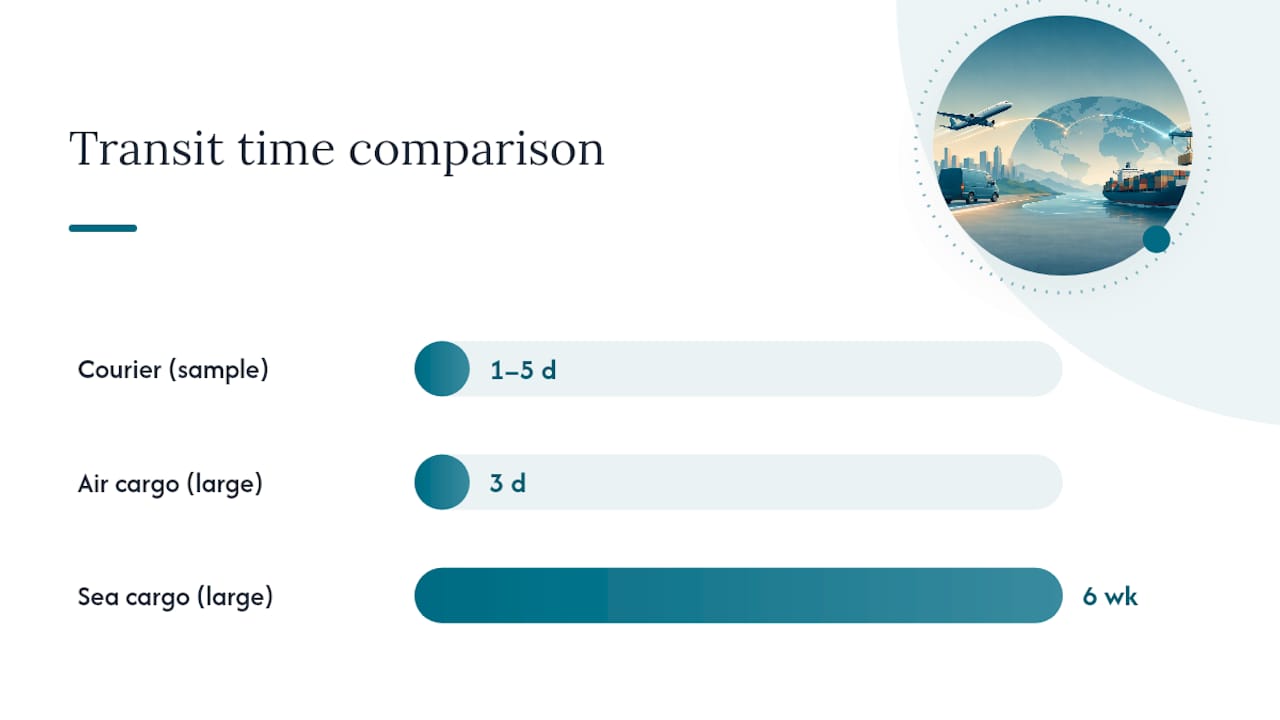
| Speed / transit time | 1 to 5 days | 3 days (air) to 6 weeks (sea) |
| Cost basis | Per parcel, flat or dimensional | Per kg or per CBM |
| Delivery model | Door-to-door | Often port/airport-to-door, sometimes terminal-to-terminal |
| Paperwork | Bundled, minimal | Commercial invoice, packing list, AWB or B/L |
| Best for | Urgent, small, one-off shipments | Bulk, recurring, or oversized shipments |
Many freight guides put the practical break-even around 30 kg — under that, courier pricing usually wins; air cargo takes over from roughly 30 to 200 kg, and sea freight becomes the economical choice above that or for full container volumes.
Here’s the tradeoff in action: a 5 kg sample shipment overseas will almost always cost less and arrive faster by courier. But that same company shipping 40 boxes at 25 kg each, one ton total, is usually better off consolidating into an air or sea freight booking, even though the transit time stretches out. Cargo’s per-unit economics improve as volume grows, which is exactly why the crossover point exists in the first place.
Tracking and insurance diverge too. Couriers give you granular, scan-by-scan visibility and usually include basic liability coverage automatically. Cargo tracking is milestone-based (departed origin port, cleared customs, arrived at destination), and insurance is typically a separate line item you have to request.
How to Choose Between Courier and Cargo: A Quick Checklist
Run any shipment through these five questions before you book:
- Weight and dimensions. Under 30 kg and small enough for a van? Courier. Heavier, palletized, or oversized? Cargo.
- Urgency. Need it there tomorrow? Courier or air cargo. Have 3 to 6 weeks of slack? Sea freight saves real money.
- Value per kilogram. High-value, low-weight goods (electronics, jewelry) often justify courier or air cargo even at higher cost.
- Packaging and oversize risk. Irregular shapes or fragile bulk items often need freight handling, not a courier’s standard parcel network.
- Frequency. Shipping the same route weekly? A freight booking arrangement beats paying courier rates every time.
A solo seller shipping one order a week stays in courier territory. A wholesaler moving 500 kg monthly to one buyer should be pricing out consolidated freight.
Pro Tip: If your value-per-kilogram is high but your volume is growing, price out air cargo before assuming courier is your only option. It’s often the missing middle tier.
What Actually Drives the Final Price and Delivery Date
Carriers rarely bill by actual weight alone. Courier services calculate dimensional weight using a volumetric divisor, often somewhere in the 5,000 to 6,000 range, so a large, light box can cost more than its scale suggests. Cargo shipments bill by CBM or a comparable chargeable-weight formula, meaning a poorly packed pallet wastes paid space.
Watch for these common add-ons before you accept a quote:
- Fuel surcharges (fluctuate monthly, rarely disclosed upfront)
- Peak season surcharges around holidays
- Remote area delivery fees
- Handling and brokerage fees on cargo shipments
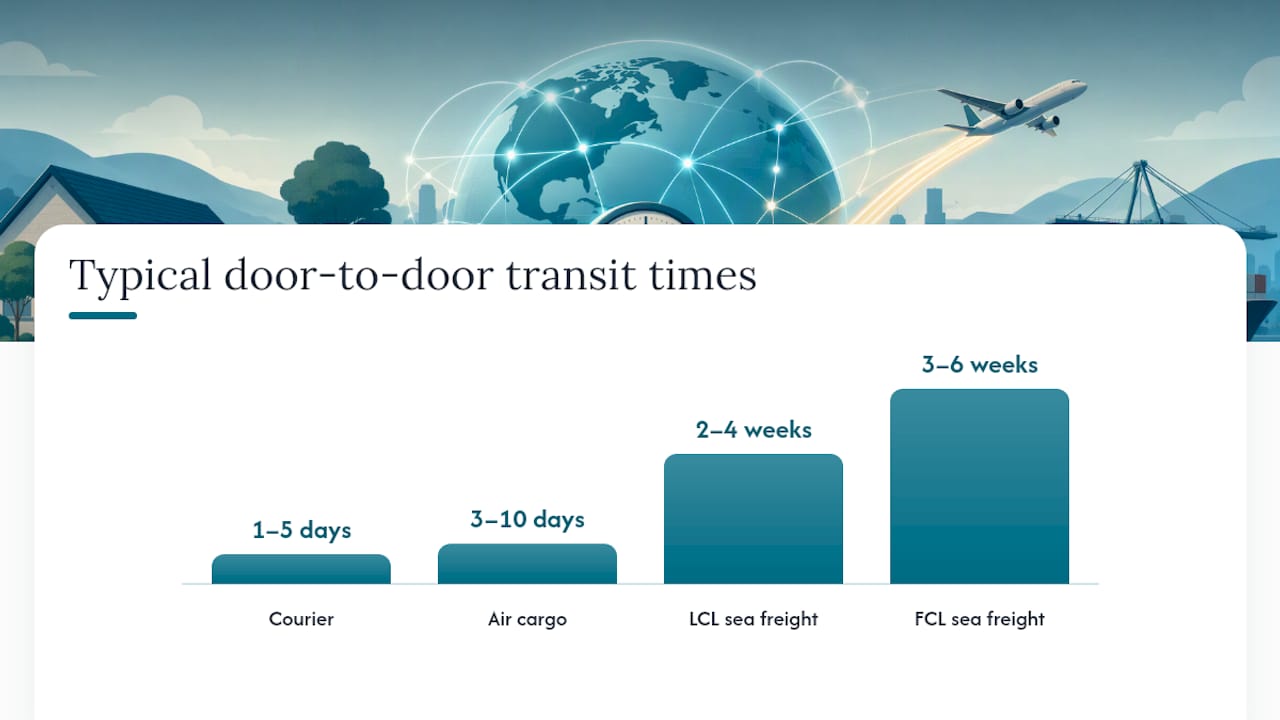
On timing, expect courier delivery in 1 to 5 days, air cargo in 3 to 10 days door-to-door once trucking and clearance are factored in, LCL sea freight in 2 to 4 weeks, and FCL sea freight in 3 to 6 weeks depending on the route.
Customs, Paperwork, and Who’s Liable if Something Goes Wrong
Couriers typically bundle customs clearance into the service itself. Cross-border parcels move through a pre-built brokerage workflow, so you rarely file anything separately. Cargo shipments almost always require a dedicated customs broker or your freight forwarder to handle clearance, and the paperwork load is heavier.
Expect to prepare or receive:
- A commercial invoice and packing list (both modes)
- An air waybill (AWB) for air cargo
- A bill of lading (B/L) for sea freight
- Import/export permits for regulated goods
Insurance follows a similar split. Courier liability is often automatic up to a modest cap, while cargo insurance is usually purchased separately and matters more given the higher shipment value at stake. Skipping it on a full container is a costly gamble if goods are damaged in transit.
How Or-ner Handles Both Courier and Cargo Bookings
A platform can cover both ends of this decision. For courier needs, that means integrated tracking, last-mile delivery, and bundled customs handling on cross-border parcels. For cargo, it means freight booking, LCL/FCL consolidation, and warehousing for businesses that need to store inventory between legs of a shipment.
The general guidance: book directly when you ship rarely and the rules are simple. Bring in a logistics partner once you’re juggling multiple modes, recurring freight, or cross-border paperwork that eats into time you’d rather spend running the business.
Three Mistakes I See Constantly, and a Checklist to Avoid Them
The most common error is booking a courier for a heavy bulk shipment out of habit, not math. Close behind: ignoring dimensional weight until the invoice arrives inflated. Third: shipping cargo internationally without confirming who’s filing the customs paperwork.
Before booking anything, check: actual and dimensional weight, the correct customs documents for your goods, and whether insurance is included or needs adding.
— Maayan
Get a Courier or Cargo Quote Through Or-ner
Once you know which side of the 30 kg line your shipment falls on, the next step is getting real numbers instead of guessing. Or-ner runs both workflows on one platform, so you’re not stuck explaining your shipment twice to two different providers.
For parcels and time-sensitive orders, Or-ner’s essential courier services for small businesses cover door-to-door delivery with tracking and bundled customs clearance built in. For pallets, containers, or recurring bulk shipments, the freight booking process walks you through consolidation options and carrier selection without needing a separate broker relationship. If you’re not sure which side your next shipment lands on, request a quote for both and compare the numbers directly. That comparison, not a general rule, is what actually tells you where the break-even sits for your specific goods.
Sources
- Courier vs freight | Inbound Logistics
- Courier vs Freight – Shipping Glossary | DutyGlobal
- Air cargo vs sea vs courier | Goods Across Borders
FAQ
What Is the Difference Between Courier and Freight?
A courier handles small, individual parcels door to door with one company managing the whole trip. Freight (cargo) moves bulk shipments by pallet or container, often through a forwarder coordinating multiple transport legs.
What Is the Difference Between Cargo and a Carrier?
Cargo refers to the goods being transported in bulk, while a carrier is the company or vessel actually moving them, whether that’s an airline, shipping line, or trucking company.
What Is the Difference Between Delivery and a Courier?
Delivery is the general act of getting goods to a recipient, while a courier is a specific service model built for fast, tracked, door-to-door delivery of smaller shipments.
What Is the Difference Between a Courier and a Hauler?
A courier moves small parcels quickly, often with same-day or next-day service, while a hauler typically moves heavier freight overland by truck, prioritizing volume over speed.
Is Courier or Cargo Cheaper for a Small Business?
It depends on volume. Courier pricing wins for anything under roughly 30 kg, while cargo becomes cheaper per kilogram once you’re shipping pallets or container-level volume regularly.