

Delivery performance metrics shape every step that packages take from warehouse to doorstep, and just a 1-day reduction in delivery time can increase average daily sales by 13.3 percent. Most businesses obsess over tracking on-time deliveries and order accuracy as if faster numbers alone guarantee smiles. Yet the real advantage is not just in reaching customers on time but in using these hidden data points to sharpen your entire strategy and outpace the competition.
Table of Contents
- Understanding Core Delivery Performance Metrics
- How to Measure and Analyze Delivery Metrics
- Boosting Efficiency with Data-Driven Insights
- Best Practices for Ecommerce and Retail Logistics
Quick Summary
| Takeaway | Explanation |
|---|---|
| Measure Delivery Performance Regularly | Regularly track key metrics like on-time delivery and DIFOT to assess logistics effectiveness. |
| Utilize Advanced Analytics | Implement data analysis techniques to transform delivery metrics into actionable insights for continuous improvement. |
| Focus on Customer-Centric Metrics | Incorporating customer feedback and satisfaction into performance metrics enhances overall service quality and loyalty. |
| Establish Continuous Improvement Frameworks | Create processes for ongoing review and optimization of logistics strategies to identify inefficiencies and drive performance. |
| Leverage Technology for Optimization | Use advanced tracking and predictive analytics to reduce costs, improve accuracy, and enhance delivery times. |
Understanding Core Delivery Performance Metrics
Delivery performance metrics are the critical indicators that reveal the health and efficiency of logistics operations. These quantifiable measurements provide businesses with insights into how well their supply chain delivers products to customers, highlighting areas of excellence and opportunities for improvement.
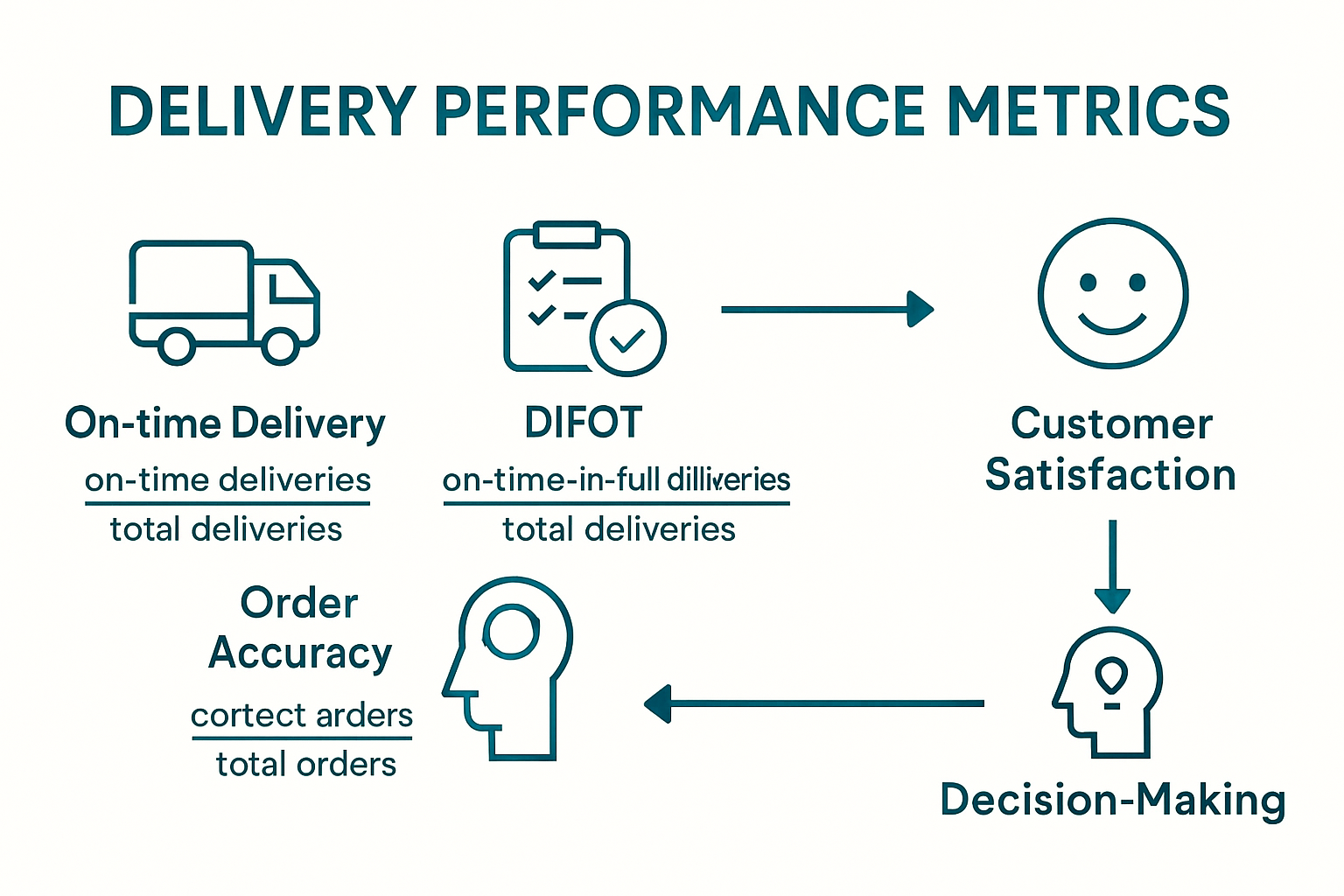
To help quickly compare the core delivery performance metrics discussed, the following summary table outlines each key indicator and its primary focus in logistics operations.
| Metric | Description | Primary Focus |
|---|---|---|
| On-Time Delivery Percentage | Proportion of shipments delivered within promised timeframe | Speed & Reliability |
| Delivery In Full, On Time (DIFOT) | Measures if deliveries meet expectations for type, quantity, location, and timing | Completeness & Accuracy |
| Order Fulfillment Rate | Ability to process and complete customer orders accurately | Operational Accuracy |
| Delivery Accuracy | Frequency of products delivered to correct destination, quantity, and item | Precision |
Core Delivery Performance Indicators
According to the Logistics Operational Guide, several fundamental metrics help organizations assess their delivery capabilities. On-time delivery percentage represents the proportion of shipments that reach customers within the promised timeframe. This metric directly impacts customer satisfaction and brand reputation.
The ‘Delivery In Full, On Time’ (DIFOT) metric offers a comprehensive evaluation of supply chain performance. As Wikipedia explains, DIFOT measures whether deliveries meet customer expectations regarding product type, quantity, location, and timing. A high DIFOT score indicates a well-synchronized logistics operation that consistently meets customer demands.
Measuring Delivery Effectiveness
Understanding delivery performance goes beyond simple tracking. It requires a holistic approach that examines multiple dimensions of logistics performance. Order fulfillment rates provide insight into an organization’s ability to process and complete customer orders accurately. Delivery accuracy metrics reveal how often products are delivered to the correct destination with the right items and quantities.
The goal of these metrics is not just to track performance but to drive continuous improvement. By analyzing these indicators, businesses can identify bottlenecks, optimize routing, improve inventory management, and ultimately enhance customer experience. Logistics managers use these metrics to make data-driven decisions that streamline operations and reduce costs.
Strategic Importance of Performance Metrics
Research on supply chain management highlights that delivery performance is more than a operational metric – it’s a strategic competitive advantage. Companies that consistently meet or exceed delivery expectations build customer trust, improve retention rates, and differentiate themselves in crowded marketplaces.
Key performance indicators in delivery encompass various aspects including speed, accuracy, completeness, and reliability. They provide a multifaceted view of logistics effectiveness, enabling businesses to pinpoint precise areas for enhancement. Whether it’s reducing transit times, minimizing errors, or improving packaging integrity, these metrics serve as a roadmap for operational excellence.
By embracing comprehensive delivery performance metrics, organizations transform logistics from a cost center into a strategic asset that drives business growth and customer satisfaction.
How to Measure and Analyze Delivery Metrics
Measuring and analyzing delivery metrics requires a systematic approach that transforms raw data into actionable insights. Businesses must develop robust strategies to collect, evaluate, and interpret performance indicators that drive logistics efficiency.
Data Collection and Performance Tracking
The US Department of Transportation emphasizes the importance of comprehensive data collection in tracking freight performance. Modern logistics operations utilize advanced tracking technologies that capture real-time information about shipments, including departure times, transit durations, and delivery confirmations.
Key data points for measurement include:
- Shipment timestamps documenting precise movement across the supply chain
- GPS tracking providing location and route information
- Electronic proof of delivery systems
- Customer feedback and satisfaction ratings
Advanced Analytics and Performance Evaluation
According to the US Government Accountability Office, effective performance analysis involves more than simple data collection. Organizations must implement sophisticated analytical approaches that transform raw metrics into meaningful performance insights. Learn more about advanced logistics tracking techniques.
Performance evaluation typically involves:
- Comparative analysis against industry benchmarks
- Trend identification across multiple delivery cycles
- Root cause investigation of delivery failures or delays
Continuous Improvement Strategy
Successful delivery metric analysis is an ongoing process of refinement. Companies must establish continuous improvement frameworks that:
For organizations looking to implement continuous improvement in logistics, the table below summarizes the key steps involved in an ongoing performance enhancement process, as outlined in the article.
| Step | Action Description |
|---|---|
| Performance Data Review | Regularly analyze delivery and operational metrics |
| Inefficiency Identification | Find patterns and sources of delays or errors |
| Targeted Improvements | Implement changes to address specific issues |
| Feedback Loops | Establish mechanisms for ongoing measurement and adjustment |
| Strategy Alignment | Link metric analysis directly to logistics planning |
- Regularly review performance data
- Identify systemic inefficiencies
- Implement targeted operational improvements
- Create feedback loops between measurement and strategic planning
By developing a comprehensive approach to measuring and analyzing delivery metrics, businesses can transform logistics from a traditional cost center into a strategic competitive advantage. The key lies in using data not just to track performance, but to drive meaningful operational excellence that ultimately enhances customer satisfaction and reduces overall logistics expenses.
Boosting Efficiency with Data-Driven Insights
Data-driven insights have revolutionized logistics operations, transforming raw performance metrics into strategic advantages. By leveraging advanced analytics, businesses can unlock unprecedented levels of operational efficiency and customer satisfaction.
Predictive Performance Optimization
Research published in Manufacturing & Service Operations Management reveals a compelling connection between delivery time performance and business outcomes. The study demonstrates that reducing delivery time from three days to two days could potentially improve average daily sales by 13.3%. This underscores the critical importance of using data to continuously refine logistics strategies.
Key strategies for predictive optimization include:
- Real-time route analysis to minimize transit times
- Predictive maintenance for transportation equipment
- Demand forecasting to allocate resources efficiently
Advanced Metric Analysis Techniques
According to the National Center for Biotechnology Information, sophisticated data analysis techniques can dramatically improve logistics performance. Organizations can now track complex metrics such as load factor, total route length, and fuel consumption with unprecedented precision. Learn more about advanced logistics optimization techniques.
Advanced analysis methods include:
- Machine learning algorithms for pattern recognition
- Statistical modeling of delivery performance
- Comprehensive performance dashboards
Transforming Data into Strategic Advantage
The Logistics Operational Guide emphasizes that data-driven insights are more than just numerical analysis. They represent a fundamental approach to understanding and improving logistics operations. By treating performance metrics as strategic assets, businesses can:
- Identify hidden inefficiencies
- Predict potential disruptions
- Create more responsive supply chain networks
- Reduce operational costs
- Enhance customer satisfaction
Successful organizations recognize that data is not just about measurement – it’s about transformation. By embracing a holistic approach to performance metrics, businesses can turn logistics from a traditional cost center into a dynamic, value-generating engine of competitive advantage. The future of logistics belongs to those who can most effectively translate data into actionable, strategic insights.
Best Practices for Ecommerce and Retail Logistics
In the fast-evolving world of ecommerce and retail, logistics performance metrics play a critical role in determining business success. Organizations must adopt strategic approaches that optimize delivery processes, enhance customer satisfaction, and maintain competitive efficiency.
Strategic Performance Measurement
According to the APQC Performance Benchmarks, successful organizations develop comprehensive performance measurement frameworks tailored to their specific operational needs. Explore our comprehensive guide to ecommerce logistics to understand how leading businesses implement robust tracking systems.
Key strategic measurement practices include:
- Comprehensive KPI selection aligned with business objectives
- Regular performance reviews
- Cross-functional performance tracking
- Transparent reporting mechanisms
Operational Efficiency Optimization
The Logistics Operational Guide emphasizes that effective logistics management requires more than just measuring performance – it demands proactive optimization strategies. Successful ecommerce and retail organizations focus on:
- Minimizing delivery times
- Reducing operational costs
- Improving order accuracy
- Enhancing customer communication
Technological integration plays a crucial role in achieving these objectives. Advanced tracking systems, real-time inventory management, and predictive analytics enable businesses to anticipate challenges and respond swiftly.
Customer-Centric Performance Metrics
Modern logistics strategies prioritize customer experience as a central performance metric. This approach goes beyond traditional operational measurements, incorporating customer feedback, satisfaction ratings, and delivery experience into performance evaluations.
Effective customer-centric metrics include:
- Net Promoter Score for delivery experience
- Return rate analysis
- Customer satisfaction surveys
- Delivery time perception tracking
By adopting a holistic approach that balances operational efficiency with customer satisfaction, ecommerce and retail businesses can transform logistics from a backend function into a strategic competitive advantage. The most successful organizations view logistics not as a cost center, but as a critical touchpoint that directly influences customer loyalty and brand perception.
Continuous improvement, technological innovation, and a data-driven mindset are the cornerstones of exceptional logistics performance in the modern retail landscape.

Frequently Asked Questions
What are the core delivery performance metrics?
Core delivery performance metrics include On-Time Delivery Percentage, Delivery In Full, On Time (DIFOT), Order Fulfillment Rate, and Delivery Accuracy. These metrics provide insights into logistics effectiveness and operational efficiency.
How can I measure delivery effectiveness?
Delivery effectiveness can be measured by tracking key performance indicators such as on-time deliveries, order accuracy, and customer satisfaction scores. Analyzing these metrics helps identify areas for improvement in the logistics process.
What is the importance of customer-centric performance metrics in logistics?
Customer-centric performance metrics prioritize customer feedback and experience, which are crucial for improving service quality, enhancing customer satisfaction, and building loyalty. These metrics help organizations understand customer perceptions of the delivery process.
How can businesses boost delivery efficiency with data-driven insights?
Businesses can boost delivery efficiency by utilizing advanced analytics to identify inefficiencies, optimize routing, and forecast demand. Implementing predictive maintenance and real-time tracking can also help streamline logistics operations.
Unlock Reliable Delivery Performance with End-to-End Solutions
Are you tracking every delivery metric but still falling behind on customer expectations? Many businesses struggle to turn data on on-time deliveries and DIFOT scores into real-world efficiency and customer loyalty. It is not enough to just record numbers. You need the right technology and a proactive partner to bridge the gap between insight and execution.
Make the shift to seamless, reliable courier services with or-ner.com. Our platform empowers ecommerce sellers and global brands with real-time shipment tracking, robust inventory management, and a global warehouse network that keeps your logistics running without bottlenecks. Ready to transform your metrics into a true competitive edge? Take control of your delivery strategy today by exploring our all-in-one logistics solutions and discover how automated workflows, predictive analytics, and dedicated support can drive fast, accurate order fulfillment for your business right now.