
TL;DR:
- Express delivery guarantees package arrival within one to three business days using air freight and priority handling. It is distinct from expedited and same-day services, which differ in speed and geographic coverage, and costs vary based on speed and distance. Using express delivery strategically for urgent, high-value, or perishable items can enhance customer satisfaction and sales.
Express delivery is a premium shipping service that moves packages to their destination within 1–3 business days, faster than any standard ground option. Carriers like UPS, FedEx, DHL, and USPS each offer express tiers under different names, including UPS Next Day Air, FedEx Overnight, and USPS Priority Mail Express. Defining express delivery correctly matters because the term gets used loosely across ecommerce platforms, and confusing it with expedited or same-day shipping leads to missed expectations on both sides of the transaction. This guide breaks down what express delivery actually means, how it works, what it costs, and when it makes strategic sense for your business.
What is express delivery, and how does it differ?
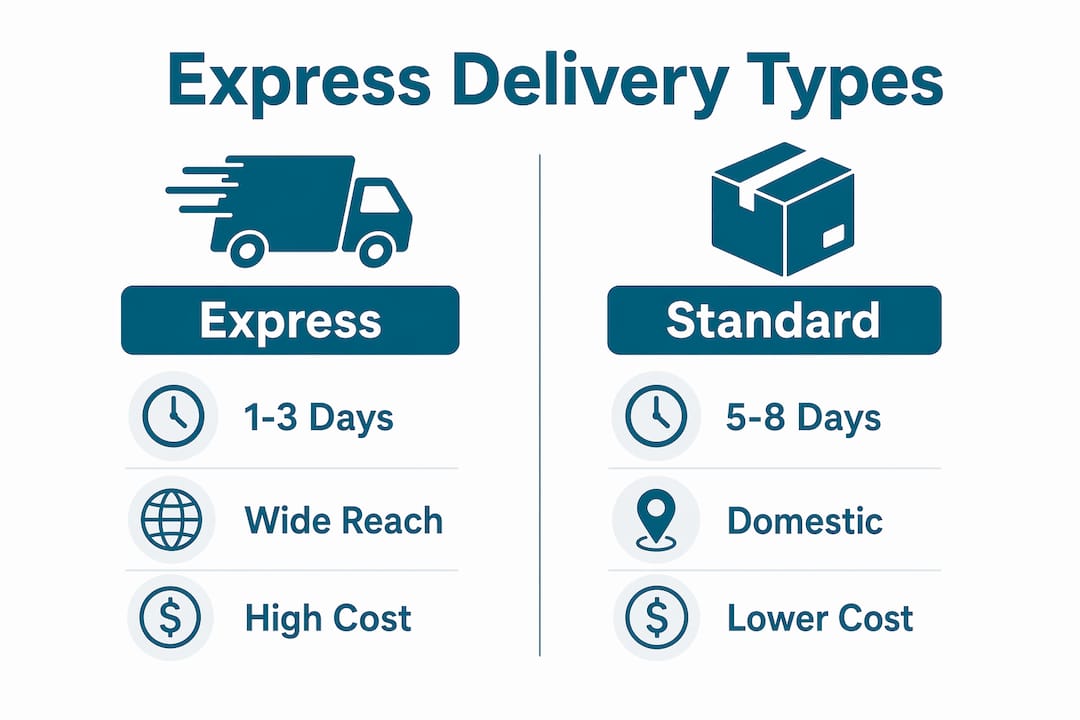
Express delivery is defined as a priority shipping tier that guarantees faster transit times than standard ground shipping, typically completing delivery within 1–3 business days. Standard ground shipping from carriers like UPS Ground or FedEx Ground averages 5–8 business days. That gap is the core value proposition of express services.

The confusion usually starts when people mix up express, expedited, and same-day delivery. These are three distinct service tiers, not interchangeable labels. Merchants with multi-tier shipping typically label their fastest option “express” and the middle tier “expedited,” though terminology varies by carrier and platform. Knowing the difference protects you from overpaying or under-delivering.
Same-day delivery is the most misunderstood comparison. Express delivery covers longer distances, while same-day services are limited to local or regional coverage, usually within a single metro area. Same-day delivery also costs 300–500% more than overnight express. That premium buys absolute immediacy, but only if the recipient is close enough to the fulfillment point.
The table below shows how these four shipping types compare across the dimensions that matter most to logistics managers and ecommerce sellers.
| Shipping Type | Transit Time | Geographic Reach | Relative Cost |
|---|---|---|---|
| Standard Ground | 5–8 business days | Nationwide | Lowest |
| Expedited | 2–3 business days | Nationwide | Moderate |
| Express | 1–3 business days | Nationwide/International | High |
| Same-Day | Same calendar day | Local/Regional only | Highest |
The practical takeaway: express delivery is the right choice when you need nationwide or international speed without the local-only constraint of same-day services.
How does express delivery actually work?
Express delivery achieves its speed through dedicated infrastructure that standard shipping does not use. Carriers route express packages through air freight networks, priority sorting hubs, and reserved delivery lanes. A package dropped off before a carrier’s cutoff time enters a separate processing stream that bypasses the slower ground network entirely.
The key features that define express shipping services include:
- Air freight priority: Most overnight and two-day express packages travel by air rather than truck, cutting transit time dramatically on long-distance routes.
- Real-time GPS tracking: Express services include live tracking and delivery guarantees, with some carriers offering insurance coverage up to $50,000 on high-value shipments.
- Money-back guarantees: FedEx, UPS, and DHL all offer refunds if express packages miss the committed delivery window, which standard shipping does not provide.
- Cutoff times: Most carriers require express packages to be tendered by 5:00–6:00 PM local time for next-day delivery. Missing that window pushes delivery back a full business day.
- Zip code eligibility: Carrier route eligibility varies dramatically by zip code. A carrier may offer next-day service to one address but not to one two miles away.
Pro Tip: Before committing to an express service level in your checkout flow, verify lane-level availability with your carrier’s API or rate calculator. Advertising next-day delivery to a zip code your carrier does not serve creates a customer service problem you cannot fix after the order is placed.
Understanding delivery speed’s impact on ecommerce helps you match the right service tier to the right customer promise. Express delivery is not a blanket solution. It works best when the origin, destination, and carrier network all align.
What does express delivery cost?
Express delivery costs more because it uses faster, more resource-intensive transport modes and requires priority handling at every stage. As of january 2026, shipping rates increased an average of 5.9% across major carriers. That increase compounds on top of already-premium express pricing.
Overnight express starts around $28 for a small domestic package and can exceed $150 for heavier or time-sensitive shipments. The table below shows approximate cost ranges across common express service tiers.
| Service Tier | Carrier Example | Approximate Cost Range |
|---|---|---|
| Overnight / Next-Day | FedEx First Overnight | $50–$150+ |
| 2-Day Express | UPS 2nd Day Air | $28–$75 |
| International Express | DHL Express Worldwide | $60–$200+ |
| Same-Day (local) | Various regional carriers | $30–$100+ |
These are estimates. Actual rates depend on package weight, dimensions, origin, destination, and any fuel surcharges applied at time of booking.
The cost-versus-speed trade-off is real, but it is not always a disadvantage. For urgent documents, medical supplies, or high-margin products where a delayed shipment means a lost sale, the premium is justified. For low-margin commodity goods, it rarely is.
Pro Tip: Negotiate volume-based express rates directly with your primary carrier. Businesses shipping more than 50 express packages per month typically qualify for discounted rate tiers that are not published on carrier websites.
Tracking ecommerce shipping trends in 2025 and 2026 shows that rate increases are not slowing down. Locking in contract pricing before annual general rate increases take effect is one of the most effective ways to control express shipping costs.
When should you use express delivery?
Express delivery solves a specific problem: the customer needs the package fast, and standard shipping cannot deliver on that promise. A 2025 study found that 86% of consumers define fast delivery as two days or less, and 63% expect it as a baseline for online shopping. That expectation creates direct pressure on ecommerce sellers to offer express options at checkout.
The scenarios where express shipping services deliver the clearest return on investment include:
- Urgent documents and legal filings: Law firms, financial institutions, and government contractors regularly ship time-sensitive materials where a missed deadline has legal or financial consequences.
- Perishable goods: Food, flowers, and pharmaceuticals require fast transit to maintain product integrity. Express delivery reduces the window for spoilage.
- Last-minute gifts and seasonal demand: Holiday periods drive a spike in express shipping volume. Retailers who offer express checkout options during peak seasons capture sales that competitors without that option lose.
- High-value electronics and luxury goods: Express shipping reduces the time a package spends in transit, which directly reduces exposure to loss or damage.
- B2B replenishment: Manufacturers and wholesalers use express tiers to fill urgent inventory gaps when standard lead times would cause a production stoppage.
Failing to offer express options creates what logistics professionals call an expectation gap. Consumer demand for fast delivery means that merchants without express options lose sales to competitors who have them. For logistics managers, the KPIs to track are on-time delivery rate, cost per express shipment, and the ratio of express to standard shipments. Monitoring those three metrics tells you whether your express tier is being used efficiently or just absorbing margin.
Reviewing common logistics challenges in 2025 shows that express delivery adoption is growing, but so are the operational complexities that come with managing multiple shipping tiers simultaneously.
Key takeaways
Express delivery is the most reliable way to meet the two-day delivery expectation that 86% of consumers now treat as a baseline for online shopping.
| Point | Details |
|---|---|
| Core definition | Express delivery moves packages in 1–3 business days using air freight and priority handling. |
| Not the same as same-day | Same-day delivery is local only and costs 300–500% more than overnight express. |
| Verify lane availability | Carrier express coverage varies by zip code, so confirm route eligibility before advertising a service level. |
| Cost is rising | Shipping rates increased 5.9% in early 2026; negotiate volume contracts to control express costs. |
| Strategic use cases | Express delivery pays off for urgent documents, perishables, high-value goods, and B2B replenishment. |
The part most sellers get wrong about express delivery
I have worked with ecommerce sellers across dozens of product categories, and the most common mistake I see is treating express delivery as a binary on/off switch. Either they offer it for everything, which destroys margin, or they do not offer it at all, which costs them sales during peak demand windows.
The smarter approach is conditional express. Offer express shipping as a paid upgrade at checkout, but build your fulfillment process so that standard orders ship fast enough to meet baseline expectations. That way, express becomes a revenue line rather than a cost center.
The second mistake is trusting carrier marketing over carrier data. A carrier’s website may show next-day availability for your zip code, but actual route-level eligibility can differ from what the general rate card suggests. I have seen sellers promise next-day delivery, book the shipment, and then discover the carrier’s actual cutoff for that lane was two hours earlier than expected. The customer service fallout from that is disproportionate to the original shipping cost.
The future of express delivery is not just faster. It is more transparent. Real-time tracking, proactive delay notifications, and accurate delivery windows are becoming table stakes. Sellers who invest in shipment tracking basics alongside their express tier will outperform those who treat tracking as an afterthought. Speed gets the sale. Visibility keeps the customer.
— Maayan
How Or-ner supports your express shipping strategy
Or-ner gives ecommerce sellers and logistics managers the tools to book, track, and manage express shipments without juggling multiple carrier portals. The platform connects freight booking, real-time tracking, and customs clearance in one place, which matters when you are managing time-sensitive shipments across multiple carriers and lanes.
If you are building or refining your express shipping process, Or-ner’s freight booking practical guide walks you through carrier selection, rate comparison, and cutoff time management step by step. For sellers scaling into cross-border express shipping, Or-ner’s global warehouse network and customs support reduce the friction that typically slows international express orders. Start with the guide, then connect with Or-ner’s team to map the right express tier to your specific product categories and customer base.
FAQ
What is the standard definition of express delivery?
Express delivery is a premium shipping service that transports packages within 1–3 business days using air freight and priority handling. It is faster than standard ground shipping, which typically takes 5–8 business days.
How is express delivery different from expedited shipping?
Express delivery is the fastest tier, while expedited shipping is a middle tier that is faster than standard but slower than express. The exact distinction depends on the carrier or merchant’s service structure.
Does express delivery guarantee on-time arrival?
Express delivery includes a delivery commitment, but it is not an absolute guarantee. Factors like route eligibility, carrier cutoff times, and weather can affect actual delivery, though most major carriers offer money-back policies for missed windows.
Why does express delivery cost more than standard shipping?
Express delivery uses air freight, priority sorting, and dedicated delivery routes, all of which cost more to operate than standard ground networks. As of early 2026, express rates start around $28 and can exceed $150 depending on weight and destination.
When does express delivery make financial sense for ecommerce sellers?
Express delivery makes financial sense for high-margin products, perishable goods, urgent B2B replenishment, and seasonal peak periods when losing a sale to a competitor costs more than the express shipping premium.