
Shipping and order fulfillment can make or break an online business. Some tools promise everything in one place while others focus on moving packages faster or making shipping easier to manage. Each service takes a different path to help you deliver on time and keep customers happy. The way you choose to handle logistics shapes how smoothly your business runs and how well you compete with others. Curious which approach matches your needs best and what sets each apart from the rest?
Table of Contents
orner

At a Glance
orner is an end-to-end logistics platform built for ecommerce sellers who need reliable courier services and full supply chain visibility. It combines freight booking, real-time shipment tracking, customs clearance, and fulfillment into a single interface that scales from small merchants to global brands. Fast cross-border shipping is enabled by strategic warehouses in Shenzhen, the US, Canada, Europe, and Australia. In short: if your business depends on predictable international delivery and tight inventory control, orner is engineered for that purpose.
Core Features
orner delivers a cohesive set of capabilities tailored to ecommerce logistics: end-to-end platform coverage from catalog to delivery, real-time shipment tracking with milestone updates and exception management, multi-modal transport support (ocean, air, land, rail), and regional warehousing across major hubs. The platform includes inventory management and full order fulfillment services—pick, pack, storage, labeling, and palletization—with workflows that integrate with major ecommerce operators like Amazon. The interface layers analytics and real-time communication on top of operational tools so you can make data-backed decisions without switching systems.
Pros
- Comprehensive supply chain control: orner consolidates catalog, inventory, fulfillment, and delivery so you manage everything from a single pane of glass. This reduces admin overhead and speeds decisions.
- Fast cross-border fulfillment: Strategic warehouse locations in Shenzhen, North America, Europe, and Australia shorten transit legs and lower landed time for international orders.
- Real-time tracking and exception management: Milestone updates and proactive alerts let you anticipate delays and resolve issues before they hit customer experience.
- User-friendly operations: The platform is built for logistics teams and sellers alike—dashboards and workflows are straightforward, reducing onboarding time.
- Industry-specific solutions: Tailored services for home goods, apparel, toys, footwear, and musical instruments mean handling and packaging are optimized for product type.
Who It’s For
orner is ideal for ecommerce sellers, manufacturers, distributors, wholesalers, and retail businesses that rely on international shipping and need a unified logistics partner. Whether you run a direct-to-consumer brand, manage wholesale accounts, or operate FBA-reliant inventory, orner gives the operational control and visibility required to scale cross-border commerce.
Unique Value Proposition
orner’s unique strength is the tight integration of reliable courier services with full fulfillment and inventory control across cross-border corridors. Unlike point solutions that only track or only fulfill, orner stitches freight booking, customs clearance, warehousing, and last-mile delivery into a single workflow—backed by analytics and real-time communication. That reduces handoffs, cuts exception resolution time, and improves delivery predictability. This design choice favors end-to-end reliability over fragmented vendor stacks—an explicit advantage when your KPI is on-time international delivery.
Real World Use Case
A retailer uses orner to coordinate shipments from factories to regional warehouses, monitor transit milestones in real time, and route orders to the closest fulfillment center for rapid last-mile delivery—resulting in fewer delays, lower shipping costs, and clearer customer communication.
Pricing
Not specified on the website.
Website: https://or-ner.com
DCS Delivery

At a Glance
DCS Delivery is a same‑day courier specialist focused on urgent, time‑sensitive shipments across several U.S. states. The service emphasizes personalized account management, professional drivers, and an adaptable vehicle fleet that supports emergency and scheduled deliveries. If your operation needs reliable, hands‑on courier support with real‑time visibility, DCS presents a straightforward, customer‑centric option — but expect to contact sales for pricing and detailed coverage limits.
Core Features
DCS Delivery centers on same‑day courier delivery and scheduled pickup/drop‑off options, supported by a mix of vehicle types to match parcel size and urgency. The platform highlights expert drivers experienced in emergency/stat deliveries and uses industry technology for order placement, communication, tracking, and proof of delivery. Each client gets a dedicated account manager to coordinate service changes, expansions, and a single point of contact for escalations.
Pros
- Reliable same‑day capability: DCS prioritizes time‑critical deliveries, providing a clear advantage for urgent logistics needs across its coverage states.
- Customer‑centric account management: Dedicated account managers reduce friction by consolidating communications and enabling faster decision cycles for order changes.
- Experienced drivers for emergency work: The company’s focus on expert drivers improves handling of high‑priority or sensitive shipments, which lowers the risk of misdelivery.
- Advanced tracking and communication: Built‑in technology for order placement through proof of delivery increases transparency and reduces phone‑tag.
- Flexible vehicle fleet: Multiple vehicle options let you match transport mode to package size and delivery urgency, avoiding wasted fees for oversized resources.
Cons
- Pricing not published: The website does not specify rates, forcing prospective users to request quotes for cost comparison and budgeting.
- Geographic scope unclear beyond listed states: While DCS lists California, Arizona, Florida, Texas, and Washington, there is limited detail on exact city coverage or service boundaries within those states.
- No industry or certification detail: The product data doesn’t specify industry verticals served (e.g., healthcare, legal, retail) or certifications that could matter for regulated shipments.
Who It’s For
DCS Delivery suits businesses that require dependable, same‑day courier service with a human touch: think clinics, labs, parts suppliers, and retail operations with urgent returns or replenishment needs across California, Arizona, Florida, Texas, and Washington. If you value an assigned account manager and real‑time proof of delivery over DIY platforms, DCS is a practical match.
Unique Value Proposition
DCS differentiates on personalized service: pairing emergency‑ready drivers and a multi‑vehicle fleet with assigned account management and technology that traces shipments from order to POD. That combination aims to reduce complexity for time‑sensitive logistics and keep a single person accountable for service continuity.
Real World Use Case
A healthcare clinic in California needs same‑day delivery of critical supplies across town. DCS assigns a dedicated account manager, dispatches an appropriate vehicle with an expert driver, and provides real‑time tracking plus proof of delivery — ensuring supplies arrive the same day with minimal administrative overhead.
Pricing
Not specified on the website
Website
Website: https://dcsdelivery.com
tdy cargo
At a Glance
tdy cargo is an Israeli cross-border logistics provider with over 40 years of hands-on experience, offering sea and air freight, customs brokerage, warehousing, packing and trade advisory under one roof. Its strength is a full-service, personalized approach that handles complex and regulated cargo while leveraging a long-standing partner network. If you need an experienced one-stop operator that can manage end-to-end international shipments, tdy cargo belongs on your short list.
Core Features
tdy cargo’s core capabilities include ocean and air freight forwarding for goods and consignments, customs brokerage for imports and exports, flexible short- and long-term storage solutions, packing and logistics sales services, and consulting on costs and international trade. The company positions itself as a comprehensive platform for clients both domestically and abroad, combining operational handling with advisory support to guide cost-efficient routing and regulatory compliance.
Clear. Practical.
Pros
- Deep industry experience: With more than 40 years of activity, tdy cargo brings institutional knowledge that helps anticipate customs and routing issues before they become costly delays.
- Comprehensive one-stop services: The combined offering of freight, customs, warehousing, packing, and advisory reduces handoffs and simplifies vendor management for your supply chain.
- Specialized cargo capability: The company has documented experience handling specialized and complex shipments, which reduces risk when your goods require certifications or unusual handling.
- Extensive partner network: A long partner network across airlines, shipping lines and freight agents increases routing options and resilience across transport modes.
- Strategic geographic locations: Geographically positioned operations enable operational efficiency and can shorten transit or handling times for key trade lanes.
Cons
- Service selection complexity for new customers: The breadth of options can be overwhelming for first‑time clients, making the onboarding and service selection process more complicated than with simpler providers.
- Potentially higher costs in some markets: Pricing can be relatively expensive in certain regions, which may reduce attractiveness for highly price-sensitive shippers.
- Exposure to global market volatility: Like any international forwarder, availability and service levels can be affected by shifts in the global market, which may impact lead times and capacity.
Who It’s For
tdy cargo is best suited for businesses that need professional, personalized international logistics support—importers, exporters, startups scaling globally, and companies with regulated or complex cargo requiring specialist handling. If you want a single partner to manage customs clearance, storage and multi‑modal transport across the full shipment lifecycle, this provider fits that profile.
Unique Value Proposition
tdy cargo’s unique value lies in combining four decades of industry experience with a vertically integrated service set—freight, customs, warehousing, packing and trade consulting—backed by a broad partner network. That combination enables tailored logistics solutions for complex shipments while keeping communication and accountability centralized.
Real World Use Case
An importer relies on tdy cargo to coordinate an international supply flow: door pickup, ocean freight, customs clearance, long-term storage, and final distribution to overseas customers. tdy cargo manages approvals and documentation at every stage and provides ongoing advisory to reduce landed cost and compliance risk.
Pricing
Quote-based — prices vary depending on service type, shipment volume, destination and cargo complexity.
Website: https://tdycargo.com
ShipBob
At a Glance
ShipBob is an end-to-end ecommerce fulfillment provider built to help online brands scale with minimal friction. It combines a global warehouse footprint, a warehouse management system with real-time inventory tracking, and wide ecommerce integrations to reduce shipping costs and speed delivery. If you care about scalability, international reach, and measurable accuracy in fulfillment, ShipBob is a strong contender — though final pricing is quote-based and can vary based on your needs.
Core Features
ShipBob’s core capabilities cover global ecommerce fulfillment, inventory distribution across multiple warehouses, and full order fulfillment services including picking, packing, and shipping. The platform supports 2-day shipping across the continental US and international shipping to 250+ destinations with DDP options. Its WMS provides real-time tracking, while negotiated carrier contracts, returns management, kitting, custom packaging, and branded unboxing experiences round out the operational toolbox. ShipBob also integrates with ecommerce platforms, ERPs, and common storefront tools to keep your sales channels and inventory synchronized.
Pros
- Extensive global warehouse network: With 60+ fulfillment centers, ShipBob reduces transit distances and gives you options for smarter inventory placement.
- Transparent and competitive pricing model: ShipBob offers customized quotes so you pay for the exact services and volumes you need rather than a one-size-fits-all fee.
- Exceptional fulfillment accuracy and reliability: ShipBob reports a 99.97% accuracy rate and 99.6% on-time shipping, which directly lowers customer complaints and re-ship costs.
- Scales with fast-growing brands: The platform’s distribution and operational services are designed to expand as order volume grows without large interruptions.
- Strong integrations and international support: Native connections to ecommerce tools and support for B2B and international shipments simplify cross-border expansion.
Cons
- Quote-based pricing can lack immediate clarity: Because pricing varies by volume and services, you’ll need to request a personalized quote to understand total costs.
- Additional fees for customization: Services like kitting, B2B fulfillment, and branded packaging can incur extra charges beyond base fulfillment fees.
- Optional paid features for brand experience: Some items you might expect included—such as branded packaging or return labels—are offered as optional or add-on services rather than standard.
Who It’s For
ShipBob is best for online retailers and ecommerce brands—from small businesses scaling up to large enterprises—that need reliable, scalable fulfillment with international reach and tight integrations to sales channels and ERPs. If your priority is reducing transit times, centralizing inventory visibility, and supporting cross-border orders, ShipBob fits.
Unique Value Proposition
ShipBob’s strength lies in combining a broad physical network (60+ centers) with a WMS that offers real-time visibility, plus negotiated carrier relationships and integration depth. That combination aims to reduce costs, improve delivery speed, and create a disruption-resistant fulfillment backbone.
Real World Use Case
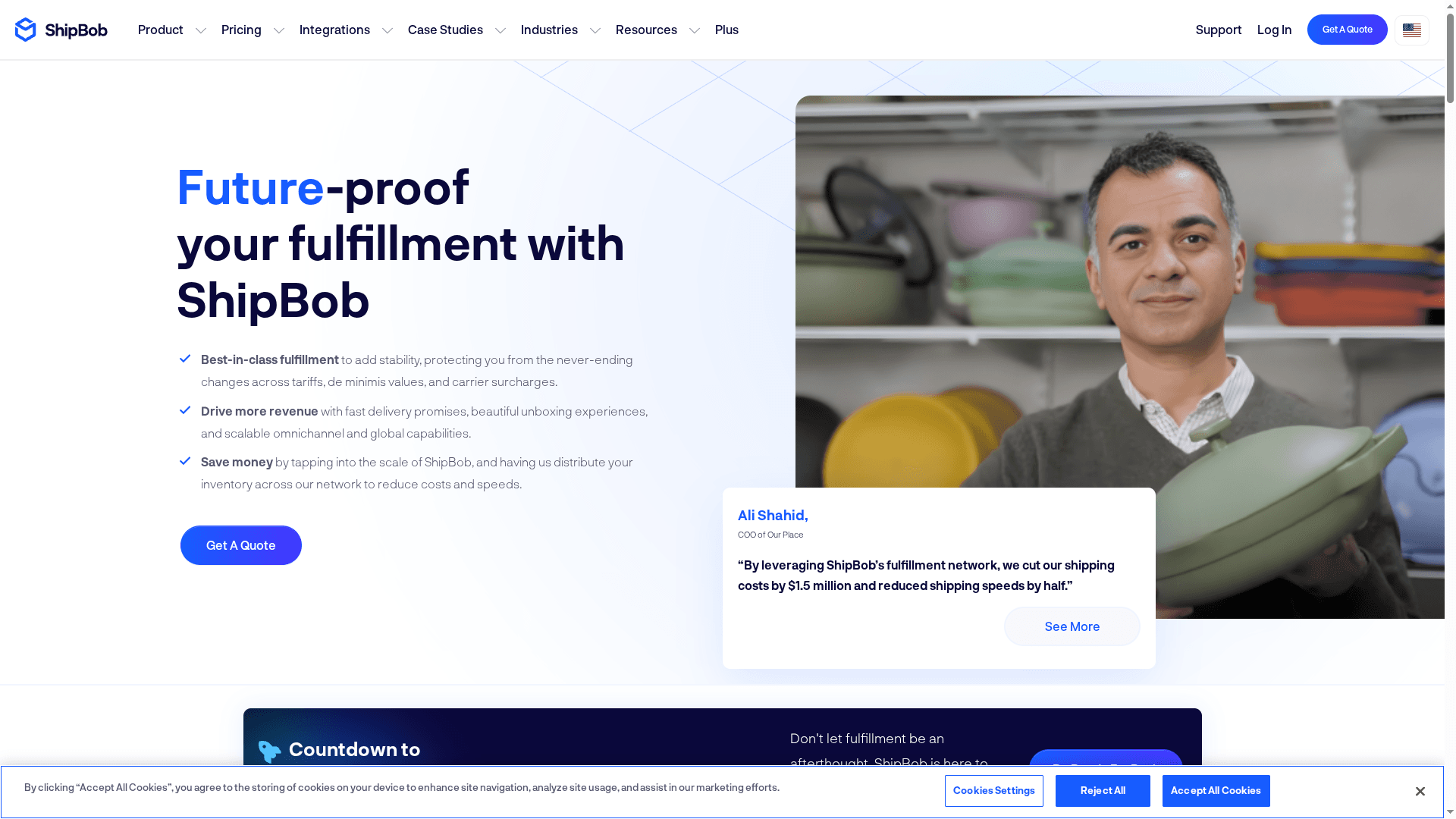
A fast-growing ecommerce brand used ShipBob’s global network to reduce shipping costs by $1.5 million while improving delivery times and customer satisfaction, enabling efficient scale-up without major operational upheaval.
Pricing
Quote-based (customized pricing based on order volume, product categories, warehousing, picking/packing, and shipping options).
Website: https://shipbob.com
Flexport
At a Glance
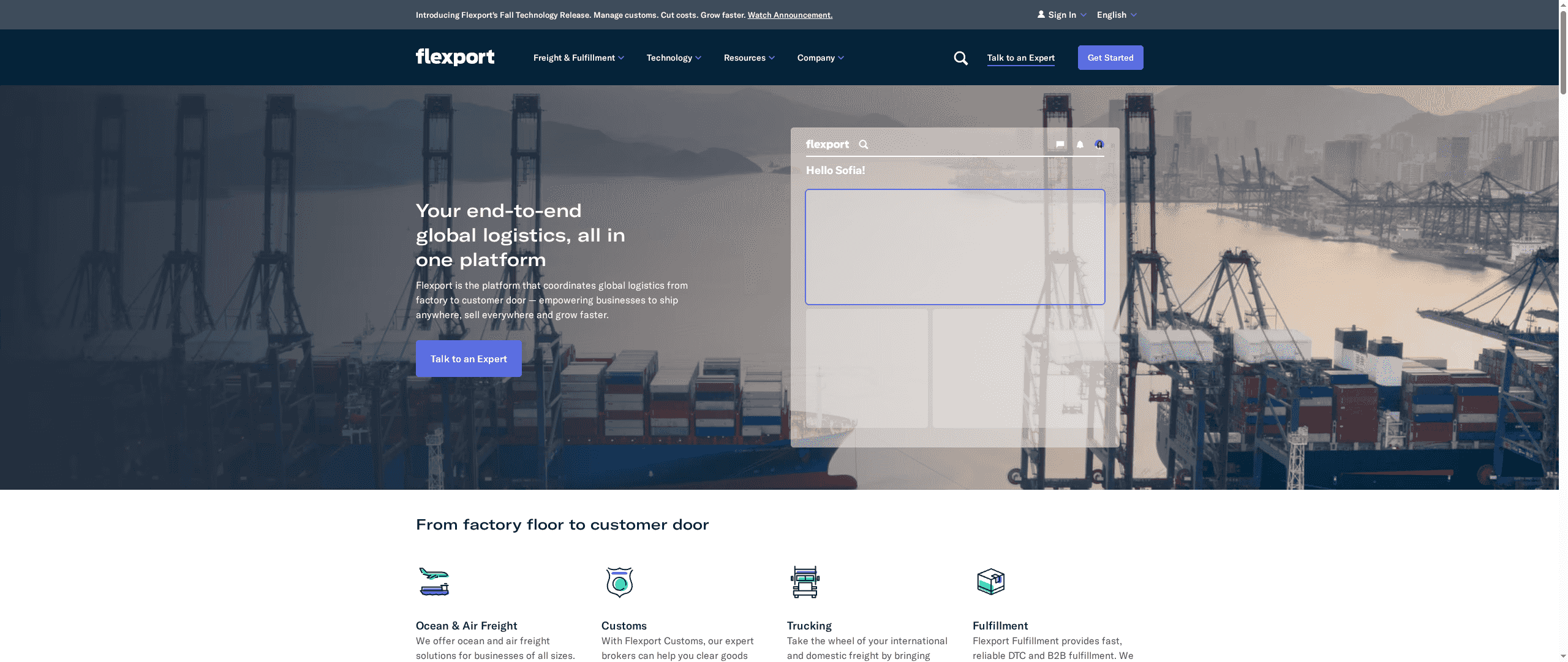
Flexport is an end-to-end global logistics platform that coordinates supply chain activities from factory to customer door, combining ocean and air freight, customs brokerage, trucking, and fulfillment with integrated technology and expert support. The platform is built for businesses that need visibility and control across complex, multi-leg shipments. If you need centralized oversight of inventory, customs, and final-mile delivery, Flexport delivers a single-pane workflow—though it can be heavier than necessary for very simple, low-volume use cases.
Core Features
Flexport’s core capabilities center on full lifecycle logistics: ocean and air freight booking, customs brokerage, integrated domestic and international trucking, and fulfillment services with ecommerce integration. The platform emphasizes real-time shipment tracking and SKU-level visibility, plus data-driven demand planning and inventory management tools designed to digitize and streamline processes. In short: it stitches freight, customs, warehousing, and last-mile into one platform so operations teams can see and act on a single source of truth.
Pros
- Comprehensive end-to-end logistics services in one platform: Flexport brings freight, customs, trucking, and fulfillment into a unified workflow so you don’t have to stitch multiple vendors together.
- Real-time visibility of shipments and inventory: The platform provides SKU-level tracking and shipment status updates to reduce blind spots across the supply chain.
- Technologically advanced with data digitization for control and transparency: Flexport digitizes paperwork and operational data to help teams analyze performance and make faster decisions.
- Strong customer support and expertise in customs and global trade: The service pairs technology with expert support to navigate regulatory complexity and customs clearance.
- Integrated solutions for freight, customs, trucking, and fulfillment: A connected stack reduces handoffs and simplifies exception management across multiple transport modes.
Cons
- Complexity may be overwhelming for very small or simple shipments: The platform’s breadth and feature set can introduce unnecessary overhead for sole proprietors or low-volume sellers.
- Pricing details are not specified openly on the website: You must contact Flexport for a quote, which reduces upfront price transparency for quick comparisons.
- Requires onboarding process to fully utilize platform features: To get full value you’ll likely need implementation and onboarding, which takes time and internal resources.
Who It’s For
Flexport is best for businesses of all sizes that want integrated, technology-driven global logistics—especially mid-market and enterprise sellers with complex supply chains, multi-leg ocean or air shipments, frequent cross-border customs interactions, and a need for centralized visibility and inventory control.
Unique Value Proposition
Flexport’s unique value lies in combining expert customs and trade knowledge with a digitally native control layer that spans freight, trucking, and fulfillment. That combination helps teams reduce manual reconciliation, surface exceptions earlier, and maintain SKU-level visibility from factory to customer.
Real World Use Case
A retail company uses Flexport to manage ocean freight from overseas factories, handle customs clearance, move goods via domestic trucking to regional warehouses, and complete final delivery to customers—leveraging real-time tracking and integrated data to reduce delays and improve inventory planning.
Pricing
Quote-based; pricing is not publicly specified and potential clients are encouraged to contact Flexport for a personalized quote.
Website: https://flexport.com
Easyship
At a Glance
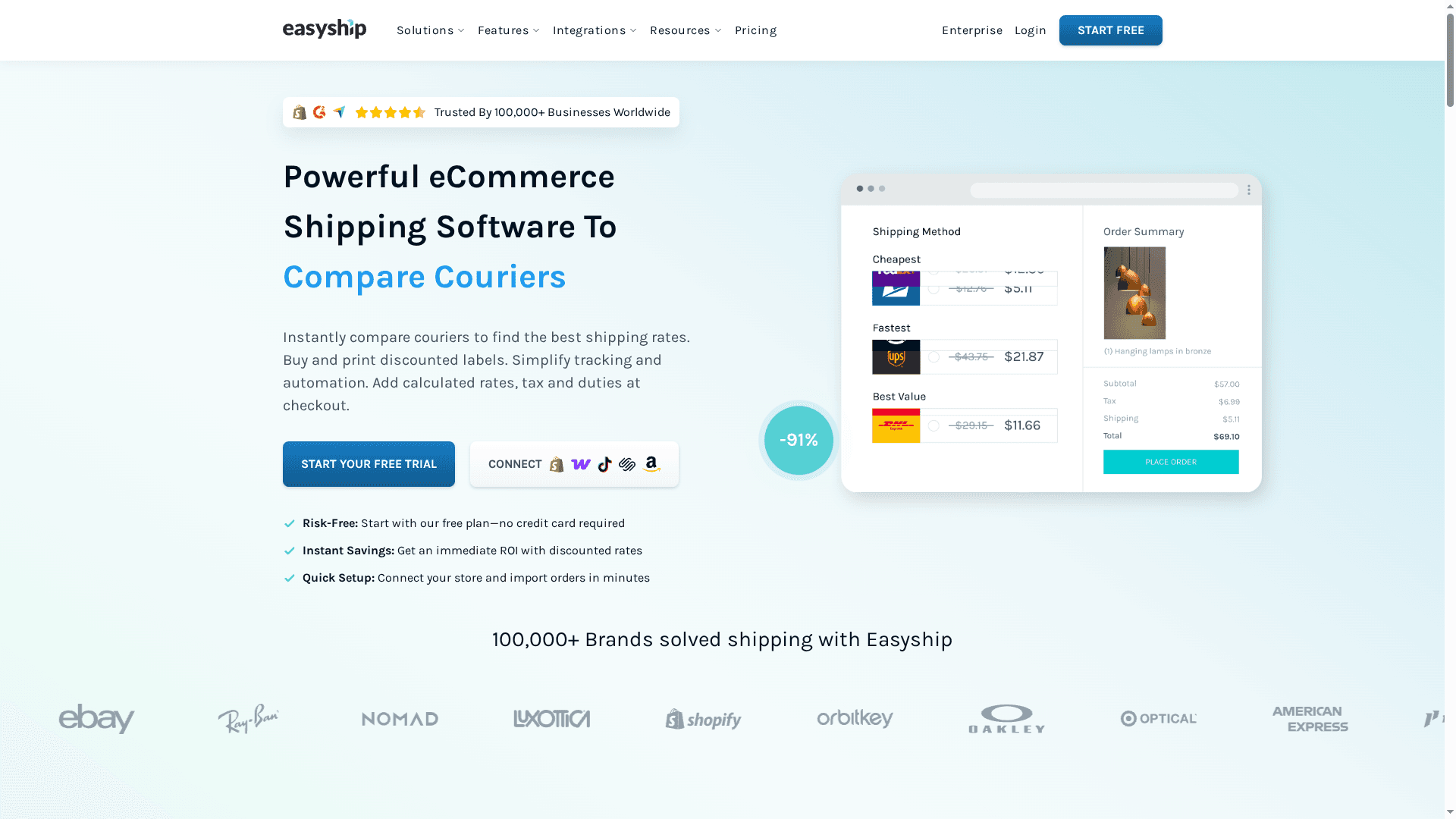
Easyship is a multi-carrier shipping platform that helps ecommerce businesses compare rates, buy discounted labels, and automate international and domestic shipments. Its biggest selling points are deep carrier coverage — over 550 courier services — and headline discounts of up to 91% on labels, which can materially lower your landed costs. The interface is built for quick store integration and fast label generation, but you should factor in plan tiers and a learning curve for advanced automation. Bottom line: a cost-focused, scalable shipping engine for sellers who want to centralize international logistics without building it themselves.
Core Features
Easyship provides an end-to-end shipping stack: instant comparison across 550+ couriers, discounted label purchasing and printing, automated workflows for batch label generation, and tax/duties calculation for international clearance. It integrates with over 60 native ecommerce platforms and marketplaces, supports a global 3PL and fulfillment network, and consolidates tracking and branded customer experiences. Those capabilities combine to reduce manual touchpoints and shorten time-to-ship for retailers handling cross-border orders.
Pros
- Deep carrier selection and savings: Easyship lets you compare more than 550 courier services and access discounts up to 91%, which can sharply cut unit shipping costs.
- Label purchasing and automation: You can buy and print discounted labels and automate common workflows, speeding fulfillment and reducing repetitive tasks.
- Strong ecommerce integrations: With over 60 native integrations, it’s straightforward to connect online stores and marketplaces and start shipping within minutes.
- Built for international trade: Automatic calculation of taxes, duties, and tariffs simplifies customs clearance and reduces surprises at delivery.
- Global fulfillment footprint: A network of 3PL and fulfillment centers helps optimize routing, delivery speed, and total landed cost for cross-border shipments.
Cons
- Limited explicit drawbacks listed in source materials: The provided product data does not list concrete technical weaknesses or performance limitations, so you’ll need to validate fit for your specific stack.
- Potential additional costs for advanced features: Higher-tier plans or add-on capabilities are implied and may add expense, but exact pricing details are not specified here.
- Requires shipping-savvy users for best results: To unlock advanced automation and tariff handling you’ll need someone familiar with ecommerce logistics and customs workflows.
Who It’s For
Easyship is ideal for ecommerce retailers, online store owners, and high-volume brands that need a centralized way to compare carriers, reduce per-shipment costs, and scale international fulfillment. If you manage cross-border orders or operate multiple marketplaces, Easyship gives you the tools to automate shipping and unify tracking without a custom integration project.
Unique Value Proposition
Easyship’s unique value is the combination of massive carrier choice, significant label discounts, and built-in customs/tax calculations that together lower cost and complexity for cross-border sellers. It acts as a one-stop shipping control tower for brands that prioritize cost optimization and operational scale.
Real World Use Case
An online retailer connects their storefront to Easyship, runs rate comparisons across carriers for each order, purchases discounted labels in batches, and uses automation rules to route specific SKUs to regional 3PLs—cutting shipping spend and delivering real-time tracking to customers.
Pricing
Offers a free plan with basic features and professional plans with additional features, including a 14-day free trial for paid plans.
Website: https://easyship.com
Shiprocket
At a Glance
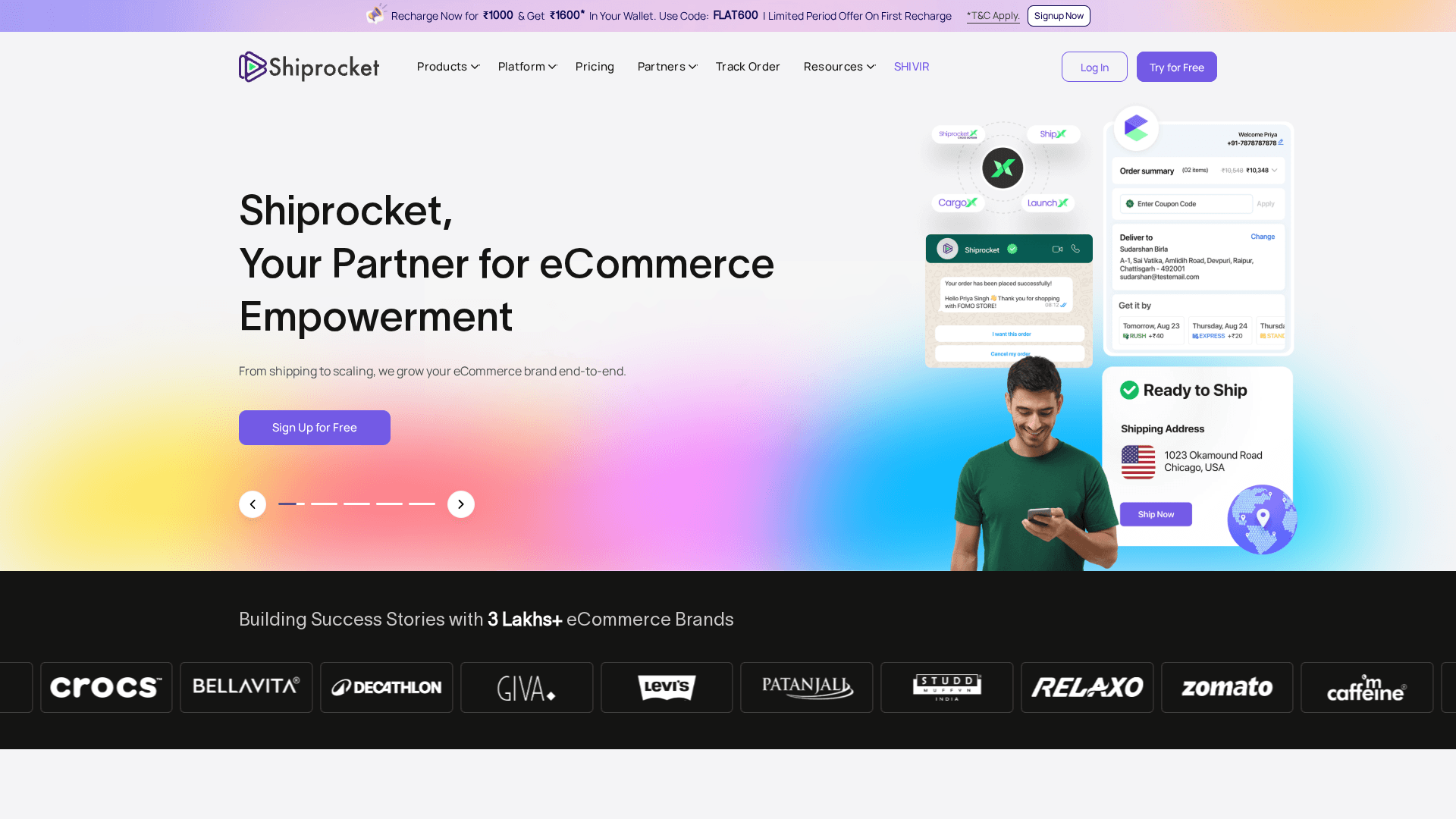
Shiprocket is an all-in-one ecommerce growth platform that bundles shipping, fulfillment, marketing, and financial tools into a single suite designed for brands that want to scale domestically and internationally. It’s strong on integration and automation, with AI-powered marketing and a large logistics footprint that supports both parcel and bulk shipments. If you want a platform that bridges shipping, warehousing, and growth tools, Shiprocket is compelling — but its breadth can be overwhelming if you only need basic courier services.
Core Features
Shiprocket combines unified domestic shipping (notably quoted at ₹20/500gms) and nationwide B2B cargo starting at ₹6/kg with end-to-end fulfillment services including warehousing, packaging, and shipping. For cross-border needs it offers multiple lanes through Shipx, Cargox, and Launchx. On the technology side, Shiprocket provides AI-driven marketing tools — Checkout optimization, Engage360, Promise badges, and Trends insights — plus integrative APIs and digital platform integrations. Financial services such as credit score checks and capital support are also part of the stack.
Pros
- End-to-end coverage: Shiprocket provides a full lifecycle solution from domestic and cross-border shipping to warehousing, packaging, and post-purchase marketing, which reduces the need for multiple vendors.
- Clear pricing anchors for volume shipping: Publicized rates like ₹20/500gms for parcel and ₹6/kg for bulk cargo give quick visibility into core shipping economics.
- Large reach and scale: With coverage across 19,000+ pin codes and presence in 220+ countries, the network supports rapid geographic expansion.
- Technology-led efficiency: AI-powered marketing, API integrations, and platform automation can cut manual tasks and improve conversion and fulfillment speeds.
- Proven market adoption: Service adoption by 3 lakh+ ecommerce brands indicates a mature platform with real-world reliability and feature depth.
Cons
- Complexity for small sellers: The platform’s wide service scope can be overwhelming for merchants who only need a straightforward courier solution.
- Higher-touch features may cost more: Customized plans and advanced services often require consultations or larger investments, which may not fit tight startup budgets.
- Limited plan transparency: While headline rates are listed, a detailed side-by-side comparison of specific plan inclusions and incremental costs is not provided in the dataset, making apples-to-apples evaluation harder.
Who It’s For
Shiprocket is best for ecommerce retailers, D2C brands, and wholesalers that plan to scale sales channels and geography and who value a single integrated partner for shipping, fulfillment, marketing, and finance. It suits teams ready to leverage automation and data-driven tools rather than those seeking the cheapest point-to-point courier.
Unique Value Proposition
Shiprocket’s unique value is its convergence of logistics and growth tools: it doesn’t only move packages, it helps you convert and finance the business around those packages. That convergence reduces platform friction and gives you a single dashboard for fulfillment, marketing, and capital decisions.
Real World Use Case
A small D2C apparel brand uses Shiprocket to warehouse inventory regionally, ship domestically with unified pricing, run AI-driven cart and post-purchase campaigns, and open cross-border lanes when a new market proves demand — all while drawing short-term capital from integrated financial services.
Pricing
Starting at Free (free tier available) with paid plans and custom pricing based on scale and feature needs.
Website: https://shiprocket.in
ShipStation
At a Glance
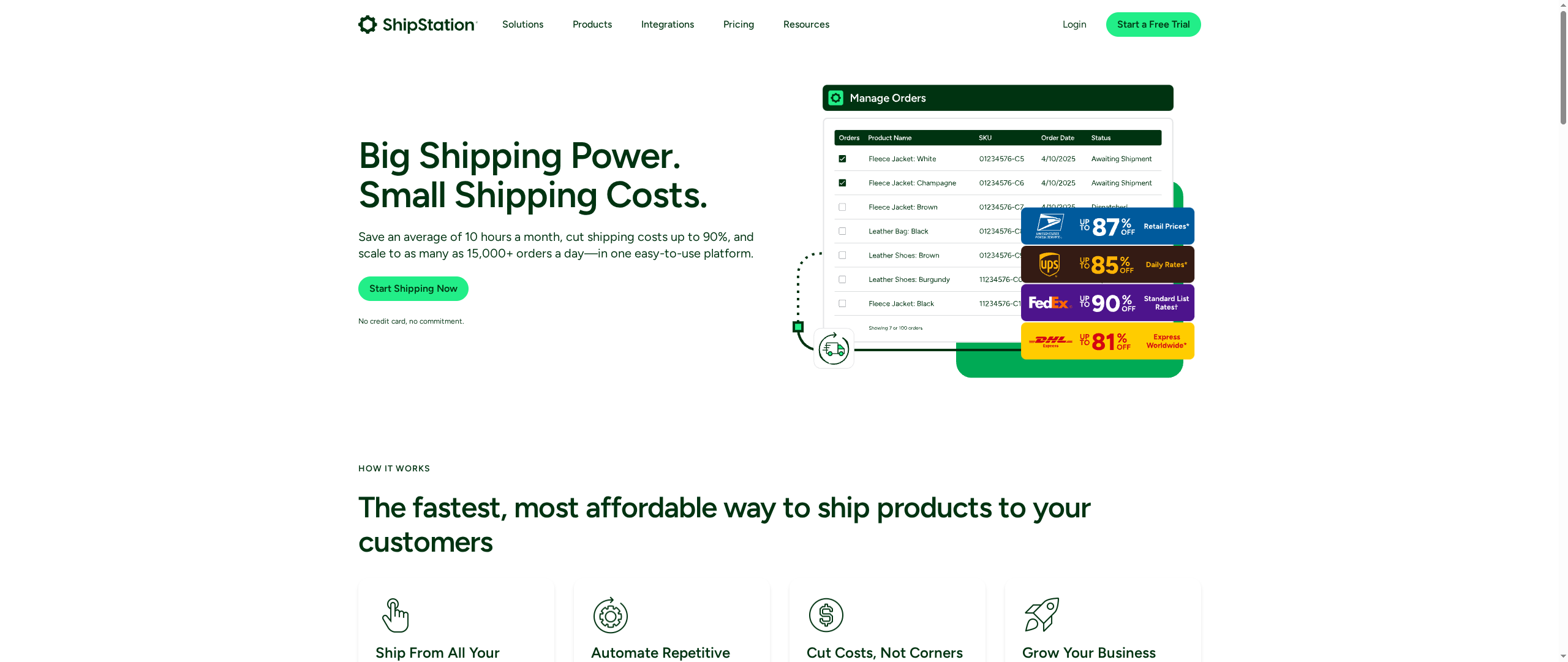
ShipStation is a mature shipping software platform aimed at ecommerce fulfillment that centralizes order management, automation, inventory, and returns across channels. In short: it reduces manual work and can drive meaningful shipping cost savings while scaling from small sellers to larger operations. It’s powerful, sometimes complex, and best suited to businesses prepared to invest time in setup and optimization.
Core Features
ShipStation combines core capabilities you expect from a cross-border shipping solution: rate shopping and label buying, integrations with numerous carriers and ecommerce platforms, order management with automation rules, inventory and warehouse management, plus branded returns and exchanges. The platform’s automation engine routes orders, prints labels, and triggers customer-facing tracking and returns flows so you can reduce touchpoints and error rates. A free trial is available for testing before committing.
Pros
- Helps cut shipping costs significantly, with potential savings up to 90%, which can have immediate ROI for high-volume shippers.
- Automates repetitive tasks and reduces human error, letting fulfillment teams focus on exceptions rather than routine label printing.
- Supports a large number of integrations and carriers, enabling you to consolidate multiple stores and channels into a single workflow.
- Scalable plans for businesses of all sizes mean you can start small and expand without swapping platforms.
- Provides branded customer experiences for tracking and returns, which improves post-purchase communication and customer satisfaction.
Cons
- Pricing varies and can be expensive for larger volume plans when advanced features or higher shipment allowances are required.
- Advanced features may require higher-tier plans, so some useful automation and reporting tools are behind paywalls.
- Some users may find setup and integration complex, which creates an upfront implementation time and potential need for specialist support.
Who It’s For
ShipStation fits ecommerce businesses from small merchants testing multi-channel fulfillment up to mid-sized retailers that need consolidated shipping workflows. If you sell across multiple marketplaces and want to centralize label buying, automation, and branded returns, ShipStation is a practical choice. If you’re looking for low-touch plug-and-play without customization, plan for some setup time.
Unique Value Proposition
ShipStation’s strength is consolidation: it unifies rate shopping, carrier access, order orchestration, and customer-facing returns in one platform so you can manage multiple stores and channels from a single pane. That consolidation, combined with automation, is what drives the platform’s cost savings and operational speed.
Real World Use Case
A mid-sized ecommerce retailer routes orders from multiple online stores into ShipStation, automates label printing and carrier selection, and publishes branded tracking pages and returns portals. The result: fewer manual steps, lower average shipping cost per order, and a smoother post-purchase experience for customers.
Pricing
Starting at $14.99/month; free for basic use with limited shipments, and plans scale up to $349.99/month for larger businesses with advanced needs.
Website: https://shipstation.com
Logistics and Fulfillment Solutions Comparison
This table compares various logistics and fulfillment platforms, focusing on their features, pros and cons, pricing, and suitability for different business needs.
| Platform | Features | Pros | Cons | Pricing |
|---|---|---|---|---|
| orner | End-to-end logistics, real-time tracking, multi-modal transport | Comprehensive control, fast cross-border, user-friendly | Pricing not specified | Not specified |
| DCS Delivery | Same-day courier, scheduled pickup/drop-off, dedicated managers | Reliable service, customer-centric, experienced drivers | Pricing and geographic scope unclear | Contact sales |
| tdy cargo | Sea/air freight, customs brokerage, trade advisory | Deep experience, one-stop services, specialized handling | Complexity for new customers, potentially higher costs | Quote-based |
| ShipBob | Global fulfillment, real-time inventory, international shipping | Extensive warehouse network, competitive pricing, high accuracy | Quote-based, optional paid features | Quote-based |
| Flexport | Ocean/air freight, customs, integrated trucking/fulfillment | Comprehensive services, real-time visibility, strong customer support | Complexity for small shipments, onboarding required | Quote-based |
| Easyship | Multi-carrier comparison, discounted labels, automation | Deep carrier selection, strong integrations, built for international trade | Advanced features may cost more, requires savvy users | Free plan + Paid plans |
| Shiprocket | Domestic/cross-border shipping, AI marketing, financial tools | End-to-end coverage, large reach, tech-led efficiency | Complexity for small sellers, limited plan transparency | Starting at Free |
| ShipStation | Order management, automation, branded returns | Significant cost savings, scalable plans, large carrier integrations | Pricing can be expensive, complex setup | $14.99/month onwards |
Elevate Your Cross-Border Shipping with Reliable Courier Services from ORNER
Navigating the complexities of international logistics can feel overwhelming. Many ecommerce sellers face unpredictability in transit times, lack of end-to-end visibility, and scattered vendor management. The article reveals these pain points clearly in its expert comparison highlighting the need for integrated freight booking, customs clearance, and fulfillment solutions that ensure timely delivery and streamlined inventory control. With ORNER, experience how combining reliable courier services with full supply chain visibility transforms your cross-border shipping from a challenge into a competitive advantage. Our platform is designed to reduce delays, cut down on exception handling, and empower sellers with real-time data and seamless workflows.
Whether you operate in home goods, apparel, or specialty products, ORNER’s strategic warehouse network and multi-modal transport support cater to your unique business needs. Explore how to simplify your logistics journey and keep your customers satisfied with reliable delivery.
Looking for answers to your logistics questions? Check out our QA Archives – ORNER for expert insights and practical advice.
Ready to take control of your cross-border shipments today Discover the advantage of reliable courier services integrated with advanced fulfillment and tracking. Visit ORNER now to see how we can support your ecommerce growth and provide the operations visibility you need to scale with confidence.
Frequently Asked Questions
What are the key features to consider in cross-border shipping solutions?
When evaluating cross-border shipping solutions, look for features such as real-time tracking, customs clearance support, and integrated logistics management. Prioritize platforms that offer comprehensive visibility and can consolidate shipping processes.
How can I reduce shipping costs when choosing a cross-border shipping provider?
To lower shipping costs, compare rates across multiple providers and look for platforms that offer bulk pricing or discounted rates for high-volume shipments. Negotiate contracts based on estimated shipping volumes to maximize savings.
What is the typical delivery timeframe for cross-border shipping solutions?
Delivery times for cross-border shipping can vary widely based on service levels and destinations, often ranging from a few days to a couple of weeks. Aim for solutions that provide estimated shipping times during the booking process to set accurate delivery expectations.
How can I ensure compliance with customs regulations when shipping internationally?
To ensure compliance, choose a shipping solution that includes customs brokerage and offers guidance on documentation requirements. Maintain clear communication with your provider to address any potential customs issues proactively.
What is the process for tracking packages across borders with shipping solutions?
Most cross-border shipping platforms offer real-time tracking, allowing you to monitor shipment status and locations. Utilize the tracking interface provided by your chosen solution to receive updates at key milestones throughout the shipping journey.
How do I choose the right cross-border shipping solution for my ecommerce business?
Assess your specific needs, such as shipping volume, product types, and geographic coverage, to determine the right solution. Start by comparing features, pricing, and support options among potential providers to find a match that aligns with your operational goals.