

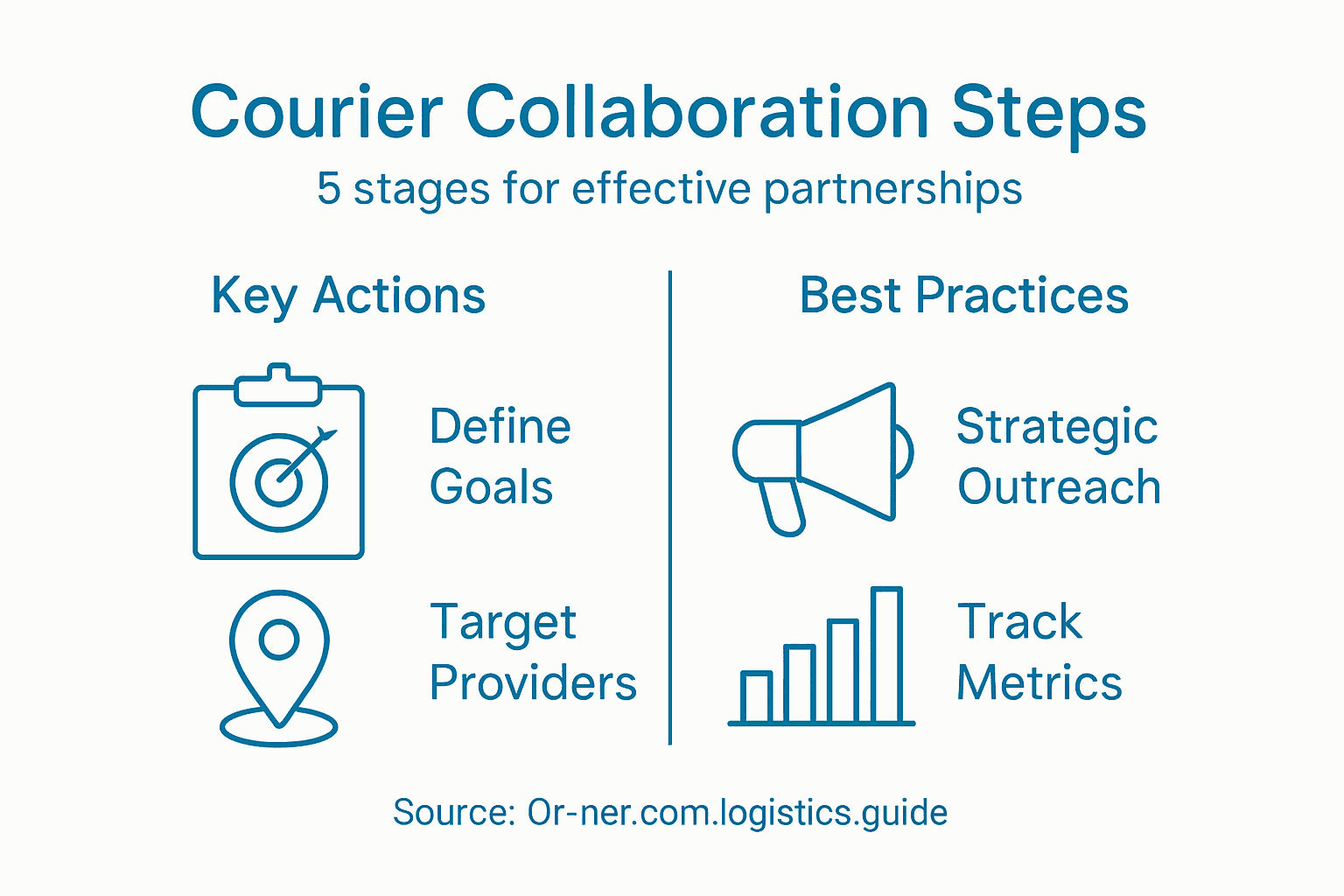
Every American ecommerce logistics manager knows the challenges of building partnerships that actually move the needle for courier reliability and delivery speed. Clear communication and measurable goals make the difference between a basic contract and a resilient logistics network. This guide highlights the strategic alignment principles that set winning collaborations apart, helping you target the right courier partners and cultivate relationships that improve your supply chain from day one.
Table of Contents
- Step 1: Define Logistics Partnership Goals
- Step 2: Identify and Target Key Courier Providers
- Step 3: Initiate Strategic Outreach and Engagement
- Step 4: Establish Collaboration Frameworks
- Step 5: Evaluate and Optimize Network Effectiveness
Quick Summary
| Key Insight | Explanation |
|---|---|
| 1. Define Clear Goals | Establish specific, measurable, achievable, relevant, and time-bound (SMART) objectives for partnerships to drive mutual success. |
| 2. Evaluate Potential Partners | Use a partnership scorecard to assess logistics partners based on technology, scalability, reputation, and cultural fit. |
| 3. Conduct Detailed Assessments | Analyze courier capabilities thoroughly, focusing on delivery speed, reliability, and regional strengths to optimize your logistics network. |
| 4. Foster Genuine Relationships | Engage potential partners through personalized communication while understanding their needs and operational challenges. |
| 5. Implement Continuous Optimization | Regularly track performance and utilize data analytics to identify improvements and enhance service quality in your courier network. |
Step 1: Define logistics partnership goals
Defining clear logistics partnership goals transforms potential collaborations from generic connections into strategic powerhouses for your courier services. Your objectives must go beyond surface level interactions and create measurable, actionable frameworks that drive mutual success.
Successful logistics partnerships start with strategic alignment principles that emphasize shared vision and collaborative targets. Begin by conducting a comprehensive assessment of your current logistics capabilities, identifying gaps where external partnerships could provide significant advantages. Map out specific operational metrics you want to improve such as delivery speed, cost reduction, geographic reach, or technology integration. Your goals should be specific measurable achievable relevant and time bound (SMART), which means quantifying exactly what success looks like.
Carefully evaluate potential logistics partners based on their ability to complement your existing infrastructure and support your business growth trajectory. Consider factors like technological capabilities, industry reputation, scalability, and cultural compatibility. Develop a clear rubric for assessing partnership potential that goes beyond financial considerations and examines long term strategic alignment.
Pro Tip: Create a detailed partnership scorecard with weighted criteria to objectively evaluate and compare potential logistics collaborators before making commitments.
Here’s a summary of key criteria to evaluate when choosing a logistics partner:
| Criteria | Business Impact | Assessment Tip |
|---|---|---|
| Technology Integration | Enables advanced tracking and efficiency | Review partner’s tech stack and API availability |
| Scalability | Supports future growth and expansion | Examine capacity for increased volume |
| Reputation | Reduces operational risk and builds trust | Check industry reviews and client testimonials |
| Cultural Compatibility | Ensures smooth cooperation and mutual understanding | Assess organizational values and communication style |
Step 2: Identify and target key courier providers
Effective courier provider selection requires a strategic approach that goes beyond basic price comparisons. Your goal is to build a network of reliable partners that can consistently meet your specific logistics demands and support your business growth.
Begin by analyzing courier service capabilities across different geographical scopes and specialization levels. Look beyond national carriers to include regional specialists and niche players who might offer unique advantages. Develop a comprehensive evaluation framework that considers critical factors such as delivery speed, tracking technologies, geographic coverage, security protocols, and overall service reliability. Pay special attention to providers that demonstrate flexibility, technological integration, and a proven track record of handling shipments similar to your business requirements.

Creating a detailed provider assessment matrix will help you systematically compare potential courier partners. Prioritize vendors who not only meet your current operational needs but also show potential for scaling alongside your business. Consider factors like technological infrastructure, customer support quality, pricing models, and their ability to handle potential future complexity in your shipping requirements.
Pro Tip: Request detailed service level agreements and conduct pilot testing with shortlisted courier providers to validate their actual performance against promised capabilities.
The table below compares main courier provider types and their typical strengths:
| Provider Type | Key Strengths | Ideal Use Case |
|---|---|---|
| National Carrier | Wide coverage, high reliability | Large-scale domestic shipping |
| Regional Specialist | Fast local delivery, tailored services | Local e-commerce or urgent shipments |
| Niche Player | Unique expertise, specialized handling | Fragile, high-value, or regulated items |
Step 3: Initiate strategic outreach and engagement
Successful courier service partnerships begin with intentional and strategic communication that demonstrates your commitment to building a meaningful collaborative relationship. Your outreach approach should be systematic professional and designed to establish credibility from the first interaction.
Start by developing strategic communication protocols that create meaningful engagement opportunities with potential courier providers. Craft personalized introduction materials that highlight your specific logistics requirements business goals and unique value proposition. Prepare comprehensive presentations that showcase your operational needs technological capabilities and long term growth strategy. When reaching out schedule initial discovery meetings that allow both parties to explore potential synergies and alignment of operational objectives. During these interactions focus on understanding their service capabilities technological infrastructure and ability to adapt to your specific shipping requirements.
Prioritize building genuine relationships that go beyond transactional interactions. Demonstrate your commitment to partnership by showing genuine interest in their operational challenges and potential collaborative solutions. Be prepared to discuss detailed performance metrics mutual growth opportunities and specific ways your businesses can create value together. Approach these conversations as collaborative problem solving sessions rather than simple vendor selection discussions.
Pro Tip: Create a standardized communication template for initial outreach that can be personalized for each potential courier provider while maintaining a consistent professional approach.
Step 4: Establish collaboration frameworks
Creating robust collaboration frameworks transforms potential courier partnerships from casual connections into strategic operational alliances. Your objective is to design a comprehensive structure that aligns organizational goals technological capabilities and mutual expectations.
Begin by developing structured partnership mechanisms that clearly define roles responsibilities and communication protocols. Develop a detailed memorandum of understanding that outlines specific performance metrics governance structures and shared accountability measures. This framework should include precise definitions of key performance indicators service level expectations technology integration requirements and conflict resolution processes. Ensure the collaboration framework addresses potential challenges by creating flexible mechanisms that allow for ongoing adaptation and continuous improvement.
Focus on building a collaborative ecosystem that promotes transparent communication mutual trust and shared strategic objectives. Create regular interaction channels such as quarterly business reviews joint planning sessions and collaborative technology integration workshops. These platforms will help both parties understand evolving operational needs identify potential improvements and maintain a proactive approach to partnership management. Document all agreements performance metrics and collaborative initiatives to ensure clear understanding and future reference.
Pro Tip: Develop a comprehensive partnership scorecard that quantifies and tracks collaborative performance across multiple dimensions to maintain accountability and drive continuous improvement.
Step 5: Evaluate and optimize network effectiveness
Optimizing your courier service network requires a systematic approach that transforms raw performance data into strategic improvements. Your goal is to create a dynamic evaluation system that continuously enhances operational efficiency and service quality.
Begin by analyzing complex logistics routing strategies that identify potential performance bottlenecks and optimization opportunities. Implement comprehensive performance tracking mechanisms that capture critical metrics such as delivery times route efficiency resource utilization and customer satisfaction rates. Develop a robust data collection framework that provides granular insights into every aspect of your courier network performance. Utilize advanced analytics tools to transform raw data into actionable intelligence that can drive meaningful operational improvements.
Integrate technological solutions that enable real time performance monitoring and predictive optimization. Leverage artificial intelligence and machine learning algorithms to forecast potential challenges predict demand fluctuations and recommend proactive network adjustments. Create a continuous feedback loop that allows for rapid adaptation and improvement. Establish regular performance review sessions where key stakeholders can collaboratively analyze network performance discuss challenges and develop targeted improvement strategies. Prioritize creating a culture of continuous improvement that views network optimization as an ongoing strategic initiative rather than a one time project.
Pro Tip: Develop a standardized performance dashboard that provides instant visibility into key network metrics and enables quick decision making across your courier service ecosystem.
Elevate Your Courier Partnerships with Reliable Courier Services
Building strong logistics partnerships requires clear goals, strategic outreach, and ongoing optimization. The challenges of identifying dependable courier providers and establishing collaboration frameworks can feel overwhelming. You want to ensure faster delivery, seamless technology integration, and trusted service reliability to grow your business with confidence.
Or-ner.com understands these key pain points and offers a comprehensive platform designed to support your end-to-end logistics needs. From realtime shipment tracking to scalable cross-border fulfillment, our solutions empower you to build a reliable courier service network that adapts and scales with your business goals. Discover how our tools help you implement advanced performance metrics and foster meaningful logistics collaborations that boost efficiency and customer satisfaction.
Take control of your courier partnerships today with Reliable Courier Services.
Ready to transform your logistics network with strategic, data-driven solutions? Visit Or-ner.com now to streamline your courier selection, optimize delivery routes, and enhance operational transparency. Harness our global network and technological advantages to stay ahead in ecommerce fulfillment and logistics partnerships.
Frequently Asked Questions
What are the key objectives for establishing logistics partnerships for courier services?
Defining clear objectives is crucial for successful logistics partnerships. Start by identifying specific operational metrics you aim to improve, such as delivery speed or cost reduction, and ensure these goals are specific, measurable, achievable, relevant, and time-bound (SMART).
How can I evaluate potential courier providers effectively?
To evaluate potential courier providers, create a detailed assessment matrix that includes factors like delivery speed, technological capabilities, and service reliability. Rank each courier against your requirements to ensure they can meet your current and future logistics needs.
What strategies can I use to initiate communication with potential courier partners?
Develop a standardized communication template that outlines your logistics requirements and business goals. Schedule initial discovery meetings to explore potential partnerships and assess service capabilities to ensure alignment.
What are some best practices for establishing collaboration frameworks with courier services?
Establish collaboration frameworks by clearly defining roles, responsibilities, and communication protocols in a memorandum of understanding. Include performance metrics and conflict resolution processes to ensure both parties understand their obligations and can adapt over time.
How can I optimize my courier service network for better performance?
To optimize your courier service network, implement comprehensive performance tracking mechanisms to capture critical metrics. Analyze data regularly to identify bottlenecks and improve routing strategies, aiming for continuous improvement in delivery efficiency and customer satisfaction.
What type of performance metrics should I track in my courier network?
Track metrics such as delivery times, route efficiency, and resource utilization to evaluate your courier network’s effectiveness. Set specific performance goals, like reducing delivery times by 15% within 60 days, to measure operational improvements.