

Supply chain miscommunication can quickly derail operations and delay shipments across your logistics network. For American ecommerce managers, refining business communication skills is the foundation of building resilient supply chains that adapt to shifting demands and global uncertainties. By identifying gaps and implementing standardized communication protocols, you lay the groundwork for smoother coordination with courier services and drive operational reliability throughout every stage of your supply chain.
Table of Contents
- Step 1: Assess Needs For Supply Chain Communication
- Step 2: Establish Clear Protocols And Channels
- Step 3: Implement Real-Time Communication Tools
- Step 4: Foster Team Collaboration And Feedback
- Step 5: Verify Information Accuracy And Responsiveness
- Step 6: Review Outcomes And Refine Communication Strategies
Quick Summary
| Key Point | Explanation |
|---|---|
| 1. Assess Communication Needs | Evaluate your organization’s communication framework to identify gaps that hinder effective supply chain operations. |
| 2. Develop Clear Protocols | Create standardized communication channels and procedures to facilitate rapid and efficient information exchange across teams. |
| 3. Implement Real-Time Tools | Adopt communication technologies that provide immediate insights and reduce potential errors in information sharing. |
| 4. Foster Team Collaboration | Encourage feedback and teamwork to create a culture of open communication, enhancing cooperation among all stakeholders. |
| 5. Verify Information Accuracy | Systematically validate data to maintain high levels of reliability in communications, supporting operational efficiency. |
| 6. Continuously Review Strategies | Regularly assess communication effectiveness, adapting strategies based on performance metrics and stakeholder feedback. |
Step 1: Assess needs for supply chain communication
Mastering effective supply chain communication starts with a comprehensive assessment of your organization’s specific communication requirements. Understanding these needs helps build resilient and responsive logistics networks that can adapt to complex business challenges.
To effectively assess your supply chain communication needs, begin by mapping out your current communication infrastructure and identifying potential gaps. This involves analyzing communication challenges across different operational levels and external partner networks. Consider the following strategic evaluation points:
- Current communication channels: Document existing communication platforms, tools, and protocols
- Information flow gaps: Identify bottlenecks where communication breaks down or slows critical processes
- Stakeholder communication requirements: Understand unique communication needs of internal teams and external partners
The goal is creating a communication framework that supports seamless information exchange. Supply chain resilience depends on clear, timely, and actionable communication across all organizational levels.
When assessing communication needs, focus on developing standardized communication protocols that enable quick decision-making and transparent information sharing. This might include implementing centralized communication platforms, establishing clear escalation procedures, and creating standardized reporting templates.
Effective communication transforms complex supply chain challenges into strategic opportunities for organizational growth.
Pro tip: Conduct quarterly communication audits to continuously refine and optimize your supply chain communication strategies.
Step 2: Establish clear protocols and channels
Establishing robust communication protocols is critical for creating a seamless and efficient supply chain management system. Your goal is to develop standardized channels that enable rapid, transparent information exchange across all organizational levels and external partnerships.

To develop effective communication protocols, start by defining communication roles and responsibilities within your supply chain network. This process involves creating a comprehensive framework that outlines how information will be shared, documented, and escalated across different teams and stakeholders.
Key elements of establishing clear protocols include:
- Communication hierarchy: Define reporting lines and decision-making authority
- Channel specification: Select and standardize communication platforms
- Escalation procedures: Create clear pathways for addressing urgent issues
- Documentation standards: Establish consistent reporting and tracking methods
Implementing formal communication guidelines ensures that every team member understands their role in maintaining effective communication. This includes developing brand guidelines, publication rules, and coordination mechanisms that create predictability and reliability.
Effective communication protocols transform potential chaos into coordinated, strategic action.
Successful protocol development requires ongoing collaboration, flexibility, and a commitment to continuous improvement. Regularly review and update your communication strategies to adapt to changing business environments and technological advancements.
Pro tip: Create a centralized communication handbook that serves as a single source of truth for all supply chain communication protocols and guidelines.
Step 3: Implement real-time communication tools
Transforming your supply chain communication requires strategic adoption of advanced real-time communication technologies that enable instant, transparent information sharing across your entire logistics network. The goal is to create a seamless, responsive communication ecosystem that eliminates delays and reduces potential misunderstandings.
Begin by exploring electronic data interchange technologies that can revolutionize how your organization manages information flow. These tools automate critical communication processes, dramatically reducing manual data entry and minimizing human error.
Key considerations for implementing real-time communication tools include:
- Compatibility assessment: Evaluate tools that integrate with existing systems
- Scalability potential: Select platforms that can grow with your business
- Security features: Ensure robust data protection and access controls
- User training requirements: Plan comprehensive onboarding for all team members
Effective implementation involves more than just selecting technology. You’ll need to develop a comprehensive strategy that addresses workflow integration, team training, and continuous optimization. This means creating detailed implementation plans, conducting pilot tests, and gathering feedback from users across different operational levels.
Real-time communication tools are not just technologies, they’re strategic assets that can transform your entire supply chain performance.
Successful tool implementation requires a holistic approach that balances technological capability with human adaptability. Encourage open communication and provide robust support during the transition to ensure smooth adoption and maximize the potential of your new communication infrastructure.
Pro tip: Select communication tools that offer extensive analytics and reporting features to continuously track and improve communication effectiveness.
The following table highlights the business impact of key supply chain communication technologies:
| Technology | Function | Business Impact |
|---|---|---|
| Electronic Data Interchange (EDI) | Automates document exchange | Lowers manual workload, reduces errors |
| Real-Time Dashboards | Visualizes supply chain metrics | Enables instant performance tracking |
| Centralized Communication Platforms | Unifies team messaging | Improves transparency, speeds decisions |
| Automated Validation Tools | Checks information accuracy | Minimizes discrepancies, boosts reliability |
Step 4: Foster team collaboration and feedback
Building a collaborative supply chain environment requires deliberate strategies that encourage open communication, trust, and continuous improvement across all organizational levels. Your primary objective is to create a dynamic feedback ecosystem that enables seamless information exchange and collective problem-solving.
Start by developing collaborative supply chain strategies that prioritize transparent communication and mutual understanding. This involves creating structured platforms and processes that facilitate meaningful interactions between internal teams and external partners.
Key approaches to fostering team collaboration include:
- Regular communication forums: Schedule consistent cross-team meetings
- Shared performance metrics: Establish collaborative goal-tracking systems
- Open feedback channels: Create safe spaces for honest, constructive dialogue
- Cross-functional training: Promote understanding across different operational roles
Effective collaboration requires more than just scheduling meetings. You’ll need to build a culture that values integrated communication and mutual learning through structured feedback mechanisms and continuous improvement initiatives.
Successful collaboration transforms individual efforts into collective excellence.
Implementing collaborative strategies means breaking down traditional silos and creating an environment where information flows freely, and team members feel empowered to contribute insights and solutions. This approach not only improves operational efficiency but also builds resilience and adaptability within your supply chain network.
Pro tip: Implement a rotating cross-functional feedback session where team members from different departments share insights and challenge existing processes.
Step 5: Verify information accuracy and responsiveness
Ensuring the reliability of your supply chain communication requires a systematic approach to validating information and maintaining rapid response capabilities. Your goal is to create a robust verification process that minimizes errors and maximizes operational efficiency.
Begin by understanding the critical role of logistics performance metrics that track the accuracy and timeliness of your supply chain operations. These metrics provide crucial insights into your communication and delivery effectiveness, helping you identify and address potential performance gaps.
Key strategies for verifying information accuracy include:
- Cross-referencing data points: Compare information from multiple sources
- Automated validation systems: Implement real-time error-checking mechanisms
- Regular reconciliation processes: Conduct periodic audits of inventory and shipment records
- Exception tracking: Develop comprehensive reporting for identifying discrepancies
A critical component of information verification is maintaining high inventory accuracy standards. This means continuously aligning physical inventory with digital records, ensuring that every piece of data reflects the actual state of your supply chain operations.
Accuracy is not an endpoint, but a continuous journey of refinement and improvement.
Responsiveness goes hand in hand with accuracy. Develop a culture of immediate communication and swift problem resolution, where team members are empowered to flag and address potential information discrepancies quickly and efficiently.
Pro tip: Implement a digital dashboard that provides real-time visibility into key performance indicators, enabling instant detection and resolution of potential accuracy issues.
Step 6: Review outcomes and refine communication strategies
Continuous improvement is the cornerstone of exceptional supply chain communication. Your ultimate goal is to develop a dynamic, adaptive approach that evolves based on real-world performance and stakeholder feedback.
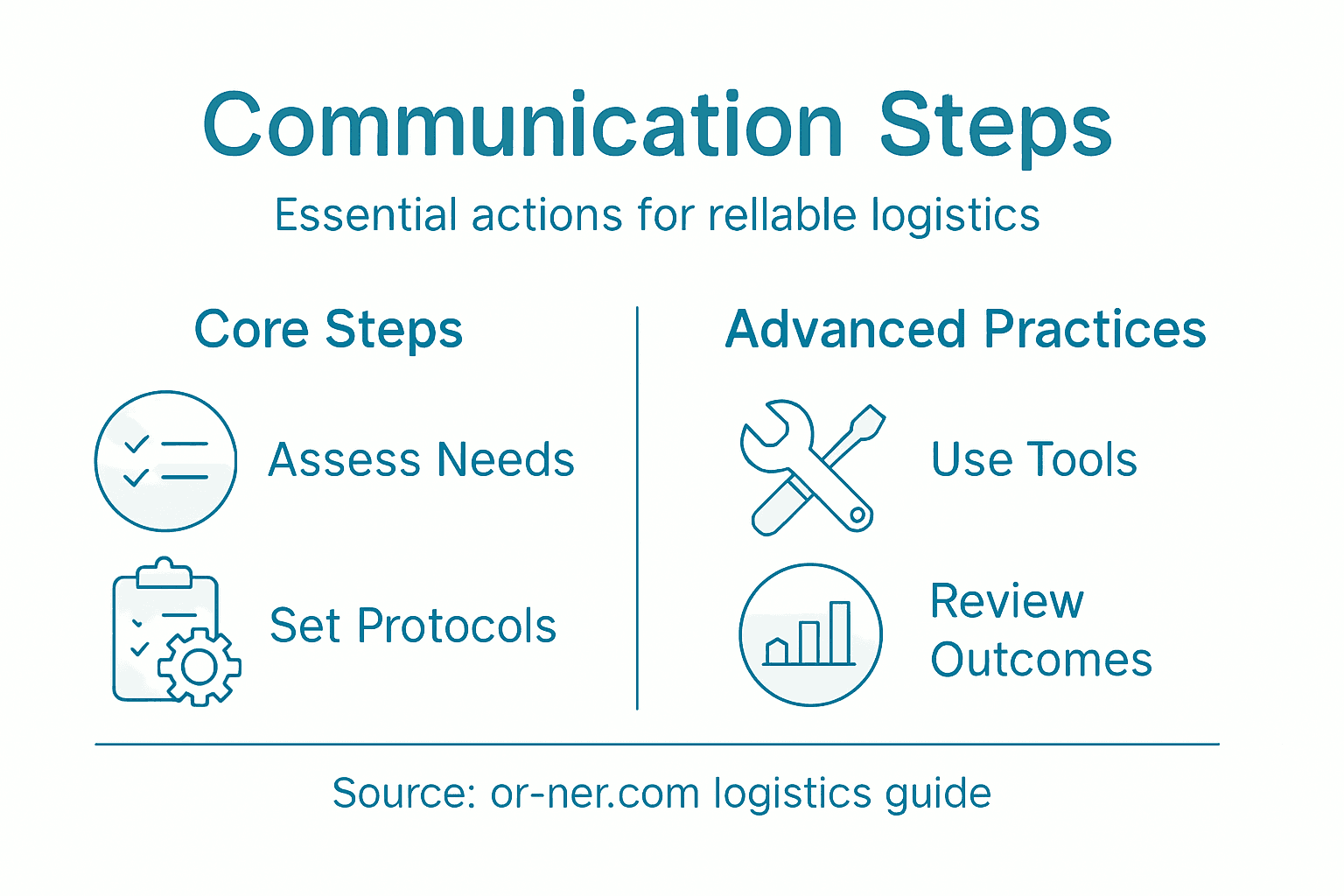
Begin by analyzing logistics service quality through comprehensive data collection and systematic evaluation. This process involves gathering insights from multiple sources to understand the effectiveness of your current communication strategies.
Key elements of strategic review and refinement include:
- Performance metric analysis: Track key performance indicators (KPIs)
- Customer feedback integration: Collect and synthesize stakeholder perspectives
- Comparative benchmarking: Compare performance against industry standards
- Root cause investigation: Identify underlying communication challenges
The review process should be data-driven and comprehensive, examining communication effectiveness from multiple angles. This means looking beyond surface-level metrics to understand the deeper dynamics of your supply chain interactions.
Refinement is not about perfection, but about continuous, incremental improvement.
Successful strategy refinement requires a proactive mindset. Create a culture that views communication challenges as opportunities for growth, encouraging open dialogue and collaborative problem-solving across all organizational levels.
Pro tip: Establish a quarterly review cycle with cross-functional teams to ensure comprehensive and diverse perspectives on communication strategy effectiveness.
Here’s a quick summary of the six key steps to optimizing supply chain communication:
| Step | Main Focus | Expected Outcome | Suggested Action |
|---|---|---|---|
| Assess Needs | Identify communication requirements | Build resilient logistics networks | Perform communication audits |
| Establish Protocols | Standardize channels and rules | Enable coordinated action | Create a communications handbook |
| Implement Tools | Adopt real-time technologies | Faster, error-free information flow | Choose analytics-capable platforms |
| Foster Collaboration | Encourage feedback and teamwork | Break down silos, boost engagement | Schedule cross-functional sessions |
| Verify Accuracy | Ensure reliable data and responsiveness | Reduce errors, improve efficiency | Use automated validation systems |
| Review & Refine | Continuous improvement | Adapt to change, optimize strategies | Conduct quarterly performance reviews |
Elevate Your Supply Chain Communication with Reliable Courier Services
Effective business communication is the backbone of reliable logistics as highlighted in the article “Master Business Communication Skills for Reliable Logistics.” Challenges like information flow gaps, unclear protocols, and lack of real-time responsiveness can disrupt your operations and impact your customers. You need a logistics partner that ensures seamless communication, real-time tracking, and verified accuracy across every step of your supply chain.
At or-ner.com, we specialize in providing reliable courier services and end-to-end logistics solutions tailored for ecommerce sellers and businesses. Our platform supports you in establishing clear communication protocols, automating updates with real-time shipment tracking, and fostering transparent collaboration between all stakeholders. Discover how our integrated tools streamline your workflow, boost inventory accuracy, and empower fast, data-driven decision-making on our landing page.
Unlock the power of communication mastery in your logistics network today. Visit or-ner.com to explore trusted courier services and fulfillment solutions designed to keep your supply chain agile and your customers satisfied. Don’t wait to transform your supply chain communication into a competitive advantage.
Frequently Asked Questions
How can I assess my organization’s communication needs in logistics?
To assess your organization’s communication needs in logistics, start by mapping out your current communication infrastructure and identifying gaps. Conduct a review of existing channels and challenges, focusing on how information flows between internal teams and external partners.
What steps should I take to establish clear communication protocols?
Begin by defining roles and responsibilities within your supply chain network. Create a framework that outlines how information is shared and escalated, ensuring clarity in communication hierarchy and establishing standard reporting methods.
What are the best real-time communication tools for logistics?
Choose real-time communication tools that integrate seamlessly with your current systems and have strong scalability potential. Ensure that selected tools also offer robust security features to protect sensitive information.
How can I foster collaboration among different teams in my logistics operations?
Foster collaboration by implementing regular communication forums and establishing open feedback channels. Schedule cross-functional meetings to share insights, creating a culture where team members feel empowered to contribute and collaborate effectively.
What methods can I use to verify information accuracy in my supply chain?
Implement a systematic approach that includes cross-referencing data points and using automated validation systems. Regularly conduct audits and close monitoring to ensure alignment between physical inventory and digital records.
How often should I review and refine my logistics communication strategies?
You should conduct a thorough review of your communication strategies on a quarterly basis. This allows you to analyze performance metrics, gather stakeholder feedback, and identify areas for continuous improvement, leading to more effective communication over time.
Recommended
- Top Benefits of Freight Forwarding for Growing Businesses 2025 – ORNER
- What Is Freight Forwarding? Guide for Modern Supply Chains 2025 – ORNER
- Reliable Courier Services in the USA – ORNER
- Essential courier services for small businesses – ORNER
- 7 Key Types of Airport Transfers for Business Travellers