Supply chain shocks are no longer rare events and even a brief disruption can cost a business millions in lost revenue.
In fact, over 75 percent of companies experienced supply chain disruptions in the past two years, exposing costly weaknesses most leaders never saw coming. But building true resilience is not about crossing your fingers or scrambling for quick fixes. It starts with a set of strategic moves that many companies overlook until it is too late.
Table of Contents
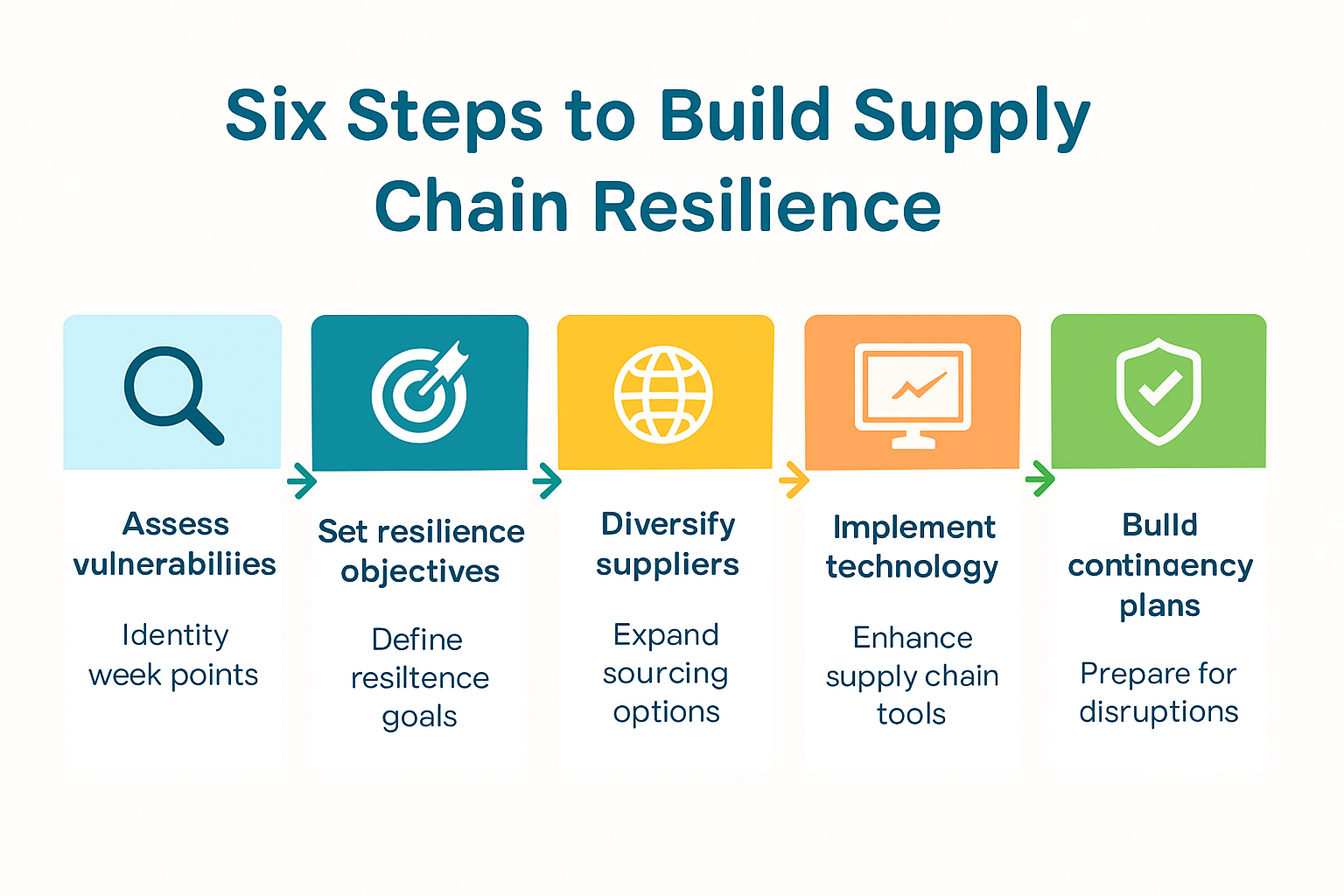
- Step 1: Assess Your Current Supply Chain Vulnerabilities
- Step 2: Define Your Resilience Objectives And Requirements
- Step 3: Diversify Your Supplier And Logistics Network
- Step 4: Implement Technology Solutions For Real-Time Monitoring
- Step 5: Develop A Contingency Plan For Disruptions
- Step 6: Test And Validate Your Resilience Strategies
Quick Summary
| Key Point | Explanation |
|---|---|
| 1. Conduct a thorough vulnerability assessment | Map your supply chain comprehensively to identify weak points, risks, and potential disruptions effectively. |
| 2. Establish clear resilience objectives | Define measurable performance benchmarks that align operational capabilities with strategic goals amid potential disruptions. |
| 3. Diversify suppliers and logistics | Create multiple sourcing and transport options to reduce reliance on single suppliers and improve adaptability to market changes. |
| 4. Implement real-time monitoring technologies | Use advanced digital tools to gain visibility, enabling proactive decision-making and early detection of supply chain risks. |
| 5. Develop and test a contingency plan | Create a dynamic response strategy for identified risks, ensuring readiness for operational challenges through regular simulations. |
Step 1: Assess Your Current Supply Chain Vulnerabilities
Building a resilient supply chain begins with a comprehensive vulnerability assessment. This critical first step helps businesses identify potential weak points, risks, and potential disruption scenarios before they become critical operational challenges. By systematically mapping and analyzing your supply chain’s current structure, you create a foundational blueprint for future strategic improvements and risk mitigation.
To conduct an effective vulnerability assessment, start by creating a detailed end-to-end mapping of your entire supply chain ecosystem. This means documenting every supplier, transportation route, warehouse, and logistics partner involved in your product’s journey. Focus on understanding not just the primary connections, but also secondary and tertiary relationships that might introduce unexpected risks.
Your mapping should include multiple critical dimensions: geographical locations of suppliers and distribution centers, transportation modes, inventory levels, alternative routing options, and potential bottlenecks. Pay special attention to single-source suppliers or regions with historical political, economic, or environmental instability. Learn more about identifying global supply chain risks to enhance your assessment strategy.
Once you have a comprehensive map, analyze each segment for potential vulnerabilities. This involves evaluating factors like supplier financial stability, transportation reliability, inventory buffer capacities, and technological infrastructure. Look for indicators such as historical delivery performance, compliance records, and adaptability during previous market disruptions.
Key verification criteria for a successful vulnerability assessment include:
- A complete, documented supply chain network map
- Identified critical dependencies and potential single points of failure
- Quantified risk levels for each supply chain segment
- Preliminary mitigation strategies for high-risk areas
Successful completion of this step means you have transformed an abstract supply chain into a transparent, analyzable system where potential vulnerabilities are clearly visible and can be strategically addressed in subsequent planning stages.
Step 2: Define Your Resilience Objectives and Requirements
After mapping your supply chain vulnerabilities, the next critical step is defining precise resilience objectives that transform potential weaknesses into strategic strengths. This phase moves beyond identifying risks to establishing clear, measurable goals that will guide your entire resilience transformation strategy. Think of these objectives as your supply chain’s north star—a comprehensive blueprint that aligns operational capabilities with organizational ambitions.
Begin by translating your vulnerability assessment into concrete performance benchmarks. These should include specific metrics around recovery time, inventory buffer requirements, supplier redundancy, and financial impact tolerance. Consider scenarios like sudden demand spikes, transportation disruptions, or geopolitical events that could potentially interrupt your operations. Explore our comprehensive guide on supply chain management fundamentals to help refine your approach.
Your resilience objectives must balance short-term operational stability with long-term strategic flexibility. This means developing goals that are not just reactive but proactively adaptive. For instance, instead of merely aiming to survive disruptions, target objectives that allow your supply chain to rapidly reconfigure and potentially even capitalize on unexpected market shifts.
Key considerations when defining resilience objectives include financial constraints, technological capabilities, and organizational risk appetite. Engage cross-functional teams—including finance, operations, procurement, and technology—to ensure a holistic perspective. Their diverse insights will help create more robust and realistic goals that account for nuanced organizational dynamics.
Verification criteria for successfully defining resilience objectives include:
- Quantifiable performance targets for supply chain responsiveness
- Clear metrics for measuring recovery speed and operational flexibility
- Alignment between resilience goals and broader business strategy
- Documented risk tolerance levels across different operational scenarios
Successful completion of this step transforms abstract vulnerability insights into actionable, strategic objectives that will drive meaningful supply chain transformation. By establishing precise, measurable goals, you create a roadmap that guides subsequent resilience-building efforts with clarity and purpose.
Step 3: Diversify Your Supplier and Logistics Network
Diversifying your supplier and logistics network transforms potential vulnerabilities into strategic opportunities for building a robust, adaptable supply chain. This critical step moves beyond single-source dependencies to create a flexible ecosystem that can rapidly respond to unexpected market disruptions. The goal is not just risk mitigation, but developing a network that provides multiple pathways for sourcing, manufacturing, and distribution.
Begin by conducting a comprehensive audit of your current supplier relationships. Identify critical components and materials where you currently rely on single or limited suppliers. Seek out alternative vendors across different geographical regions, ensuring that these new potential partners meet your quality, cost, and performance standards. Discover strategies for navigating global supply chain complexities to enhance your diversification approach.
Geographical diversification is more than just finding additional suppliers—it requires building genuine relationships and understanding each partner’s capabilities. Evaluate potential new suppliers not just on immediate cost, but on their technological capabilities, financial stability, compliance standards, and ability to integrate smoothly into your existing supply chain infrastructure. Consider suppliers from different regions to reduce risks associated with localized disruptions like natural disasters, political instability, or regional economic challenges.
Logistics network diversification requires a similar strategic approach. This means developing multiple transportation routes, exploring different shipping modes, and creating redundant logistics partnerships. Consider establishing relationships with carriers and logistics providers across various regions and transportation methods—including ocean, air, and land routes—to ensure continuous movement of goods even if one pathway becomes compromised.
Key verification criteria for successful supplier and logistics network diversification include:
- Documented alternative suppliers for critical components
- Established relationships with vendors in multiple geographical regions
- Mapped alternative transportation and logistics routes
- Verified quality and compliance standards for new network partners
Successful completion of this step creates a supply chain network that is not just resilient, but strategically flexible—capable of dynamically responding to global market changes while maintaining operational continuity.

Step 4: Implement Technology Solutions for Real-Time Monitoring
Implementing advanced technology solutions for real-time monitoring transforms your supply chain from a reactive system to a proactive, intelligent network. This critical step leverages digital tools to create unprecedented visibility, enabling rapid decision-making and early risk detection across your entire operational ecosystem. By integrating sophisticated monitoring technologies, businesses can transform raw data into actionable strategic insights.
Start by selecting comprehensive tracking and analytics platforms that offer end-to-end supply chain visibility. These systems should integrate multiple data streams, including inventory levels, transportation routes, supplier performance, and real-time market conditions. Look for solutions that provide customizable dashboards, predictive analytics, and automated alert mechanisms that can instantly flag potential disruptions or performance anomalies. Explore our comprehensive guide to streamlining global trade technologies to enhance your technological approach.
Effective real-time monitoring goes beyond simple tracking. It requires creating an interconnected digital ecosystem where sensors, IoT devices, blockchain technologies, and advanced analytics work together seamlessly. Consider implementing technologies like GPS tracking for shipments, RFID tags for inventory management, and machine learning algorithms that can predict potential supply chain interruptions before they occur. These tools provide granular insights into every stage of your supply chain, from raw material sourcing to final product delivery.
Technology implementation is not just about purchasing tools but creating a culture of data-driven decision-making. Train your team to understand and leverage these new monitoring technologies, ensuring they can interpret complex data streams and take proactive actions. Develop clear protocols for how different teams will respond to alerts and insights generated by these monitoring systems.
Key verification criteria for successful technology implementation include:
- Fully integrated real-time monitoring dashboard
- Automated alert systems for potential supply chain disruptions
- Documented response protocols for different types of alerts
- Comprehensive data integration across multiple supply chain segments
Successful completion of this step creates a technology-enabled supply chain that can anticipate challenges, respond with agility, and maintain operational continuity in an increasingly complex global marketplace.
Step 5: Develop a Contingency Plan for Disruptions
Developing a robust contingency plan transforms potential supply chain vulnerabilities into strategic opportunities for rapid adaptation. This critical step moves beyond theoretical risk assessment to creating actionable, executable strategies that enable your organization to respond swiftly and effectively to unexpected disruptions. A well-crafted contingency plan acts as your operational safety net, ensuring business continuity even in the most challenging scenarios.
Begin by conducting comprehensive scenario planning that goes beyond generic risk templates. Map out specific disruption scenarios based on your earlier vulnerability assessment, including potential triggers like geopolitical events, natural disasters, transportation breakdowns, or supplier failures. For each scenario, develop detailed response protocols that outline specific actions, responsible team members, communication channels, and resource allocation strategies. Explore our insights on navigating global supply chain risks to enhance your planning approach.
Your contingency plan must be dynamic and flexible, not a static document. Create modular response frameworks that can be quickly adapted to evolving situations. This means establishing clear decision-making hierarchies, defining rapid communication protocols, and building in redundant systems that can be activated quickly. Consider developing tiered response strategies that provide graduated approaches depending on the severity and nature of the disruption.
Effective contingency planning requires cross-functional collaboration. Engage teams from operations, finance, procurement, and technology to ensure a holistic approach. Conduct regular tabletop exercises and simulations that test your plan’s effectiveness, identifying potential gaps and refining response mechanisms. These practice sessions help team members internalize the contingency plan, ensuring they can execute quickly under pressure.
Key verification criteria for a successful contingency plan include:
- Documented response protocols for multiple disruption scenarios
- Clear communication and escalation pathways
- Identified backup suppliers and alternative logistics routes
- Established financial reserves for emergency resource allocation
Successful completion of this step creates a living, adaptable framework that empowers your organization to navigate uncertainties with confidence and strategic agility.
Step 6: Test and Validate Your Resilience Strategies
Testing and validating your resilience strategies transforms theoretical planning into practical, battle-tested operational capabilities. This crucial step moves beyond documentation to actively stress-testing your supply chain’s ability to withstand and recover from potential disruptions. By rigorously simulating various scenarios, you can identify hidden vulnerabilities and refine your strategic approach before real-world challenges emerge.
Begin by designing comprehensive simulation scenarios that reflect the most probable and impactful disruption risks identified in your earlier vulnerability assessment. These simulations should be multi-dimensional, involving cross-functional teams and testing not just technical systems but also human response protocols. Create scenarios that challenge different aspects of your supply chain, such as sudden supplier failures, transportation blockages, unexpected demand fluctuations, or technological infrastructure breakdowns. Explore advanced strategies for managing global supply chain challenges to enhance your testing approach.
Utilize digital twin technologies and advanced simulation platforms that can model complex supply chain interactions with remarkable precision. These tools allow you to run multiple iterations of potential disruption scenarios, analyzing response times, resource allocation effectiveness, and recovery strategies without risking actual operational disruptions. Engage team members from different departments to participate in these simulations, ensuring a holistic approach that captures perspectives from operations, finance, procurement, and technology.
Validation is not a one-time event but an ongoing process of continuous improvement. After each simulation, conduct thorough debriefing sessions that critically analyze performance, identifying both strengths and areas requiring refinement. Document lessons learned, update contingency plans, and develop targeted training programs that address any skill or system gaps revealed during testing. This iterative approach ensures your resilience strategies remain dynamic and responsive to evolving market conditions.
Key verification criteria for successful strategy testing include:
- Documented simulation results with clear performance metrics
- Identified improvement areas in current resilience strategies
- Updated contingency plans reflecting simulation insights
- Cross-functional team feedback and engagement levels
Successful completion of this step transforms your supply chain resilience from a theoretical concept into a tangible, adaptable operational framework capable of navigating complex global challenges.
The following checklist table summarizes the key verification criteria for each main step in building a resilient supply chain. Use this table to ensure your organization has completed each critical requirement before moving on to the next phase.
| Step | Verification Criteria |
|---|---|
| Assess Supply Chain Vulnerabilities | Supply chain network map complete; critical dependencies identified; risk levels quantified; preliminary mitigation strategies documented |
| Define Resilience Objectives | Quantifiable performance targets; clear recovery and flexibility metrics; alignment with business strategy; documented risk tolerance |
| Diversify Supplier & Logistics Network | Alternative suppliers documented; relationships in multiple regions; mapped alternative routes; quality standards verified |
| Implement Technology Solutions | Integrated real-time dashboard; automated alert systems; documented protocols; full data integration across segments |
| Develop Contingency Plan | Documented response protocols; clear communication and escalation paths; backup suppliers and routes identified; emergency financial reserves established |
| Test & Validate Strategies | Documented simulation results; identified improvement areas; updated contingency plans; cross-functional feedback gathered |
Take Control of Your Supply Chain Resilience With Reliable Courier Services
As you map out vulnerabilities and build resilience for future growth, you already understand how fragile a single freight delay or lack of supplier visibility can be. The article has shown you that strong, proactive supply chains need reliable partners for everything from real-time tracking to rapid adaptation during disruptions. If streamlining workflows, ensuring transparent shipment monitoring, and instantly handling exceptions sound like challenges in your business, now is your chance to address them.
Experience the ease of end-to-end logistics with reliable courier services built for ecommerce sellers, wholesalers, and brands like yours. From booking freight to using real-time analytics and flexible warehousing, our platform at or-ner.com gives you the tools to secure your entire supply chain. Ready to transform your risk into opportunity? See how our all-in-one logistics platform can support your growth and make resilience a competitive advantage today.
Frequently Asked Questions
What are the first steps to assess supply chain vulnerabilities?
To assess supply chain vulnerabilities, start by creating an end-to-end map of your entire supply chain, including suppliers, transportation routes, warehouses, and logistics partners. Analyze each segment for potential risks such as single-source suppliers, geographical instabilities, and historical delivery performance.
How can I define resilience objectives for my supply chain?
Resilience objectives should translate your vulnerability assessment into measurable performance benchmarks. This includes metrics on recovery times, inventory buffers, supplier redundancy, and the financial impact of disruptions. Engage cross-functional teams to ensure these objectives align with broader business strategies.
Why is technology important for supply chain resilience?
Technology, such as real-time monitoring systems, provides visibility into the supply chain, enabling proactive decision-making and early risk detection. Implementing tracking and analytics platforms helps transform raw data into actionable insights, ensuring timely responses to potential disruptions.
What should a contingency plan for supply chain disruptions include?
A contingency plan should include detailed response protocols for various disruption scenarios, clear communication pathways, identified backup suppliers, and alternative logistic routes. Regular testing and updating of the plan ensure it remains effective and adapted to current conditions.