
TL;DR:
- Courier aggregation consolidates multiple courier services into a single platform, enabling ecommerce sellers to compare rates, generate labels, and manage carriers efficiently. It becomes essential for businesses shipping over 500 parcels monthly, offering benefits like cost savings, service diversity, operational resilience, and automation. Implementing automated routing rules helps improve shipping reliability and streamlines complex carrier management for high-volume, scalable ecommerce logistics.
Courier aggregation is a shipping strategy that consolidates multiple courier services into one platform, giving ecommerce sellers a single interface to compare rates, generate labels, and manage carriers without switching between portals. The industry term for this approach is multi-carrier shipping management, and understanding why choose courier aggregation matters most when your order volume starts outpacing what a single carrier can handle reliably. Sellers shipping more than 500 parcels monthly find that manual multi-carrier setups become unsustainable fast. At that threshold, aggregation stops being a convenience and becomes a core operational requirement.
Why choose courier aggregation for ecommerce logistics
Courier aggregation works by pulling multiple carriers’ rate cards, service levels, and transit time data into one platform. When an order is placed, the system evaluates available carriers against your predefined rules, such as cost ceilings, destination zones, and package weight, then selects the best option automatically. The result is a real-time rate comparison that replaces manual courier service comparison across separate tabs and spreadsheets.
The mechanics behind aggregation rely on three core functions:
- Rate ingestion: The platform connects to each carrier’s API and pulls live pricing, so you always see current rates rather than outdated contract tables.
- Rule-based routing: You set conditions once. The system applies them to every shipment, assigning carriers based on product type, destination, delivery speed, or cost priority.
- Label generation and tracking: Labels print from one interface, and tracking data feeds back into the same system, giving you and your customers a single source of truth.
Aggregation also integrates with existing ERP and order management systems. Shipping experts confirm that platforms work best when connected to your existing order workflows, centralizing shipping from fragmented processes into data-driven pipelines.
Pro Tip: Before connecting a new aggregation platform to your ERP, map every carrier touchpoint in your current process. Gaps you find during mapping are exactly what the platform’s routing rules need to cover.
What are the real benefits of courier aggregation?
The most direct benefit is cost reduction through competitive rate comparison. When you spread volume across carriers, you gain negotiating leverage that a single-carrier setup cannot produce. Carrier diversification creates pricing pressure that drives rates down, especially when carriers know you have alternatives ready to activate.
Beyond cost, the courier aggregation advantages include:
- Wider service options: Access to regional carriers, economy services, and express options in one place means you can match the right service to each order rather than forcing every shipment through one carrier’s network.
- Operational resilience: When a carrier experiences delays or service failures, you reroute through an alternative without rebuilding your shipping setup from scratch. Carrier diversification protects your brand from disruptions that a single-carrier dependency cannot survive.
- Reduced manual workload: Consolidating carriers into one platform eliminates multiple portal logins, separate tracking dashboards, and the spreadsheet juggling that consumes hours each week.
- Scalability: As your order volume grows, adding a new carrier to an aggregation platform takes hours, not weeks of integration work.
Top-volume ecommerce sellers average three to five active carriers in their mix. That number reflects deliberate diversification, not complexity for its own sake. Each carrier in the mix serves a specific purpose: a primary carrier for volume, a regional carrier for last-mile efficiency, and a backup for peak periods or service failures.
The benefits of courier aggregation also extend to customer experience. Faster, more reliable delivery options reduce cart abandonment and post-purchase complaints. When you can offer next-day delivery through one carrier and economy shipping through another, all from the same checkout flow, you give customers a real choice rather than a take-it-or-leave-it rate.

How does automation in aggregation improve shipping reliability?
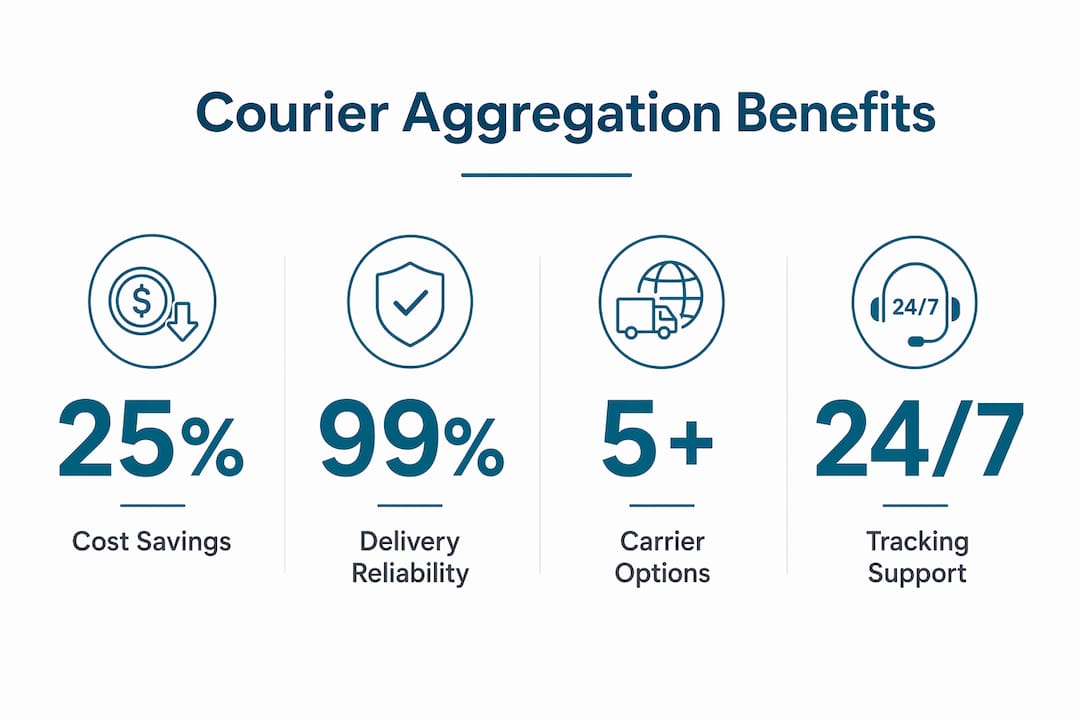
Aggregation is not just a rate comparison tool. Its real value lies in the automation layer that governs every routing decision. Automated routing rules let you exclude carriers with known regional service issues, assign fragile items to specialized handlers, and enforce cost ceilings without human intervention on each shipment.
The automation layer works through a hierarchy of rules that execute in sequence:
- Service-level guardrails: Set minimum delivery speed requirements by destination zone. The system will never route a priority shipment through an economy-only carrier, regardless of price.
- Cost ceilings and floors: Define the maximum you will pay per shipment by weight class. The platform filters out any carrier exceeding that threshold before presenting options.
- SKU-level carrier assignments: Assign specific product categories to specific carriers. Fragile goods, oversized items, and hazardous materials each carry different handling requirements that the system enforces automatically.
- Destination exclusions: Block carriers from specific regions where their performance data shows consistent delays or damage rates above your threshold.
Standardized routing rules prevent the operational drift that happens when individual team members make ad-hoc carrier choices under time pressure. Consistency across thousands of shipments is only possible when the decision logic is encoded in the platform, not held in someone’s head.
Operational performance data integrated into one workflow also improves tracking accuracy and support depth. When a customer contacts you about a delayed shipment, your team sees the full carrier history, tracking events, and exception flags in one screen rather than logging into three separate carrier portals.
Pro Tip: Review your routing rule performance monthly. Carriers change their service footprints and pricing regularly. Rules that worked well in Q1 may route shipments inefficiently by Q3 without a review cycle.
How to integrate courier aggregation into your ecommerce logistics
Integration works best when you treat it as a phased process rather than a single cutover event. Sellers under 200 orders per month can often manage with one primary carrier and a manual fallback. Once you cross 500 orders per month, multi-carrier automation becomes essential for both cost control and service consistency.
A practical integration approach follows this sequence:
- Audit your current carrier mix: Identify which carriers you use, what you pay, and where service failures occur most often. This baseline tells you which gaps aggregation needs to fill first.
- Select two to three carriers for your initial setup: Choose a primary carrier for the bulk of your volume, a regional carrier for specific zones where your primary underperforms, and a backup for peak periods. Adding more carriers before your routing rules are stable creates complexity without benefit.
- Assess platform compatibility: Confirm that the aggregation platform connects to your order management system or ERP via API. Platforms that require manual order imports negate most of the efficiency gains. Or-ner’s platform, for example, integrates across ocean, air, and land transport modes with direct connections to major ecommerce operators.
- Build routing rules before going live: Define cost ceilings, service-level requirements, and destination rules before routing real orders. Testing rules with historical order data catches edge cases before they affect customers.
For sellers managing cross-border logistics, aggregation adds another layer of value. International shipments involve customs clearance, duty calculation, and carrier-specific documentation requirements. An aggregation platform that handles these variables automatically reduces the compliance risk that comes with manual cross-border shipping decisions.
Choosing the right carriers for your mix also requires understanding how to evaluate courier partners beyond price. Transit time consistency, damage rates, and customer communication quality all affect your brand reputation in ways that a low rate cannot offset. You can also learn more about courier aggregation’s role in ecommerce logistics to sharpen your platform selection criteria.
Understanding international shipping savings through aggregation is particularly relevant for sellers expanding into new markets, where local carrier knowledge and rate structures differ significantly from domestic shipping.
Key Takeaways
Courier aggregation is the most effective way for ecommerce sellers to reduce shipping costs, improve delivery reliability, and manage carrier complexity at scale through a single automated platform.
| Point | Details |
|---|---|
| Start at 500 orders/month | Multi-carrier automation becomes essential once you exceed 500 monthly shipments. |
| Diversify to three to five carriers | Top sellers use multiple carriers to avoid bottlenecks and gain rate negotiating leverage. |
| Automate routing rules | Encoding carrier selection logic in the platform prevents human error and operational drift. |
| Integrate with your ERP | Aggregation platforms deliver full value only when connected to existing order management systems. |
| Review rules regularly | Carrier performance and pricing change; routing rules need monthly review to stay effective. |
The part most sellers get wrong about multi-carrier shipping
Most sellers I talk to approach courier aggregation as a cost-cutting exercise. They connect two carriers, run a rate comparison, and declare the job done. That approach captures maybe 30% of the available value.
The real leverage is in the automation layer. When you encode your carrier selection logic into routing rules, you remove the single biggest source of shipping errors: human judgment under time pressure. A warehouse team member choosing a carrier at 4:00 PM on a Friday will not make the same decision as your carefully designed routing rule. The rule wins every time, and your customers never notice the difference.
I have also seen sellers resist adding carriers because they fear complexity. That fear is understandable but misplaced. A well-configured aggregation platform makes three carriers easier to manage than one carrier handled manually. The platform absorbs the complexity. You see a clean dashboard.
The other misconception is that aggregation is only for large operations. Sellers at 500 orders per month gain as much proportional benefit as enterprise operations with 50,000 monthly shipments. The cost savings and resilience benefits scale with your volume, but the operational clarity is immediate regardless of size.
My honest advice: treat your aggregation platform as infrastructure, not a tool. Build it carefully, integrate it deeply, and review it regularly. The sellers who do that consistently outperform those who treat it as a set-and-forget rate comparison widget.
— Maayan
Or-ner’s platform for multi-carrier ecommerce shipping
Or-ner brings multi-carrier management, real-time rate comparison, and automated routing into one platform built for ecommerce sellers who need reliable courier services at scale.
The platform connects to carriers across ocean, air, and land transport modes, integrates with major ecommerce operators including Amazon, and handles customs clearance and cross-border documentation automatically. Sellers managing high-volume shipping or expanding into new markets use Or-ner’s global logistics platform to centralize carrier management, reduce per-shipment costs, and maintain delivery consistency without adding operational headcount. If you are evaluating how to build a carrier mix that grows with your business, Or-ner’s tools give you the rate visibility and routing control to make that decision with real data.
FAQ
What is courier aggregation in ecommerce?
Courier aggregation is the practice of consolidating multiple courier services into one platform for rate comparison, label generation, and carrier management. It is also called multi-carrier shipping management.
When should I start using a courier aggregation platform?
Sellers shipping more than 500 parcels per month benefit most from automated multi-carrier platforms, as manual management at that volume creates unsustainable complexity and cost inefficiency.
How does courier aggregation reduce shipping costs?
Spreading volume across carriers creates negotiating leverage and enables real-time rate comparison, so each shipment routes through the lowest-cost carrier that meets your service requirements.
What is the difference between courier aggregation and a single-carrier setup?
A single-carrier setup routes all shipments through one provider, creating a single point of failure and no rate competition. Courier aggregation uses multiple carriers with automated routing rules to improve both cost and resilience.
How many carriers should I include in my aggregation setup?
Most ecommerce sellers start with two to three carriers: a primary for volume, a regional carrier for specific zones, and a backup for peak periods or service disruptions. Top-volume sellers typically maintain three to five active carriers.