
Supply chain mapping sounds complicated, with so many organizations, people, and materials crisscrossing the globe to deliver even the simplest product. Yet companies that map their supply chains can uncover hidden risks and simplify tangled logistics networks at a surprising scale. What really flips expectations is that some of the biggest breakthroughs come not from cutting-edge tech but from simply seeing the big picture—suddenly, weaknesses and opportunities leap into view that nobody noticed before.
Table of Contents
- Defining Supply Chain Mapping: Key Concepts And Terms
- The Importance Of Supply Chain Mapping In Business
- How Supply Chain Mapping Works: Processes And Tools
- Impact Of Effective Supply Chain Mapping On Performance
- Real-World Applications Of Supply Chain Mapping In Industries
Quick Summary
| Takeaway | Explanation |
|---|---|
| Effective supply chain mapping enhances transparency | Creating clear visualizations helps businesses understand their supply networks, leading to better management and optimization. |
| Risk management is a key benefit of mapping | Identifying potential vulnerabilities and single-source suppliers allows proactive strategies to mitigate risks before they escalate. |
| Operational efficiency is improved through data analysis | Streamlining logistics and enhancing resource allocation reduces costs and eliminates inefficiencies in supply chain operations. |
| Supply chain mapping fosters competitive advantage | Businesses that utilize mapping can quickly adapt to market changes, increasing resilience and responsiveness to customer demands. |
| Continuous monitoring is essential for success | Treating supply chain maps as dynamic documents allows organizations to keep their strategies relevant amidst evolving conditions. |
Defining Supply Chain Mapping: Key Concepts and Terms
Supply chain mapping represents a strategic approach to visualizing and understanding the intricate network of organizations, people, technologies, activities, and resources involved in delivering a product or service from supplier to customer. At its core, this process transforms complex logistics relationships into a comprehensible framework that enables businesses to analyze, optimize, and manage their entire supply chain ecosystem.
Core Elements of Supply Chain Mapping
Supply chain mapping goes beyond simple tracking. It involves creating a comprehensive representation that reveals multiple layers of interconnectivity. According to the National Institute of Standards and Technology, this visualization helps organizations identify potential risks and improve overall supply chain resilience.
Key components of an effective supply chain map include:
To help readers quickly grasp the core elements that make up a supply chain map, the following table summarizes the primary components and their roles in the mapping process.
| Component | Description |
|---|---|
| Supplier Relationships | Documents direct and indirect suppliers across different tiers |
| Material Flow | Tracks movement of raw materials, components, and finished products |
| Information Systems | Captures communication channels and data exchange mechanisms |
| Geographical Locations | Maps physical sites for production, warehousing, and distribution |
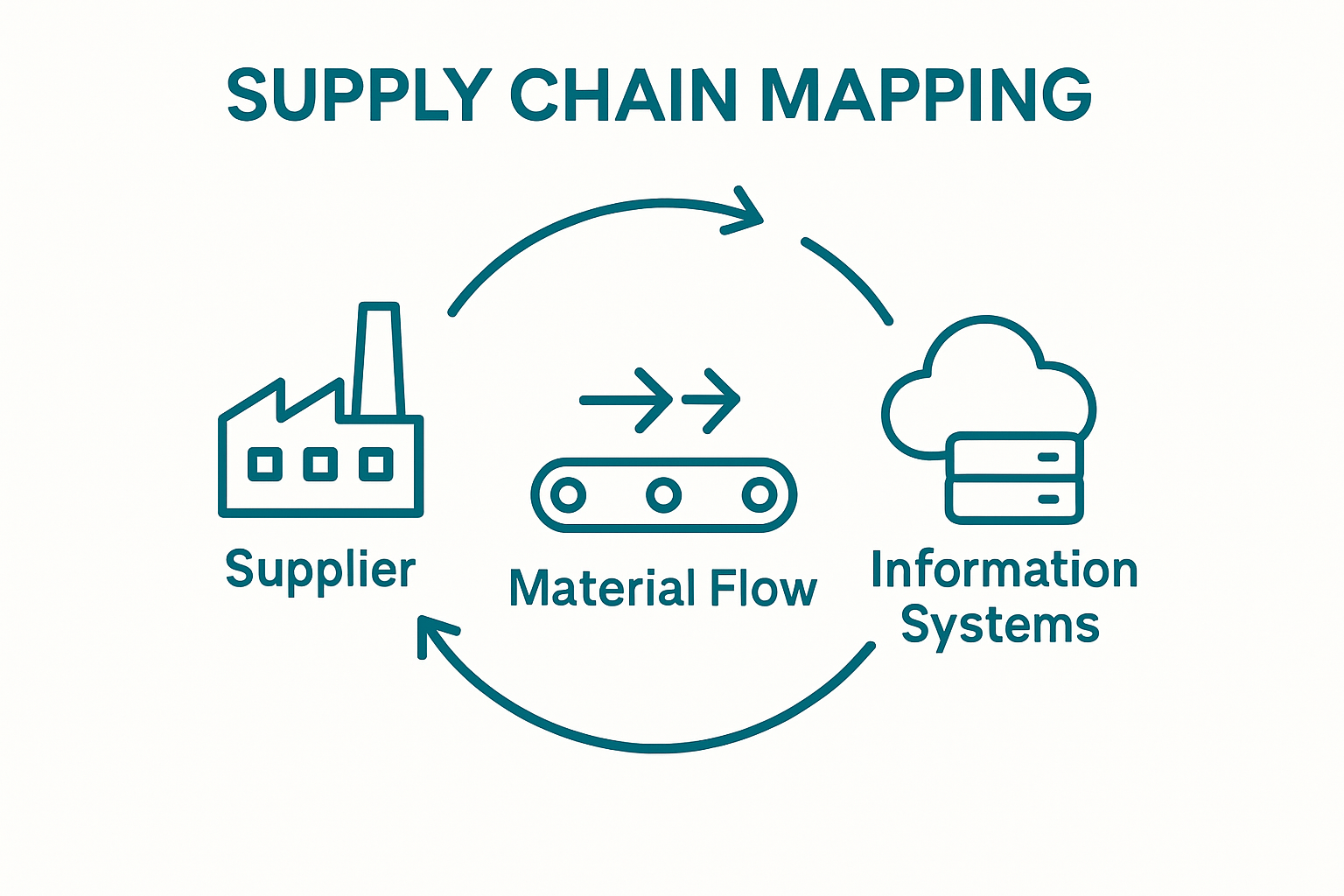
- Supplier Relationships: Documenting direct and indirect suppliers across different tiers
- Material Flow: Tracking the movement of raw materials, components, and finished products
- Information Systems: Capturing communication channels and data exchange mechanisms
- Geographical Locations: Mapping physical sites of production, warehousing, and distribution
Strategic Importance of Supply Chain Visualization
Effective supply chain mapping provides organizations with unprecedented transparency and control. By understanding complex supply chain networks, businesses can make more informed decisions about sourcing, risk management, and operational efficiency.
The process enables companies to:
- Identify potential bottlenecks and vulnerabilities
- Optimize logistics and transportation routes
- Enhance supplier relationship management
- Improve overall supply chain performance and responsiveness
Modern supply chain mapping leverages advanced technologies like data analytics, geographic information systems (GIS), and real-time tracking tools to create dynamic, adaptive representations of complex global supply networks.
The Importance of Supply Chain Mapping in Business
Supply chain mapping has become a critical strategic tool for businesses seeking to navigate increasingly complex global markets. By providing comprehensive visibility into the entire supply network, organizations can transform potential vulnerabilities into opportunities for innovation and competitive advantage.
Risk Management and Strategic Planning
According to Iowa State University’s Center for Industrial Research and Service, supply chain mapping enables businesses to identify and mitigate potential risks before they escalate. Strategic risk identification involves understanding the intricate connections between suppliers, manufacturers, distributors, and end customers.
Key risk management benefits include:
- Identifying geographical concentrations of suppliers
- Detecting potential single-source vulnerabilities
- Assessing geopolitical and economic disruption risks
- Understanding complex supplier interdependencies
Operational Efficiency and Cost Optimization
By tracking critical supply chain metrics, organizations can significantly improve operational performance. Supply chain mapping allows businesses to:
- Streamline logistics and transportation routes
- Reduce unnecessary inventory holding costs
- Eliminate redundant processes
- Optimize resource allocation
Competitive Advantage and Adaptability
In today’s rapidly changing business environment, supply chain mapping provides a dynamic framework for continuous improvement. Companies that invest in comprehensive supply chain visualization can respond more quickly to market changes, customer demands, and potential disruptions. This adaptability translates into increased resilience, faster decision-making, and ultimately, a stronger competitive position in the global marketplace.
The table below compares the main benefits of supply chain mapping across three critical business dimensions, helping illustrate how mapping delivers value in risk management, efficiency, and competitive positioning.
| Dimension | Benefit Highlights |
|---|---|
| Risk Management | Identifies vulnerabilities, single-source suppliers, and disruption risks |
| Operational Efficiency | Streamlines logistics, reduces costs, and eliminates redundant processes |
| Competitive Advantage | Enables rapid adaptation and increased resilience in dynamic markets |
How Supply Chain Mapping Works: Processes and Tools
Supply chain mapping is a sophisticated process that transforms complex logistics networks into clear, actionable visual representations. By leveraging advanced technologies and strategic methodologies, businesses can create comprehensive maps that reveal intricate relationships and potential opportunities across their entire supply ecosystem.
Data Collection and Analysis
According to NIST’s Manufacturing Innovation Blog, the initial stage of supply chain mapping involves systematic data collection from multiple sources. Comprehensive data gathering requires engagement with various stakeholders and sophisticated information systems.
Key data collection components include:
- Supplier contact information and historical performance records
- Geographic locations of production and distribution centers
- Transportation and logistics routing details
- Inventory management and production capacity data
Visualization and Mapping Technologies
Modern supply chain mapping relies on advanced digital tools that transform raw data into actionable insights. By exploring resilient supply chain strategies, organizations can select appropriate visualization technologies that match their specific operational requirements.
Primary mapping technologies encompass:
- Geographic Information Systems (GIS)
- Enterprise Resource Planning (ERP) software
- Advanced data analytics platforms
- Cloud-based collaboration tools
Continuous Monitoring and Optimization
Supply chain mapping is not a one-time activity but an ongoing process of continuous improvement. Successful organizations treat their supply chain maps as dynamic documents that evolve with changing market conditions, technological advancements, and strategic business objectives. This approach enables real-time risk assessment, performance tracking, and proactive decision-making, ultimately creating a more agile and responsive supply chain infrastructure.
Impact of Effective Supply Chain Mapping on Performance
Supply chain mapping represents more than a strategic visualization exercise. It is a powerful performance optimization tool that fundamentally transforms how businesses understand, manage, and improve their operational capabilities. By providing unprecedented insights into complex logistics networks, organizations can drive substantial improvements across multiple performance dimensions.
Operational Efficiency and Cost Management
According to research published in the National Center for Biotechnology Information, collaborative buyer-supplier relationships facilitated by supply chain mapping can dramatically enhance operational performance. Strategic mapping enables businesses to identify and eliminate inefficiencies, reducing unnecessary operational expenses and streamlining resource allocation.
Key performance improvements include:
- Reduced inventory holding costs
- Minimized transportation and logistics expenses
- Enhanced procurement strategy effectiveness
- Improved resource utilization across the supply chain
Risk Mitigation and Strategic Decision Making
By tracking critical supply chain metrics, organizations gain a comprehensive understanding of potential vulnerabilities and opportunities. Supply chain mapping transforms risk management from a reactive to a proactive discipline, allowing businesses to anticipate and mitigate potential disruptions before they impact performance.
Strategic risk management benefits encompass:
- Early identification of potential supply chain bottlenecks
- Enhanced supplier diversity and resilience
- Improved contingency planning capabilities
- More accurate demand forecasting
Competitive Advantage and Innovation
Effective supply chain mapping transcends operational improvements, becoming a catalyst for innovation and competitive differentiation. Organizations that develop sophisticated mapping capabilities can respond more quickly to market changes, customer demands, and emerging technological trends. This agility translates into a significant competitive advantage, enabling businesses to outperform competitors by creating more responsive, adaptable supply chain ecosystems.

Real-World Applications of Supply Chain Mapping in Industries
Supply chain mapping has emerged as a transformative strategy across diverse industries, enabling organizations to navigate increasingly complex global networks with unprecedented precision and strategic insight. By providing comprehensive visibility into intricate logistics ecosystems, businesses can optimize operations, mitigate risks, and drive sustainable competitive advantages.
Manufacturing and Technology Sectors
In manufacturing and technology industries, supply chain mapping becomes a critical tool for managing complex, multilayered production networks. According to recent research, advanced mapping techniques now leverage Knowledge Graphs and Large Language Models to extract supply chain information from diverse public sources, revealing critical interdependencies and alternative sourcing options.
Key application areas include:
- Electronic component procurement
- Semiconductor supply chain management
- Advanced manufacturing resource allocation
- Technology product lifecycle tracking
Automotive and Renewable Energy Industries
By exploring track and trace technologies, automotive and renewable energy sectors are revolutionizing their supply chain strategies. Complex supply networks in these industries demand sophisticated mapping approaches that can track materials from raw resource extraction through final product assembly.
Critical mapping applications encompass:
- Electric vehicle battery supply chains
- Renewable energy equipment sourcing
- Critical mineral tracking
- Sustainable manufacturing resource management
Healthcare and Pharmaceutical Supply Chains
In healthcare and pharmaceutical industries, supply chain mapping plays a crucial role in ensuring product safety, regulatory compliance, and efficient distribution. The ability to trace materials, components, and finished products through multiple international jurisdictions has become increasingly important, particularly in managing global health challenges and maintaining rigorous quality control standards.
Transform Your Supply Chain Mapping Into Real Results
You have just learned how supply chain mapping creates the transparency needed to identify bottlenecks, reduce risks, and drive business growth. But understanding your supply chain is only the first step. If you face challenges like unclear material flows, shipping delays, or limited visibility, you need reliable solutions that turn insights into action. This is where powerful logistics technology and expert support make all the difference for ecommerce sellers, manufacturers, and brands.
Why wait to optimize your operations? Discover how reliable courier services from or-ner.com empower you to translate supply chain mapping into faster shipping, end-to-end tracking, and seamless warehousing. Connect your process data with automated shipping, real-time exception alerts, and global fulfillment from a single platform. Take the next step and explore the all-in-one logistics solutions designed for your industry needs. Turn your supply chain knowledge into competitive advantage starting today.
Frequently Asked Questions
What is supply chain mapping?
Supply chain mapping is a strategic approach to visualizing and understanding the complex network of organizations, people, technologies, activities, and resources involved in delivering a product or service from supplier to customer.
Why is supply chain mapping important for businesses?
Supply chain mapping is important because it enhances transparency, helps identify potential risks, optimizes logistics, and improves overall supply chain performance, ultimately giving businesses a competitive advantage.
How does supply chain mapping help with risk management?
Supply chain mapping helps identify and mitigate potential risks by revealing intricate connections between suppliers, manufacturers, and distributors, allowing businesses to proactively address vulnerabilities before they escalate.
What technologies are used in supply chain mapping?
Modern supply chain mapping utilizes technologies such as Geographic Information Systems (GIS), Enterprise Resource Planning (ERP) software, advanced data analytics platforms, and cloud-based collaboration tools to create dynamic representations of supply networks.