Choosing the right warehouse location can impact up to 50 percent of total logistics costs, according to supply chain studies. Every decision you make at this stage can shape your business growth, efficiency, and customer satisfaction for years to come. By understanding the factors that matter most, you can turn a complex process into a strategic advantage and avoid missteps that stall your success.
Table of Contents
- Step 1: Assess Business And Logistics Requirements
- Step 2: Analyze Target Markets And Service Zones
- Step 3: Evaluate Transportation Networks And Costs
- Step 4: Select Warehouse Sites Using Data Analytics
- Step 5: Verify Location Effectiveness With Pilot Runs
Quick Summary
| Key Point | Explanation |
|---|---|
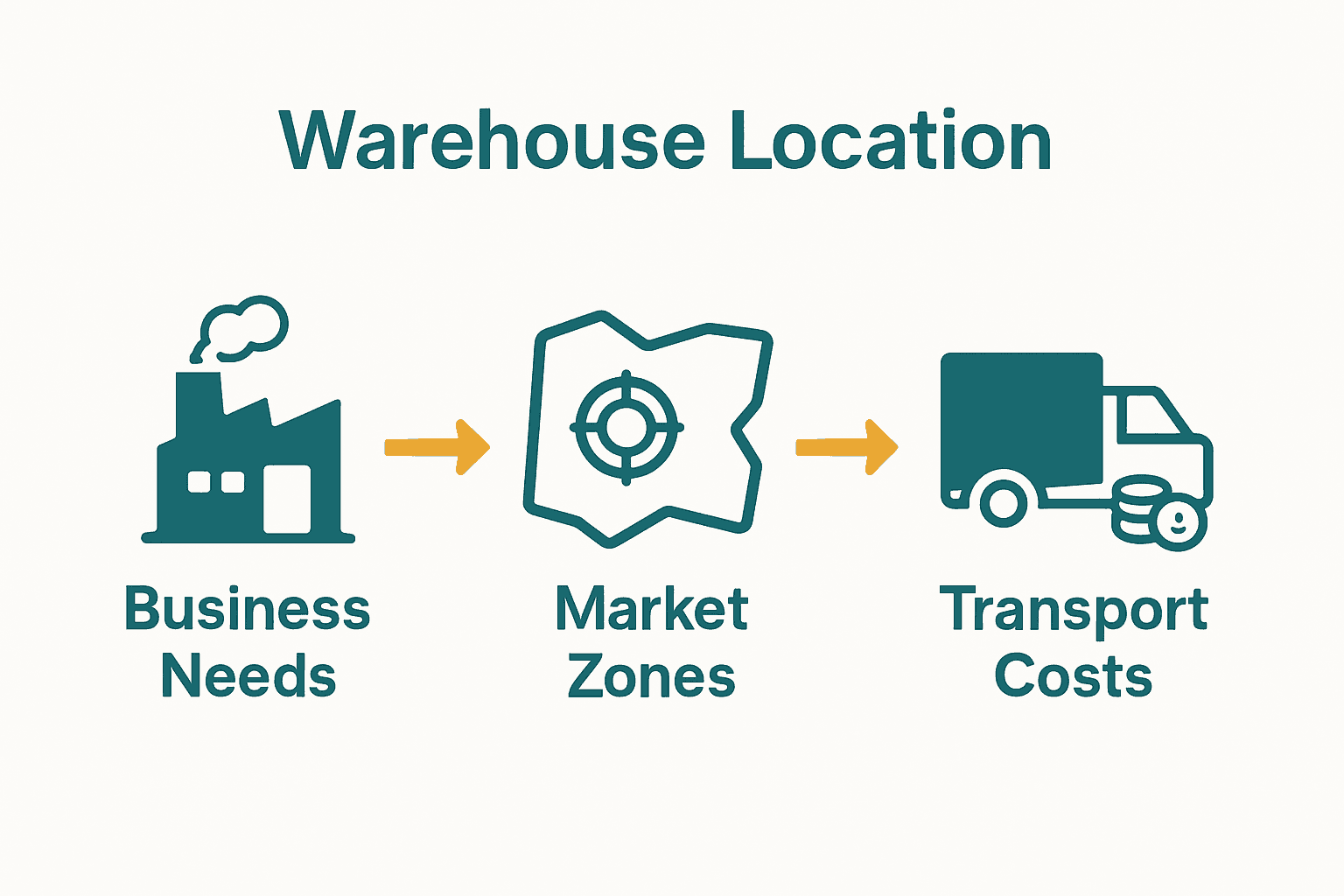
| 1. Assess business and logistics needs first | Start with a detailed analysis of sales volumes and product characteristics to align warehouse location with operational goals. |
| 2. Map customer demographics and service zones | Use demographic data to identify where your customers are located, enabling efficient service delivery and optimized warehouse placement. |
| 3. Evaluate transportation costs carefully | Analyze regional transportation networks and costs to minimize shipping expenses and maintain high service levels for customers. |
| 4. Utilize data analytics for site selection | Develop a data model that integrates essential criteria to support objective comparisons of potential warehouse locations. |
| 5. Conduct pilot runs for location validation | Test selected warehouse sites with real-world scenarios to identify operational efficiencies and resolve any potential issues before full implementation. |
 |
|
Step 1: Assess business and logistics requirements
Successfully selecting a warehouse location starts with a comprehensive assessment of your business and logistics requirements. This crucial first step will help you align your physical infrastructure with your strategic operational goals.
According to research from iimm.org, effective warehousing strategies are fundamental to reducing overall logistics costs and enhancing market competitiveness. Begin by conducting a detailed analysis of several key factors. These include evaluating your current and projected sales volumes, understanding your product characteristics, assessing shipping patterns, and analyzing customer distribution networks.
The location selection process requires examining multiple dimensions beyond simple geography. So01.tci-thaijo.org highlights critical factors such as transportation infrastructure, local regulatory policies, operating costs, labor market availability, and proximity to key markets. Create a comprehensive scorecard that weights these factors based on their importance to your specific business model. This systematic approach will help you objectively compare potential warehouse locations and make data driven decisions that support your long term logistics strategy.
Pro tip: Don’t just look at current requirements. Build flexibility into your location strategy to accommodate potential future growth and market expansion. Your warehouse should be a strategic asset that can adapt as your business evolves.
Step 2: Analyze target markets and service zones
Understanding your target markets and service zones is critical for optimizing warehouse location strategy. This step helps you pinpoint precisely where your customers are concentrated and how to efficiently serve their needs.
Research from So01.tci-thaijo.org emphasizes the significance of market proximity in determining distribution center locations. Start by mapping your customer base geographically using detailed demographic data and sales analytics. Analyze factors such as population density, consumer spending patterns, and historical purchasing behaviors. This will help you identify primary and secondary service zones where your warehouse can provide the most strategic coverage.
According to Log.logcluster.org, understanding service zones involves more than just geographical proximity. Consider transportation infrastructure, delivery time expectations, and the potential for future market expansion. Create a comprehensive zone map that includes travel times, transportation routes, and potential logistical challenges. By developing a nuanced understanding of your service zones, you can optimize warehouse placement to minimize shipping costs and maximize customer satisfaction.

Pro tip: Use geospatial mapping tools and customer data analytics to create a dynamic visualization of your market reach. This will help you make more informed decisions about warehouse location and service zone optimization.
Step 3: Evaluate transportation networks and costs
Carefully analyzing transportation networks and associated costs is a critical step in determining the most strategic warehouse location. This evaluation will help you understand the financial and logistical implications of your potential site selection.
Research from So01.tci-thaijo.org identifies transportation infrastructure as a pivotal factor in warehouse location decisions. Begin by conducting a comprehensive assessment of regional transportation networks. Map out major highways, rail lines, shipping routes, and proximity to airports. Calculate the potential transportation costs for incoming supplies and outgoing product distribution. Consider factors such as fuel expenses, carrier rates, tolls, and potential volume discounts based on shipping frequency and route optimization.
According to Log.logcluster.org, evaluating transportation networks goes beyond simple distance calculations. Analyze the quality and reliability of transportation infrastructure, including road conditions, traffic patterns, and potential bottlenecks. Create a detailed cost model that accounts for both direct transportation expenses and indirect costs like potential delivery delays or route inefficiencies. This nuanced approach will help you identify a location that minimizes overall transportation expenses while maintaining high service levels.
Pro tip: Leverage advanced logistics software to simulate different transportation scenarios and compare total landed costs across potential warehouse locations. This data driven approach can reveal hidden cost savings and operational advantages that might not be immediately apparent.
Step 4: Select warehouse sites using data analytics
Selecting the optimal warehouse site requires a sophisticated approach that goes beyond traditional decision making. Data analytics provides a powerful framework for transforming complex logistics information into actionable insights that drive strategic location choices.
Research from Ideas.repec.org presents an innovative methodology combining advanced analytical techniques like Improved Fuzzy SWARA and MARCOS methods for warehouse location selection. Begin by developing a comprehensive data model that integrates multiple criteria such as transportation costs, market proximity, infrastructure quality, labor availability, and operational expenses. Create a weighted scoring system that assigns numerical values to each criterion, allowing for objective and quantitative site comparisons.
According to Pmc.ncbi.nlm.nih.gov, strategic site selection involves using Mixed-Integer Nonlinear Programming models that optimize both storage efficiency and transportation distances. Leverage data analytics tools to simulate different warehouse placement scenarios, analyzing potential outcomes and trade offs. Run multiple iterations of your data model to identify locations that not only meet current operational requirements but also provide flexibility for future business growth and market expansion.
Pro tip: Invest in robust data visualization tools that can help you communicate complex analytical findings to stakeholders. The ability to transform raw data into clear, compelling visual representations will make your warehouse location strategy more persuasive and understandable.
Step 5: Verify location effectiveness with pilot runs
Pilot runs are the critical final validation step in your warehouse location strategy. These controlled operational tests will help you confirm that your selected site meets all performance expectations and reveals any potential operational challenges before full scale implementation.
According to Log.logcluster.org, conducting pilot runs is essential for assessing safety, security, and operational efficiency. Design a comprehensive pilot run that simulates real world logistics scenarios. This involves running a limited volume of inventory through the entire warehouse workflow testing receiving processes, storage configurations, order picking routes, and shipping procedures. Measure key performance indicators such as processing times, error rates, handling efficiency, and overall operational flow to identify potential bottlenecks or improvement opportunities.
Research from Iieta.org emphasizes the importance of warehouse layout and operational testing. Utilize your pilot run to validate not just location logistics but also warehouse design effectiveness. Track metrics like inventory accuracy, equipment utilization, worker productivity, and material handling efficiency. Be prepared to make iterative adjustments based on insights gathered during these trial operations. Document all findings meticulously to create a baseline for continuous improvement and future optimization.
Pro tip: Treat pilot runs as learning opportunities rather than pass or fail tests. The goal is to uncover subtle operational nuances that data analytics alone cannot reveal. Encourage team feedback and maintain flexibility to refine your warehouse strategy based on real world performance insights.
Achieve Warehouse Location Success with Or-Ner’s Comprehensive Logistics Solutions
Selecting the perfect warehouse location requires making sense of complex factors like market proximity, transportation costs, and operational flexibility. If you are struggling with optimizing your warehouse strategy to reduce shipping delays and control expenses, you are not alone. Many businesses face challenges aligning their logistics infrastructure with strategic goals while staying adaptable for growth. Or-Ner.com offers tailored solutions that tackle these critical pain points by combining data-driven insights with a global network of fast, scalable warehouses designed for diverse ecommerce sectors.
Don’t leave your warehouse location success to chance. Partner with Or-Ner to leverage reliable courier services, real-time shipment tracking, and integrated inventory management that support smarter distribution and logistics decisions. Explore how our platform empowers you to simulate transportation scenarios, manage cross-border shipments seamlessly, and ensure your goods reach customers on time, every time. Take control of your supply chain now by visiting Or-Ner and discovering solutions to elevate your warehouse strategy from step one to pilot runs.
Frequently Asked Questions
How do I assess my business requirements for warehouse location?
Assess your business requirements by evaluating current and projected sales volumes, product characteristics, and customer distribution networks. Start by creating a comprehensive checklist of these factors to guide your assessment.
What factors should I consider in my logistics strategy for selecting a warehouse location?
Key factors include transportation infrastructure, operating costs, local regulatory policies, and labor market availability. Create a scoring system that weighs these criteria based on their significance to your business model.
How can I analyze my target markets to optimize warehouse placement?
Map your customer base using demographic data and analyze consumer spending patterns to identify service zones. Combine this data with transportation routes and travel times to enhance your warehouse’s strategic coverage.
What role do transportation costs play in warehouse location selection?
Transportation costs are crucial in determining overall logistics expenses and impact your distribution efficiency. Calculate potential costs related to incoming supplies and outgoing deliveries, aiming to minimize these expenses by evaluating various shipping routes.
How can data analytics improve my warehouse location decision-making?
Data analytics helps in creating a weighted scoring system for site comparisons based on multiple criteria, such as operational expenses and labor availability. Leverage analytics tools to run different scenarios and visually represent your findings for informed decision-making.
What should I do during pilot runs to ensure my warehouse strategy is effective?
Conduct pilot runs to simulate real-world logistics scenarios, focusing on key performance indicators like processing times and error rates. Utilize findings from the pilot to make iterative adjustments before full-scale implementation, ensuring a smooth operational flow.