Managing a fast-moving American supply chain can turn stressful when product labels become a tangled web of compliance rules. For Ecommerce sellers and logistics managers, staying ahead of federal regulations is crucial, from nutrition facts required by the FDA to safety warnings enforced by the Consumer Product Safety Commission. This article clarifies essential labeling requirements across the United States, helping you reduce risks and build confidence in your product operations.
Table of Contents
- Defining Product Labeling Requirements In U.S.
- Major Types Of Mandatory Labels And Claims
- Key Federal Agencies And Legal Rules
- Critical Compliance Obligations And Penalties
- Common Errors And Best Practices For Labels
Key Takeaways
| Point | Details |
|---|---|
| Understanding Labeling Requirements | U.S. product labeling is regulated by multiple federal agencies, each overseeing different categories to ensure consumer protection. |
| Key Mandatory Elements | Essential labeling components include country of origin, ingredient lists, net weight, manufacturer information, and safety warnings. |
| Compliance Risks | Non-compliance can lead to substantial penalties, including fines, product recalls, and damage to brand reputation. |
| Best Practices for Accuracy | Implement systematic review processes and checklists to ensure labels are accurate and align with current regulations. |
Defining Product Labeling Requirements in U.S.
Product labeling requirements in the United States represent a complex regulatory framework designed to protect consumers and ensure transparent commercial practices. These requirements vary significantly across different product categories, mandating specific information that manufacturers must display on packaging and product surfaces.
The U.S. government enforces labeling standards through multiple federal agencies, with each focusing on distinct product types. FDA regulations for food labeling represent one critical component of this comprehensive system. Companies must understand and comply with these intricate guidelines to avoid potential legal complications and marketplace penalties.
Key product labeling requirements typically encompass several mandatory elements:
- Country of Origin: Indicating where the product was manufactured
- Ingredient List: Detailed breakdown of product components
- Net Weight/Volume: Precise measurement of product quantity
- Manufacturer Information: Contact details and business address
- Safety Warnings: Potential hazards or usage instructions
Regulatory complexity means businesses must carefully navigate multiple compliance standards across different product categories. Textile products, children’s goods, electronics, and food items each have unique labeling specifications that demand meticulous attention to detail.
Pro tip: Consult specialized legal counsel or regulatory experts to ensure complete compliance with product labeling requirements across your specific product lines.
Major Types of Mandatory Labels and Claims
Mandatory product labels in the United States serve multiple critical functions, ranging from consumer protection to regulatory compliance. Consumer Product Safety Commission guidelines outline comprehensive requirements that businesses must carefully navigate across various product categories.
The primary types of mandatory labels encompass several key classifications:
- Safety Warning Labels: Highlighting potential hazards and risks
- Product Identification Labels: Providing specific product details
- Tracking Labels: Enabling product traceability and recall management
- Ingredient Disclosure Labels: Detailing product composition
- Dimensional and Weight Labels: Specifying precise product measurements
Under the Fair Packaging and Labeling Act, consumer commodities must include specific mandatory information. These regulations ensure transparency by requiring manufacturers to disclose net contents, product identity, and manufacturer information on packaging.
Different product categories demand unique labeling approaches. Children’s products require age-specific warnings, toys need small parts labels, and food items must include nutrition facts. Electronics, textiles, and hazardous materials each have distinct labeling requirements that demand precise attention to regulatory details.

Pro tip: Develop a comprehensive labeling checklist specific to your product category to ensure complete regulatory compliance.
Key Federal Agencies and Legal Rules
Product labeling in the United States involves a complex network of federal agencies, each responsible for enforcing specific regulatory standards across different product categories. Electronic Code of Federal Regulations provides the foundational legal framework that guides these comprehensive labeling requirements.
Key federal agencies responsible for product labeling regulations include:
- Food and Drug Administration (FDA): Oversees food, drug, and cosmetic product labels
- Consumer Product Safety Commission (CPSC): Manages safety labeling for consumer goods
- Federal Trade Commission (FTC): Regulates packaging and marketing claims
- United States Department of Agriculture (USDA): Monitors food and agricultural product labeling
- Environmental Protection Agency (EPA): Handles environmental and chemical product labels
USDA’s Food Standards and Labeling Policy demonstrates the intricate legal frameworks that guide product label compliance. Each agency maintains specific regulations that manufacturers must carefully navigate, with potential penalties for non-compliance ranging from financial fines to product recalls.
The legal rules surrounding product labeling are designed to protect consumer interests by ensuring transparency, safety, and accurate product representation. These regulations require businesses to provide clear, truthful information about product contents, potential risks, origin, and intended use across various industry sectors.
Here’s a summary of how different federal agencies oversee labeling requirements in the United States:
| Agency | Regulated Products | Main Label Focus |
|---|---|---|
| FDA | Food, drugs, cosmetics | Ingredients, nutrition, safety |
| CPSC | Consumer goods | Safety warnings, age notices |
| FTC | Packaged goods, advertising | Marketing claims, labeling |
| USDA | Meat, poultry, agricultural items | Food standards, origin |
| EPA | Pesticides, chemicals | Environmental and hazard info |
Pro tip: Maintain a dedicated compliance team or consultant who stays current with evolving federal labeling regulations to minimize legal risks.
Critical Compliance Obligations and Penalties
Product labeling compliance represents a complex legal landscape with significant financial and operational consequences for businesses. National Institute of Standards and Technology regulations outline the fundamental obligations that manufacturers must meticulously follow to avoid potential penalties.
Key compliance obligations typically encompass several critical areas:
- Accurate Product Identity: Precisely describing product characteristics
- Quantity Declaration: Providing exact measurement specifications
- Manufacturer Information: Including complete contact and origin details
- Safety Warning Disclosures: Highlighting potential product risks
- Ingredient Transparency: Fully listing product composition
Consumer Product Safety Commission guidelines detail the potential consequences of non-compliance, which can be severe and multifaceted. Penalties may include substantial financial fines, mandatory product recalls, potential legal actions, and significant reputational damage that could impact a company’s market standing.
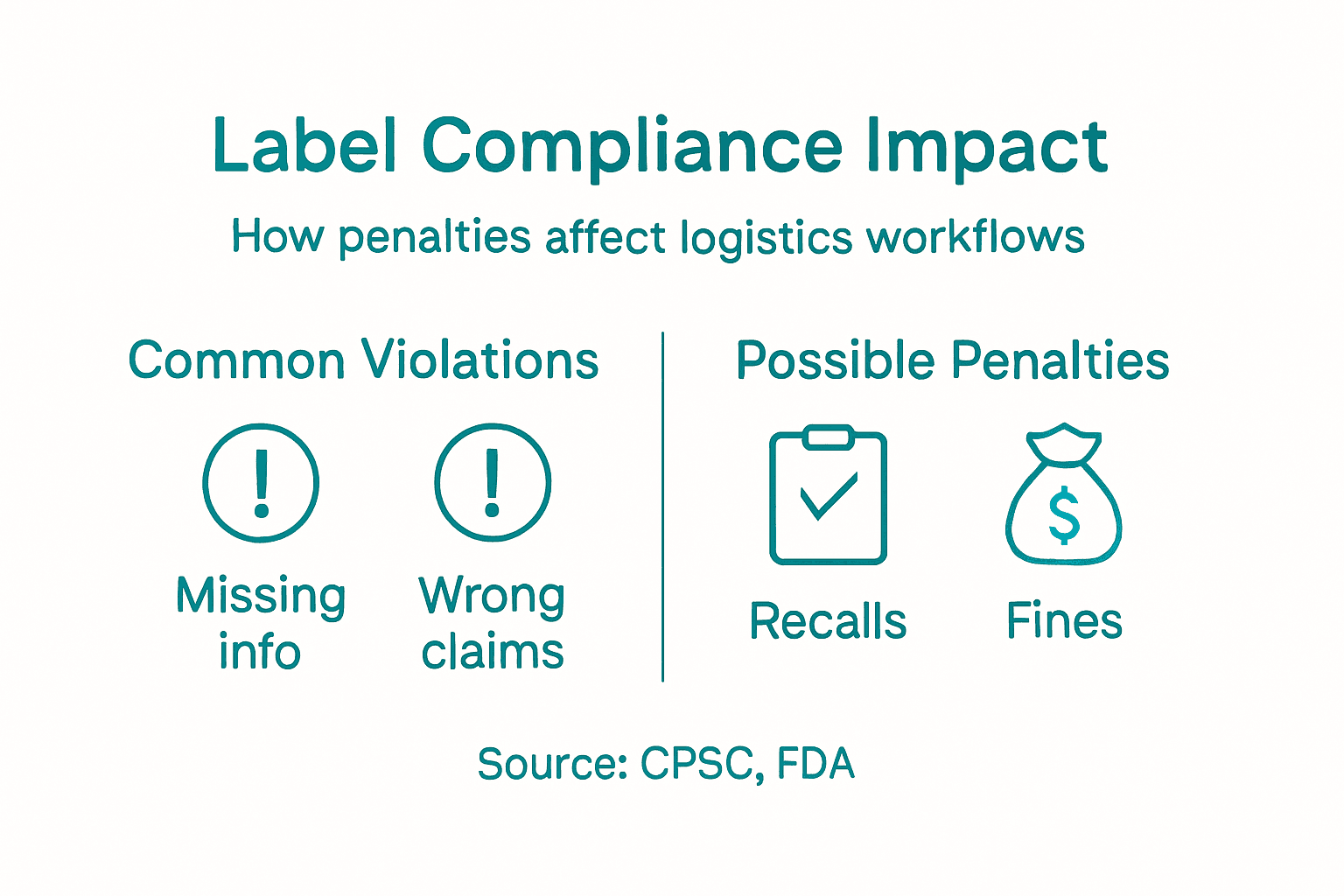
The enforcement mechanisms are designed to be comprehensive and stringent. Regulatory agencies conduct regular inspections, market surveillance, and investigations to ensure businesses adhere to labeling standards. Companies found in violation may face escalating penalties, ranging from warning notices and corrective action requirements to substantial monetary sanctions and potential criminal prosecution for repeated or intentional violations.
This table compares typical consequences for non-compliance versus best practices for avoiding penalties:
| Aspect | Non-Compliance Consequences | Best Practice for Compliance |
|---|---|---|
| Financial Impact | Heavy fines, legal costs | Regular audits, expert review |
| Market Reputation | Brand damage, consumer distrust | Clear, accurate label content |
| Operational Effects | Product recalls, business delays | Up-to-date regulatory knowledge |
| Regulatory Standing | Increased inspections, penalties | Proactive compliance monitoring |
Pro tip: Implement a proactive compliance review system that regularly audits product labels against the most current federal regulatory standards.
Common Errors and Best Practices for Labels
Product labeling represents a critical area where minor mistakes can lead to significant regulatory challenges and potential legal consequences. Paramount Global’s comprehensive labeling guide highlights the nuanced landscape of compliance and potential pitfalls businesses must carefully navigate.
Common labeling errors that companies frequently encounter include:
- Incomplete Ingredient Lists: Omitting critical ingredient details
- Incorrect Allergen Warnings: Failing to highlight potential health risks
- Misleading Product Claims: Making unsubstantiated marketing statements
- Incorrect Measurement Declarations: Providing inaccurate quantity information
- Font Size and Readability Issues: Using illegible or non-compliant label formatting
Association of Food and Drug Officials guidelines emphasize the importance of creating clear, truthful, and comprehensive labels. Best practices involve developing a systematic approach to label creation that prioritizes accuracy, transparency, and regulatory alignment.
Successful label management requires a proactive strategy that combines technological tools, expert review, and ongoing regulatory education. Companies should implement robust internal review processes, leverage automated compliance checking systems, and maintain direct communication channels with relevant regulatory agencies to ensure continuous adherence to evolving labeling standards.
Pro tip: Develop a comprehensive label review checklist that includes cross-verification with the latest federal regulatory requirements before final product release.
Simplify Compliance and Logistics for Product Labeling Success
Navigating complex product labeling requirements creates unique challenges for ecommerce sellers and businesses managing cross-border shipments. The need for accurate labels, safety warnings, and regulatory compliance often slows down supply chains and increases the risk of costly recalls or delays. At the same time, logistics must keep pace with these demands without compromising efficiency or delivery timelines.
Or-ner.com offers reliable courier services and a robust logistics platform designed to help you manage these challenges effortlessly. From customs clearance that respects the intricate federal labeling rules to inventory management ensuring you ship the right products with compliant labels, our end-to-end solutions empower your business to scale globally with confidence.
Don’t let labeling complexities hinder your growth. Discover how our platform supports transparent, compliant product flows across ocean, air, and land transport modes. Visit Or-ner.com now to streamline your supply chain with real-time tracking, integrated compliance workflows, and dedicated support tailored to your products and industry needs. Start simplifying your logistics today for flawless, compliant shipping tomorrow.
Frequently Asked Questions
What are the key components of product labeling requirements?
Key components of product labeling requirements typically include the country of origin, ingredient list, net weight or volume, manufacturer information, and necessary safety warnings.
How do federal agencies influence product labeling?
Federal agencies, such as the FDA, CPSC, and FTC, enforce specific regulations for labeling across different product categories, ensuring transparency and consumer protection.
What are the consequences of non-compliance with labeling requirements?
Non-compliance with labeling requirements can lead to heavy fines, product recalls, potential legal actions, and damage to a company’s reputation.
What common errors should businesses avoid in product labeling?
Businesses should avoid common errors such as incomplete ingredient lists, incorrect allergen warnings, misleading product claims, inaccurate measurement declarations, and issues with font size and readability.
Recommended
- Just in Time Delivery: Essential Guide for 2025 Success – ORNER
- Top Benefits of Freight Forwarding for Growing Businesses 2025 – ORNER
- What Is Freight Forwarding? Guide for Modern Supply Chains 2025 – ORNER
- What Is Same Day Delivery? 2025 Guide for Online Retailers – ORNER
- Spooly – 3D Filament Tracker & Manager | Bambu Lab Integration