
Managing stock levels in a fast-moving American fashion or home goods warehouse often feels like solving a complex puzzle. Efficient inventory turnover is key to reducing costly storage and preventing product obsolescence, especially when trends shift quickly. By focusing on this vital metric, ecommerce logistics managers gain the tools to optimize fulfillment processes, maintain better cash flow, and elevate customer satisfaction without letting unused products pile up.
Table of Contents
- Inventory Turnover Ratio Defined for Ecommerce
- Calculating Turnover: Methods and Key Metrics
- Impact on Cash Flow and Holding Costs
- Strategies to Improve Turnover in Fashion and Home Goods
- Common Pitfalls and How to Avoid Them
Key Takeaways
| Point | Details |
|---|---|
| Understanding Inventory Turnover Ratio | The inventory turnover ratio is a key performance metric that shows how efficiently a company sells and replaces its inventory. This directly impacts profitability and operational effectiveness. |
| Impact on Cash Flow | Efficient inventory management positively influences cash flow by reducing holding costs and improving liquidity. Higher turnover rates indicate improved financial health. |
| Importance of Metrics | Alongside the inventory turnover ratio, metrics like Days Sales of Inventory and GMROII provide deeper insights into inventory performance and profitability. |
| Avoiding Common Pitfalls | Businesses should address challenges such as inconsistent demand forecasting and inadequate technology to enhance inventory management effectiveness and financial outcomes. |
Inventory Turnover Ratio Defined for Ecommerce
The inventory turnover ratio (ITR) represents a critical performance metric for ecommerce businesses tracking how efficiently they manage product inventory. This financial indicator measures how often inventory is sold within a specific timeframe, providing essential insights into procurement, sales, and overall operational effectiveness.
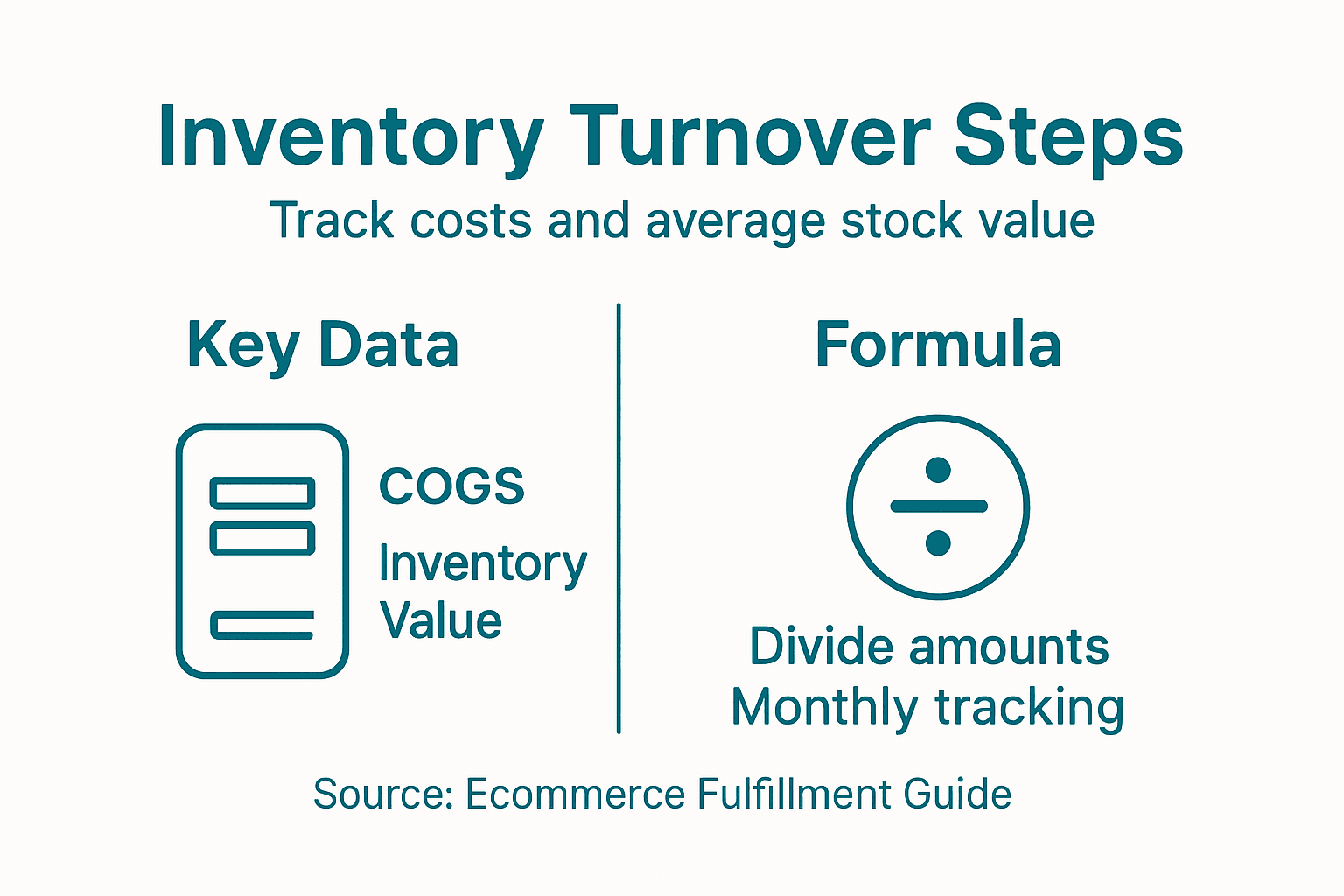
At its core, the inventory turnover ratio calculates the number of times a company sells and replaces its entire inventory during a given period. The formula is straightforward: divide the cost of goods sold by the average inventory value. A higher ratio signals several positive outcomes:
- Faster product movement through sales channels
- More efficient inventory procurement
- Reduced storage and holding costs
- Better cash flow management
- Minimized risk of product obsolescence
For ecommerce businesses, understanding this metric goes beyond simple number crunching. It directly impacts profitability by revealing how well a company transforms inventory investments into revenue. Low turnover rates might indicate overstocking, while high turnover rates suggest robust sales performance and strategic inventory management.
Calculating the ratio involves gathering two key pieces of data: total cost of goods sold and average inventory value. By tracking this metric consistently, online retailers can make data-driven decisions about purchasing, warehousing, and sales strategies.
Pro tip: Track your inventory turnover ratio monthly to quickly identify trends and adjust your procurement strategies proactively.
Calculating Turnover: Methods and Key Metrics
Calculating the inventory turnover ratio requires a systematic approach that provides meaningful insights into a company’s operational efficiency. Precise calculation methods involve several key mathematical steps and considerations that go beyond simple number crunching.
The fundamental formula for inventory turnover involves dividing the cost of goods sold by the average inventory value. This calculation can be broken down into two primary components:
- Cost of Goods Sold (COGS): Total direct costs of producing goods sold during a specific period
- Average Inventory: Calculated by adding beginning and ending inventory values and dividing by two
Ecommerce businesses can enhance their turnover ratio analysis by considering additional metrics that provide deeper context:
- Days Sales of Inventory (DSI): Measures how long inventory sits before being sold
- Gross Margin Return on Inventory Investment (GMROII): Evaluates inventory profitability
- Sell-through Rate: Percentage of inventory sold versus total inventory
A comprehensive inventory turnover analysis goes beyond simple calculations and requires understanding broader operational dynamics.
These supplementary metrics help ecommerce managers develop a more nuanced view of inventory performance. By tracking multiple indicators, businesses can identify potential inefficiencies, optimize procurement strategies, and make data-driven decisions about stock management.
Here’s how key inventory metrics compare:
| Metric | What It Measures | Business Impact |
|---|---|---|
| Inventory Turnover Ratio (ITR) | Frequency inventory is sold | Reflects sales efficiency and cash flow |
| Days Sales of Inventory (DSI) | Average days to sell inventory | Reveals inventory holding speed |
| GMROII | Profit per dollar of inventory | Shows inventory profitability |
| Sell-through Rate | Portion of stock sold | Tracks demand and sales strategy success |
Pro tip: Compare your inventory turnover ratio against industry benchmarks to gain meaningful insights into your operational performance.
Impact on Cash Flow and Holding Costs
Inventory turnover directly influences an organization’s financial health through its profound impact on cash flow and holding costs. Inventory management strategies reveal critical connections between inventory movement and financial performance that extend far beyond simple stock tracking.
Holding costs represent a significant financial burden for ecommerce businesses, encompassing various expenses associated with storing and maintaining inventory:
- Warehouse rental and storage space expenses
- Insurance and security costs
- Utility charges for inventory storage
- Risk of product depreciation
- Labor costs for inventory management
- Potential inventory obsolescence
The relationship between inventory turnover and cash flow is complex and multifaceted. Higher turnover rates typically indicate more efficient inventory management, which translates into several financial advantages:
- Reduced capital tied up in static inventory
- Lower storage and maintenance expenses
- Faster conversion of inventory into revenue
- Improved overall liquidity
- Enhanced ability to invest in growth opportunities
Efficient inventory management transforms static inventory into dynamic financial resources.
Ecommerce businesses can optimize their financial performance by continuously monitoring and improving their inventory turnover ratio. This involves developing sophisticated procurement strategies, leveraging demand forecasting technologies, and maintaining a lean, responsive inventory approach.
Pro tip: Aim to balance inventory levels by implementing just-in-time inventory management techniques that minimize holding costs while maintaining adequate stock.
Strategies to Improve Turnover in Fashion and Home Goods
Improving inventory turnover in fashion and home goods requires sophisticated, data-driven approaches that address the unique challenges of these dynamic markets. Advanced inventory control frameworks have emerged as critical tools for ecommerce businesses seeking to optimize their stock management and reduce holding costs.
Successful strategies for enhancing inventory turnover in these sectors include:
- Implementing predictive demand forecasting technologies
- Utilizing real-time inventory tracking systems
- Developing flexible procurement approaches
- Creating dynamic pricing strategies
- Establishing rapid product lifecycle management
- Integrating artificial intelligence for inventory optimization
Fashion and home goods retailers face particularly challenging inventory management environments due to rapid trend changes and seasonal variations. To combat these challenges, businesses can leverage several key approaches:
- Adopt machine learning algorithms for precise demand prediction
- Develop agile supply chain relationships
- Implement just-in-time inventory management
- Create multi-channel sales strategies
- Use data analytics for continuous inventory refinement
Successful inventory management transforms unpredictability into a strategic advantage.
Technology plays a crucial role in modern inventory optimization. Advanced analytics, artificial intelligence, and machine learning enable businesses to create more responsive and efficient inventory management systems that can quickly adapt to market changes and consumer preferences.

Below is a summary of strategies for increasing turnover in fast-changing markets:
| Strategy | Description | Key Benefit |
|---|---|---|
| Predictive Demand Forecasting | Uses data to anticipate customer needs | Reduces overstocking |
| Real-Time Inventory Tracking | Monitors inventory instantly | Enables rapid replenishment |
| Dynamic Pricing | Adjusts prices based on demand | Moves slow stock faster |
| Agile Supply Chain Management | Quickly adapts to market shifts | Prevents excess inventory |
Pro tip: Invest in real-time inventory tracking technologies that provide actionable insights and enable rapid decision-making.
Common Pitfalls and How to Avoid Them
Ecommerce businesses often encounter critical challenges that can significantly undermine their inventory management effectiveness. Inventory management failures frequently stem from systematic issues that can be proactively identified and addressed through strategic interventions.
The most common pitfalls in inventory management include:
- Inconsistent demand forecasting
- Inadequate technology integration
- Poor inventory tracking mechanisms
- Lack of real-time data visibility
- Inefficient procurement strategies
- Insufficient safety stock planning
These challenges can create substantial operational risks for businesses, potentially leading to significant financial consequences:
- Unexpected stockouts causing lost sales
- Excessive inventory holding costs
- Reduced cash flow flexibility
- Increased warehousing expenses
- Diminished customer satisfaction
Strategic inventory management transforms potential risks into opportunities for operational excellence.
Mitigating these risks requires a comprehensive approach that combines technological solutions, data-driven insights, and adaptive management strategies. Implementing robust inventory tracking systems, developing sophisticated demand prediction models, and maintaining flexible procurement relationships can help businesses navigate complex inventory challenges effectively.
Pro tip: Conduct quarterly inventory audits to identify and proactively address potential management gaps before they escalate into significant operational issues.
Boost Your Inventory Turnover with Reliable Courier Services
Managing inventory turnover ratio effectively is essential to improving fulfillment efficiency and maintaining healthy cash flow. Challenges like inadequate inventory tracking and slow product movement can leave your ecommerce business stuck with excessive holding costs and lost sales opportunities. By focusing on actionable strategies such as real-time inventory monitoring and dynamic supply chain management, you can transform your stock management into a competitive advantage.

Partner with or-ner.com, a comprehensive logistics and supply chain platform offering reliable courier services designed to optimize inventory turnover. Access advanced tools for freight booking, real-time shipment tracking, and cross-border logistics that integrate seamlessly with your ecommerce operations. Start streamlining your fulfillment today by visiting our platform and discover how we support fast, scalable, and data-driven inventory management solutions that boost your cash flow and reduce holding costs.
Frequently Asked Questions
What is the inventory turnover ratio (ITR)?
The inventory turnover ratio (ITR) measures how often inventory is sold and replaced over a specific timeframe, indicating how efficiently a business manages its inventory.
How do I calculate the inventory turnover ratio?
To calculate the inventory turnover ratio, divide the cost of goods sold (COGS) by the average inventory value. The formula is: ITR = COGS / Average Inventory.
Why is a high inventory turnover ratio favorable for a business?
A high inventory turnover ratio indicates efficient inventory management, leading to faster product sales, reduced storage costs, improved cash flow, and lower risk of product obsolescence.
What strategies can improve my inventory turnover ratio?
To improve your inventory turnover ratio, consider implementing predictive demand forecasting, real-time inventory tracking, dynamic pricing strategies, and maintaining agile supply chain relationships.
Recommended
- Just in Time Delivery: Essential Guide for 2025 Success – ORNER
- Inventory Turnover Rate: Boosting Ecommerce Logistics – ORNER
- Complete Guide to Outsourcing Order Fulfillment – ORNER
- Inventory Replenishment Methods: Boost Supply Chain Efficiency – ORNER
- Affordable Bulk DTF Transfers for Your Business Needs: Quality, Speed, – Transfer Kingz
- 7 Essential Warehouse Food Storage Tips for Businesses – Probe IT