
Every international shipment puts your e-commerce business under the spotlight of strict government scrutiny, where missing even a single document can mean costly delays or fines. For American logistics managers, mastering the basics of international trade compliance is not just a legal requirement but a strategic move to protect your supply chain and reputation. Understanding how U.S. agencies enforce rules for exports, tariffs, and sanctions helps you navigate risks and keep your cross-border shipping running smoothly.
Table of Contents
- Defining International Trade Compliance Basics
- Types of Regulations in Cross-Border Trade
- How Compliance Powers Reliable E-Commerce
- Legal Framework: U.S. and Global Standards
- Core Obligations: Documentation and Customs Rules
- Risks, Costs, and Common Mistakes in Compliance
Key Takeaways
| Point | Details |
|---|---|
| Understanding Compliance | International trade compliance is essential for U.S. e-commerce companies to navigate complex regulations, ensuring legal and ethical practices in cross-border transactions. |
| Risk Mitigation | Proactive compliance management reduces the risk of financial penalties and operational disruptions through detailed documentation and monitoring systems. |
| Technological Integration | Investing in compliance software streamlines regulatory checks, document generation, and real-time updates, enhancing operational efficiency and reducing risks. |
| Regular Audits | Conducting quarterly compliance audits helps identify vulnerabilities and adapt strategies to meet changing international trade regulations. |
Defining International Trade Compliance Basics
International trade compliance represents a complex regulatory framework that governs cross-border business transactions for U.S. e-commerce companies. At its core, compliance means adhering to a comprehensive set of rules established by governmental agencies to ensure legal and ethical international trade practices. These regulations are designed to protect national economic interests, manage potential security risks, and maintain fair global trading standards.
The landscape of international trade compliance involves multiple critical components, including managing export control mechanisms implemented by agencies like the Departments of State, Commerce, and Treasury. Businesses must navigate intricate requirements such as tracking restricted product categories, understanding tariff classifications, verifying customer identities, and ensuring goods do not violate international sanctions or export restrictions.
Successful trade compliance demands a proactive approach that integrates legal expertise, technological solutions, and comprehensive documentation strategies. E-commerce companies must develop robust internal processes that systematically verify shipment details, classify products accurately, and maintain meticulous records of international transactions. This includes understanding complex regulations surrounding intellectual property rights, managing potential customs duties, and implementing risk mitigation strategies that protect both the business and its customers.
Here’s a quick overview of key U.S. agencies involved in international trade compliance and their core roles:
| Agency | Primary Focus | Example Responsibility |
|---|---|---|
| Department of Commerce | Export controls | Administers EAR regulations |
| Department of State | National security, arms | Oversees ITAR rules and licenses |
| Department of Treasury | Economic sanctions | Enforces OFAC sanction lists |
| U.S. Customs and Border Protection | Customs enforcement | Manages import inspections and duties |
Pro tip: Invest in specialized trade compliance software that automates regulatory checks and provides real-time updates on changing international trade regulations to minimize potential legal risks.
Types of Regulations in Cross-Border Trade
Cross-border trade regulations encompass a complex web of legal frameworks designed to govern international commercial activities. These regulations are strategically developed to protect national economic interests, ensure fair trading practices, and maintain critical security standards. The primary objective is to create a structured environment that balances international commerce with national policy objectives and potential risk mitigation.
The United States implements multiple layers of regulatory mechanisms, including trade remedy laws that address critical aspects of international commerce. These regulations span several key domains: antidumping provisions, which prevent foreign companies from selling products below fair market value; countervailing duty laws that offset international subsidies; export control mechanisms for sensitive technologies; and comprehensive customs enforcement protocols. Government agencies like the Department of Commerce and International Trade Administration play pivotal roles in developing and implementing these intricate regulatory standards.
International trade regulations also involve sophisticated compliance requirements surrounding product classifications, tariff management, and adherence to international treaties. E-commerce businesses must navigate complex rules related to intellectual property protection, sanctions compliance, and detailed documentation requirements. These regulations often involve intricate interactions between federal statutes, international agreements like NAFTA and World Trade Organization (WTO) frameworks, and specific industry-specific guidelines that can vary dramatically across different product categories and international markets.
Pro tip: Develop a comprehensive compliance checklist that maps out specific regulatory requirements for each international market you plan to operate in, and regularly update this document to reflect changing global trade policies.
How Compliance Powers Reliable E-Commerce
Compliance is the foundational infrastructure that transforms e-commerce from a risky digital marketplace into a trustworthy global platform. By establishing rigorous legal and operational standards, compliance mechanisms create a secure environment that protects businesses, consumers, and digital transactions from potential risks and vulnerabilities.

Modern e-commerce relies on sophisticated compliance frameworks that address digital trade challenges. These frameworks encompass critical domains such as data governance, consumer protection, international trade agreements, and cybersecurity protocols. By proactively integrating regulatory requirements into daily operational processes, businesses can significantly enhance their credibility, reduce transactional risks, and build consumer trust across diverse international markets.
The strategic implementation of compliance programs goes beyond mere legal adherence. It involves creating robust internal systems that anticipate potential regulatory challenges, continuously monitor changing international trade dynamics, and develop adaptive strategies. E-commerce companies that invest in comprehensive compliance infrastructures can differentiate themselves by demonstrating commitment to transparency, ethical business practices, and customer protection. This approach not only mitigates legal risks but also creates competitive advantages in increasingly complex global digital marketplaces.
Pro tip: Conduct quarterly compliance audits to identify potential regulatory gaps and develop a proactive strategy for addressing emerging international trade and digital commerce regulations.
Legal Framework: U.S. and Global Standards
The international trade compliance landscape is fundamentally shaped by the intricate interplay between United States legal principles and global regulatory standards. At its core, this framework combines the complex mechanisms of U.S. common law with international treaty obligations, creating a sophisticated system that governs cross-border commercial interactions and ensures fair, transparent global trade practices.
The U.S. legal system provides a robust foundation for international trade compliance through its multilayered standards development approach. Federal and state court systems work in concert with regulatory agencies to interpret and enforce trade regulations, while simultaneously engaging with international bodies like the World Trade Organization to harmonize global trade standards. This approach allows for flexible yet rigorous compliance mechanisms that can adapt to rapidly changing global economic environments.
E-commerce businesses must navigate a complex web of legal requirements that span multiple jurisdictions and regulatory domains. This involves understanding not just U.S. federal statutes, but also international trade agreements, bilateral treaties, and sector-specific regulations that can vary dramatically across different global markets. Successful compliance requires a proactive strategy that anticipates regulatory changes, maintains meticulous documentation, and develops robust internal processes that can quickly adapt to evolving legal landscapes.
Pro tip: Develop a comprehensive compliance matrix that maps regulatory requirements across different international markets, and schedule monthly reviews to track potential legal changes that could impact your e-commerce operations.
Core Obligations: Documentation and Customs Rules
Documentation represents the critical foundation of international trade compliance, serving as the primary mechanism through which e-commerce businesses demonstrate legal and regulatory adherence. Every cross-border transaction requires a meticulously crafted set of documents that validate the shipment’s origin, value, content, and intended use, creating a transparent record that facilitates smooth customs clearance and regulatory verification.
U.S. e-commerce companies must navigate complex customs documentation requirements that extend far beyond simple shipping labels. These obligations encompass detailed paperwork including commercial invoices, certificates of origin, product classification codes, and comprehensive shipping manifests. Each document must precisely align with U.S. Customs and Border Protection guidelines, ensuring that every international shipment meets stringent regulatory standards designed to protect national economic interests and maintain global trade integrity.
Successful international trade documentation requires a strategic approach that anticipates potential regulatory challenges across different global markets. E-commerce businesses must develop robust internal systems capable of generating accurate, consistent documentation that can withstand intense scrutiny from customs officials. This involves not just completing forms, but understanding the nuanced requirements of different countries, maintaining detailed records of product sourcing, and implementing sophisticated tracking mechanisms that provide real-time visibility into the complex journey of international shipments.
Pro tip: Invest in specialized trade compliance software that automates document generation and provides real-time updates on changing international documentation requirements to minimize potential customs clearance delays.
Risks, Costs, and Common Mistakes in Compliance
International trade compliance represents a complex landscape fraught with potential financial and legal risks that can devastate unprepared e-commerce businesses. The consequences of non-compliance extend far beyond simple monetary penalties, potentially compromising a company’s entire operational infrastructure and long-term market credibility.
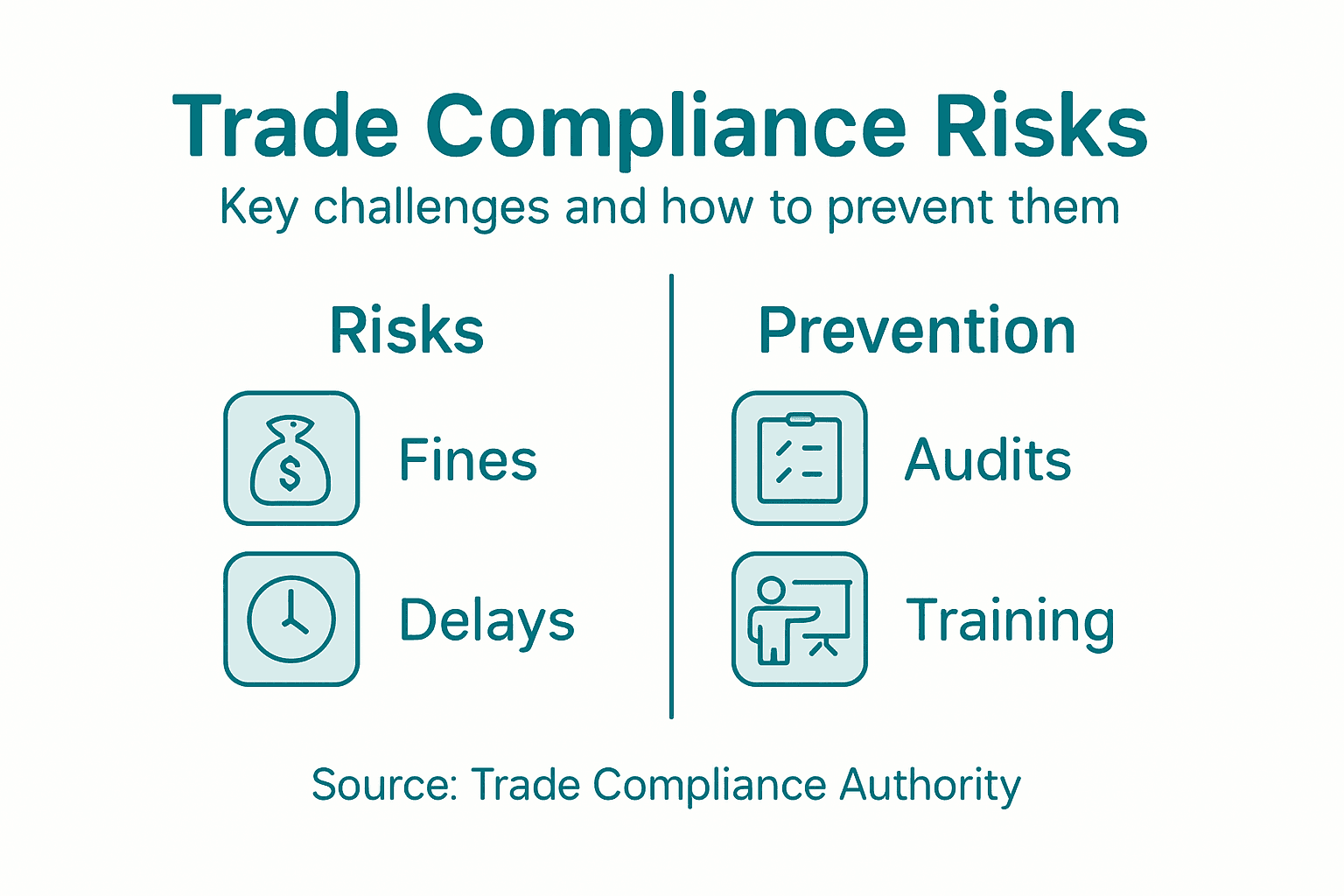
E-commerce organizations face substantial challenges when navigating compliance program vulnerabilities. Common mistakes include inadequate documentation, misunderstanding regulatory requirements, and failing to implement robust monitoring systems. These errors can trigger significant financial consequences, including substantial fines, shipment delays, potential legal actions, and permanent restrictions on international trading privileges. Penalties can range from modest financial assessments to complete prohibition of cross-border commercial activities.
Successful risk mitigation demands a proactive and comprehensive approach to compliance management. This involves developing sophisticated internal controls, maintaining rigorous documentation processes, conducting regular compliance audits, and investing in continuous staff training. E-commerce businesses must create adaptive compliance frameworks that can quickly respond to changing international regulations, technological innovations, and emerging global trade dynamics. The most effective strategies integrate advanced technological solutions with deep regulatory expertise, enabling real-time monitoring and rapid adaptation to complex international trade environments.
Below is a summary of common trade compliance risks with corresponding consequences and prevention strategies:
| Risk Type | Potential Consequence | Prevention Strategy |
|---|---|---|
| Inaccurate Documentation | Customs delays or fines | Automated record management systems |
| Regulatory Misunderstanding | Legal penalties | Continuous staff training and legal review |
| Inadequate Monitoring | Missed updates, violations | Real-time compliance software alerts |
| Improper Classification | Overpayment or penalties | Employ expert classification procedures |
Pro tip: Implement a quarterly compliance risk assessment protocol that systematically reviews your international trade documentation, regulatory adherence, and potential vulnerability points to preemptively identify and address potential compliance challenges.
Ensure Seamless International Trade Compliance with Trusted Logistics Support
Navigating the demanding landscape of international trade compliance requires more than just understanding regulations. It demands reliable courier services and comprehensive cross-border logistics that keep your e-commerce shipments on track while adhering to complex documentation and customs rules. Many U.S. sellers struggle with compliance risks like improper classification and inadequate monitoring that lead to costly delays and penalties. That is where or-ner.com can transform your global operations.
Take control of your supply chain with our end-to-end solutions that automate customs clearance, provide real-time shipment tracking, and ensure your freight booking matches stringent export control standards. Whether you are a manufacturer, wholesaler, or individual merchant, or-ner.com offers scalable warehousing and reliable courier services designed to protect your brand and maintain compliance integrity. Start reducing risks and enhancing trust with our specialized logistics platform tailored for international e-commerce today. Discover how seamless compliance and logistics converge by exploring our services at reliable courier services, then take the next step towards hassle-free global trade management.
Frequently Asked Questions
What is international trade compliance?
International trade compliance refers to the regulations and rules that govern cross-border business transactions. It involves adhering to standards established by governmental agencies to ensure legal and ethical practices in international trade.
Why is documentation important in international trade compliance?
Documentation is crucial because it provides a transparent record that validates the shipment’s origin, value, and content. Proper documentation ensures smooth customs clearance and regulatory verification, protecting businesses from potential fines and delays.
What are some common risks associated with international trade compliance?
Common risks include inaccurate documentation, misunderstanding regulatory requirements, and inadequate monitoring systems. These can lead to customs delays, fines, legal penalties, and restrictions on international trading privileges.
How can e-commerce companies mitigate compliance risks?
E-commerce companies can mitigate compliance risks by implementing robust internal controls, maintaining rigorous documentation processes, conducting regular compliance audits, and investing in continuous staff training to stay updated on regulatory changes.
Recommended
- Global Trade Compliance: Streamlining Cross-Border Shipping – ORNER
- Complete Guide to Global Trade Documentation – ORNER
- Understanding International Shipping Regulations – ORNER
- Ecommerce Shipping Insurance Guide 2025: Reduce Risk and Loss – ORNER
- US Threatens Retaliation Against EU Firms Over Digital Taxes
- 7 Key Benefits of Secure Translation for Compliance Teams