TL;DR:
- Effective delivery experience management relies on proactive communication, precise ETA management, and flexible options to build customer trust and loyalty. Automated notifications, live tracking, and personalized branding significantly reduce support costs and increase conversion rates. Continuously measuring delivery metrics and closing communication gaps are essential for delivering consistent and satisfying last-mile service.
Customer delivery experience is defined as every interaction a buyer has with your brand from the moment they place an order to the moment the package lands in their hands. Getting it right is not optional. Research from Narvar shows that precise delivery dates at checkout drove a 16% reduction in WISMO inquiries and a significant conversion lift for Harry Rosen. For e-commerce businesses and logistics managers, knowing how to improve customer delivery experience means mastering four disciplines: proactive communication, accurate ETA management, flexible delivery options, and continuous performance measurement. Delivery experience management (DEM) is the industry term for this discipline, and it is the framework this guide follows.
How to improve customer delivery experience with proactive notifications

Silence after checkout is the fastest way to lose customer trust. Automated, event-driven notifications close that gap by keeping buyers informed at every milestone without requiring them to reach out.
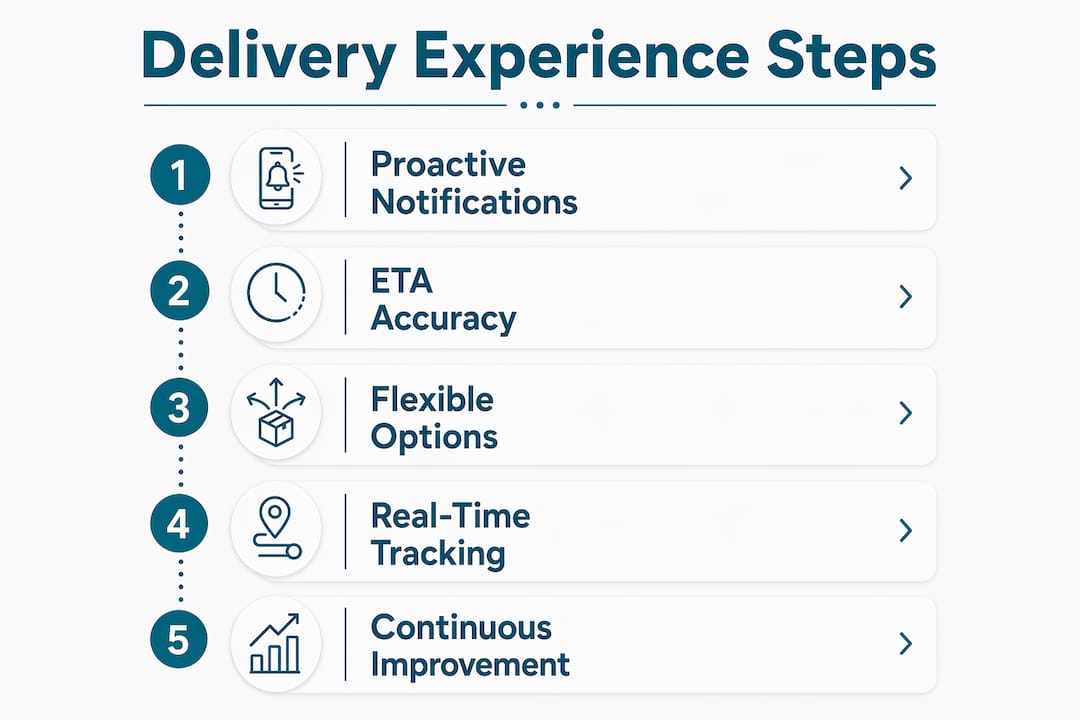
The core notification sequence every e-commerce operation needs covers five events:
- Order confirmed — sent within minutes of purchase to set expectations immediately.
- Order dispatched — triggers when the carrier picks up the package, with an initial ETA.
- Out for delivery — sent the morning of delivery so customers can plan their day.
- Delay alert — triggered automatically when an exception occurs, with a revised ETA.
- Delivered — confirms receipt and opens the door for a post-delivery review request.
This sequence matters because DEM reduces WISMO tickets by 72%, cutting 30–40% of all inbound e-commerce support calls. Fewer support tickets means lower operational costs and a customer base that feels informed rather than ignored.
Channel selection also affects how well notifications land. SMS achieves open rates far above email for time-sensitive alerts. WhatsApp works well in markets where it dominates mobile communication. Email remains the right channel for order confirmations and detailed receipts. The best approach is to let customers choose their preferred channel at checkout.
Brand personalization inside notifications is often overlooked. A plain carrier email with a tracking number does nothing for your brand equity. A notification with your logo, your tone of voice, and a link to your branded tracking page reinforces the relationship you built during the sale.
Pro Tip: Segment your notification content by customer history. A first-time buyer needs more reassurance than a repeat customer. Adjust the copy accordingly and you will see measurable improvements in post-delivery satisfaction scores.
Does ETA accuracy matter more than delivery speed?
Yes. Customers tolerate a longer wait far better than a missed promise. EasyRoutes confirms that proactive, clear messaging preserves trust better than silence, and that principle extends directly to how you set and manage estimated delivery dates.
The key metrics to track here are not average delivery speed but on-time-in-window rate and ETA accuracy. These two figures tell you whether your promises match reality.
Common ETA management failures and fixes:
- Static ETAs set at dispatch — replace with dynamic ETAs that refresh based on real driver progress and route conditions.
- Optimistic default windows — set windows based on historical performance data, not best-case scenarios.
- No exception escalation — build triggers that alert dispatchers when a driver falls behind so they can intervene before a missed delivery.
- No customer-facing ETA refresh — update the tracking page in real time so customers see the same picture your dispatch team sees.
| ETA Problem | Customer Impact | Fix |
|---|---|---|
| Static ETA at dispatch | Missed deliveries, angry calls | Dynamic ETA from driver GPS |
| Overpromised window | Distrust, cart abandonment | Historical data-based windows |
| No delay notification | WISMO spike, support cost | Automated exception alerts |
| No ETA refresh on tracking page | Customer anxiety | Live tracking page updates |
The Harry Rosen case is instructive beyond the headline number. Surfacing precise estimated delivery dates at checkout did not just reduce WISMO. It produced a measurable conversion lift because customers who see a credible delivery date are more likely to complete the purchase. Accurate ETAs are a revenue driver, not just a service metric.
Pro Tip: Measure ETA accuracy weekly by comparing promised windows against actual delivery timestamps. Feed that data back into your routing and scheduling logic every month. Continuous calibration is what separates good delivery operations from great ones.
What flexible delivery options do customers actually expect?
Customers in 2026 expect control over their delivery, not just a notification that a package is coming. Onfleet identifies choice, accuracy, and transparency as the three baseline expectations that now define whether a delivery experience satisfies or frustrates.
The flexible options that move the needle most are:
- Scheduled delivery windows — let customers pick a two-hour window at checkout or post-purchase.
- Same-day and next-day options — table stakes for urban markets and high-value orders.
- Safe drop-off instructions — allow customers to specify a porch, neighbor, or locker location.
- Contactless delivery — photo confirmation replaces signature for low-risk residential deliveries.
- Post-checkout rescheduling — a self-service portal where customers can shift their delivery date without calling support.
Proof of delivery closes the experience loop. A GPS-timestamped photo of the package at the door eliminates “I never received it” disputes and gives customers immediate confirmation. Signature capture remains appropriate for high-value shipments. For standard residential deliveries, a photo with a GPS coordinate is faster, cheaper, and equally credible.
Flexibility also reduces cart abandonment. When a shopper sees only one delivery option at checkout, they face a binary choice: accept it or leave. Offering two or three options converts that binary into a preference decision, which is a much lower barrier to completing the purchase. Logistics managers who treat delivery options as a conversion tool rather than a fulfillment afterthought consistently see stronger checkout completion rates.
How does real-time tracking reduce customer anxiety?
Live GPS tracking is the single most effective tool for reducing post-purchase anxiety. Fleet Rabbit data shows that real-time delivery tracking with proactive delay notifications reduces WISMO calls by 60–75%, increases Net Promoter Score by up to 34 points, and cuts cart abandonment by up to 22%. Those three numbers together make a compelling case for treating tracking as a core business investment.
Here is how to implement live tracking effectively:
- Deploy GPS-enabled driver apps that push location data to your order management system every 60–90 seconds.
- Build a branded tracking page that customers access from their notification link, showing driver location, ETA, and stop count.
- Set exception triggers that fire when a driver is more than 15 minutes behind schedule, alerting both the dispatcher and the customer simultaneously.
- Integrate tracking data with your support platform so agents see the same real-time status the customer sees, eliminating the “let me check on that” delay.
- Send a driver-approaching notification when the driver is two stops away, giving customers a final heads-up to be available.
Exception management is where most operations fall short. Knowing a delay is happening is only useful if someone acts on it. Effective exception management means dispatchers receive alerts before customers do, giving your team a window to reroute, reassign, or communicate proactively rather than reactively.
A branded tracking page also does something a carrier’s generic tracking link cannot. It keeps the customer inside your brand environment, creates an opportunity to show related products or loyalty program details, and reinforces the relationship between the purchase and the brand that fulfilled it.
Pro Tip: Use your branded tracking page as a post-purchase marketing channel. A well-timed banner for a complementary product or a loyalty points reminder on the tracking page reaches a customer at peak engagement, right when they are actively thinking about their order.
How do you measure and continuously improve delivery performance?
Measurement without action is just data collection. The goal is a feedback loop that connects delivery metrics to operational decisions on a regular cadence.
The KPIs that matter most for delivery experience management are on-time-in-window rate, ETA accuracy, failed first delivery attempt rate, and WISMO ticket volume by exception type. Tracking WISMO tickets by delivery milestone and exception type is particularly powerful because it shows you exactly where your notification sequence has gaps. If you see a spike in WISMO calls after the “dispatched” notification, you know customers are not getting enough information between dispatch and delivery.
Post-delivery surveys are underused. A two-question survey sent 24 hours after delivery, asking customers to rate the experience and describe any issue, generates actionable data at low cost. Link those survey responses to the specific driver, route, or carrier partner involved and you have a coaching and accountability tool built into your operations.
Delivery performance metrics should also connect to customer lifetime value data. A customer who had a poor delivery experience and received no proactive communication is significantly less likely to reorder. Quantifying that churn risk in dollar terms makes the business case for investing in DEM platforms and notification infrastructure far easier to approve.
Bizrate Insights emphasizes that retailers must treat last-mile delivery as an owned touchpoint. Even when you outsource the physical delivery, you control the communication cadence, the escalation process, and the customer-facing brand experience. Outsourcing the truck does not mean outsourcing the relationship.
Key takeaways
Improving customer delivery experience requires proactive communication, accurate ETAs, flexible options, live tracking, and a structured measurement loop working together as a system.
| Point | Details |
|---|---|
| Proactive notifications cut support costs | DEM reduces WISMO tickets by 72%, directly lowering inbound support volume. |
| ETA accuracy drives revenue | Precise delivery dates at checkout reduce cart abandonment and increase conversion rates. |
| Flexibility is a baseline expectation | Scheduled windows, safe drop-off, and post-checkout rescheduling are now standard customer expectations. |
| Live tracking lifts NPS by up to 34 points | Real-time GPS tracking with delay alerts is the highest-impact single investment for delivery satisfaction. |
| Measure by milestone, not just average speed | On-time-in-window rate and WISMO ticket tagging reveal exactly where your delivery experience breaks down. |
The part of delivery experience most operations get wrong
I have spent years watching e-commerce businesses invest heavily in warehouse technology and carrier contracts while leaving the post-dispatch communication completely unmanaged. The assumption is that once the package leaves the building, the carrier owns the experience. That assumption is wrong, and it costs real money.
The insight that changed how I think about this came from watching a mid-size apparel brand lose a meaningful percentage of its repeat customers not because of late deliveries, but because customers had no idea where their orders were. The deliveries were actually on time. The silence was the problem.
What I have found works is treating every notification as a brand touchpoint with the same care you give a marketing email. The tone, the timing, and the content all matter. A delay notification that says “Your order is running late, here is the new ETA, and here is what we are doing about it” builds more trust than a perfectly on-time delivery with no communication along the way.
The other thing I would push back on is the idea that automation removes the personal element. Done well, automated notifications feel personal because they are specific, timely, and relevant to exactly what the customer is experiencing at that moment. Generic is the enemy, not automation. The brands that get this right use real-time order tracking not just as a logistics tool but as a trust-building channel.
My honest recommendation: audit your current notification sequence against the five-event framework in this article. Most operations are missing at least two of those touchpoints. Fix the gaps before you invest in anything else.
— Maayan
How Or-ner supports a better delivery experience
Or-ner is built for e-commerce sellers and logistics managers who need reliable, trackable, and flexible fulfillment without building the infrastructure themselves.
Or-ner’s reliable courier services are designed specifically for U.S. e-commerce operations, with real-time shipment tracking, exception management, and flexible delivery options built into the platform. Whether you are shipping apparel, home goods, or high-value electronics, Or-ner provides the visibility and control that the strategies in this article require. For smaller operations, Or-ner’s courier solutions for small businesses offer the same tracking and communication infrastructure at a scale that fits your volume. Explore Or-ner’s service pages to find the fulfillment setup that matches your delivery experience goals.
FAQ
What is delivery experience management?
Delivery experience management (DEM) is the practice of proactively managing customer communication and expectations from order dispatch through final delivery. DEM platforms reduce WISMO tickets by up to 72% by automating milestone notifications and branded tracking.
How do proactive notifications reduce support costs?
Automated notifications at key delivery milestones prevent customers from needing to contact support to find out where their order is. LateShipment data shows DEM cuts 30–40% of all inbound e-commerce support calls.
What delivery metrics should i track first?
Start with on-time-in-window rate, ETA accuracy, and WISMO ticket volume tagged by delivery milestone. These three metrics reveal where your delivery experience breaks down faster than average delivery speed alone.
Does real-time tracking actually improve customer loyalty?
Yes. Fleet Rabbit research shows live tracking with proactive delay alerts increases NPS by up to 34 points and reduces cart abandonment by up to 22%, making it one of the highest-return investments in delivery experience.
Can i control delivery experience if i outsource last-mile delivery?
Yes. Even with an outsourced carrier, you control the communication cadence, the branded tracking page, and the escalation process. Bizrate Insights confirms that brand-controlled communication is the primary driver of customer trust regardless of who physically delivers the package.