
Global supply chains keep the world moving and your business running, but the risks have never been higher. Over 25 percent of companies faced ten or more supply chain disruptions in just one year, according to industry data. Most people think weather or politics are the biggest threats, yet it is invisible cyber attacks and everyday tech failures that can really bring operations to a standstill.
Table of Contents
- Key Threats To Global Supply Chains
- How Supply Chain Risks Impact Your Business
- Best Practices For Reducing Supply Chain Risks
- Future Trends In Global Supply Chain Risk Management
Quick Summary
| Takeaway | Explanation |
|---|---|
| Diversify suppliers strategically. | Develop a multi-tiered supplier network to reduce risks from single sources and ensure continuity of supply. |
| Embrace advanced technology for risk management. | Utilize AI and machine learning for real-time tracking and predictive analytics to identify potential disruptions. |
| Create and communicate robust contingency plans. | Establish detailed scenarios for disruptions and maintain open communication with stakeholders to enhance readiness. |
| Invest in adaptive infrastructure for climate challenges. | Enhance infrastructure to withstand extreme weather and explore alternative routing to mitigate environmental risks. |
| Focus on sustainability in risk strategies. | Integrate environmental considerations into risk management for a comprehensive approach to future uncertainties. |
Key Threats to Global Supply Chains
Global supply chains face an unprecedented array of complex risks that can disrupt operations, compromise business continuity, and create significant financial challenges. Understanding these threats is crucial for organizations seeking to build resilient and adaptive logistics networks.
Geopolitical Disruptions and Economic Instability
Geopolitical tensions have emerged as a critical factor threatening global supply chain stability. According to UNCTAD, the convergence of international conflicts, trade disputes, and economic uncertainties creates a complex “polycrisis” environment that directly impacts transport reliability and shipping capacity. Companies now must navigate increasingly unpredictable global landscapes where political decisions can instantaneously transform trade routes and operational capabilities.
Key geopolitical risks include sudden trade restrictions, economic sanctions, border control changes, and regional conflicts that can interrupt critical supply pathways. Organizations must develop sophisticated contingency plans that allow rapid reconfiguration of logistics networks when traditional routes become compromised.
Environmental and Climate Challenges
Climate change represents another significant threat to global supply chains. The Center for Strategic and International Studies reports that extreme weather events are increasingly damaging port infrastructure and causing substantial operational disruptions. Rising sea levels, more frequent hurricanes, floods, and unpredictable weather patterns pose substantial risks to maritime transportation and logistics networks.
These environmental challenges demand proactive risk management strategies. Businesses must invest in adaptive infrastructure, develop alternative routing mechanisms, and implement advanced forecasting technologies to mitigate potential disruptions. The ability to quickly reroute shipments or shift operational strategies becomes paramount in maintaining supply chain resilience.
Technological Vulnerabilities and Cybersecurity Threats
In an increasingly digital world, technological vulnerabilities present another critical risk to global supply chains. Cybersecurity breaches can compromise entire logistics networks, exposing sensitive data and potentially halting critical operations. Modern supply chains rely heavily on interconnected digital systems, making them potential targets for sophisticated cyber attacks.
Companies must prioritize robust cybersecurity protocols, implement advanced threat detection systems, and regularly audit their technological infrastructure. This includes protecting logistics risk management strategies through comprehensive digital security frameworks that can anticipate and neutralize potential technological threats.
By recognizing and proactively addressing these key threats, organizations can develop more resilient, adaptable, and secure global supply chain ecosystems capable of navigating increasingly complex international business environments.
To clarify the three major categories of threats faced by global supply chains, here is a summary table highlighting each risk type, its key challenges, and recommended mitigation strategies as described in the article.
| Threat Category | Key Challenges | Recommended Mitigation |
|---|---|---|
| Geopolitical Disruptions & Economic Instability | Trade restrictions, sanctions, border changes, regional conflicts | Develop contingency plans and flexible logistics networks |
| Environmental & Climate Challenges | Extreme weather, port damage, floods, unpredictable patterns | Invest in adaptive infrastructure, alternative routing |
| Technological Vulnerabilities & Cybersecurity Threats | Cyber attacks, digital system failures, data breaches | Implement cybersecurity protocols and threat detection |
How Supply Chain Risks Impact Your Business
Supply chain risks are not merely theoretical challenges but concrete threats that can dramatically transform business performance, financial stability, and long-term strategic potential. Understanding these impacts requires a comprehensive examination of how global disruptions translate into immediate and long-term organizational consequences.
Financial Performance and Operational Costs
Supply chain disruptions carry profound financial implications. According to the Federal Reserve Bank of Richmond, approximately half of economic shocks are amplified through supply chain networks, directly influencing a company’s bottom line. These disruptions can cause significant cost increases, with businesses experiencing unexpected expenses related to rerouting shipments, finding alternative suppliers, and managing inventory volatility.
The economic impact extends beyond immediate operational costs. Companies may face reduced profit margins, increased insurance premiums, and potential contractual penalties when unable to meet delivery commitments. Our guide on supply chain management basics highlights the importance of proactive risk mitigation strategies to minimize these financial vulnerabilities.
Strategic Competitiveness and Market Position
Supply chain risks fundamentally challenge a company’s competitive positioning. UNCTAD research emphasizes that supply chain resilience has transformed from a cost consideration to a strategic priority directly influencing investor confidence and market perception. Companies experiencing frequent disruptions risk losing market share to more adaptable competitors.
For instance, the 2021 semiconductor shortage dramatically demonstrated how supply chain vulnerabilities can halt entire production cycles. Businesses unable to secure critical components saw significant market share erosion, while those with diversified sourcing and robust contingency plans maintained operational continuity. This scenario underscores the critical nature of comprehensive risk management in maintaining strategic competitiveness.
Reputational and Customer Trust Dynamics
Beyond financial metrics, supply chain risks profoundly impact organizational reputation and customer trust. The Centre for Economic Policy Research notes that systemic shocks increasingly affect multiple sectors simultaneously, with the Business Continuity Institute reporting that over 25% of firms experienced ten or more disruptions in 2020.
Customers now expect transparency and reliability, and repeated supply chain failures can erode hard-earned trust. Late deliveries, product unavailability, and inconsistent service quality can trigger customer churn and negative brand perception. Modern consumers are increasingly sophisticated, valuing not just product quality but also a company’s ability to maintain reliable, ethical, and resilient supply networks.
Navigating these complex risk landscapes requires a holistic approach that integrates strategic planning, technological innovation, and adaptive organizational capabilities. Businesses must view supply chain risk management not as a defensive strategy but as a proactive mechanism for sustained competitive advantage.
Best Practices for Reducing Supply Chain Risks
Reducing supply chain risks requires a strategic and comprehensive approach that goes beyond traditional risk management techniques. Organizations must develop robust, adaptive strategies that anticipate potential disruptions and create flexible operational frameworks.
Strategic Supplier Diversification and Relationship Management
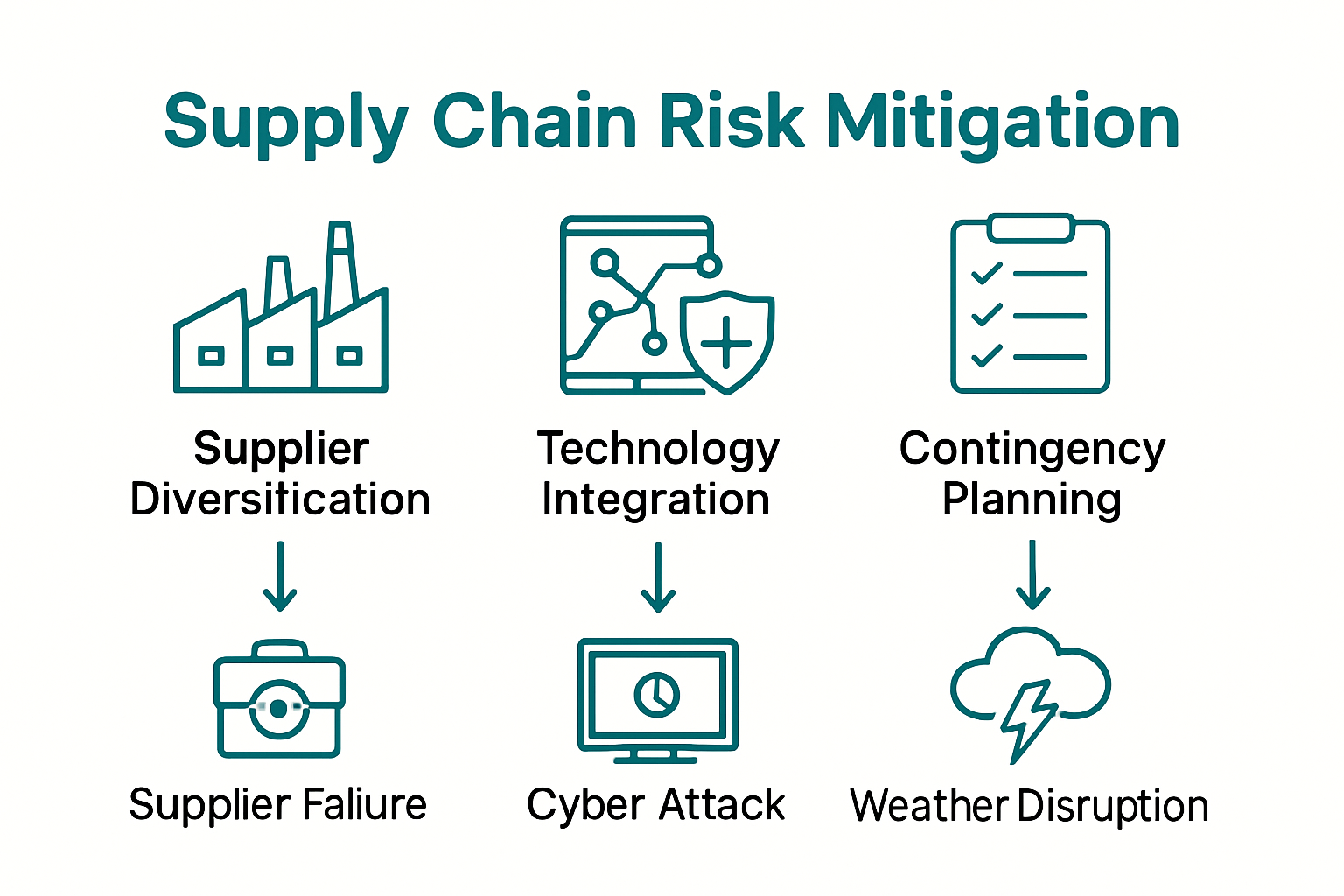
One of the most critical practices for mitigating supply chain risks involves strategic supplier diversification. According to Purdue University’s Krannert School of Management, businesses should develop a multi-tiered supplier network that reduces dependency on single sources. This approach involves identifying and cultivating relationships with multiple suppliers across different geographical regions, ensuring continuity of supply even if one source becomes unavailable.
Effective supplier relationship management goes beyond transactional interactions. Companies must invest time in understanding suppliers’ capabilities, financial stability, and potential vulnerabilities. Our comprehensive supply chain management guide emphasizes the importance of conducting thorough due diligence and maintaining transparent communication channels with key supply partners.
Advanced Risk Assessment and Technological Integration
McKinsey & Company recommends a structured approach to risk management that involves systematic identification, documentation, and continuous monitoring of potential disruptions. This requires implementing advanced technological solutions such as artificial intelligence and machine learning algorithms that can predict potential supply chain vulnerabilities.
Key technological strategies include real-time tracking systems, predictive analytics platforms, and integrated risk management software. These tools enable organizations to:
- Monitor supplier performance in real-time
- Identify potential bottlenecks before they escalate
- Develop data-driven contingency plans
- Assess risk levels across different supply chain segments
Comprehensive Contingency and Communication Planning
The Business Development Bank of Canada highlights the critical importance of developing robust contingency plans and maintaining open communication channels. Effective contingency planning involves creating detailed scenarios that outline potential disruption responses, including alternative sourcing strategies, inventory buffer mechanisms, and rapid reconfiguration protocols.
Successful risk mitigation demands a proactive communication strategy that keeps all stakeholders informed. This includes:
- Regular briefings with suppliers
- Transparent reporting to investors and customers
- Cross-functional internal communication protocols
- Rapid response mechanisms for unexpected disruptions
By integrating these best practices, organizations can transform supply chain risk management from a defensive posture to a strategic competitive advantage. The goal is not merely to survive potential disruptions but to build resilient, adaptive supply networks that can thrive amid uncertainty.
The following table summarizes the best practices outlined for reducing supply chain risks, organizing them by approach and highlighting their core actions and benefits.
| Best Practice | Core Actions | Key Benefits |
|---|---|---|
| Strategic Supplier Diversification & Relationship Management | Build multi-tiered supplier networks; assess supplier stability | Reduces dependency, ensures continuity |
| Advanced Risk Assessment & Technological Integration | Utilize AI, real-time tracking, predictive analytics | Early identification of disruptions |
| Comprehensive Contingency & Communication Planning | Develop detailed scenarios; maintain open communication | Fast response, improved coordination |
Future Trends in Global Supply Chain Risk Management
The landscape of global supply chain risk management is rapidly evolving, driven by technological innovations, geopolitical complexities, and increasing environmental uncertainties. Organizations must anticipate and adapt to emerging trends that will reshape how businesses approach risk mitigation and operational resilience.
Technology-Driven Risk Intelligence
UNCTAD emphasizes the critical importance of visibility and data integration in future supply chain strategies. Emerging technologies are transforming risk management from a reactive to a predictive discipline. Artificial intelligence, machine learning, and advanced analytics are becoming fundamental tools for identifying potential disruptions before they materialize.
Businesses are increasingly investing in real-time monitoring systems that provide comprehensive insights across global supply networks. These technologies enable companies to:
- Detect potential risks with unprecedented accuracy
- Create dynamic risk scoring models
- Develop adaptive response mechanisms
- Integrate third-party risk management capabilities
Advanced predictive models now incorporate complex variables including geopolitical tensions, climate change projections, and economic indicators. Our logistics risk management guide highlights how these technologies are revolutionizing strategic planning and risk mitigation approaches.
Collaborative and Resilient Network Strategies
The UK Government’s Foresight Project indicates a significant shift towards more collaborative and interconnected supply chain ecosystems. Future risk management will depend less on individual organizational capabilities and more on collective resilience across entire industry networks.
Key emerging strategies include:
- Developing shared risk intelligence platforms
- Creating cross-industry collaboration mechanisms
- Establishing flexible, decentralized supply network architectures
- Implementing transparent risk-sharing protocols
Sustainability and Adaptive Governance
IBM’s research suggests that future supply chain risk management will be intrinsically linked to sustainability and adaptive governance models. Organizations must develop comprehensive frameworks that integrate environmental considerations, social responsibilities, and dynamic risk response capabilities.
This approach requires:
- Comprehensive carbon footprint tracking
- Advanced scenario planning capabilities
- Flexible regulatory compliance mechanisms
- Holistic risk assessment methodologies that consider economic, environmental, and social dimensions
The future of supply chain risk management is not about eliminating risks but about building organizational capabilities that can seamlessly adapt to complex, unpredictable global environments. Success will depend on an organization’s ability to transform risk management from a defensive strategy to a dynamic, intelligence-driven approach that creates competitive advantages.

Frequently Asked Questions
What are the main threats to global supply chains?
The main threats include geopolitical disruptions, environmental and climate challenges, and technological vulnerabilities such as cybersecurity threats. Each of these factors can significantly impact supply chain stability and operational efficiency.
How can supply chain risks affect my business financially?
Supply chain risks can lead to increased operational costs, reduced profit margins due to delays, and potential penalties for non-compliance with delivery commitments. Businesses may also face unexpected expenses related to finding alternative suppliers or rerouting shipments.
What best practices can I implement to reduce supply chain risks?
Best practices include diversifying suppliers, utilizing advanced technologies for risk assessment, and developing comprehensive contingency plans. These strategies help ensure continuity of supply and enable quick responses to potential disruptions.
How is technology changing supply chain risk management?
Technology is moving supply chain risk management towards a more predictive and proactive approach. Innovations like artificial intelligence and real-time monitoring systems allow businesses to identify potential risks before they escalate, enhancing overall resilience.
Tackle Global Supply Chain Risks with Reliable Courier Services
Are you overwhelmed by unpredictable disruptions, rising costs, or a lack of supply chain visibility as highlighted in our article? Many ecommerce sellers and businesses struggle with supplier delays, sudden market shifts, and the need for end-to-end risk management. Without a strong logistics partner offering reliable courier services, you risk missing customer expectations and damaging your brand.

Now is the time to protect your business with or-ner.com. Our platform gives you real-time shipment tracking, automated workflows, and global warehouse connections so you can avoid costly delays and stay ahead of disruptions. Stop worrying about uncertainty and keep your competitive edge. Explore reliable courier services today to ensure your supply chain is prepared for anything.