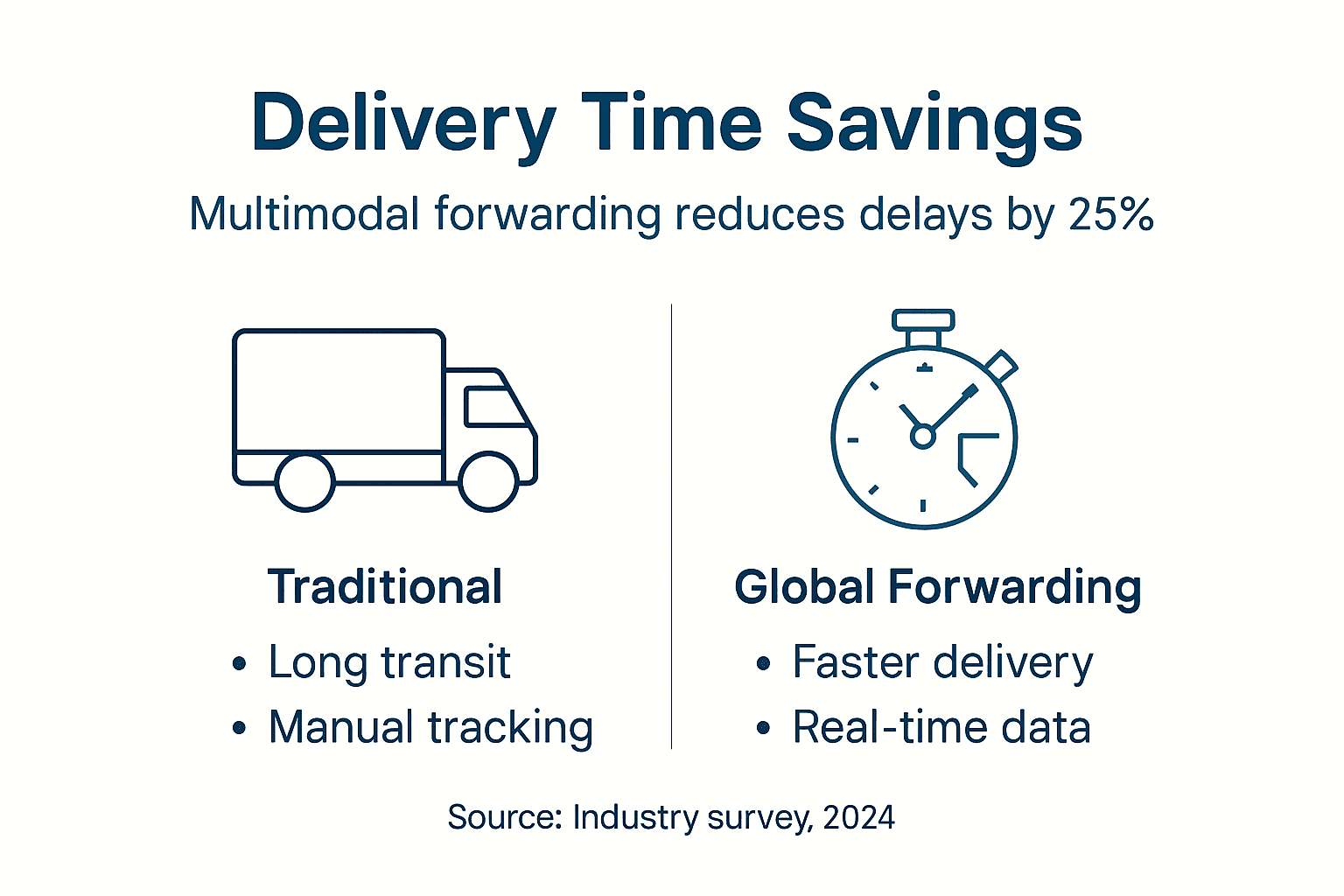
Multimodal transport can reduce cross-border delivery times by up to 25%, transforming how ecommerce businesses fulfill international orders. This guide explains how global forwarding integrates transport modes, customs expertise, and technology to streamline your shipping operations. You’ll learn to evaluate providers, avoid common pitfalls, and implement solutions that balance speed, cost, and compliance for sustainable international growth.
Table of Contents
- Introduction To Global Forwarding Solutions
- Multimodal Transportation In Global Forwarding
- Customs Clearance And Compliance In Global Forwarding
- Shipment Visibility And Technology Integration
- Common Misconceptions About Global Forwarding
- Criteria For Selecting A Global Forwarding Solution
- Benefits Of Integrated Courier And Fulfillment Services
- Conclusion: Implementing Reliable Global Forwarding Solutions
- Discover Top Global Forwarding Solutions With ORNER
Key Takeaways
| Point | Details |
|---|---|
| Multimodal Integration | Combining ocean, air, and land transport optimizes cost and speed for cross-border shipments. |
| Real-Time Tracking Impact | End-to-end visibility reduces shipment exceptions by 73%, improving customer satisfaction. |
| Customs Expertise | Expert brokerage prevents delays and fines, ensuring faster clearance and regulatory compliance. |
| Provider Selection Criteria | Balance reliability, technology, speed, and cost to find the right forwarding partner. |
| Integrated Services Advantage | Combining courier and fulfillment reduces handling costs and accelerates order processing. |
Introduction to Global Forwarding Solutions
Global forwarding combines freight booking, customs brokerage, and warehousing to create seamless international shipping pathways for ecommerce businesses. As 7 Key Freight Forwarder Benefits for Ecommerce Success – ORNER explains, this integration streamlines international ecommerce shipments by consolidating complex logistics functions under expert management. Rather than juggling multiple carriers, customs agents, and warehouse providers, you work with a single partner who coordinates every step of your cross-border journey.
Understanding what is freight forwarding starts with recognizing three core components. First, freight booking secures space on ships, planes, and trucks at negotiated rates. Second, customs clearance handles documentation, duties, and regulatory compliance in each destination country. Third, warehousing provides strategic storage points for inventory staging and order consolidation.
For ecommerce businesses expanding internationally, global forwarding unlocks access to markets that would otherwise require prohibitive infrastructure investments. You gain the operational capacity of multinational corporations without building your own network. This levels the playing field, letting small and midsize sellers compete globally while maintaining lean operations.
The importance becomes clear when you consider the alternative. Managing international shipping independently means navigating constantly changing regulations, negotiating with multiple carriers in different languages, and absorbing the full risk of delays or compliance failures. By leveraging specialized forwarding expertise, you focus on product development and marketing while logistics professionals handle the complexity. The principles behind Adward insights on automation apply here: specialized systems always outperform generalized approaches when complexity scales.
Key benefits for ecommerce operations include:
- Access to volume discounts through consolidated shipping
- Reduced documentation errors via experienced customs brokers
- Faster problem resolution through established carrier relationships
- Predictable transit times enabling accurate customer communication
Multimodal Transportation in Global Forwarding
Multimodal transport solutions can cut cross-border delivery times by up to 25%, according to How Real-Time Tracking Transforms Global Supply Chains, fundamentally changing ecommerce logistics economics. This approach combines ocean freight for bulk shipments, air cargo for time-sensitive products, and ground transport for regional distribution. Each mode serves specific needs within your overall shipping strategy.

Ocean freight offers the lowest per-unit cost for high-volume shipments, making it ideal for inventory restocking and non-urgent orders. Air cargo delivers speed when product launches or seasonal demand require rapid fulfillment. Ground transport provides the final mile connection, moving goods from ports or airports to warehouses and end customers. Understanding bulk shipping solutions helps you optimize container loads and reduce wasted capacity.
Here’s how the modes compare:
| Transport Mode | Typical Transit Time | Relative Cost | Best Use Case |
|---|---|---|---|
| Ocean Freight | 20-45 days | Lowest | High-volume inventory replenishment |
| Air Cargo | 3-7 days | Highest | Time-sensitive, high-value products |
| Ground Transport | 1-5 days | Medium | Regional distribution, last mile |
| Rail Freight | 10-20 days | Low-Medium | Continental bulk shipments |
Regional warehousing amplifies multimodal efficiency by creating strategic inventory positions closer to end customers. When you combine ocean freight to a hub warehouse with local air or ground distribution, you achieve ocean freight economics with air freight responsiveness. Your warehouse location strategy determines whether customers receive orders in two days or two weeks.
Consolidation centers group smaller shipments into full containers, dramatically reducing costs for businesses without sufficient volume to fill entire containers independently. You share space with other shippers, paying only for your portion while accessing the same preferential rates as larger competitors. This democratizes international shipping for emerging ecommerce brands.
Pro Tip: Match transport mode to product characteristics, not just urgency. High-value electronics justify air freight even for non-urgent orders because reduced transit time lowers capital tied up in inventory. Conversely, bulky, low-margin items like home furnishings demand ocean freight to preserve profitability. Calculate the holding cost of inventory in transit to make informed mode selections.
The real power emerges when modes work together. Your electronics ship by air to a regional warehouse, then distribute via ground courier within 48 hours. Meanwhile, replenishment inventory travels by ocean to the same warehouse, arriving before air-shipped stock depletes. This choreography requires sophisticated planning but delivers the real-time tracking benefits that distinguish excellent customer experiences from mediocre ones.
Customs Clearance and Compliance in Global Forwarding
Expert customs brokerage reduces shipment delays and compliance risks, as detailed in Customs Clearance Explained: Ensuring Smooth Cross-Border Shipping – ORNER, making it a cornerstone of effective global forwarding. Every international shipment crosses regulatory boundaries where documentation errors or missing permits trigger costly holds. Professional brokers navigate these checkpoints with accuracy that self-managed clearance rarely achieves.
Customs documentation requirements vary by country, product category, and shipment value. Standard paperwork includes commercial invoices, packing lists, certificates of origin, and import licenses. Specialized products need additional permits: electronics require electromagnetic compatibility certifications, textiles need country-of-origin declarations, and food items demand health certificates. Missing any single document halts your shipment at the border until you provide it.
Compliance directly impacts your bottom line through multiple channels. First, delays extend delivery times, eroding customer satisfaction and increasing support costs. Second, incorrect declarations trigger fines ranging from hundreds to thousands of dollars per violation. Third, repeated compliance failures damage your importer reputation, subjecting future shipments to enhanced scrutiny and slower processing.
Automation and AI tools now handle much of the customs preparation that previously required manual data entry. Modern platforms extract product details from your catalog, match items to harmonized tariff codes, calculate duties automatically, and generate compliant documentation in minutes. This eliminates transcription errors while freeing your team to focus on strategy rather than paperwork. Understanding global trade compliance requirements across your target markets protects you from preventable mistakes.
Critical compliance elements include:
- Accurate product classification using HS codes
- Proper valuation for duty calculation
- Country-of-origin documentation
- Restricted item screening and permitting
- Importer of record designation
Pro Tip: Partner with forwarders who invest heavily in customs technology and employ licensed brokers with specific experience in your product categories. Generic forwarding expertise doesn’t translate to category-specific regulatory knowledge. A broker who handles electronics daily knows nuances that a generalist would miss, preventing problems before they occur.
The regulatory landscape constantly evolves as governments adjust trade policies, tariff rates, and documentation requirements. Your forwarding partner should proactively notify you of changes affecting your shipments, not react after problems arise. This forward-looking approach, similar to concepts in merch fulfillment workflow optimization, prevents disruptions rather than managing them.
Shipment Visibility and Technology Integration
73% of ecommerce logistics managers report fewer shipment exceptions after implementing end-to-end tracking solutions, according to How Real-Time Tracking Transforms Global Supply Chains. This dramatic improvement stems from visibility enabling proactive intervention rather than reactive crisis management. When you know a shipment faces delays 48 hours before delivery, you can reroute inventory, notify customers, or expedite alternatives.
Real-time tracking transforms logistics from a black box into a transparent, manageable process. GPS transponders on containers and vehicles broadcast location updates throughout transit. IoT sensors monitor environmental conditions, alerting you if temperature-sensitive products experience harmful exposure. Automated exception management systems flag anomalies like unexpected stops, route deviations, or customs holds immediately, triggering investigation before customers notice problems.
Modern tracking platforms integrate multiple data sources into unified dashboards. You see ocean freight container positions, air cargo flight status, ground courier locations, and warehouse inventory levels simultaneously. This consolidation eliminates the need to check multiple carrier websites or spreadsheets, saving hours weekly while reducing the risk of overlooking critical updates.
Common technology tools enhancing visibility include:
- GPS and cellular tracking devices for container monitoring
- Cloud-based dashboards aggregating multi-carrier data
- API integrations connecting forwarding systems to ecommerce platforms
- Automated customer notification systems
- Predictive analytics forecasting delivery times
The best shipment tracking software extends beyond simple location updates to provide actionable intelligence. Advanced systems use machine learning to identify patterns indicating likely delays, recommend alternative routing, and optimize future shipment planning based on historical performance data. This transforms tracking from a monitoring tool into a strategic advantage.
Pro Tip: Integrate tracking data directly with your ecommerce platform and customer service systems. When tracking updates automatically populate order status pages and trigger customer notifications, you reduce support inquiries by 40% or more. Customers who can self-serve tracking information contact support less frequently, lowering operational costs while improving satisfaction.
73% reduction in shipment exceptions demonstrates the measurable ROI of investing in comprehensive tracking infrastructure rather than relying on basic carrier-provided tools.
Exception management capabilities separate basic tracking from true visibility. When a shipment misses a connection or encounters customs delays, automated workflows notify relevant stakeholders, provide resolution options, and document actions taken. This structured response prevents small issues from cascading into customer-facing failures. The real-time tracking transforms supply chains article details how leading companies leverage these capabilities for competitive advantage.
Common Misconceptions About Global Forwarding
Selecting the cheapest forwarder frequently increases total costs through longer transit times, higher damage rates, and poor customer service when problems arise. While rate sheets show attractive per-kilogram prices, hidden costs emerge in missed delivery windows, lost sales from out-of-stock situations, and customer churn from unreliable fulfillment. True cost includes reliability, speed, and problem resolution capability, not just the invoice amount.
Many small and midsize ecommerce businesses assume global forwarding serves only large enterprises with container-load volumes. This misconception keeps growing companies stuck with expensive, inefficient shipping arrangements. Modern forwarding services offer consolidation programs specifically designed for smaller shippers, providing enterprise-level rates and service through shared container space. You gain negotiating power collectively that you’d never achieve independently.
Another prevalent myth positions technology integration as a luxury feature rather than a fundamental requirement. Businesses operating without real-time tracking, automated documentation, and integrated communication systems function at a severe disadvantage. Manual processes introduce errors, delay exception response, and prevent the data-driven optimization that separates profitable international operations from struggling ones.
Key misconceptions to avoid:
- Myth: Budget forwarders save money. Reality: Hidden costs from delays and failures exceed savings.
- Myth: Only large shippers benefit from forwarding. Reality: Consolidation programs serve businesses of all sizes.
- Myth: Basic tracking suffices for visibility. Reality: Advanced integration prevents problems and optimizes operations.
- Myth: All forwarders offer equivalent service. Reality: Expertise, technology, and network quality vary dramatically.
- Myth: Customs compliance is straightforward. Reality: Regulations change constantly and require specialized knowledge.
The belief that forwarding relationships can switch easily based on quarterly rate shopping damages long-term efficiency. Effective forwarding partnerships require time to optimize routing, establish communication workflows, and build institutional knowledge of your products and requirements. Constantly changing providers to save pennies per kilogram prevents achieving the operational excellence that saves dollars per shipment. Stability enables continuous improvement that transactional relationships never achieve.
Criteria for Selecting a Global Forwarding Solution
Choosing a forwarding partner requires evaluating five core criteria that determine operational success. Reliability measures on-time delivery rates, shipment damage frequency, and consistency across different routes and seasons. A partner delivering 95% on-time performance provides the predictability your inventory planning and customer communication require. Anything below 90% introduces too much variability to support professional ecommerce operations.
Customs expertise separates adequate forwarders from exceptional ones. Evaluate broker licensing, category-specific experience, and track records for clearance speed in your target markets. Ask for references from ecommerce businesses shipping similar products to similar destinations. A forwarder excelling at industrial equipment clearance may struggle with consumer electronics, where different regulations and documentation requirements apply.
Technology integration determines whether you’ll operate with modern efficiency or manual frustration. Essential capabilities include API connections to your ecommerce platform, real-time tracking with proactive exception alerts, automated documentation generation, and consolidated reporting across all shipments. Request demonstrations showing actual workflows, not marketing presentations, to verify claimed capabilities.
Cost effectiveness evaluates total landed costs, not just freight rates. Compare all-in pricing including fuel surcharges, handling fees, customs brokerage, and accessorial charges. A seemingly expensive quote may prove cheaper when competitors’ hidden fees emerge. Request detailed breakdowns showing every cost component for accurate comparison.
Speed requirements depend on your product mix and customer expectations. Evaluate transit time commitments, not estimates, for your primary routes. Understand the difference between port-to-port timing and true door-to-door delivery, as the final mile often consumes more time than ocean or air freight. Review historical performance data rather than accepting promises.
Trade-offs among these criteria require strategic decisions aligned with your business model. Luxury brands may prioritize speed and reliability over cost, justifying premium services that protect brand reputation. Mass-market sellers might accept longer transit times to maximize margins, balancing price sensitivity against delivery expectations. Understanding shipping cost optimization helps you make these strategic choices systematically.
Follow this assessment process:
- Define must-have requirements based on your product characteristics and customer expectations
- Request detailed proposals from 4-6 forwarding candidates with specific route and volume assumptions
- Verify references by speaking directly with current clients in your industry
- Conduct test shipments with top 2-3 candidates before committing to long-term contracts
- Establish performance metrics and review them quarterly to ensure continued service quality
The evaluation process should emphasize alignment with your growth trajectory. A forwarder perfect for your current 50-shipment monthly volume may lack the infrastructure to support 500 shipments as you scale. Discuss expansion scenarios to verify they can grow with you. Understanding freight forwarder benefits across different business stages helps you anticipate future needs.
Benefits of Integrated Courier and Fulfillment Services
Integrated services combining forwarding, courier, and fulfillment operations reduce order processing time by 30 to 50% compared to using separate providers for each function. This acceleration stems from eliminating handoffs where shipments wait for the next provider to take custody. When one company manages the entire journey from international freight to last-mile delivery, transitions happen seamlessly within unified systems rather than across organizational boundaries.
Cost savings emerge from multiple sources. Consolidated shipping reduces packaging and handling labor since products don’t require repacking at each transition point. Volume discounts apply across the entire service spectrum when one provider handles all logistics functions. Technology investments amortize across broader operations, making advanced capabilities affordable at lower volumes.
Here’s how integrated versus standalone services compare:
| Metric | Integrated Services | Standalone Services |
|---|---|---|
| Average Processing Time | 2-3 days | 4-6 days |
| Handling Cost per Unit | $1.50-$2.50 | $3.00-$4.50 |
| System Integration Effort | Single API connection | 3-5 separate integrations |
| Exception Resolution Time | 4-8 hours | 24-48 hours |
| Inventory Visibility | Real-time, end-to-end | Fragmented, delayed |
A practical example illustrates the difference. An apparel retailer ships inventory from Asia to US fulfillment centers. With integrated services, containers arrive at port, clear customs, transfer directly to the fulfillment center, and become available for customer orders within 48 hours. Individual customer orders then ship via the same provider’s courier network. With standalone services, the ocean freight company delivers to a terminal, a drayage company moves containers to the fulfillment center, customs clearance occurs through a separate broker, and customer orders ship via an unconnected courier. Each transition adds time and cost.
Key operational advantages include:
- Unified tracking from factory to customer doorstep
- Single point of contact for issue resolution
- Consistent service standards across all logistics functions
- Simplified billing and reconciliation
- Reduced risk of shipment loss during transitions
Integrated providers leverage ecommerce fulfillment solutions that connect international freight, warehousing, and last-mile delivery into continuous workflows. This continuity enables sophisticated strategies like cross-docking, where international shipments bypass warehouse storage entirely and move directly to customer delivery. Such efficiency remains impossible when different companies control each logistics stage.
The strategic value extends beyond operational efficiency to customer experience. When one system manages the entire journey, you provide customers accurate tracking from order placement through delivery. Updates reflect actual shipment status rather than lagging indicators from disconnected systems. This transparency builds trust and reduces support inquiries, improving satisfaction while lowering operational costs.
Conclusion: Implementing Reliable Global Forwarding Solutions
Global forwarding integration delivers measurable improvements in delivery speed, cost efficiency, and customer satisfaction for ecommerce businesses operating internationally. Combining multimodal transport, customs expertise, and technology platforms creates logistics capabilities that individual component services cannot match. The 25% reduction in delivery times and 73% decrease in shipment exceptions represent tangible competitive advantages in markets where fulfillment performance directly impacts conversion and retention.
Successful implementation follows a structured approach that minimizes risk while maximizing learning. Begin by assessing your current logistics performance to establish baseline metrics for transit times, costs, exception rates, and customer satisfaction. This data provides the foundation for measuring improvement and justifying investment in enhanced forwarding services.
Follow this implementation roadmap:
- Audit Current Performance: Document transit times, costs, exception rates, and customer feedback for existing shipping operations
- Define Requirements: Specify must-have capabilities based on product characteristics, volume projections, and customer expectations
- Evaluate Providers: Request proposals from 4-6 forwarding candidates and verify references from current clients
- Pilot Test: Conduct trial shipments with top candidates, measuring performance against baseline metrics
- Scale Gradually: Expand volume with selected partner while maintaining performance monitoring and continuous improvement
Expect a 3-6 month optimization period as your team and forwarding partner refine processes, establish communication workflows, and identify improvement opportunities. Initial results may not match long-term performance as relationships mature and institutional knowledge accumulates. Patience during this period yields substantial long-term benefits.
Continuous improvement requires regular performance reviews examining both tactical execution and strategic alignment. Quarterly business reviews should cover on-time delivery rates, cost per shipment trends, exception resolution speed, and customer satisfaction metrics. Use these sessions to address problems, explore new capabilities, and adjust strategies as your business evolves.
The efficiency gains from professional global forwarding free your team to focus on core business activities rather than logistics firefighting. This leverage allows small teams to compete globally while maintaining the operational excellence larger competitors require entire departments to achieve. Your forwarding partner becomes an extension of your team, providing expertise and infrastructure that would take years and millions of dollars to build independently.
Discover Top Global Forwarding Solutions with ORNER
Now that you understand the critical elements of effective global forwarding, ORNER helps you identify and compare the providers best suited to your specific requirements. Our curated comparisons evaluate forwarding services across the dimensions that matter most to ecommerce operations: reliability, technology integration, customs expertise, and cost effectiveness.
Explore our comprehensive reviews of top freight forwarding services to find providers offering the multimodal capabilities and tracking technology this guide recommends.
For businesses focused on cross-border expansion, our analysis of top cross-border shipping tools highlights platforms delivering the customs compliance and documentation automation that prevents delays. Additionally, our evaluation of best shipment tracking software identifies solutions providing the visibility and exception management that reduces problems by 73%.
Visit ORNER to access expert comparisons that transform logistics complexity into strategic advantage, helping you select partners who accelerate growth rather than create obstacles.
FAQ
What are global forwarding solutions?
Global forwarding solutions coordinate international shipping through integrated multimodal transport, customs brokerage, and strategic warehousing services. These platforms manage the entire cross-border logistics journey from origin to destination, handling freight booking, regulatory compliance, and last-mile delivery. For ecommerce businesses, they provide enterprise-level shipping capabilities without requiring infrastructure investment.
How does multimodal transportation improve ecommerce shipping?
Multimodal transportation combines ocean, air, and land freight to balance cost, speed, and reliability based on specific shipment requirements. By matching transport mode to product characteristics and delivery urgency, businesses reduce transit times by up to 25% while optimizing costs. This flexibility enables responsive fulfillment strategies that single-mode shipping cannot achieve, improving customer satisfaction and inventory efficiency.
Why is customs compliance important in global forwarding?
Proper customs compliance prevents shipment delays, regulatory fines, and damaged importer reputations that disrupt international ecommerce operations. Expert brokers ensure accurate documentation, correct duty calculation, and regulatory adherence across destination markets. This expertise accelerates clearance, reduces costs, and protects your ability to import freely into target countries.
What should I consider when choosing a global forwarding partner?
Evaluate reliability through on-time delivery rates, customs expertise via category-specific experience, and technology capabilities including real-time tracking and API integrations. Balance cost effectiveness by comparing total landed costs rather than base freight rates. Select partners whose infrastructure can scale with your growth trajectory, supporting current operations while accommodating future expansion into new markets and higher volumes.
Recommended
- Top Benefits of Freight Forwarding for Growing Businesses 2025 – ORNER
- 7 Proven Ways to Reduce Delivery Times for Online Sellers – ORNER
- How Can You Reduce International Shipping Costs? – ORNER
- Top Freight Forwarding Services – Expert Comparison 2025 – ORNER
- Urgent Deliveries in Today’s Fast-Paced World | same day delivery services uk