TL;DR:
- Export shipping regulations govern how goods leave the U.S. and require exporters to classify products, screen all parties, file EEI, and retain records for five years. Exporters must understand frameworks like EAR, ITAR, and OFAC sanctions, and accurately classify products using Schedule B and ECCN codes to determine licensing needs. Building a compliance program with documented procedures, management support, training, and regular audits helps small businesses avoid penalties and maintain smooth international shipping.
Export shipping regulations are the legal rules that govern how goods leave the United States and enter foreign markets. Three federal agencies set the core framework: the Bureau of Industry and Security (BIS), U.S. Customs and Border Protection (CBP), and the Department of State’s Directorate of Defense Trade Controls (DDTC). For e-commerce businesses shipping internationally, these rules are not optional paperwork. A single misclassified product or missed filing can result in shipment holds, civil penalties, or criminal charges. Understanding export compliance requirements before your first international order ships is the fastest way to protect your business.
What are the main export shipping regulations frameworks?
Two primary regulatory systems cover most U.S. exports. The Export Administration Regulations (EAR), administered by BIS, govern commercial and dual-use goods. The International Traffic in Arms Regulations (ITAR), administered by DDTC, govern defense articles and services. Most e-commerce products fall under EAR, but sellers of electronics, sensors, or encryption software need to verify this carefully.
Beyond EAR and ITAR, the Office of Foreign Assets Control (OFAC) enforces economic sanctions against specific countries, entities, and individuals. OFAC sanctions are separate from export licensing. A product can be EAR99 (the lowest-control classification) and still be prohibited from export if the buyer appears on an OFAC sanctions list.
Key regulatory frameworks every exporter must know:
- EAR (15 CFR Parts 730–774): Covers dual-use goods, software, and technology with both commercial and potential military applications.
- ITAR (22 CFR Parts 120–130): Covers defense articles, munitions, and related technical data.
- OFAC Sanctions Programs: Country-based and list-based restrictions that apply regardless of product classification.
- CBP Export Requirements: Governs Electronic Export Information (EEI) filing, carrier obligations, and port-of-exit procedures.
- Schedule B / Harmonized System (HS) Codes: The numeric classification system used on all export documents and customs declarations.
Understanding which framework applies to your product is the first step in any global shipping compliance process.
How do you classify products and determine licensing requirements?
Product classification is the foundation of export compliance. Every physical product exported from the United States gets two numbers: a Schedule B number for statistical reporting and an Export Control Classification Number (ECCN) for licensing purposes. Schedule B codes are administered by the U.S. Census Bureau. ECCN codes are administered by BIS and found in the Commerce Control List (CCL).
The classification process works in four steps:
- Identify the Schedule B number. Use the Census Bureau’s Schedule B search tool to find the correct 10-digit code based on the product’s physical characteristics and function.
- Determine the ECCN. Cross-reference the product against the CCL. If no ECCN applies, the product is classified as EAR99, the default low-control category.
- Check the Reasons for Control. Each ECCN lists specific reasons for control (e.g., national security, anti-terrorism). These determine which countries require a license.
- Assess license exceptions. BIS provides several license exceptions, such as License Exception ENC for encryption items or License Exception LVS for low-value shipments, that can eliminate the need for a formal license application.
A critical misconception: EAR99 classification alone does not guarantee license-free export. Destination, end-user identity, and end-use can all trigger licensing requirements even for EAR99 items. An EAR99 laptop shipped to a sanctioned country still requires authorization.
Exporters also remain legally responsible for their own classification decisions. A supplier-provided ECCN code is a starting point, not a legal shield. Misclassification carries civil penalties up to $300,000 per violation or twice the transaction value, whichever is greater.

Pro Tip: If you are unsure of your ECCN, submit a formal Classification Request to BIS. The agency responds in writing, and that written determination is legally defensible in an audit.
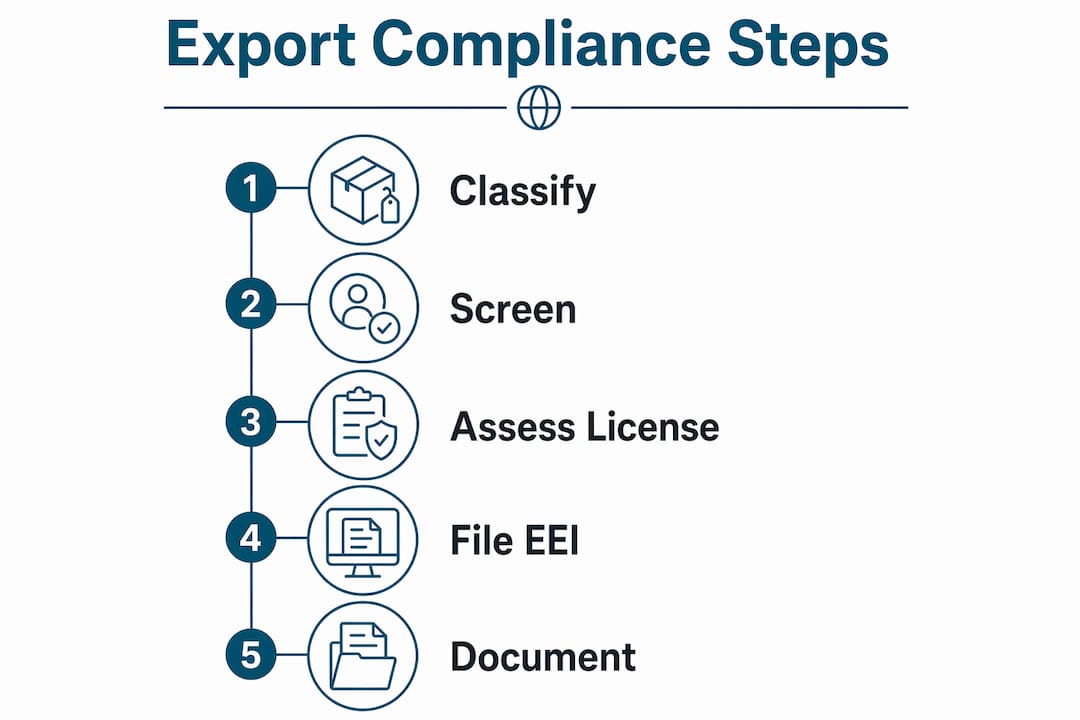
The reliable export workflow follows a strict order: classify the product first, then screen parties, then assess license needs, then document every decision. Skipping or reversing this sequence is the most common source of compliance failures.
Why does restricted party screening matter for every shipment?
Restricted party screening is mandatory for every export transaction, regardless of product value or destination. The U.S. government maintains several lists of individuals, companies, and organizations that are prohibited or restricted from receiving U.S. exports.
The primary lists every exporter must screen against include:
- BIS Entity List: Foreign parties subject to specific license requirements due to national security concerns.
- BIS Denied Persons List: U.S. and foreign persons denied export privileges.
- OFAC Specially Designated Nationals (SDN) List: Individuals and entities subject to asset freezes and transaction prohibitions.
- State Department Debarred List: Parties barred from ITAR-controlled transactions.
- Unverified List: Parties BIS could not verify in end-use checks, requiring extra caution.
Screening must cover all transaction parties, not just the buyer. Freight forwarders, end-users, financial institutions, and even intermediate consignees require screening. A clean buyer with a flagged freight forwarder still creates a compliance violation.
Timing matters. Screen at order placement, again before shipment, and once more before filing the Automated Export System (AES) entry. Business relationships change, and a party can be added to a restricted list between order and shipment.
Pro Tip: Document every screening result, including the date, the lists checked, and the outcome. This log is your primary defense in a BIS audit. Undocumented screening is treated the same as no screening.
Conducting regular internal audits of your screening process catches gaps before regulators do. Audits should review a sample of completed transactions to confirm screening was performed on all parties at the right time.
What are the EEI filing and documentation requirements?
Electronic Export Information (EEI) is the U.S. government’s primary export data collection mechanism. Exporters file EEI through the Automated Export System (AES), a CBP-administered platform. AES filing is mandatory for shipments valued over $2,500 per Schedule B item or for any shipment requiring an export license, regardless of value.
Filing deadlines are strict and vary by transport mode:
| Transport Mode | AES Filing Deadline Before Departure |
|---|---|
| Ocean vessel | 24 hours before vessel departure |
| Air (including express) | 2 hours before aircraft departure |
| Truck (border crossing) | 1 hour before crossing |
| Rail (border crossing) | 2 hours before crossing |
Upon successful AES filing, the system generates an Internal Transaction Number (ITN). Carriers are legally required to have the ITN before loading cargo. Shipments without a valid ITN or an accepted exemption citation cannot be legally transported. The exemption for shipments under $2,500 per Schedule B item with no license requirement must be cited directly on the shipping documents.
Core export documents required for every international shipment include the commercial invoice, packing list, bill of lading or airway bill, and the export license or license exception citation when applicable. Each document must be consistent. A value discrepancy between the commercial invoice and the AES filing is a common trigger for CBP holds.
Recordkeeping is a legal obligation. Under 15 CFR §762, exporters must retain all export-related records for at least five years from the date of export. This includes AES filings, commercial invoices, screening logs, classification decisions, and any red-flag investigation notes. Records must be stored in a way that allows retrieval within a reasonable time if BIS requests them.
How do you build an export compliance program that actually works?
An export compliance program does not require a full-time compliance officer. Most small and midsize exporters distribute compliance responsibilities among existing staff. A COO handling classification decisions and a logistics manager overseeing AES filings and screening can satisfy BIS audit expectations when roles are clearly documented.
BIS guidelines identify eight core elements for an effective program. The practical essentials for e-commerce businesses are:
- Written compliance procedures: A documented policy that covers classification, screening, licensing, and recordkeeping. This does not need to be a legal brief. A clear internal checklist works.
- Management commitment: Leadership must formally authorize the compliance program and allocate time for it. A signed policy statement from the business owner satisfies this requirement.
- Employee training: Training must be documented annually. Formal seminars are not required. Internal walkthroughs with attendance records fulfill BIS expectations.
- Internal audits: Review completed shipments quarterly to confirm classification, screening, and filing steps were completed correctly and in the right order.
- Corrective action procedures: When an audit finds a gap, document the finding and the fix. BIS views documented self-correction favorably.
Export compliance is not static. Regulations change, product lines expand, and new markets open. A compliance program that worked for 50 shipments per month needs review when volume reaches 500. Build the review cadence into your operations calendar from the start.
Key Takeaways
Export shipping regulations require every U.S. exporter to classify products, screen all transaction parties, file EEI through AES, and retain records for five years under 15 CFR §762.
| Point | Details |
|---|---|
| Classify before anything else | Determine your Schedule B number and ECCN before screening or licensing decisions. |
| EAR99 is not a free pass | Destination, end-user, and end-use controls can require a license even for EAR99 items. |
| Screen all parties, every time | Buyers, freight forwarders, and end-users must all be screened against U.S. government restricted lists. |
| File AES on time | Ocean shipments require AES filing 24 hours before departure; air requires 2 hours. |
| Keep records for five years | All export documents, screening logs, and classification decisions must be retained under 15 CFR §762. |
The compliance mindset that actually protects your business
I have watched e-commerce businesses treat export compliance as a box-checking exercise. They file the AES entry, attach a commercial invoice, and call it done. That approach works until it does not, and when it fails, the penalties are not proportional to the mistake.
The exporters who avoid serious problems treat compliance as an operational discipline, not a paperwork task. They classify products before they list them for sale internationally. They screen parties before they confirm orders. They document decisions the same day they make them, not the week before an audit.
One thing I consistently recommend to businesses just starting to export: use a licensed freight forwarder for your first 12 months of AES filings. Freight forwarders file as your authorized agent, and a good one will flag classification gaps and screening issues before the shipment moves. That early feedback is worth more than any compliance manual.
The other underrated move is building your compliance review into your quarterly business review. Export regulations change. The Entity List updates regularly. New sanctions programs appear with little warning. A 30-minute quarterly review of your classification decisions and screening logs catches drift before it becomes a violation.
Treat export regulations as the price of access to global markets, not as an obstacle to them. Businesses that get this right ship faster, face fewer holds, and build the kind of documented track record that makes customs clearance predictable.
— Maayan
Or-ner’s logistics platform for compliant international shipping
Managing export documentation across multiple carriers, modes, and destinations is where compliance gaps most often appear. Or-ner’s global logistics platform centralizes freight booking, shipment tracking, and customs clearance support in one place, giving e-commerce exporters the visibility they need to catch filing errors before cargo moves.
Or-ner supports ocean, air, and land shipments with real-time tracking and documentation management built into the workflow. The platform integrates with major e-commerce operators, so your order data flows directly into your shipping and compliance process. For businesses scaling their international sales in 2026, Or-ner provides the infrastructure to ship reliably without building a compliance department from scratch.
FAQ
What triggers mandatory AES filing for U.S. exports?
AES filing is required for any U.S. export shipment valued over $2,500 per Schedule B item or for any shipment that requires an export license, regardless of value.
What is an ITN and why do carriers require it?
An ITN (Internal Transaction Number) is generated by AES upon successful EEI filing. Carriers cannot legally load cargo without a valid ITN or an accepted exemption citation on the shipping documents.
Does EAR99 classification mean no export license is needed?
Not always. EAR99 items can still require a license based on the destination country, the end-user’s identity, or the intended end-use of the product.
How long must exporters keep export records?
Under 15 CFR §762, exporters must retain all export-related records, including AES filings, invoices, screening logs, and classification decisions, for at least five years from the date of export.
Can a small e-commerce business run a compliance program without a dedicated officer?
Yes. Most small and midsize exporters distribute compliance duties among existing staff, such as a COO and logistics manager, and meet BIS audit expectations through documented procedures and annual training records.