
Many ecommerce managers believe end-to-end logistics solutions only make sense for large enterprises with massive order volumes. This misconception costs businesses significant money and competitive advantage. Integrated logistics platforms enable streamlined, cost-effective, scalable ecommerce supply chain management for businesses of all sizes. This guide covers definitions, benefits, technology roles, challenges, comparisons, and implementation strategies to help you optimize your logistics operations.
Table of Contents
- Understanding End-To-End Logistics Solutions
- Key Benefits Of Integrated End-To-End Logistics For Ecommerce
- Technology’s Critical Role: Tracking, Automation, And Analytics
- Overcoming Challenges In Cross-Border And International Logistics
- Common Misconceptions About End-To-End Logistics Solutions
- Comparing Traditional Vs Integrated End-To-End Logistics Models
- Implementing And Scaling Reliable End-To-End Logistics Solutions
- Discover Reliable End-To-End Logistics With ORNER
- Frequently Asked Questions
Key takeaways
| Point | Details |
|---|---|
| Integration drives efficiency | End-to-end logistics integrates freight, courier, warehousing, and tracking for streamlined ecommerce operations. |
| Automation cuts costs | Real-time visibility and automation reduce costs by up to 20% while cutting stockouts by 40%. |
| Cross-border simplified | Automated customs clearance reduces international shipping delays by 30% through streamlined documentation. |
| Scalable for all sizes | Integrated solutions work for SMBs and large enterprises, with platforms designed for businesses processing under 50 daily orders. |
| Better than fragmented | Centralized logistics management beats traditional fragmented services in cost, speed, and reliability. |
Understanding end-to-end logistics solutions
End-to-end logistics represents fully integrated supply chain management from product origin to final customer delivery. Rather than juggling multiple disconnected service providers, businesses gain unified control over every logistics touchpoint.
End-to-end logistics covers freight booking, courier, warehousing, and tracking as essential components. These systems coordinate ocean, air, and land transport modes within a single platform. Inventory management connects directly with order fulfillment, creating seamless workflows that eliminate manual handoffs between systems.
Core components include:
- Freight booking across multiple carriers and transport modes
- Courier service coordination for last-mile delivery
- Warehousing optimization with real-time inventory tracking
- Shipment tracking providing complete supply chain visibility
- Exception management identifying and resolving delays proactively
Multi-modal transport coordination enables businesses to select optimal shipping methods based on cost, speed, and product requirements. A single shipment might combine ocean freight for international transport, domestic trucking for regional distribution, and local courier services for final delivery.
Centralized management reduces fragmentation that creates communication gaps, duplicate data entry, and delayed problem resolution. Ecommerce logistics key insights show integrated platforms cut coordination time significantly. When inventory systems connect directly with shipping manifests and tracking data, businesses detect issues before they impact customers.
Ecommerce fulfillment solutions built on integrated logistics frameworks enable faster scaling. You add sales channels without rebuilding your entire supply chain infrastructure.
Key benefits of integrated end-to-end logistics for ecommerce
Integrated logistics platforms cut ecommerce supply chain costs by up to 20% through automation and streamlined processes. Manual data entry disappears when systems share information automatically. Duplicate shipping charges vanish when one platform manages all carrier relationships.

Combining freight, courier, and warehousing services eliminates vendor management overhead. You negotiate once instead of maintaining separate contracts with ocean carriers, trucking companies, warehouses, and local delivery services. Consolidated billing simplifies accounting and reveals total logistics spend clearly.
Shipment speed and reliability improve through cohesive multi-modal routing. Integrated systems select optimal carrier combinations based on real-time performance data rather than static routing tables. When delays occur, automated rerouting maintains delivery commitments.
Automation improves inventory visibility reducing stockouts by 40% while enabling leaner inventory levels. Real-time stock updates across warehouses prevent overselling and emergency air shipments. Predictive analytics forecast demand spikes before they drain inventory.
Operational disruptions decrease when exception management flags issues early. Late pickups, customs delays, and carrier capacity problems trigger alerts for immediate intervention. Proactive communication keeps customers informed instead of surprised by missed deliveries.
Scalability benefits emerge as businesses expand into new markets and channels. Adding Amazon FBA alongside your Shopify store requires zero logistics infrastructure changes when both integrate with your end-to-end platform. International expansion becomes configuration rather than complete system overhaul.
Key advantages include:
- Reduced labor costs through warehouse automation
- Lower inventory carrying costs from improved turnover
- Decreased customer service volume handling delivery inquiries
- Faster time-to-market for new products and regions
Pro Tip: Calculate total landed cost including duties, warehousing, and courier fees rather than comparing only base shipping rates. The cheapest ocean freight often creates higher total costs through slower customs clearance and expensive last-mile delivery.
Freight forwarder benefits ecommerce shipping success by coordinating these complex variables within unified workflows. Environmental impact decreases through optimized routing and consolidated shipments, supporting sustainability in ecommerce logistics goals.
Technology’s critical role: tracking, automation, and analytics
Real-time tracking transforms supply chain visibility from periodic status updates to continuous monitoring. GPS sensors on trucks, RFID tags in warehouses, and API integrations with carriers create complete shipment histories. Decision-makers see exactly where products sit at any moment.
Real-time shipment visibility and exception management significantly reduce late deliveries by flagging problems immediately. When a shipment misses a connection or sits too long at customs, automated alerts notify logistics teams before delivery windows pass. Proactive communication reaches customers with updated ETAs instead of excuses.
Exception management extends beyond simple alerts. Smart systems suggest alternative routing, identify backup inventory locations, and calculate cost impacts of various recovery options. You make informed decisions quickly rather than scrambling reactively.
Warehouse automation enhances inventory accuracy through:
- Barcode scanning eliminating manual counting errors
- Automated storage and retrieval systems maximizing space utilization
- Pick-and-pack robots reducing labor costs and processing time
- Integrated inventory management syncing stock levels across all channels
Data analytics identify operational risks before they escalate. Analyzing carrier performance reveals which services consistently deliver on time versus those requiring buffer days. Customer complaint patterns highlight specific products requiring better packaging or handling.
Forecasting improves when historical shipping data combines with sales trends. Seasonal demand spikes become predictable, enabling proactive warehouse staffing and inventory positioning. You stock regional distribution centers based on actual order patterns rather than guesswork.
Pro Tip: Configure exception alerts based on shipment value and delivery urgency rather than treating all delays equally. A delayed birthday gift requires immediate intervention while restocking inventory can tolerate minor variations.
Track and trace technology supply chains enable customer self-service portals reducing support inquiries. Buyers check shipment status themselves instead of calling your team. Automated delivery notifications manage expectations throughout the shipping journey.
Technology scalability matters as order volumes grow. Cloud-based platforms handle volume spikes during peak seasons without infrastructure upgrades. API connections integrate new sales channels and carrier services through configuration rather than custom development.
Overcoming challenges in cross-border and international logistics
Customs clearance creates the biggest bottleneck in international ecommerce shipping. Manual documentation preparation involves commercial invoices, certificates of origin, and product classifications across varying regulatory frameworks. Errors trigger inspections, fines, and shipment returns.
End-to-end platforms automate customs clearance documentation reducing delay variability by 30% through pre-validated data and electronic submissions. Product catalogs store harmonized tariff codes, country-specific requirements, and valuation rules. Systems generate compliant paperwork automatically for each destination.
Compliance management across jurisdictions requires centralized knowledge bases updated as regulations change. Trade agreements, restricted product lists, and labeling requirements vary by country. Integrated platforms maintain current rules and flag potential compliance issues during order entry rather than at the border.
Multi-modal transport coordination balances cost against transit time for international shipments. Ocean freight offers low per-unit costs but requires 4-6 weeks for Asia-US routes. Air freight delivers in days but costs 5-10 times more. Smart routing splits shipments based on demand urgency and profit margins.
| Clearance Method | Processing Time | Error Rate | Cost Impact |
|---|---|---|---|
| Manual customs clearance | 3-7 business days | 15-25% documentation errors | High – delays cause storage fees and missed delivery windows |
| Automated customs clearance | 1-2 business days | 2-5% documentation errors | Low – faster processing reduces holding costs and improves cash flow |
Tariff and duty management requires calculating landed costs accurately before quoting customer prices. Integrated platforms apply current duty rates, value-added taxes, and handling fees based on product classifications and destination countries. Customers see true total costs upfront instead of surprise charges at delivery.
Documentation strategies include:
- Electronic advance manifest submissions meeting carrier deadlines
- Automated calculation of de minimis thresholds avoiding unnecessary duties
- Digital archiving of all customs paperwork for audit compliance
- Real-time duty drawback tracking recovering eligible refunds
Customs clearance explained shipping guides detail specific requirements by country and product category. Maintaining current knowledge prevents costly mistakes.
Customs compliance automation reduces manual research time while improving accuracy. Systems update tariff classifications and regulatory requirements automatically as trade policies evolve.
Common misconceptions about end-to-end logistics solutions
Myth number one claims end-to-end logistics only works for large enterprises processing thousands of daily orders. Reality shows scalable end-to-end logistics platforms are effective for businesses with fewer than 50 daily orders through tiered pricing and modular features. Small sellers access enterprise-grade tracking and automation without enterprise budgets.
Cloud-based platforms eliminate infrastructure costs that previously limited small business adoption. You pay for actual usage rather than building capacity for peak volumes. Seasonal businesses scale up during holidays and scale down during slow periods.
The cheapest shipping option misconception leads businesses to select carriers based solely on base rates. Reality reveals lowest-price carriers often lack reliable tracking, offer limited customer service, and generate higher damage claims. Total cost of ownership includes customer service time resolving delivery issues, refunds for lost packages, and lost customers from poor experiences.
Fragmented services suffice represents another dangerous myth. Managing separate relationships with ocean carriers, trucking companies, warehouses, customs brokers, and last-mile couriers creates coordination nightmares. Information sits in disconnected systems requiring manual consolidation. Problems fall through gaps between providers.
Integration provides essential benefits:
- Single source of truth for inventory and shipment data
- Unified tracking across all transport modes and providers
- Coordinated exception handling when delays occur
- Consolidated reporting revealing true logistics performance
- Simplified vendor management reducing administrative overhead
These misconceptions impact businesses directly. Higher total costs from hidden fees and inefficiencies erode profit margins. Customer satisfaction suffers when delivery experiences disappoint. Growth stalls when logistics infrastructure cannot scale with demand.
Ecommerce logistics key insights demonstrate how integrated solutions overcome these limitations. Even businesses just starting international expansion benefit from platforms handling compliance complexity.
Scalable logistics solutions small biz case studies show companies growing from 10 to 1000 daily orders without changing core logistics infrastructure. The platform scales while business focus remains on products and customers.
Comparing traditional vs integrated end-to-end logistics models
Traditional fragmented logistics operates through disconnected point solutions. You contract separately with ocean freight forwarders, domestic trucking companies, warehouse operators, and courier services. Each provider maintains independent systems requiring manual data transfer and status updates.
Limited visibility characterizes fragmented models. Tracking ends when one provider hands shipments to the next. Gaps between handoffs create blind spots lasting hours or days. You learn about problems only after customers complain.
Manual problem-solving dominates traditional approaches. Delayed shipments require calling multiple providers to locate packages and determine causes. Resolution depends on individual relationships and provider responsiveness rather than systematic processes.
| Aspect | Traditional Fragmented Model | Integrated End-to-End Model |
|---|---|---|
| Integration level | Separate contracts and systems for each service | Single platform managing all logistics functions |
| Visibility | Limited tracking with gaps between providers | Real-time tracking across entire supply chain |
| Cost structure | Multiple invoices with hidden fees and reconciliation overhead | Consolidated billing with transparent total costs |
| Delivery speed | Manual coordination creates delays at handoffs | Automated routing optimizes speed across all modes |
| Scalability | Requires negotiating new contracts for each expansion | Configuration changes add channels and regions |
| Exception handling | Manual phone calls and email to resolve issues | Automated alerts with suggested resolutions |
| Data analytics | Fragmented data requires manual consolidation | Unified reporting across all operations |
Integrated end-to-end models offer seamless multi-modal coordination through unified platforms. Ocean freight connects directly to domestic distribution and last-mile delivery within one system. Inventory updates trigger automatic fulfillment workflows.
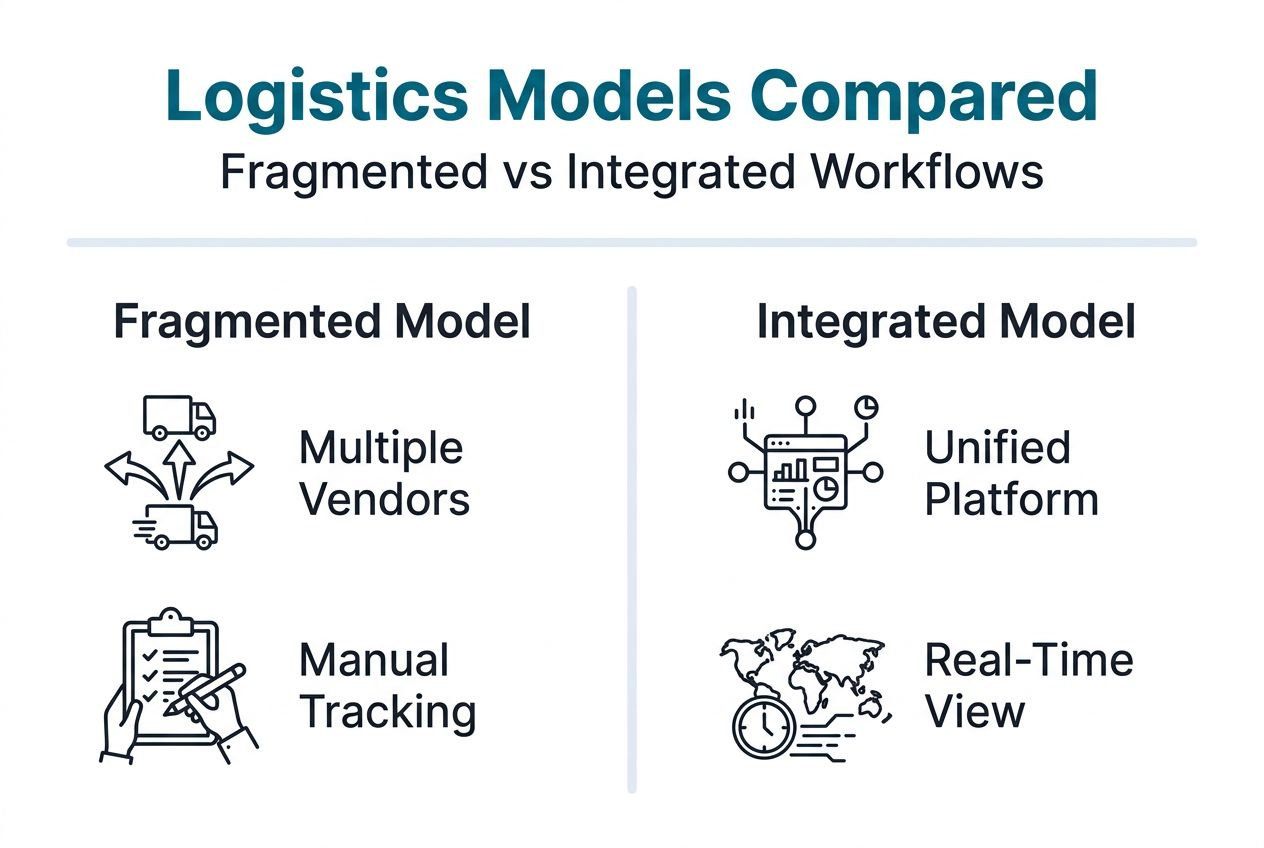
Real-time tracking continues uninterrupted across all providers and transport modes. You see complete shipment journeys from warehouse pickup through final delivery. Customers receive accurate ETAs based on actual progress rather than estimates.
Automated documentation eliminates manual data entry between systems. Product details entered once populate customs paperwork, shipping labels, and tracking notifications. Compliance checks happen automatically before shipments leave warehouses.
Proactive issue resolution replaces reactive problem-solving. Exception alerts identify delays immediately with suggested alternatives. Systems reroute shipments automatically based on predefined rules and cost thresholds.
Ecommerce logistics overview demonstrates how integrated models transform operational efficiency. Businesses reduce logistics staff time by 30-40% while improving delivery performance.
The Logistics Integration Maturity Model helps assess readiness:
- Fragmented: Disconnected providers with manual coordination
- Connected: Basic API integrations between some systems
- Automated: Workflow automation across major processes
- Optimized: AI-driven routing and predictive analytics
- Transformative: Fully autonomous supply chain operations
Most businesses start at level 1 or 2. Moving to level 3 delivers the biggest ROI through automation eliminating repetitive manual work.
Implementing and scaling reliable end-to-end logistics solutions
Successful implementation follows structured steps ensuring smooth transitions and measurable improvements. Rushing integration creates gaps while over-planning delays benefits.
- Assess current logistics fragmentation by mapping all providers, systems, and manual touchpoints
- Identify essential components your business requires based on order volumes, destinations, and product types
- Evaluate platform providers beyond price considering integration capabilities, technology features, and reliability track records
- Implement tracking and automation starting with highest-volume routes and products
- Scale warehousing strategically as order volumes grow using data to guide location decisions
- Monitor performance via analytics dashboards measuring costs, delivery times, and exception rates
Provider evaluation criteria should emphasize total value over lowest quotes. Integration capability determines how easily platforms connect with your existing ecommerce systems, marketplaces, and accounting software. Choosing shipping carriers requires evaluating service quality alongside rates.
Technology features enabling growth include:
- API connections to major ecommerce platforms
- Real-time inventory synchronization across warehouses
- Automated customs documentation for international shipping
- Exception management with configurable alert rules
- Analytics dashboards revealing logistics performance trends
Reliability matters more than features. Research provider uptime statistics, customer retention rates, and case studies from similar businesses. Test platforms with pilot programs before committing to full migrations.
Scalability indicators include flexible pricing that grows with volumes, modular features you activate as needed, and geographic coverage supporting expansion plans. Platforms should handle 10x order growth without requiring replacements.
Pro Tip: Prioritize total landed cost and long-term operational efficiency over lowest upfront pricing when selecting logistics partners. Cheap solutions create expensive problems through poor reliability, limited support, and integration gaps requiring manual workarounds.
Cost transparency requires understanding all fees including base shipping rates, fuel surcharges, residential delivery fees, address correction charges, and peak season premiums. Request detailed pricing breakdowns preventing surprise charges.
Ecommerce fulfillment solutions should integrate seamlessly with inventory management and order processing systems. Manual data transfer between systems kills the efficiency gains integration provides.
Scalable warehousing strategies position inventory near customer concentrations reducing delivery times and last-mile costs. Analytics reveal optimal warehouse locations based on actual order destinations rather than assumptions. Starting with one fulfillment center and expanding as regional volumes justify additional locations balances costs against service levels.
Discover reliable end-to-end logistics with ORNER
Transforming your ecommerce supply chain from fragmented services to integrated logistics requires the right platform partner. ORNER delivers comprehensive solutions connecting every logistics touchpoint within unified workflows.
Our global logistics platform courier services coordinate ocean freight, air shipping, domestic trucking, and last-mile delivery through one interface. Real-time tracking follows shipments across all transport modes eliminating visibility gaps.
Warehouse location strategy optimal logistics guidance helps position inventory for fastest, most cost-effective fulfillment. Our global fulfillment center network supports regional distribution reducing delivery times and shipping costs.
Best shipment tracking software provides complete supply chain visibility with automated exception management. You resolve issues proactively instead of explaining delays to frustrated customers. Explore how ORNER streamlines ecommerce logistics enabling scalable, efficient growth.
Frequently asked questions
What are end-to-end logistics solutions in ecommerce?
End-to-end logistics solutions provide fully integrated supply chain management covering transportation, warehousing, tracking, and delivery from product origin to final customer. These platforms coordinate ocean freight, air shipping, domestic trucking, and courier services within unified systems eliminating handoff gaps between disconnected providers.
How do integrated logistics solutions differ from traditional fragmented services?
Integrated solutions centralize control through single platforms managing all logistics functions with real-time visibility across the entire supply chain. Traditional fragmented services require separate contracts with multiple providers creating coordination overhead, tracking gaps, and manual problem-solving. Integrated platforms automate workflows and exception handling that fragmented models handle manually.
Can small businesses benefit from end-to-end logistics platforms?
Small ecommerce businesses processing under 50 daily orders access enterprise-grade logistics through scalable platforms with tiered pricing and modular features. Cloud-based systems eliminate infrastructure costs while providing tracking, automation, and analytics previously available only to large enterprises. You pay for actual usage scaling costs with order volumes.
What technology enables end-to-end logistics efficiency?
Real-time tracking via GPS and RFID provides complete shipment visibility triggering automated alerts for delays and exceptions. Warehouse automation through barcode scanning and robotic systems improves inventory accuracy while reducing labor costs. Data analytics forecast demand, optimize routing, and identify operational risks enabling proactive management instead of reactive problem-solving.
How do integrated courier services improve ecommerce delivery reliability?
Integrated courier coordination within end-to-end platforms optimizes carrier selection based on real-time performance data rather than static routing rules. Automated exception management detects delays immediately enabling proactive rerouting and customer communication. Unified tracking across all carriers provides accurate delivery estimates and reduces customer service inquiries about shipment status.
Recommended
- What is Ecommerce Logistics? Key Insights for 2025 – ORNER
- 7 Top Logistics Challenges 2025 and How to Overcome Them – ORNER
- Freight Forwarding for Ecommerce: 6% CAGR Growth in 2026 – ORNER
- Urban Logistics Solutions for Efficient Delivery in 2025 – ORNER
- How to Shop Online for Clothes: A Complete Guide for Women – Be Juliet