TL;DR:
- A streamlined ecommerce shipping workflow involves automated processes connecting order management, warehouse, and carrier systems to reduce costs and errors. Implementing proper system integrations, managing inventory first, and using automated labels and tracking improve accuracy and efficiency. Choosing the right fulfillment model and consistently monitoring core metrics are essential for scalable, cost-effective shipping operations.
A workflow for ecommerce shipping is the organized sequence of steps that moves an order from placement to delivery accurately, quickly, and at the lowest possible cost. Most store owners underestimate how much this process costs them. The average ecommerce business spends 15%–20% of total revenue on shipping and fulfillment. That makes your fulfillment operation one of the largest controllable expenses you run. Tools like ShipStation, EasyPost, and third-party logistics (3PL) integrations exist specifically to bring that number down while keeping customers happy.
What does an ecommerce shipping workflow require?
An effective order fulfillment workflow runs on three interconnected systems: an order management system (OMS), a warehouse management system (WMS), and a carrier integration layer. Each one handles a distinct job, and gaps between them are where errors and delays live.

The OMS captures every order, validates payment, and routes it downstream. The WMS tracks inventory location, directs pickers, and records what leaves the building. The carrier layer, built on APIs from tools like EasyPost or ShipStation, generates labels, selects the best rate, and transmits shipment data to the carrier. When these three systems talk to each other automatically, you get speed and accuracy. When staff re-key data between them manually, you get mistakes.
Automation reduces manual errors and accelerates the fulfillment cycle by handling order ingestion, address validation, label creation, and status syncing without human input. That is not a luxury for large operations. It is the baseline for any store processing more than a few dozen orders per day.
| Tool | Primary Function | Key Strength |
|---|---|---|
| ShipStation | Multi-carrier label generation | Broad carrier network, rate comparison |
| EasyPost | Carrier API integration | Developer-friendly, address verification |
| ShipBob | 3PL fulfillment | Distributed warehousing, fast delivery |
| Shopify Shipping | Native label printing | Direct store integration |
| Ordoro | OMS + shipping hybrid | Dropshipping and multi-channel support |
Pro Tip: Connect your OMS, WMS, and shipping platform through direct API integrations before you scale. Fixing broken data flows at high order volumes costs far more than building them correctly from the start.
What are the steps in a streamlined shipping process?
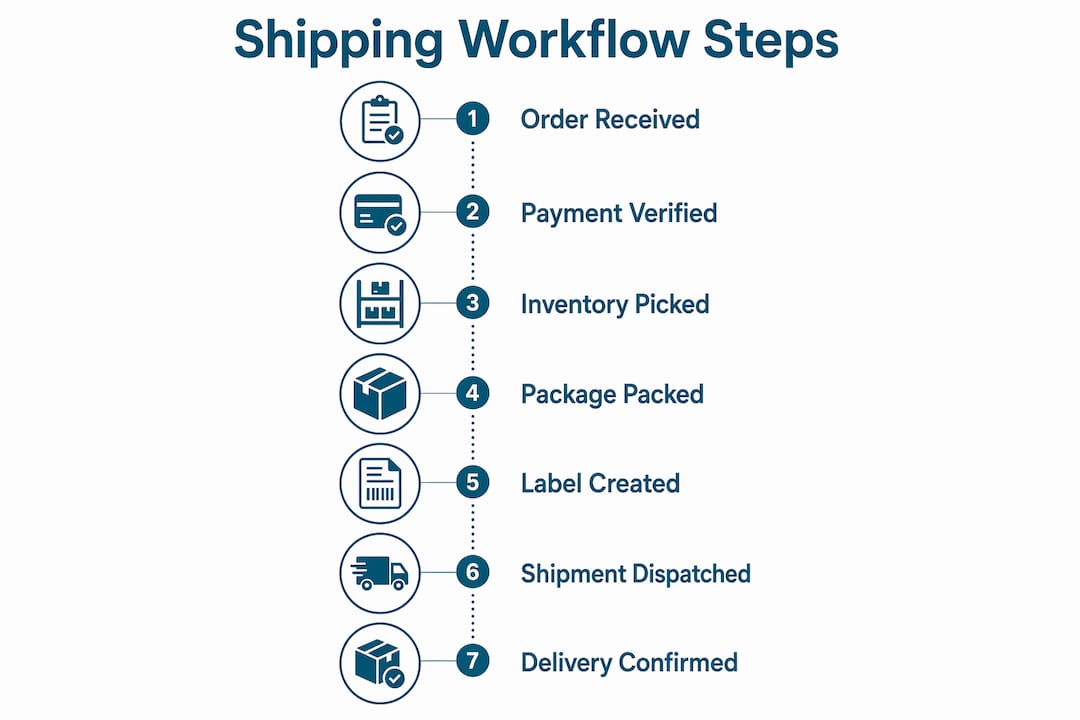
The shipping process workflow runs from order receipt through delivery confirmation and exception handling. Each stage has a specific job. Skipping or rushing any one of them creates downstream problems that are expensive to fix.
-
Order intake and validation. The OMS receives the order and immediately checks the shipping address against a validation database. Invalid addresses caught here cost nothing to fix. Invalid addresses caught after a package ships cost you a reship and a frustrated customer.
-
Payment authorization. Authorize funds at order placement but capture payment only after the shipment leaves your facility. This practice simplifies refunds when an item is out of stock and eliminates the need to reverse a completed charge.
-
Inventory allocation. Allocation decisions must happen before you send any order confirmation or promise a ship date. Committing to a delivery window without confirming stock availability leads to stockouts, canceled orders, and reputation damage.
-
Picking. The WMS generates a pick list organized by warehouse zone or bin location. Batch picking, where one picker collects items for multiple orders in a single pass, cuts travel time significantly in larger facilities.
-
Packing. Choose packaging based on product dimensions, weight, and fragility. Oversized boxes inflate dimensional weight charges from carriers like UPS and FedEx. Undersized packaging increases damage claims. Review Or-ner’s guidance on packaging for ecommerce shipping for material and sizing recommendations.
-
Label creation and carrier selection. Automated label generation and electronic Advanced Shipment Notice (ASN) transmission minimize errors and chargebacks. Your shipping platform compares rates across carriers in real time and selects the best option based on rules you define, such as speed, cost, or carrier preference by zone.
-
Carrier handoff and tracking setup. The package scans out of your facility and tracking data flows back into your OMS automatically. Customers receive a tracking notification without any manual step from your team.
-
Delivery confirmation and payment capture. Once the carrier confirms delivery, your system captures the authorized payment. This sequence keeps your cash flow clean and your refund process simple.
-
Exception handling. Failed deliveries, returns, and backorders need a defined process, not improvised decisions. Set rules in your OMS for each exception type so your team executes consistently every time.
Pro Tip: Run a weekly audit of your exception queue. A spike in address validation failures often signals a checkout UX problem, not a carrier problem. Fix it at the source.
How do you fix common shipping workflow problems?
The most expensive shipping management mistakes are not dramatic failures. They are quiet, recurring errors that compound over months. Knowing where they originate lets you stop them before they scale.
Invoicing for ordered quantity instead of shipped quantity is the most common billing error in ecommerce logistics. Automated invoicing tied to shipment records prevents discrepancies and chargebacks. Best practice uses EDI 810 electronic invoices that pull data directly from shipment confirmation records, not the original order.
Manual data re-keying between systems is the single largest source of fulfillment errors. Top distribution operations achieve order accuracy above 99.5% by moving data system-to-system rather than through manual handoffs. Every time a person types a value that a system could transfer automatically, you introduce risk.
Here are the most effective optimization moves for your shipping procedure:
- Audit your carrier mix quarterly. Volume discounts from UPS, FedEx, and USPS are negotiable, and your leverage increases as order volume grows.
- Set address validation as a hard gate at checkout, not a soft warning. Catching bad addresses before order placement costs nothing.
- Monitor four core metrics weekly: order accuracy rate, average fulfillment time, shipping cost per order, and return rate by SKU.
- Sync inventory counts between your ecommerce platform and WMS in real time. Batch syncing creates oversell windows that generate cancellations.
- Review your ecommerce shipping best practices regularly as carrier pricing and service levels change.
Pro Tip: Set a carrier cost alert in ShipStation or EasyPost that flags any shipment where the actual cost exceeds the estimated cost by more than 10%. Investigate every flag. Dimensional weight miscalculations and zone creep are the usual culprits.
How does your fulfillment model shape the workflow?
Your fulfillment model determines how much of the shipping workflow you control directly and how much you hand off to a partner. Each model fits a different stage of business growth.
Self-fulfillment means your team picks, packs, and ships from your own facility. You control every step, which is valuable for fragile, customized, or high-margin products. The tradeoff is fixed overhead: warehouse space, staff, and equipment costs do not flex with order volume.
3PL fulfillment through providers like ShipBob, Deliverr, and ShipMonk gives you distributed warehousing and pre-negotiated carrier rates. Orders ship from the fulfillment center closest to the customer, which cuts transit time and cost. The integration requirement is real: your OMS must connect to the 3PL’s system cleanly, or you lose visibility and accuracy. Or-ner’s breakdown of logistics solutions for ecommerce covers how to evaluate 3PL fit for different business types.
Dropshipping removes warehousing entirely. Your supplier ships directly to the customer. Margins are thinner, and you have no control over packing quality or ship times. Dropshipping works best for product testing or catalog expansion, not as a primary model for a brand that competes on delivery experience.
| Fulfillment Model | Cost Structure | Speed | Control | Best For |
|---|---|---|---|---|
| Self-fulfillment | Fixed overhead | Moderate | High | Custom, fragile, or high-margin goods |
| 3PL | Variable per order | Fast | Medium | Scaling brands, broad geographic reach |
| Dropshipping | Low upfront | Slow to moderate | Low | Product testing, wide catalog |
The right model depends on your order volume, product type, and growth trajectory. Many growing brands use self-fulfillment for their core SKUs and a 3PL for overflow or geographic expansion.
Key takeaways
A well-built ecommerce shipping workflow cuts fulfillment costs, prevents billing errors, and delivers the order accuracy that keeps customers coming back.
| Point | Details |
|---|---|
| Automate system connections | Link your OMS, WMS, and carrier API directly to eliminate manual re-keying errors. |
| Authorize before you capture | Hold payment at order placement and capture only after shipment to simplify refunds. |
| Invoice on shipped quantity | Tie invoices to shipment records, not order records, to prevent chargebacks. |
| Allocate inventory first | Confirm stock availability before sending any order confirmation or ship date promise. |
| Match fulfillment model to volume | Use self-fulfillment for control, 3PL for scale, and dropshipping only for catalog testing. |
Where automation actually pays off
I have reviewed a lot of ecommerce shipping operations, and the pattern is consistent. Businesses that struggle with fulfillment costs are almost never struggling with carrier rates. They are struggling with data. A wrong address, a label printed for the wrong SKU, an invoice sent for ten units when eight shipped. These are not carrier problems. They are process problems, and they are entirely preventable.
The 99.5% order accuracy benchmark is not aspirational. It is the floor for any operation that wants to avoid chargebacks and retain wholesale accounts. Getting there requires one thing above all else: stop letting humans move data between systems. Every manual step is a liability.
The payment authorization model is one I wish more merchants adopted earlier. Authorizing at order placement and capturing at shipment sounds like an accounting detail. In practice, it eliminates a whole category of customer service headaches. When a backorder happens, you release the authorization instead of processing a refund. Customers respond very differently to those two experiences.
The other thing I would push back on is the instinct to delay automation investment until you “get bigger.” The cost of fixing a broken workflow at 500 orders per day is ten times the cost of building it correctly at 50. Invest in clean system integrations early, monitor your exception queue weekly, and treat every recurring error as a process failure worth solving permanently.
— Maayan
How Or-ner supports your fulfillment operations
Building a reliable shipping operation requires more than good intentions. It requires carrier connections, real-time tracking, and the kind of logistics infrastructure that takes years to build independently.
Or-ner’s global logistics platform gives ecommerce sellers and logistics managers access to reliable courier services, automated carrier integrations, real-time shipment tracking, and cross-border fulfillment tools built for scale. Whether you ship domestically or internationally, Or-ner connects your operation to a global network of warehouses and fulfillment centers. If you want a practical starting point for carrier selection and cost control, Or-ner’s freight booking guide for ecommerce walks you through the process step by step.
FAQ
What is a workflow for ecommerce shipping?
A workflow for ecommerce shipping is the defined sequence of steps from order receipt through delivery confirmation, including validation, picking, packing, label creation, carrier handoff, and exception handling. It is the operational backbone of any fulfillment operation.
How much do ecommerce businesses spend on shipping?
Shipping and fulfillment costs 15%–20% of revenue for the average ecommerce business. That makes it one of the largest controllable costs after product sourcing.
What order accuracy rate should i target?
Top-performing fulfillment operations achieve accuracy above 99.5% through direct system-to-system data flows. Manual re-keying between platforms is the primary reason most operations fall short of that benchmark.
When should i switch from self-fulfillment to a 3pl?
Switch to a 3PL when self-fulfillment overhead exceeds the per-order cost of outsourcing, or when your customers are concentrated in regions far from your warehouse. Providers like ShipBob and ShipMonk offer distributed fulfillment that cuts transit times without requiring you to open new facilities.
How do i prevent invoicing chargebacks in ecommerce shipping?
Invoice based on shipped quantity, not ordered quantity, and use electronic document exchange to tie invoices directly to shipment confirmation records. Automated invoicing aligned to shipments eliminates the discrepancies that trigger chargebacks.