
TL;DR:
- Ecommerce shipping laws in 2025 eliminate the US $800 de minimis exemption, requiring full customs clearance for all shipments. EU’s ICS2 Phase 3 mandates complete advance cargo data, with non-compliance causing customs delays of up to 12 days, affecting time-sensitive products. Sellers must switch to DDP, automate HS code classification, and configure multi-state billing systems to stay compliant and ensure customer satisfaction.
Ecommerce shipping laws 2025 mark the most significant regulatory shift in cross-border trade in over a decade. The U.S. eliminated its $800 de minimis exemption on august 29, 2025, requiring full customs clearance and duty payment on every inbound commercial shipment. The EU simultaneously activated Import Control System 2 (ICS2) Phase 3, tightening advance cargo data requirements for all air and express freight. If you sell across borders or manage logistics for a multi-market brand, these changes affect your cost structure, your delivery timelines, and your customer experience starting now.
What are the major 2025 ecommerce shipping regulations affecting U.S. imports?
The end of the de minimis exemption is the single largest structural change in U.S. import law in years. Before august 29, 2025, about 4 million daily shipments moved through U.S. customs duty-free under the $800 threshold. That volume now requires full customs processing, and the financial and operational burden falls directly on sellers.
Every commercial shipment entering the U.S. must now use one of two models:
- Delivered Duty Paid (DDP): The seller pays all duties and taxes before delivery. The customer receives the package with no surprise charges at the door.
- Pre-Entry DDU (Delivered Duty Unpaid): Duties are collected from the recipient at delivery. This model creates friction and drives cart abandonment when customers see unexpected fees.
- Consumer-to-consumer gifts under $100 remain exempt. This is the only surviving carve-out from the old de minimis framework.
- Carriers including USPS, DHL, and UPS have updated their manifest and duty collection systems to reflect the new rules, but processing times for commercial parcels have increased as a result.
- Non-compliant shipments face holds, returns to origin, or destruction at the border. The cost of a returned international shipment typically exceeds the original shipping cost.
The practical default for most ecommerce sellers is DDP. Customers expect a clean checkout experience with no post-delivery billing. Many contracts still use outdated Delivered at Place (DAP) terms, which shift duty liability to the buyer. Any contract signed before 2024 needs a review and likely a renegotiation.
Pro Tip: Run a quick audit of your carrier agreements and checkout flow. If your customers see “duties may apply at delivery” anywhere in the purchase process, you are operating under DAP terms and losing conversions you may not even be tracking.
How do 2025 ecommerce shipping laws affect international shipments to the EU?
The EU’s ICS2 Phase 3 requirement applies to all air freight and express shipments entering the European Union. Sellers and their logistics partners must submit a complete advance cargo manifest before the shipment departs. Incomplete or missing data triggers an automatic hold.
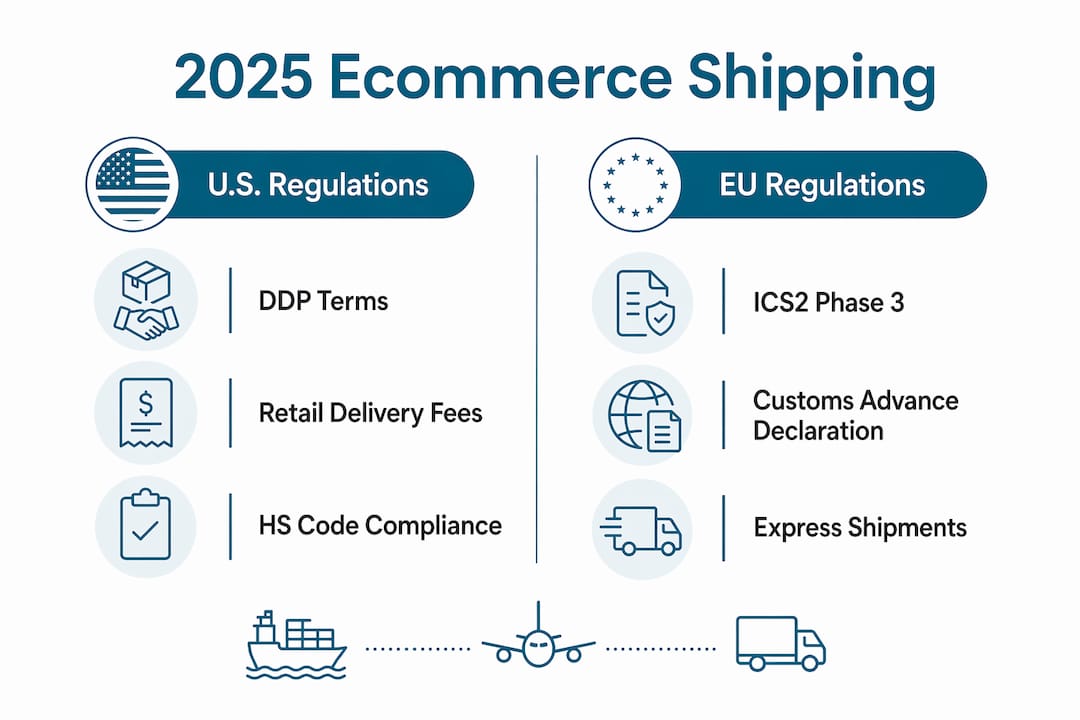
The consequences of a failed ICS2 submission are concrete. Customs holds from rejected manifests run 5–12 business days. For time-sensitive products like apparel, electronics, or seasonal goods, a 12-day hold can mean missed sales windows and a wave of customer service contacts.
Key compliance requirements under ICS2 Phase 3 include:
- Complete shipper and consignee data submitted before departure, not on arrival.
- Accurate commodity descriptions at the line-item level. Vague entries like “gift” or “merchandise” are rejected.
- Carrier coordination to confirm that your logistics partner’s system is ICS2-certified and submitting data in the correct format.
- Amazon EU seller requirements add another layer. Amazon requires EU sellers to maintain a fiscal representative for One-Stop Shop (OSS) VAT compliance or face listing suppression within 30 days.
The broader picture is that compliance requirements have roughly tripled for cross-border sellers since ICS2 and regional tax enforcement expanded. That is not a metaphor. Sellers who managed one or two compliance checkpoints in 2022 now manage six or more across documentation, VAT, duties, and carrier data standards. Understanding the full scope of cross-border ecommerce rules before you ship is the only way to avoid compounding delays.
What operational challenges do sellers face under 2025 shipping laws?
The new shipping regulations 2025 create three distinct operational pressure points: product classification, fee management, and system scalability. Each one can generate fines or delays independently. Together, they create a compliance surface area that manual processes cannot cover reliably.

Product classification and HS codes
Customs classification errors now generate direct penalties to merchants, not to brokers. Sellers must audit SKU HS code classifications annually because reliance on outdated 2022 World Customs Organization (WCO) HS code updates is a primary trigger for customs fines and shipment holds. A single misclassified SKU across a high-volume catalog can produce thousands of dollars in penalties per quarter.
Retail Delivery Fees across U.S. states
State-level Retail Delivery Fees (RDF) add a fractured compliance layer on top of federal changes. Colorado charges $0.28 per retail delivery, rising to $0.31 in july 2026. That fee applies regardless of which carrier performs the delivery and must appear as a separate line item on the invoice.
The table below shows how RDF compliance requirements differ across key variables:
| Variable | What it means for sellers |
|---|---|
| Fee amount | Varies by state; Colorado is $0.28 per delivery currently |
| Invoice requirement | Must be a separate line item, not bundled into shipping cost |
| Triggers | Differ by state: some use order value thresholds, others use sales volume |
| Exemptions | Vary widely; some states exempt low-value orders or certain product categories |
| System support | Many billing systems require manual configuration to itemize RDF correctly |
Scalability of manual compliance
Manual compliance systems fail at roughly $2 million in annual cross-border gross merchandise value. Beyond that threshold, the volume of SKUs, markets, and regulatory variables exceeds what a spreadsheet-based approach can track without errors. Sellers at that scale need automated duty calculation, classification tools, and real-time carrier data feeds.
Pro Tip: If you sell in more than three U.S. states, map your RDF exposure by state before your next billing system update. The penalty for missing a required line item is not just the fee itself. It is the audit risk that follows.
How can sellers ensure ecommerce delivery compliance in 2025?
Compliance with the new retail shipping guidelines 2025 requires changes at the contract, technology, and operational levels. Patching one area while ignoring the others leaves gaps that enforcement will find.
- Switch all carrier contracts to DDP terms. Review every agreement signed before 2024. If the contract uses DAP or DDU language, renegotiate before your next high-volume shipping season.
- Verify ICS2 certification with your EU carriers. Ask your logistics partner directly whether their system submits advance cargo declarations in the format required by EU customs authorities. If they cannot confirm it, find a partner who can.
- Implement automated HS code classification. Manual classification does not scale. Use a classification tool that updates with WCO schedule changes and flags SKUs that have not been reviewed in the past 12 months.
- Configure billing systems for RDF line items. Multi-state sellers need each state’s fee itemized separately. This often requires custom billing configuration and a legal review of each state’s exemption rules.
- Use bonded warehouses or Free Trade Zones (FTZs). Storing inventory in an FTZ before customs entry allows you to defer duty payment until goods are sold and shipped domestically. This is a cash flow tool as much as a compliance tool.
- Appoint an EU fiscal representative if you sell on Amazon EU. OSS VAT registration is not optional for EU marketplace sellers. Failure to maintain a fiscal representative triggers listing suppression within 30 days.
The global shipping regulations picture will continue to evolve through 2026 and beyond. Sellers who build compliance into their operations now, rather than reacting to enforcement actions, will carry a structural cost advantage over those who do not. Reviewing your ecommerce logistics challenges with a qualified freight partner is the fastest way to identify gaps before they become fines.
Pro Tip: Treat your compliance audit as a quarterly event, not an annual one. Regulations in the EU and across U.S. states are updating faster than most sellers’ legal teams can track on a yearly review cycle.
Key takeaways
Ecommerce shipping compliance in 2025 requires DDP terms, ICS2-certified carriers, automated HS code classification, and state-level RDF configuration across every market you serve.
| Point | Details |
|---|---|
| U.S. de minimis ended | All commercial shipments now require full customs clearance and duty payment; the $800 exemption is gone. |
| DDP is the standard | Switch contracts from DAP to Delivered Duty Paid to avoid surprise charges that kill customer satisfaction. |
| ICS2 Phase 3 is active | Incomplete EU cargo manifests trigger holds of up to 12 business days; verify your carrier’s certification. |
| Automate at $2M GMV | Manual compliance breaks down beyond $2 million in cross-border sales; automated systems are required at that scale. |
| RDF requires line-item invoicing | State-level Retail Delivery Fees must appear separately on invoices; most billing systems need manual configuration to comply. |
The compliance shift nobody warned sellers about
I have watched ecommerce sellers treat customs compliance as a finance problem for years. Pay the duties, file the paperwork, move on. What 2025 revealed is that compliance is now an operations problem. The ICS2 manifest rejection is not a tax issue. It is a logistics failure that stops your shipment at the border for nearly two weeks. The RDF line-item requirement is not an accounting nuance. It is a billing system configuration that most platforms do not handle automatically.
The sellers I see struggling most are not the ones who ignored the new rules. They are the ones who understood the rules but assumed their existing carrier or billing platform would handle the changes automatically. That assumption is wrong in most cases. Carriers updated their systems for the big structural changes, but the edge cases, the state-level fees, the ICS2 data field requirements, the OSS VAT fiscal representative rules, those require seller-side action.
My honest advice: stop thinking about compliance as a legal checkbox and start thinking about it as a product feature. Your customer’s experience of your brand ends the moment a package hits a customs hold or arrives with an unexpected duty bill. Every compliance failure is a customer experience failure. The sellers who will win the next two years are the ones who make compliance invisible to the buyer.
— Maayan
How Or-ner supports ecommerce shipping compliance
Navigating the new duty, manifest, and fee requirements is complex. Or-ner’s reliable courier services are built to handle exactly this kind of regulatory environment, with customs clearance support, DDP shipping options, and carrier integrations that meet current U.S. and EU requirements.
Or-ner works with ecommerce sellers of all sizes, from independent merchants to global brands, across sectors including apparel, home goods, and electronics. The platform covers freight booking, real-time tracking, customs documentation, and cross-border fulfillment from a single interface. For small businesses navigating multi-state RDF rules or first-time EU shipments, Or-ner’s small business courier solutions provide the structure and support to ship compliantly without building an in-house compliance team.
FAQ
What replaced the $800 de minimis exemption in 2025?
The U.S. eliminated the $800 de minimis exemption on august 29, 2025. All commercial shipments now require full customs clearance and duty payment under either Delivered Duty Paid (DDP) or Pre-Entry DDU terms, with the only exception being consumer-to-consumer gifts under $100.
What is ICS2 Phase 3 and who does it affect?
ICS2 Phase 3 is the EU’s mandatory advance cargo declaration requirement for all air freight and express shipments entering the European Union. It affects any ecommerce seller or logistics provider shipping to EU member states, requiring complete manifest data before departure or risking customs holds of up to 12 business days.
What is a Retail Delivery Fee and which states charge it?
A Retail Delivery Fee (RDF) is a state-imposed charge on retail deliveries made to customers within that state. Colorado currently charges $0.28 per delivery, increasing to $0.31 in july 2026. Other states have adopted similar fees with different amounts, triggers, and exemptions, requiring multi-state sellers to configure billing systems individually for each jurisdiction.
When does manual compliance become a liability for cross-border sellers?
Manual customs classification and duty calculation become unreliable at approximately $2 million in annual cross-border gross merchandise value. Beyond that threshold, automated compliance systems are required to avoid audit risk and classification errors that generate direct penalties to merchants.
Do Amazon EU sellers need a fiscal representative for VAT?
Yes. Amazon requires EU marketplace sellers to maintain a fiscal representative for One-Stop Shop (OSS) VAT compliance. Sellers who fail to do so face listing suppression within 30 days, which effectively removes their products from EU Amazon storefronts.