

Over 72 percent of online shoppers say they abandon purchases due to confusing or incomplete product information. In the fast-paced world of ecommerce, reliable catalog management is what stands between a lost sale and a loyal customer. From product accuracy to inventory updates, mastering catalog organization helps businesses deliver consistency that builds trust and drives sales. This overview reveals the practical steps and tools needed to keep your product catalog efficient, responsive, and ready for growth.
Table of Contents
- What Is Ecommerce Catalog Management?
- Key Components And Essential Functions
- Automation And Catalog Management Tools
- Integration With Logistics And Fulfillment
- Common Challenges And Mistakes To Avoid
Key Takeaways
| Point | Details |
|---|---|
| Ecommerce Catalog Management | A strategic process that organizes and maintains product information across digital sales channels to enhance customer experience. |
| Core Components | Successful catalog management involves accurate product data, effective inventory synchronization, dynamic pricing strategies, and consistent channel representation. |
| Automation Tools | Implementing modern catalog management tools can streamline processes, reduce errors, and enhance efficiency in updating product information. |
| Integration with Logistics | Integrating catalog management with logistics is essential for real-time inventory tracking and order fulfillment, improving overall operational efficiency. |
What Is Ecommerce Catalog Management?
Ecommerce catalog management is the strategic process of organizing, maintaining, and updating comprehensive product information across multiple digital sales channels. According to GoDaddy, this critical business function involves several core activities including writing product descriptions, setting competitive prices, logically organizing items, and managing inventory levels.
At its core, catalog management ensures that customers receive accurate, consistent, and compelling product information wherever they encounter your brand. Channel Engine emphasizes that this approach is fundamental to creating a reliable customer experience across various digital touchpoints. When executed effectively, catalog management transforms raw product data into a cohesive, engaging narrative that drives purchasing decisions.
The key components of successful ecommerce catalog management include:
- Product Data Accuracy: Maintaining precise details about product specifications, dimensions, materials, and variations
- Digital Asset Management: Organizing high-quality images, videos, and multimedia content
- Pricing Strategy: Dynamically updating pricing across different platforms
- Inventory Synchronization: Real-time tracking of stock levels and availability
- Channel Consistency: Ensuring uniform product presentation across websites, marketplaces, and mobile platforms
Effective catalog management is not just about data organization—it’s about creating a seamless, informative shopping experience that builds customer trust and drives conversions. By implementing robust catalog management strategies, businesses can reduce errors, improve customer satisfaction, and streamline their online selling processes.
Key Components and Essential Functions
According to ADA Global, catalog management involves several critical components that form the backbone of effective ecommerce product representation. These core components include product data management, product categorization, inventory management, pricing strategies, and attribute management. Each of these elements plays a crucial role in creating a comprehensive and user-friendly product catalog.
Big Commerce highlights that the essential functions of catalog management go beyond mere data organization. They focus on optimizing product metadata, improving operational productivity, and enhancing the overall customer experience by ensuring that product details are accurate, consistent, and up-to-date across all sales channels.
Let’s break down the key components in more detail:
- Product Data Management: Comprehensive collection and maintenance of all product-specific information
- Categorization and Organization: Logical grouping of products to enable easy customer navigation
- Inventory Tracking: Real-time monitoring of stock levels, variants, and availability
- Pricing Dynamics: Flexible pricing strategies including discounts, promotions, and channel-specific pricing
- Attribute Management: Detailed product specifications like size, color, material, and technical details
Successful catalog management requires a holistic approach that integrates these components seamlessly. By implementing robust systems that capture, update, and distribute product information efficiently, businesses can create a more engaging and trustworthy online shopping experience. The goal is to transform raw product data into a compelling narrative that not only informs but also motivates potential customers to make purchases.

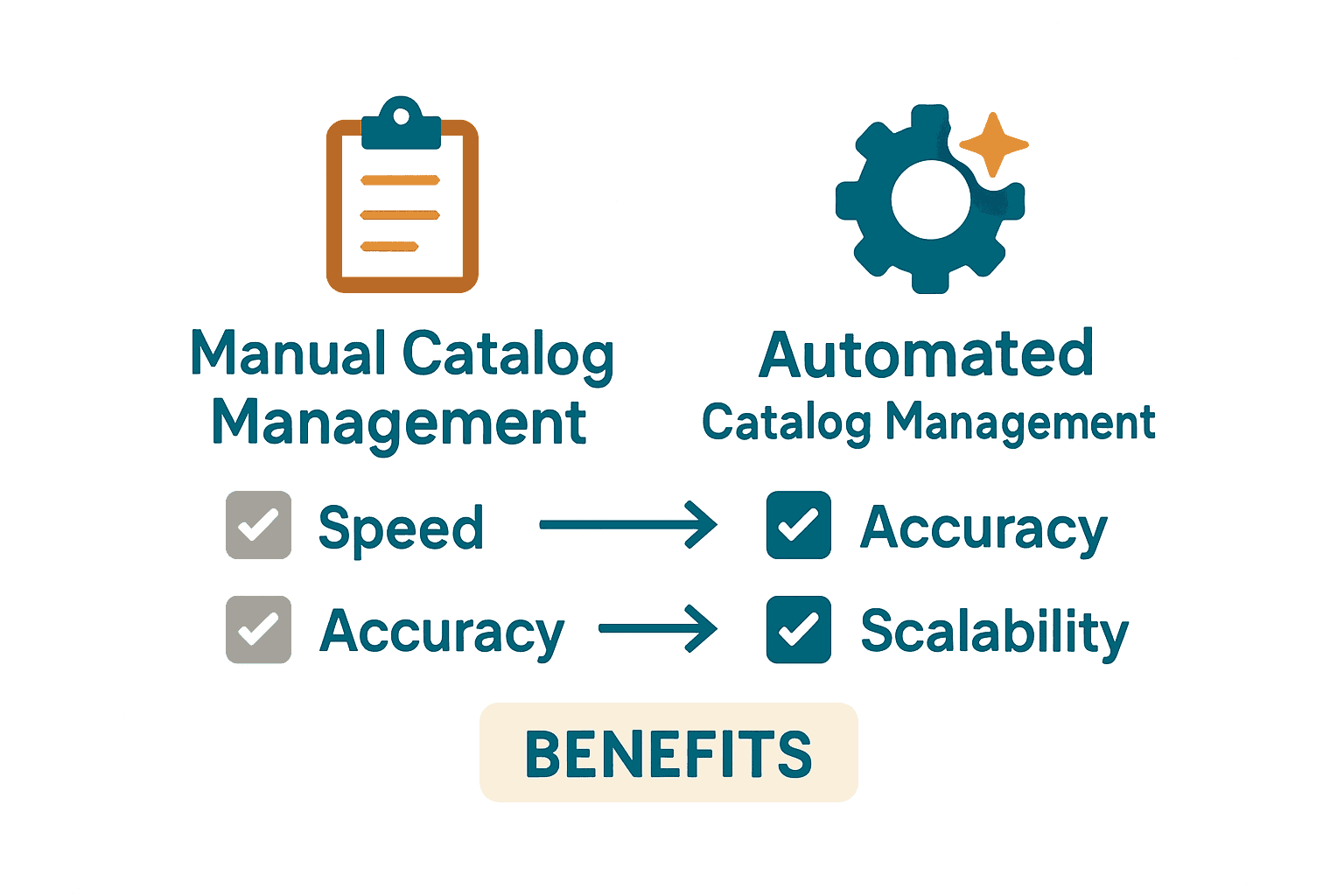
Automation and Catalog Management Tools
In the rapidly evolving world of ecommerce, catalog management tools have become essential for streamlining product information processes. Big Commerce emphasizes that these tools provide a single, centralized interface that allows businesses to add, update, and remove products from their online stores efficiently, ultimately saving time and dramatically reducing the risks associated with inventory mismanagement.
Cutting-edge technological advancements are transforming catalog management through intelligent automation. A fascinating research study from arXiv highlights a machine learning-driven visual content management system specifically designed for large ecommerce catalogs. This advanced system can aggregate images from multiple suppliers, intelligently analyze them, and dynamically arrange visual content to meet specific customer demands.
Key features of modern catalog management automation tools include:
- Bulk Product Updates: Simultaneous editing of multiple product entries
- Automated Image Processing: Intelligent image selection and optimization
- AI-Powered Categorization: Smart product classification algorithms
- Real-Time Inventory Synchronization: Instant stock level tracking across platforms
- Price and Promotion Management: Dynamic pricing rule implementations
When selecting a catalog management tool, businesses should prioritize solutions that offer seamless integration, robust automation capabilities, and scalability. Check out our guide on warehouse automation trends to understand how these technologies are reshaping ecommerce logistics and inventory management. The right tool can transform complex product data management from a challenging task into a streamlined, efficient process that supports business growth and enhances customer experience.
Integration With Logistics and Fulfillment
The seamless integration of catalog management with logistics and fulfillment represents a critical strategy for modern ecommerce operations. A groundbreaking research study from arXiv showcasing JD.com’s approach demonstrates how data-driven methodologies can revolutionize inventory allocation and product selection across distribution centers, ultimately enhancing overall fulfillment efficiency.
Cutting-edge technological innovations are transforming logistics integration.
 arXiv highlights an innovative approach using embedded technology and ant colony algorithms to optimize package distribution routes and dramatically improve delivery times. These advanced strategies enable businesses to create more responsive and intelligent logistics networks that can adapt quickly to changing market demands.
Key integration strategies for catalog management and logistics include:
- Real-Time Inventory Synchronization: Ensuring accurate stock levels across multiple platforms
- Automated Order Routing: Intelligently directing orders to nearest fulfillment centers
- Dynamic Pricing Adjustment: Incorporating shipping costs and inventory availability
- Implement centralized data management systems
- Develop API connections between catalog and logistics platforms
- Utilize predictive analytics for demand forecasting
For ecommerce businesses looking to streamline their operations, understanding ecommerce fulfillment solutions is crucial. By creating tight integration between product catalogs and logistics systems, companies can reduce operational costs, minimize errors, and provide faster, more reliable shipping experiences that directly impact customer satisfaction and retention.
Common Challenges and Mistakes to Avoid
Catalog management presents numerous complexities that can derail ecommerce success. Big Commerce highlights several critical challenges, including rapidly changing product catalogs, poor organizational strategies, and the continuous challenge of keeping pace with evolving customer preferences. These issues can quickly lead to data inaccuracies that ultimately result in lost sales opportunities.
Channel Engine emphasizes that many businesses stumble by failing to integrate their technology infrastructure effectively. Neglecting regular updates and maintenance of product listings, and not leveraging specialized catalog management software, can create significant operational bottlenecks that undermine overall business performance.
Most common catalog management mistakes include:
- Inconsistent Product Information: Mismatched details across different sales channels
- Outdated Inventory Tracking: Inaccurate stock level representations
- Poor Image Quality: Low-resolution or irrelevant product images
- Neglecting multi-channel synchronization
- Manual data entry without validation processes
- Ignoring customer feedback and product performance metrics
To prevent these pitfalls, businesses must adopt a proactive approach. understand how order fulfillment solutions work to create a comprehensive strategy that addresses catalog management challenges holistically. Implementing robust systems, automating updates, and maintaining data integrity are crucial steps in developing a resilient and competitive ecommerce catalog management approach.
Streamline Your Ecommerce Catalog and Logistics for Seamless Growth
Managing an ecommerce catalog can be overwhelming when juggling product data accuracy, inventory synchronization, and dynamic pricing. You want a smooth, reliable system that turns complex catalog management challenges into a competitive advantage. At ORNER, we understand these pain points and offer comprehensive logistics and supply chain solutions tailored specifically for ecommerce businesses looking to optimize their catalog alongside dependable fulfillment. From real-time inventory tracking to integrated order routing and reliable courier services, our platform helps you avoid common pitfalls like inconsistent product information and delayed shipments.
Take control today by linking your ecommerce catalog management with cutting-edge logistics through ORNER. Explore expert insights at our QA Archives – ORNER to learn practical tips and get started immediately. Don’t let catalog challenges slow your growth. Visit ORNER now for scalable, automated solutions that keep your products moving and your customers coming back.
Frequently Asked Questions
What is ecommerce catalog management?
Ecommerce catalog management is the strategic process of organizing, maintaining, and updating comprehensive product information across multiple digital sales channels to ensure accurate and engaging customer experiences.
What are the key components of successful catalog management?
The key components include product data accuracy, digital asset management, pricing strategy, inventory synchronization, and channel consistency, all of which work together to create an effective ecommerce catalog.
How can automation tools improve catalog management?
Automation tools enhance catalog management by providing features like bulk product updates, real-time inventory synchronization, and AI-powered categorization, which streamline processes and reduce errors in managing product information.
What common challenges should businesses avoid in catalog management?
Common challenges include inconsistent product information, outdated inventory tracking, and poor image quality. Businesses should focus on regular updates, multi-channel synchronization, and leveraging technology for data maintenance.
Recommended
- What is Ecommerce Logistics? Key Insights for 2025 – ORNER
- What Is Order Fulfillment? Complete Guide for Ecommerce – ORNER
- Ecommerce Marketing Strategies for Boosting Reliable Sales – ORNER
- Understanding Ecommerce Fulfillment Solutions for Success – ORNER
- Odoo eCommerce ERP. Functions of Odoo eCommerce