Over 33 percent of American online stores rely on dropshipping or fulfillment services to stay competitive. For American ecommerce entrepreneurs running small or medium-sized stores, choosing between these two models can make or break operational efficiency. Knowing exactly how dropshipping and fulfillment differ sets the foundation for smarter decisions about inventory, branding, and long-term profitability.
Table of Contents
- Fundamental Differences: Dropshipping Vs Fulfillment
- Inventory Ownership And Management Structures
- Operational Processes And Supplier Relationships
- Costs, Risks, And Legal Considerations
- Delivery Speed, Branding, And Customer Experience
- How To Choose The Best Model For Your Store
Key Takeaways
| Point | Details |
|---|---|
| Investment Considerations | Dropshipping requires minimal upfront costs, while fulfillment demands a significant initial investment for inventory management. |
| Control and Quality | Fulfillment provides greater control over product quality and shipping processes compared to dropshipping, which relies on third-party suppliers. |
| Customer Experience | Traditional fulfillment allows for consistent branding and faster shipping, enhancing overall customer satisfaction compared to the variable nature of dropshipping. |
| Suitable Business Types | New entrepreneurs with limited capital may prefer dropshipping, while established brands seeking quality control should opt for fulfillment. |
Fundamental Differences: Dropshipping vs Fulfillment
In the dynamic world of U.S. ecommerce, understanding the fundamental differences between dropshipping and fulfillment is crucial for entrepreneurs seeking scalable business models. Inventory management strategies fundamentally distinguish these two approaches, each offering unique advantages and challenges for online retailers.
Dropshipping represents a low-investment model where sellers transfer customer orders directly to manufacturers or wholesalers who then ship products. Unlike traditional fulfillment, dropshippers never physically handle inventory. This approach minimizes upfront costs and reduces operational complexity, allowing entrepreneurs to launch online stores with minimal capital investment. However, dropshipping comes with trade-offs: typically lower profit margins, less quality control, and reduced ability to customize packaging or shipping experiences.
Fulfillment, in contrast, provides complete inventory management and shipping control. Online retailers using fulfillment services purchase, store, and manage their own inventory, enabling faster shipping times, better product quality oversight, and more consistent customer experiences. While requiring higher initial investment and operational infrastructure, fulfillment allows for greater brand customization, faster order processing, and potentially higher profit margins through bulk purchasing strategies.
Pro Tip: Before selecting between dropshipping and fulfillment, conduct a detailed cost-benefit analysis specific to your product category and target market.
Here’s how dropshipping and fulfillment models contrast across key business dimensions:
| Business Area | Dropshipping Model | Fulfillment Model |
|---|---|---|
| Startup Investment | Minimal upfront costs | Significant initial outlay |
| Quality Control | Minimal ability to oversee | Direct, full control |
| Shipping Speed | Supplier dependent, often slower | Fast, predictable |
| Brand Customization | Very limited options | High; full branding control |
| Operational Complexity | Simple, fewer processes | Higher, requires logistics management |
| Typical Profit Margin | Usually lower | Can be higher with bulk strategies |
Inventory Ownership and Management Structures
Inventory ownership represents a critical strategic decision for U.S. ecommerce entrepreneurs, fundamentally shaping operational approaches and financial investments. Supply chain ownership structures significantly impact business performance, with different models presenting unique advantages and challenges.
In dropshipping models, retailers effectively eliminate direct inventory ownership, transferring inventory management responsibilities to suppliers or manufacturers. This approach minimizes upfront capital requirements, allowing entrepreneurs to launch online stores without substantial financial risk. However, the tradeoff involves reduced control over product quality, shipping timelines, and inventory availability. Dropshippers essentially become intermediaries, managing marketing and customer relationships while relying entirely on third-party suppliers for product fulfillment.
Traditional inventory ownership models, conversely, provide online retailers complete control over stock management. By purchasing, warehousing, and directly managing inventory, businesses can ensure product quality, implement custom packaging, and create more predictable shipping experiences. This model requires higher initial investments in warehouse space, inventory procurement, and management systems but offers greater flexibility and potentially higher profit margins through strategic bulk purchasing and inventory optimization.
Pro Tip: Conduct a comprehensive financial analysis comparing dropshipping and traditional inventory ownership, factoring in your specific product category, target market margins, and operational capabilities.
Operational Processes and Supplier Relationships
Navigating the complex landscape of ecommerce requires a strategic approach to supplier relationship management, especially when differentiating between dropshipping and traditional fulfillment models. The operational processes underlying these approaches fundamentally reshape how online retailers interact with their supply chain partners, manage inventory, and deliver customer experiences.
In dropshipping, operational processes are characterized by remote management and indirect supplier interactions. Retailers essentially function as intermediaries, relying entirely on suppliers to manage inventory, packaging, and shipping. This model demands exceptional communication and carefully constructed supplier relationships, as the dropshipper has minimal direct control over product quality, shipping timelines, and inventory accuracy. Success hinges on establishing robust vendor partnerships that can consistently meet customer expectations without direct operational oversight.
Traditional fulfillment models offer more integrated operational control, allowing retailers to design comprehensive supply chain strategies. By maintaining direct ownership of inventory and warehousing processes, businesses can implement detailed quality control measures, customize packaging, and create more predictable shipping experiences. These models require significant upfront investment in infrastructure and supplier relationship development but provide greater flexibility in managing product flow, responding to market changes, and maintaining consistent customer service standards.
Pro Tip: Develop a comprehensive supplier scorecard system that objectively evaluates vendor performance across key metrics like delivery speed, product quality, and communication responsiveness.
Costs, Risks, and Legal Considerations
U.S. ecommerce entrepreneurs must carefully navigate the complex financial and legal landscape when choosing between dropshipping and traditional fulfillment models. Legal risks associated with dropshipping present unique challenges that require strategic understanding and proactive management.
Dropshipping models introduce significant financial and legal vulnerabilities. The low upfront investment attracts entrepreneurs, but comes with substantial hidden costs. Retailers face potential risks including supplier unreliability, product quality inconsistencies, and complex legal compliance requirements. Without direct control over inventory, dropshippers become legally responsible for products they never physically handle. This means potential liability for defective products, intellectual property disputes, and consumer protection violations. Financial risks include unpredictable shipping costs, potential chargebacks, and slim profit margins that can quickly erode business sustainability.
Traditional fulfillment models demand higher initial investments but provide more comprehensive risk management. By maintaining direct inventory control, businesses can implement rigorous quality assurance processes, reducing legal exposure and building stronger consumer trust. These models allow for more predictable cost structures, including precise inventory valuation, shipping expenses, and potential returns management. Fulfillment approaches enable businesses to develop more robust compliance frameworks, with greater transparency in product sourcing, safety standards, and consumer protection protocols.
Pro Tip: Consult with a specialized ecommerce legal professional to develop a comprehensive risk mitigation strategy tailored to your specific business model and product categories.
Delivery Speed, Branding, and Customer Experience
In the competitive landscape of U.S. ecommerce, delivery performance directly impacts customer satisfaction and ultimately determines long-term business success. Both dropshipping and traditional fulfillment models face critical challenges in maintaining superior customer experiences through efficient shipping and consistent brand representation.
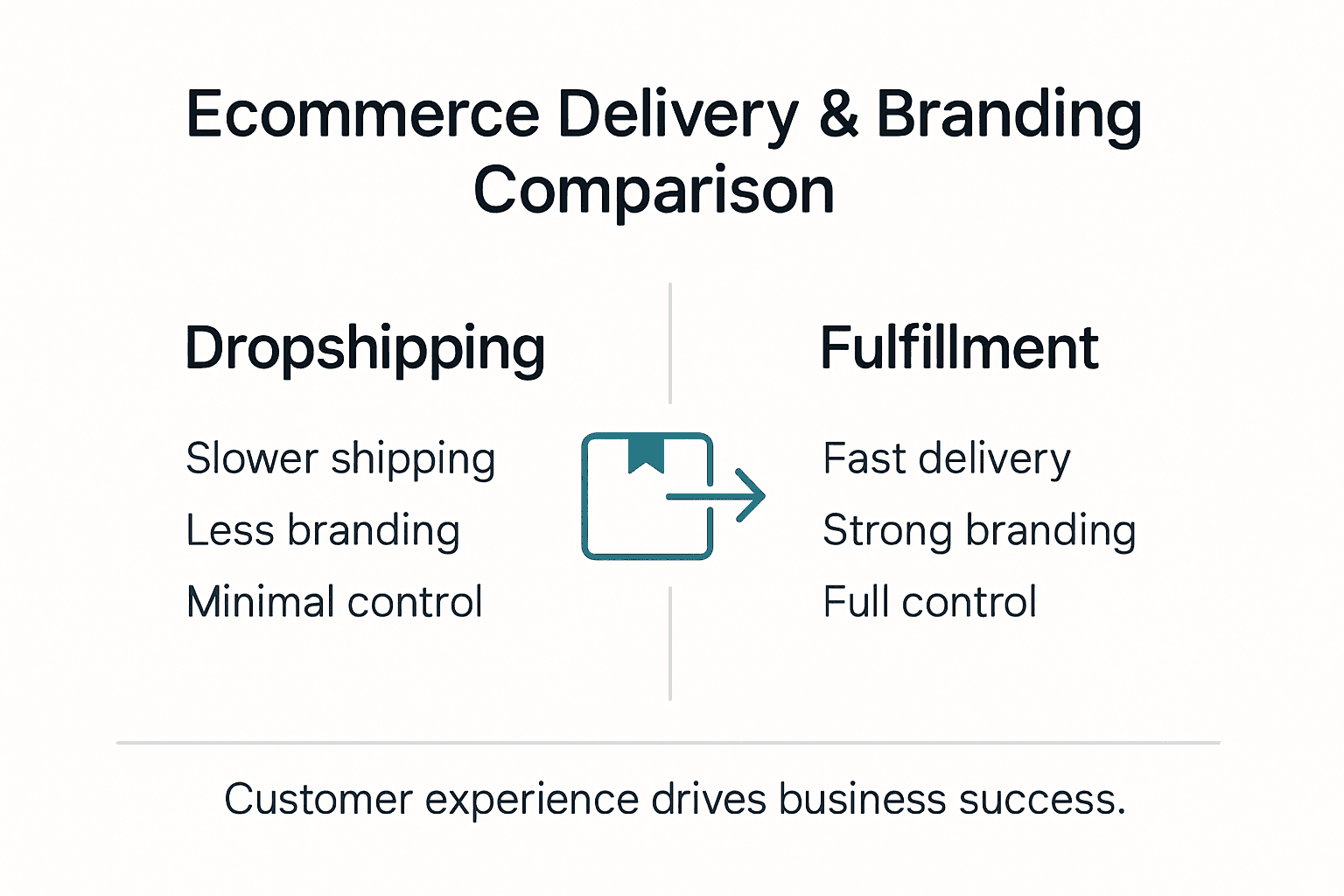
Dropshipping models inherently struggle with delivery speed and brand consistency. Without direct control over inventory and shipping processes, online retailers become dependent on supplier performance. This model introduces significant variability in shipping times, packaging quality, and overall customer experience. Customers might receive products from different suppliers with varying packaging standards, potentially diluting brand identity and creating unpredictable delivery experiences. The lack of centralized quality control means dropshippers must carefully vet and continuously monitor supplier performance to maintain acceptable service levels.
Traditional fulfillment approaches offer superior control over delivery speed and branding elements. By managing inventory in-house or through dedicated fulfillment centers, businesses can implement standardized packaging, consistent shipping protocols, and more predictable delivery timelines. This model enables entrepreneurs to create cohesive brand experiences, from custom packaging to precise shipping tracking, which directly influences customer perception and loyalty. Advanced fulfillment strategies allow for personalized touches like branded insert cards, carefully selected packaging materials, and streamlined return processes that transform shipping from a logistical necessity into a strategic brand touchpoint.
Pro Tip: Invest in professional packaging design and develop a consistent unboxing experience that reinforces your brand’s unique personality and values.
How to Choose the Best Model for Your Store
Strategic selection of logistics models requires a comprehensive understanding of your unique business requirements, financial capabilities, and long-term growth objectives. U.S. ecommerce entrepreneurs must critically evaluate their operational constraints and market positioning before committing to either dropshipping or traditional fulfillment strategies.
Dropshipping presents an attractive option for entrepreneurs with limited capital and those seeking to minimize initial inventory investments. This model is particularly suitable for businesses testing new product categories, targeting niche markets, or operating with extremely tight startup budgets. However, dropshipping demands exceptional supplier relationship management and a high tolerance for reduced profit margins. Ideal candidates for dropshipping include digital entrepreneurs, those with limited storage capabilities, and businesses exploring product market fit without significant upfront financial risk.
Traditional fulfillment models offer superior advantages for established businesses or those with clear, stable product lines. Companies with predictable sales volumes, specialized product requirements, or a strong emphasis on brand experience will find fulfillment more aligned with their strategic goals. This approach provides greater control over product quality, shipping consistency, and customer experience. Businesses with substantial capital, established product catalogs, and a commitment to creating premium brand interactions should strongly consider investing in their own fulfillment infrastructure or partnering with dedicated fulfillment centers.
Pro Tip: Create a detailed decision matrix comparing potential dropshipping and fulfillment models, scoring each option against your specific business metrics like profit margin, scalability, and brand control.
Use this quick reference to choose the best model based on your business needs:
| Business Type | Recommended Model | Key Reason to Choose |
|---|---|---|
| New entrepreneur, limited capital | Dropshipping | Low risk; minimal investment |
| Established brand, high sales volume | Fulfillment | Greater control; supports scaling |
| Testing new product markets | Dropshipping | Flexibility; no inventory risk |
| Emphasis on premium brand experience | Fulfillment | Custom packaging and consistency |
Optimize Your Ecommerce Logistics With Reliable Courier Services
Choosing between dropshipping and fulfillment impacts every aspect of your online store from inventory control to delivery speed and brand experience. If you are struggling with limited control over shipping times or looking to enhance your customer experience with streamlined inventory management and fast delivery, the solution lies in a trusted logistics partner that understands your unique challenges.
Unlock the full potential of your ecommerce business by partnering with Reliable Courier Services designed specifically for sellers who demand efficiency and scalability. Whether you want to reduce operational complexity, gain real-time shipment tracking, or scale your warehousing capabilities, or-ner.com offers end-to-end logistics solutions tailored to support your growth. Take control of your supply chain today and turn shipping from a risk into a competitive advantage. Visit https://or-ner.com to explore how our platform can transform your ecommerce fulfillment experience.
Frequently Asked Questions
What is the key difference between dropshipping and fulfillment in ecommerce?
Dropshipping involves selling products without holding any inventory, as orders are sent directly to suppliers who ship to customers. Fulfillment requires retailers to purchase and manage their own inventory, allowing greater control over shipping and product quality.
What are the benefits of using the dropshipping model for my online store?
Dropshipping offers minimal upfront investment and reduced operational complexity, making it ideal for entrepreneurs with limited capital. It allows for quick testing of new products and markets without the risk of holding inventory.
What challenges do dropshipping businesses face compared to fulfillment models?
Dropshipping typically experiences lower profit margins, less control over product quality, and slower shipping times, as retailers rely on suppliers. In contrast, fulfillment provides direct control over shipping processes and product management, ensuring faster and more consistent delivery to customers.
How can I choose between dropshipping and fulfillment for my ecommerce business?
Consider your startup budget, the importance of brand control, and your operational capabilities. Dropshipping is suited for low-risk startups or market testing, while fulfillment is ideal for established brands requiring consistent quality and faster shipping.
Recommended
- What Is Same Day Delivery? 2025 Guide for Online Retailers – ORNER
- What Is Freight Forwarding? Guide for Modern Supply Chains 2025 – ORNER
- Top Benefits of Freight Forwarding for Growing Businesses 2025 – ORNER
- Complete Guide to Outsourcing Order Fulfillment – ORNER
- Dropshipping: Die Einfache Art des Online-Handels – nova.02:media