Most American ecommerce entrepreneurs underestimate how dramatically courier choice can impact drop shipping success. With over 40 percent of packages experiencing delays or mishandling in cross-border transactions, fulfillment efficiency becomes a defining factor for new online retailers. By understanding the essentials of drop shipping and carefully selecting reliable courier services, new sellers can build customer trust, maintain fast delivery standards, and gain a real edge in the competitive world of American online commerce.
Table of Contents
- Defining Drop Shipping in Ecommerce
- How the Drop Shipping Process Works
- Types of Drop Shipping Models Used Today
- Reliable Courier Services for Fulfillment
- Costs, Risks, and Common Pitfalls
Key Takeaways
| Point | Details |
|---|---|
| Drop Shipping Model Benefits | Drop shipping enables sellers to operate without maintaining inventory, reducing upfront costs and risk. This model allows for a diverse product range without extensive logistics. |
| Challenges in Quality Control | Limited control over product quality and shipping timelines can affect customer satisfaction. Sellers must vet suppliers meticulously to mitigate these risks. |
| Importance of Reliable Couriers | Choosing effective courier services is crucial for ensuring timely delivery and customer satisfaction. Detailed performance evaluations of courier partners can enhance service quality. |
| Financial and Operational Risks | Entrepreneurs should be aware of thin profit margins and operational challenges such as supplier reliability. Implementing backup plans can help maintain stability in the business. |
Defining Drop Shipping in Ecommerce
Drop shipping represents a revolutionary retail fulfillment strategy where online sellers completely bypass traditional inventory management. In this model, sellers partner with manufacturers or wholesalers who directly ship products to customers, eliminating the need for sellers to stock or physically handle merchandise. Cross-border e-commerce transactions have made this approach increasingly attractive for entrepreneurs seeking minimal upfront investment.
The fundamental mechanism of drop shipping involves a seamless transaction sequence. When a customer places an order through an online store, the seller forwards the order details to a third-party supplier, who then packages and ships the product directly to the end consumer. This approach dramatically reduces operational complexity and capital requirements, allowing entrepreneurs to launch online businesses with minimal financial risk. Unlike traditional retail models, drop shipping enables sellers to offer a wide product range without maintaining physical inventory.
However, the drop shipping model is not without challenges. Product quality control becomes more difficult since sellers never physically handle merchandise. Shipping times can be unpredictable, particularly when working with international suppliers, which may impact customer satisfaction. Sellers must carefully vet suppliers, establish clear communication protocols, and potentially maintain backup supplier relationships to mitigate potential disruptions.
Pro tip: Before committing to a drop shipping business, conduct thorough research on potential suppliers and request product samples to validate quality and shipping reliability.
How the Drop Shipping Process Works
The drop shipping process unfolds through a precise, interconnected sequence that transforms online customer orders into delivered products. At its core, the workflow begins when a customer selects and purchases an item from an online storefront. Export documentation and logistics play a critical role in ensuring this transaction moves smoothly from initial sale to final delivery.

Once an order is placed, the seller immediately forwards the customer’s shipping details and purchase information to the designated drop shipping partner. This third-party supplier—typically a manufacturer or wholesaler—then takes responsibility for packaging and shipping the product directly to the end consumer. The seller never physically handles the merchandise, instead acting as an intermediary who manages customer interactions, marketing, and order processing while the supplier handles inventory and shipping logistics.
Technological integrations are crucial in streamlining the drop shipping workflow. Modern e-commerce platforms enable real-time order transmission, automatic inventory tracking, and seamless communication between sellers and suppliers. Inventory management systems help sellers monitor product availability, prevent overselling, and maintain accurate stock information without maintaining physical warehouses. These technological solutions reduce operational complexity and enable entrepreneurs to manage global product offerings with minimal infrastructure investment.
Pro tip: Invest in robust order management software that provides real-time synchronization between your online store and supplier systems to minimize shipping delays and order processing errors.
Types of Drop Shipping Models Used Today
Drop shipping encompasses several nuanced models, each offering unique approaches to inventory management and product distribution. E-commerce fulfillment frameworks reveal a complex landscape of strategies that enable online sellers to optimize their operational efficiency without maintaining extensive physical inventories.
The primary drop shipping models include blind drop shipping, where suppliers ship products directly to customers without revealing their identity, and private label drop shipping, which allows sellers to brand products as their own. Some entrepreneurs utilize multi-supplier drop shipping strategies, partnering with multiple manufacturers to diversify product offerings and mitigate supply chain risks. This approach enables sellers to provide a broader product range while maintaining flexibility in sourcing and inventory management.
Additionally, specialized drop shipping models have emerged to address specific market needs. Niche-focused models like print-on-demand for custom merchandise, digital product drop shipping for downloadable content, and specialized inventory drop shipping for complex or high-value products demonstrate the remarkable adaptability of this business approach. These models allow entrepreneurs to enter markets with minimal upfront investment, targeting specific consumer segments with tailored product offerings.
Pro tip: Research and test multiple drop shipping models to identify the most suitable approach for your specific product category and target market.
Here’s a comparison of the main drop shipping models and their business impact:
| Model Type | Branding Control | Supplier Transparency | Ideal For |
|---|---|---|---|
| Blind Drop Shipping | Low—no seller branding | Supplier stays hidden | Low-cost general merchandise |
| Private Label | High—seller branding | Supplier identity hidden | Niche products, brand building |
| Multi-Supplier | Variable, per supplier | Depends on agreements | Broad product ranges, risk spread |
| Print-on-Demand | High—custom branding | Production partner hidden | Custom or artistic products |
| Digital Product | Seller branding varies | No physical shipment | Downloadables, e-books, software |
Reliable Courier Services for Fulfillment
Successful drop shipping hinges on selecting reliable courier services that can consistently deliver products efficiently and professionally. Package delivery networks represent the critical infrastructure that transforms online transactions into physical product exchanges, bridging the gap between sellers and customers across diverse geographic regions.
The most effective courier services for drop shipping offer several key characteristics. These include comprehensive tracking systems, competitive shipping rates, extensive global coverage, and flexible delivery options. Integrated logistics platforms enable sellers to streamline shipping processes, providing real-time shipment updates and allowing entrepreneurs to monitor package movements from initial dispatch to final customer delivery. Sophisticated courier services now incorporate advanced technologies like automated routing, predictive delivery estimates, and seamless international customs clearance.
Drop shipping entrepreneurs must carefully evaluate potential courier partners based on multiple performance metrics. Critical considerations include average delivery times, shipping costs, reliability ratings, geographical coverage, and specialization in e-commerce fulfillment. Some couriers offer dedicated services for online retailers, including specialized packaging, consolidated shipping options, and integrated return management systems. These value-added services can significantly enhance the overall customer experience and reduce operational complexities for drop shipping businesses.
Pro tip: Compare multiple courier services using detailed performance metrics and request trial shipments to thoroughly assess their reliability and service quality before making a long-term commitment.
Costs, Risks, and Common Pitfalls
Drop shipping presents an attractive business model, but entrepreneurs must navigate a complex landscape of potential challenges. Supply chain disruptions can dramatically impact operational effectiveness, introducing significant financial and reputational risks that require careful strategic management.
The primary financial risks include razor-thin profit margins and unpredictable expenses. Inventory acquisition costs remain low, but sellers often encounter hidden expenses such as marketing, platform fees, and customer service support. Pricing becomes particularly challenging, as drop shippers must balance competitive pricing with maintaining sufficient profit margins. International suppliers can introduce additional complexity through currency fluctuations, import duties, and potential quality control issues that directly impact overall business profitability.
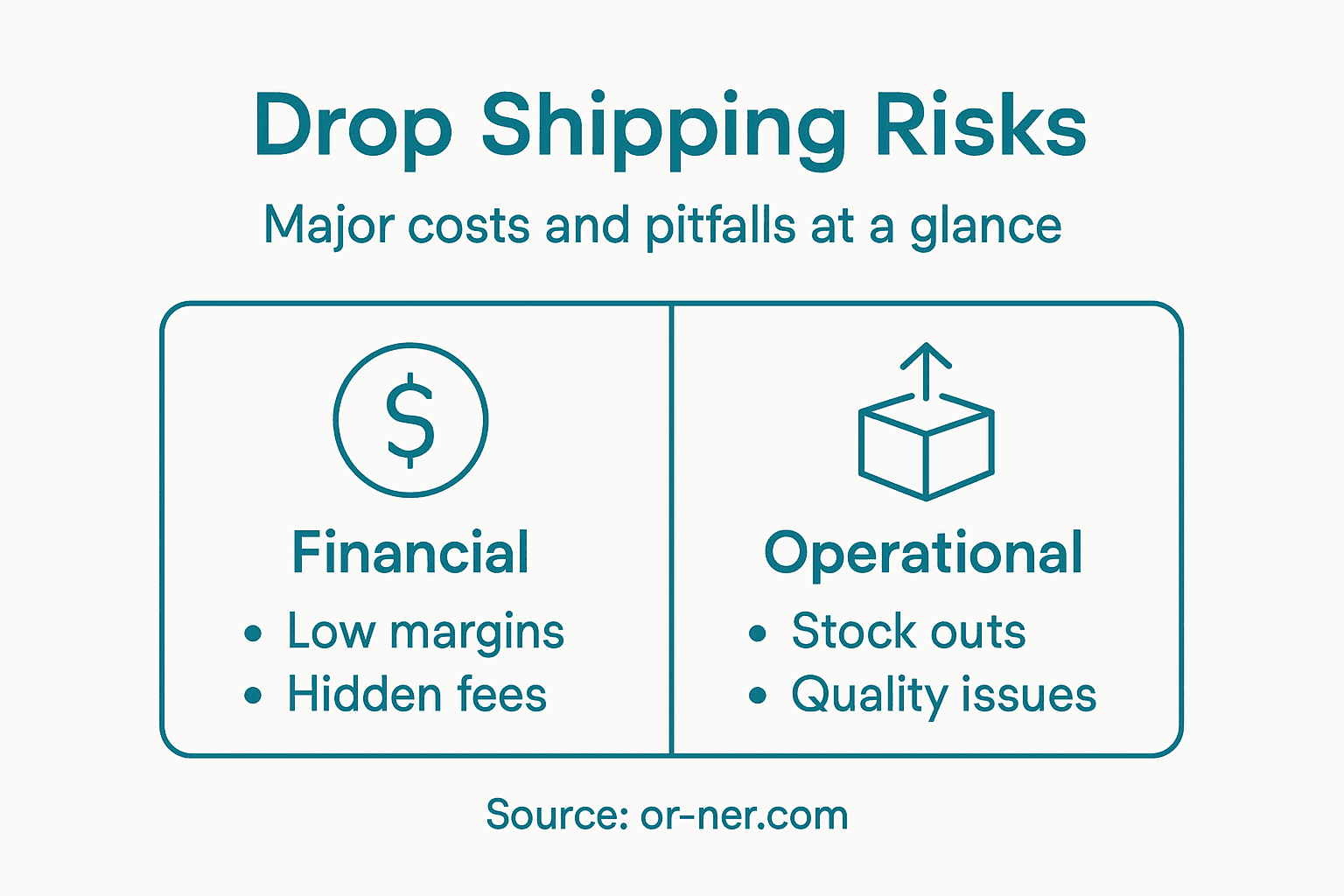
Operational risks represent another critical concern for drop shipping entrepreneurs. Limited control over product quality, shipping times, and inventory management can lead to significant customer dissatisfaction. Suppliers might unexpectedly discontinue products, experience stockouts, or ship incorrect or damaged merchandise. These scenarios can quickly erode customer trust and potentially result in negative reviews, refund requests, and long-term reputational damage. Successful drop shippers must develop robust contingency plans, maintain multiple supplier relationships, and implement stringent quality verification processes to mitigate these inherent operational vulnerabilities.
The following table summarizes common costs and risks in drop shipping:
| Category | Key Challenge | Business Impact |
|---|---|---|
| Financial | Thin profit margins | Lower net income, high competition |
| Operational | Limited product control | Risk of poor quality, bad reviews |
| Supply Chain | Supplier stockouts or delays | Lost sales, customer complaints |
| Logistics | Unpredictable shipping costs/times | Harder to ensure on-time delivery |
| Reputational | Negative customer feedback | Damaged brand, reduced repeat sales |
Pro tip: Develop comprehensive supplier evaluation protocols and maintain backup suppliers to quickly address potential inventory or quality issues before they impact customer experience.
Empower Your Drop Shipping Success with Reliable Courier Services
Drop shipping offers entrepreneurs a flexible way to launch ecommerce businesses without holding inventory but brings challenges like unpredictable shipping times and quality control. At or-ner.com, we understand these challenges and provide end-to-end logistics solutions designed to eliminate uncertainty. Our platform offers reliable courier services combined with real-time shipment tracking, customs clearance, and inventory management to help you gain full visibility and control over your fulfillment process. Leveraging a global network of warehouses and fulfillment centers, we support cross-border logistics and fast, scalable deliveries that keep your customers satisfied and your business thriving.
Take control of your drop shipping operations now by partnering with the logistics experts at or-ner.com. Explore our comprehensive freight booking, real-time shipment tracking, and robust inventory management tools that streamline your workflows and reduce costly delays. Don’t let unreliable shipping hold your ecommerce growth back. Visit or-ner.com and transform your fulfillment into a competitive advantage today.
Frequently Asked Questions
What is drop shipping in ecommerce?
Drop shipping is a retail fulfillment strategy where online sellers partner with manufacturers or wholesalers to ship products directly to customers, bypassing the need to hold inventory themselves.
How does the drop shipping process work?
The drop shipping process begins when a customer places an order on an online store. The seller then forwards the order details to a third-party supplier, who handles packaging and shipping directly to the customer without the seller ever physically handling the product.
What are the potential risks associated with drop shipping?
Potential risks include thin profit margins, limited control over product quality and shipping times, supplier stockouts, and reputational risks from negative customer feedback due to poor fulfillment experiences.
What types of drop shipping models exist?
Common drop shipping models include blind drop shipping, private label drop shipping, multi-supplier drop shipping, print-on-demand, and digital product drop shipping, each offering different levels of branding control and operational flexibility.