
Over half of American apparel brands now rely on outsourced logistics partners to keep their supply chains moving smoothly. With rising customer expectations for speed and accuracy, the choice between Third Party Logistics and Fourth Party Logistics shapes everything from delivery times to cost control. This guide highlights the most important differences between these models so you can strengthen efficiency and fulfillment for your American ecommerce business.
Table of Contents
- Defining 3PL and 4PL in U.S. Logistics
- Key Differences Between 3PL and 4PL Services
- Roles and Responsibilities in Apparel Fulfillment
- Cost Implications and Risk Management Factors
- Choosing the Best Model for Ecommerce Brands
Key Takeaways
| Point | Details |
|---|---|
| Understanding 3PL and 4PL | 3PL focuses on specific logistics tasks, while 4PL manages the entire supply chain ecosystem. |
| Selecting the Right Model | Consider your brand’s complexity and growth potential when choosing between 3PL and 4PL services. |
| Cost and Risk Management | Weigh the transparent pricing of 3PL against the potential cost efficiencies of a centralized 4PL model. |
| Technological Integration | Evaluate the technology capabilities of logistics providers to ensure they align with your operational needs and objectives. |
Defining 3PL and 4PL in U.S. Logistics
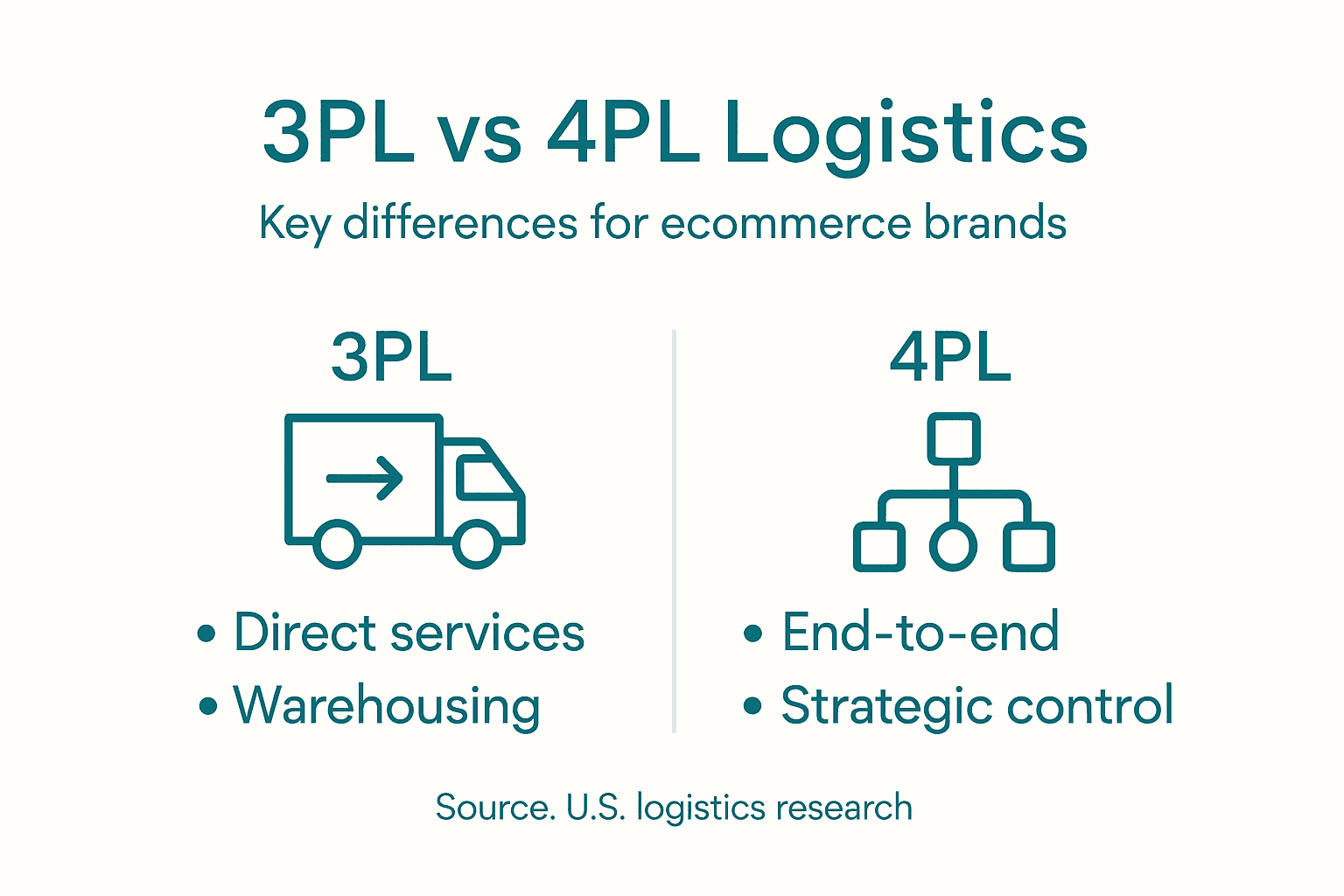
Logistics outsourcing has transformed how apparel brands manage supply chain operations, with Third Party Logistics (3PL) and Fourth Party Logistics (4PL) representing two strategic approaches to managing transportation and warehousing functions. U.S. logistics research indicates these models offer distinct capabilities for businesses seeking efficient supply chain management.
A 3PL provider handles specific logistics functions like transportation, warehousing, and distribution on behalf of a company. These providers directly interact with manufacturers and suppliers, executing tactical logistics tasks such as inventory management, order fulfillment, and shipping. They operate as specialized service providers that take responsibility for discrete segments of the supply chain, allowing businesses to focus on core competencies.
In contrast, a 4PL provider represents a more comprehensive logistics solution that manages the entire supply chain ecosystem. Detailed naval logistics research reveals that 4PL providers act as strategic coordinators, overseeing multiple logistics providers and making high-level strategic decisions. They integrate complex supply chain activities, offering a single interface that coordinates procurement, transportation, warehousing, and technology systems across different service providers.
Pro tip: When selecting between 3PL and 4PL models, carefully assess your apparel brand’s complexity, growth trajectory, and need for strategic supply chain management.
Here’s a concise comparison of 3PL versus 4PL providers in U.S. apparel logistics:
| Aspect | 3PL (Third Party Logistics) | 4PL (Fourth Party Logistics) |
|---|---|---|
| Scope of Services | Focuses on select logistics functions | Oversees entire supply chain ecosystem |
| Strategic Role | Executes tactical daily operations | Implements high-level strategic management |
| Provider Coordination | Manages its own operations | Coordinates multiple logistics partners |
| Technology Use | Implements operational systems | Integrates advanced analytics and tech |
| Ideal Use Case | Brands needing service flexibility | Brands seeking holistic supply chain leadership |
Key Differences Between 3PL and 4PL Services
Understanding the nuanced differences between Third Party Logistics (3PL) and Fourth Party Logistics (4PL) is crucial for apparel brands seeking to optimize their supply chain strategies. Strategic logistics research highlights the fundamental distinctions in their operational approaches and strategic capabilities.
At the operational level, 3PL providers focus on executing specific logistics functions like transportation, warehousing, and distribution. These service providers handle tactical tasks such as inventory management, order processing, and shipping. Their role is primarily transactional, managing discrete segments of the supply chain with specialized expertise in physical logistics operations. Businesses typically engage 3PL providers to outsource specific logistics activities, reducing operational complexity and leveraging external logistics expertise.

Naval logistics research reveals that 4PL providers represent a more comprehensive and strategic approach to supply chain management. Unlike 3PL providers, 4PL entities act as comprehensive logistics integrators, managing the entire supply chain ecosystem. They coordinate multiple logistics providers, implement advanced technology solutions, and develop strategic logistics frameworks that align with broader corporate objectives. 4PL providers offer end-to-end supply chain oversight, utilizing data analytics, technology integration, and strategic planning to optimize logistics performance across all operational dimensions.
Pro tip: Assess your organization’s logistics complexity and strategic goals to determine whether a 3PL or 4PL model best suits your supply chain requirements.
Roles and Responsibilities in Apparel Fulfillment
Third Party Logistics providers play a critical role in managing the complex logistics landscape for apparel brands, handling everything from inventory management to final product delivery. Their responsibilities extend far beyond simple transportation, encompassing a comprehensive suite of services designed to streamline the entire fulfillment process for online and retail clothing businesses.
In the apparel industry, 3PL providers typically manage several key operational functions. These include warehouse management, where they handle receiving, storing, and organizing clothing inventory with precision. Transportation logistics represent another crucial responsibility, involving the strategic movement of garments from manufacturers to distribution centers and ultimately to end consumers. Additionally, 3PL providers manage critical processes like order picking, packaging, and returns processing, ensuring that each clothing item is handled with care and efficiency.
Annual 3PL industry research highlights the evolving nature of logistics responsibilities in the apparel sector. Modern 3PL providers are increasingly integrating advanced technologies to enhance inventory visibility, implement real-time tracking systems, and provide data-driven insights that help apparel brands optimize their supply chain performance. This technological integration allows for more accurate demand forecasting, reduced shipping times, and improved overall customer satisfaction.
Pro tip: Evaluate potential 3PL partners based on their technological capabilities, industry-specific experience, and ability to scale with your apparel brand’s growth.
Cost Implications and Risk Management Factors
Strategic logistics research reveals that selecting between 3PL and 4PL models involves complex cost considerations and risk management strategies for apparel businesses. The financial implications extend beyond simple pricing structures, encompassing long-term operational efficiency, technological investments, and potential supply chain vulnerabilities.
With 3PL providers, cost structures tend to be more transparent and predictable. Businesses typically pay for specific services like warehousing, transportation, and order fulfillment on a transactional or volume-based model. This approach allows for more granular cost control, enabling apparel brands to scale logistics expenses directly in proportion to their business growth. However, managing multiple 3PL providers can introduce coordination challenges and potential inefficiencies that may incrementally increase overall logistics expenditures.
Comprehensive logistics outsourcing analysis demonstrates that 4PL models can deliver sophisticated cost optimization through centralized management and advanced technology integration. By consolidating logistics oversight under a single strategic partner, businesses can potentially reduce redundant expenses, minimize inventory carrying costs, and implement more sophisticated risk mitigation strategies. The trade-off involves higher upfront investment and greater dependency on a single logistics integrator, which requires careful vendor selection and continuous performance monitoring.
Pro tip: Conduct a comprehensive total cost of ownership analysis that considers both direct logistics expenses and potential strategic advantages when comparing 3PL and 4PL models.
Choosing the Best Model for Ecommerce Brands
Ecommerce logistics research reveals that selecting the ideal logistics model depends on multiple strategic factors specific to each online business. Understanding the nuanced differences between 3PL and 4PL models can help apparel brands make informed decisions that align with their operational complexity, growth trajectory, and strategic objectives.
For smaller ecommerce brands with straightforward logistics requirements, a 3PL model typically offers the most cost-effective and flexible solution. These providers excel at handling discrete logistics functions such as warehousing, order processing, and shipping. They allow businesses to leverage specialized expertise without significant infrastructure investments. Brands experiencing moderate growth can benefit from 3PL’s transactional approach, which provides granular control over specific logistics activities and enables scalable, pay-as-you-go service models.
Logistics outsourcing analysis indicates that rapidly expanding ecommerce brands with complex supply chain needs should consider transitioning to a 4PL model. These comprehensive logistics integrators offer end-to-end supply chain management, advanced technological capabilities, and strategic oversight that go beyond traditional logistics execution. 4PL providers can help brands optimize entire logistics ecosystems, implement sophisticated tracking systems, and develop more agile, responsive supply chain strategies that support accelerated growth and market adaptation.
Pro tip: Conduct a thorough assessment of your current and projected logistics complexity before selecting between 3PL and 4PL models, considering factors like order volume, geographic expansion, and technological integration requirements.
To help apparel brands decide, here’s a summary of key factors influencing the choice between 3PL and 4PL:
| Decision Factor | Better Suited for 3PL | Better Suited for 4PL |
|---|---|---|
| Business Size | Small to midsize brands | Rapidly growing, large brands |
| Supply Chain Complexity | Straightforward, less integration | High complexity, multi-channel |
| Technology Requirements | Basic integrations | Advanced, centralized systems |
| Desire for Control | Direct, operational control | Strategic, delegated oversight |
| Scalability Needs | Gradual, volume-based growth | Rapid, cross-network expansion |
Choose the Right Logistics Partner for Your Apparel Brand’s Growth
Navigating the choice between 3PL and 4PL logistics can be challenging for ecommerce apparel brands facing increasing supply chain complexity and growth demands. Whether you need a tactical partner that handles warehousing and shipping or a strategic integrator managing your entire logistics ecosystem, finding reliable courier services and seamless fulfillment is crucial to avoid costly inefficiencies and supply chain risks. At Or-Ner, we understand these pain points and offer scalable, technology-driven logistics solutions tailored for ecommerce sellers, wholesalers, and global brands, empowering you to optimize inventory management, cross-border shipping, and real-time order tracking with ease.
Don’t let logistics hurdles slow your business growth. Discover how our end-to-end platform combines flexible 3PL capabilities with strategic oversight to support your evolving needs. Take control of your supply chain with Or-Ner’s comprehensive solutions designed for apparel fulfillment and beyond. Start your journey toward faster delivery, transparent communication, and scalable logistics today.
Frequently Asked Questions
What is the main difference between 3PL and 4PL logistics?
3PL focuses on managing specific logistics functions like transportation and warehousing, while 4PL oversees the entire supply chain ecosystem and coordinates multiple logistics providers.
When should an apparel brand consider moving from a 3PL to a 4PL model?
Brands experiencing rapid growth and facing complex supply chain needs should consider transitioning to a 4PL model for end-to-end management and strategic oversight.
What factors should be considered when choosing between 3PL and 4PL models?
Consider business size, supply chain complexity, technology requirements, desire for control, and scalability needs when selecting between 3PL and 4PL models.
How do cost structures differ between 3PL and 4PL services?
3PL services typically have transparent, transaction-based costs, while 4PL services may offer more sophisticated cost optimization through centralized management but may require higher upfront investments.