Shipping a package from your store to a customer halfway across the world can seem simple until you try it. Behind every order there are countless moving parts from comparing rates across carriers to juggling customs forms and keeping customers updated every step of the way. Some solutions promise deep discounts, others offer smart tracking and some even handle fulfillment from start to finish. Discovering which platform fits best for growing a business is a puzzle worth exploring.
Table of Contents
orner
At a Glance
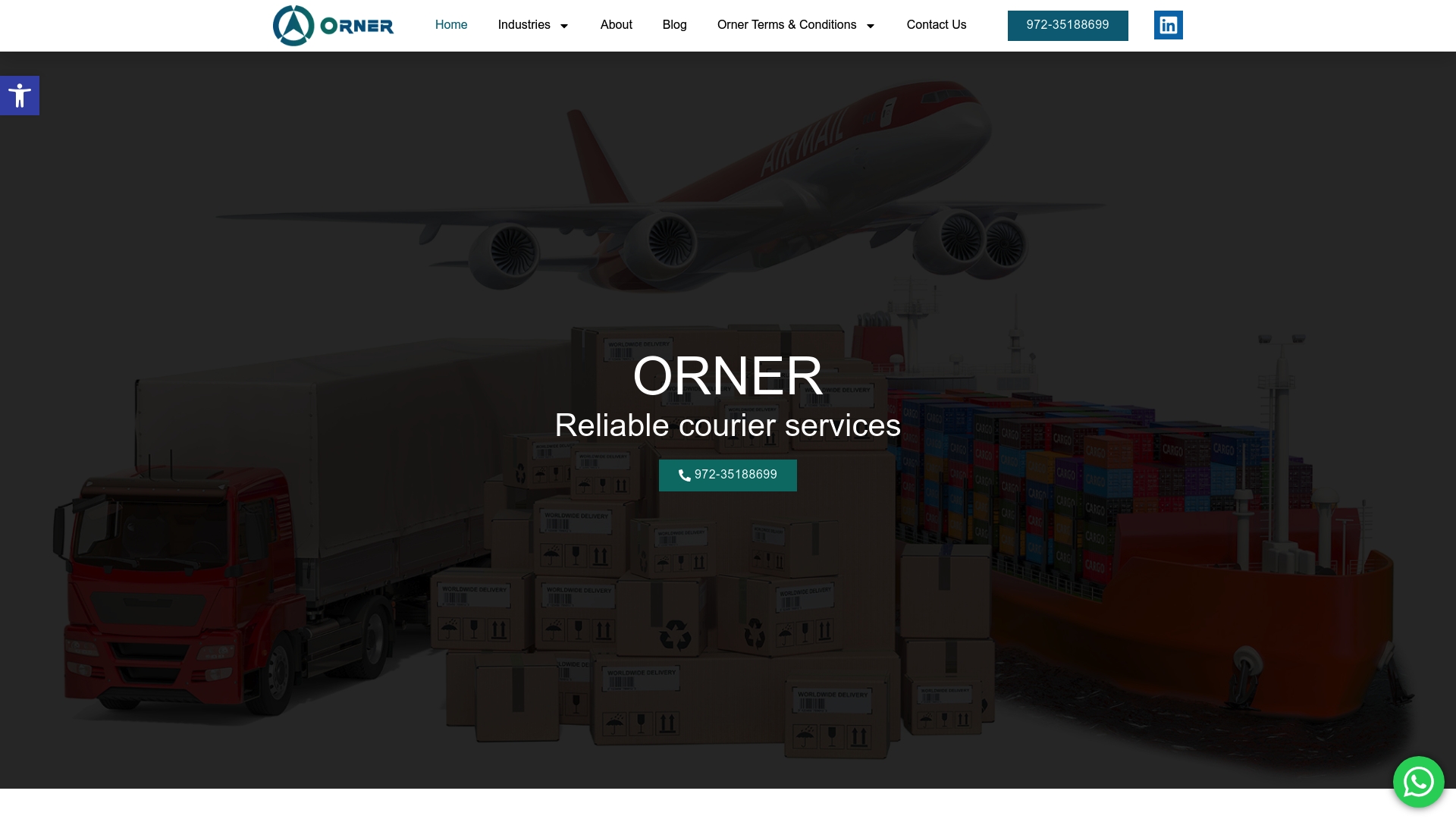
orner is a comprehensive platform for ecommerce sellers, providing end-to-end courier and logistics solutions including booking, tracking, and delivery of freight shipments worldwide. The platform emphasizes reliable courier services and supply chain visibility, making it a strong choice for sellers who need a single partner for freight booking, customs handling, and fulfillment. Pricing and detailed tiering are not published, which appears to reflect a deliberate focus on customized solutions for businesses rather than off-the-shelf plans.
Core Features
orner delivers end-to-end logistics solutions from factory to customer door, combining order management, booking, and tracking across ocean, air, and land transportation modes. You get real-time tracking and communication, supply chain management and visibility, customs handling, cargo insurance, and working capital support. The integrated platform supports automation and workflow customization and connects fulfillment operations with a global network of warehouses and fulfillment centers, while enabling data-driven decision making and exception management through its user interface.
Pros
- Comprehensive logistics coverage: orner consolidates freight booking, customs clearance, warehousing, and last-mile delivery into a single workflow so you can reduce platform fragmentation.
- Global fulfillment footprint: The platform promotes a network of warehouses and fulfillment centers in strategic locations, enabling faster delivery and local inventory management.
- Real-time data and communication: Built-in tracking and live communication give visibility across ocean, air, and land modes, which helps you react quickly to exceptions and customer inquiries.
- Automation and workflow customization: Support for automated processes and tailored workflows reduces manual effort and scales with order volume.
- Industry-specific support: orner provides dedicated assistance for ecommerce brands, wholesalers, and manufacturers, including catalog management and wholesale expansion support.
Who It’s For
orner is aimed at ecommerce sellers, retailers, manufacturers, and wholesalers that need an integrated, global logistics partner. If your business requires cross-border shipments, customs and compliance support, or multi-country inventory management, orner is designed to consolidate those needs under one platform. It suits teams that value visibility, automation, and close operational support rather than managing multiple disconnected vendors.
Unique Value Proposition
orner’s unique strength is its all-in-one approach: it brings freight booking, customs handling, cargo insurance, working capital support, and multi-modal tracking into a unified interface focused on reliable courier services and fulfillment. The platform’s UI is built for decision-making, offering analytics, exception management, and real-time communication—features that remove guesswork from cross-border logistics. For businesses scaling internationally, orner emphasizes fast, scalable, and flexible logistics through its global warehouses and fulfillment centers, positioning itself as an alternative to piecemeal solutions by reducing handoffs and manual reconciliation. This design choice prioritizes tailored enterprise workflows and direct operational support over standardized public pricing.
Real World Use Case
An online retailer uses orner to manage inventory across multiple countries, automate order fulfillment, track shipments in real time, and handle customs documentation seamlessly, enabling faster delivery to customers and improved supply chain efficiency.
Pricing
Not specified; orner appears to offer customized pricing and solution design rather than fixed public tiers, which is common for end-to-end logistics platforms serving a range of business sizes.
Website: https://or-ner.com
ShipBob

At a Glance
ShipBob is an end-to-end ecommerce fulfillment provider built for brands that need scalable, technology-enabled logistics. With a network of more than 60 fulfillment centers and a 99.97% order accuracy rate, it emphasizes predictable, transparent pricing and close integration with ecommerce platforms. If you want to reduce transit times and centralize inventory across multiple warehouses, ShipBob is a compelling option — though exact pricing typically requires a consultation.
Core Features
ShipBob combines warehousing, order fulfillment, international shipping, and inventory management into a single service. Its platform integrates with ecommerce platforms, ERPs, and sales channels through APIs and app-store plugins, giving you a user-friendly dashboard and real-time inventory tracking with reorder alerts. ShipBob also supports customized unboxing and branding, global fulfillment across 60+ warehouses, and multiple international shipping options including DDP where available.
Pros
- Transparent, flat-rate fulfillment pricing: ShipBob promotes predictable costs so you can model margins and budget more reliably.
- Large global warehouse network: With over 60 fulfillment centers worldwide, brands can reduce transit times and optimize shipping costs by distributing inventory geographically.
- Advanced technology and integrations: The platform offers API integrations and an intuitive dashboard that simplify order routing, tracking, and reporting.
- Scalable support for growth: ShipBob is designed to support brands as they expand internationally, with services and capacity that scale with volume.
- Fast and reliable delivery options: The provider advertises 2-day delivery across the U.S., which helps improve customer experience and conversion.
- Dedicated on-site support: Fulfillment centers offer on-site assistance to help resolve exceptions and manage operations.
Cons
- Customized pricing requires consultation: Precise quotes depend on volume and services chosen, so you cannot get a simple off-the-shelf price for all needs.
- Extra charges for advanced services: Some services such as kitting and B2B fulfillment may incur additional fees beyond standard fulfillment.
- International pricing variability: International shipping prices and available options depend on destination and service levels, so costs can vary significantly by market.
Who It’s For
ShipBob fits ecommerce and direct-to-consumer brands that need a technology-driven fulfillment partner with global reach. It’s ideal for merchants scaling sales, expanding into new countries, or seeking predictable fulfillment costs while retaining branding options for the customer experience.
Unique Value Proposition
ShipBob’s strength is the combination of a large international warehouse footprint and integrated technology that centralizes inventory, automates order routing, and provides clear visibility into fulfillment performance — all aimed at simplifying cross-border growth.
Real World Use Case
One brand implemented ShipBob’s global fulfillment network, expanded inventory across multiple warehouses, and achieved $1.5 million in shipping cost savings while cutting delivery times in half to better meet rising demand.
Pricing
Pricing is customized based on volume, services selected, and specific needs; standard fees typically include implementation, receiving, warehousing, and order fulfillment. Exact rates require a consultation to produce a tailored quote.
Website: https://shipbob.com
Flexport
At a Glance
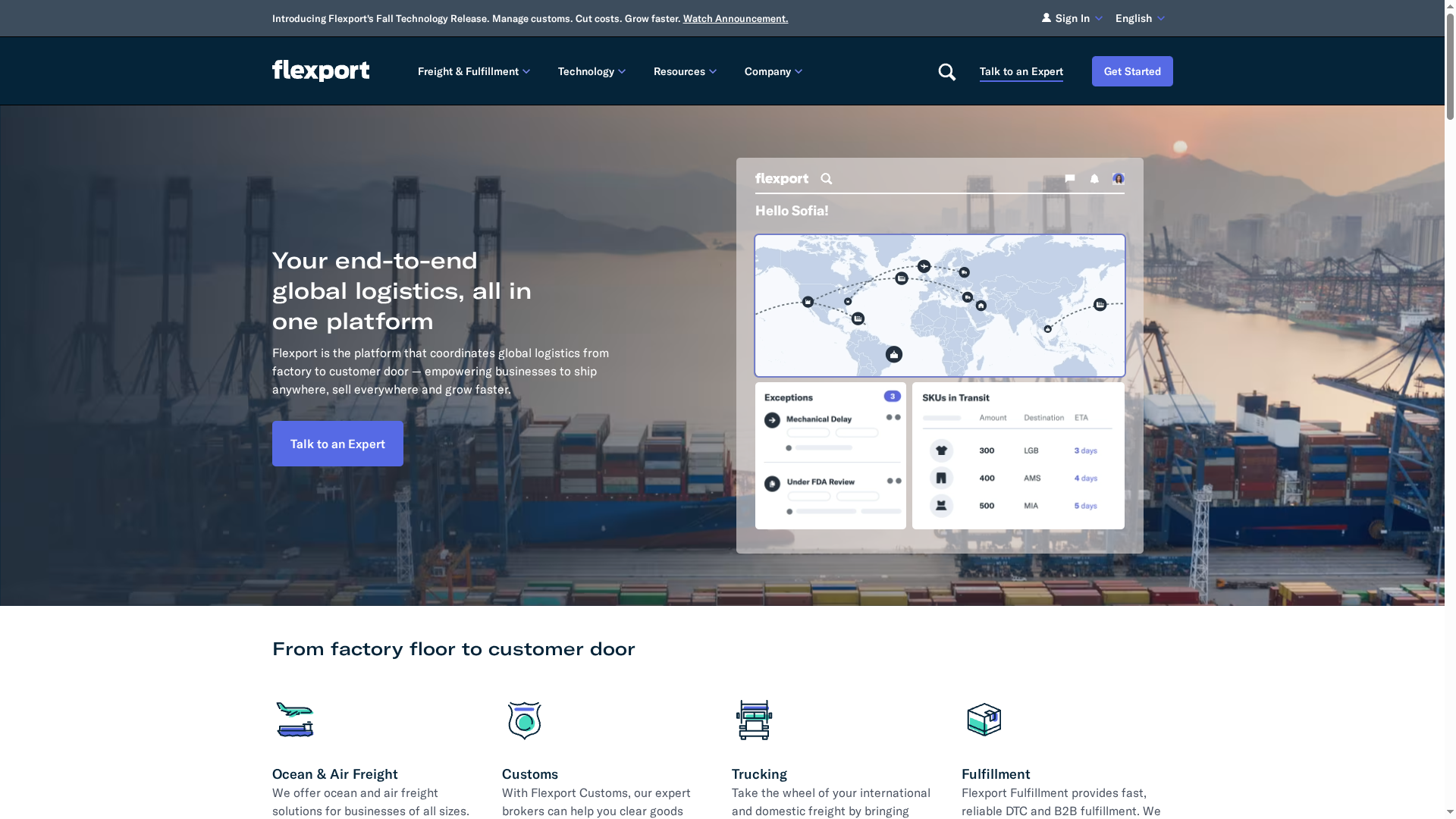
Flexport is an end-to-end global logistics platform that coordinates international shipping from factory to customer door, emphasizing technology-driven visibility and control. It supports ocean and air freight, customs brokerage, trucking, and fulfillment while serving over 10,000 clients, including Shopify, Walmart, and Shein Marketplace. For mid and large shippers looking to centralize cross-border operations, Flexport promises SKU-level tracking and integrated workflows that reduce manual handoffs. That said, pricing details and geographic coverage are not specified in the provided content.
Core Features
Flexport combines ocean and air freight services with SKU-level visibility and real-time tracking, integrated customs brokerage to speed clearance and reduce duties, and domestic and international trucking for ground operations. The platform includes fast fulfillment services that tie into ecommerce platforms and a broader suite of supply chain data digitization tools to surface end-to-end visibility and control. Together, these capabilities let you manage freight, customs, last-mile trucking, and fulfillment from a single digital dashboard.
Pros
- Comprehensive, single-platform approach: Flexport bundles ocean, air, customs, trucking, and fulfillment so you can reduce vendor fragmentation and manage supply chain steps in one place.
- SKU-level, real-time visibility: The platform provides detailed tracking down to the SKU level, which helps you trace inventory and shipments with greater precision.
- Strong data and technology focus: Flexport emphasizes digitization and data management to optimize speed and cost across the supply chain.
- Established customer base and integrations: Serving over 10,000 clients, including major marketplaces, signals enterprise credibility and likely integrations with leading ecommerce platforms.
- Dedicated operational support: The product claims an expert support team to guide customers through each step of shipping, which helps reduce execution risk.
Cons
- Pricing transparency is absent in the provided content, which makes budgeting and ROI calculations difficult for buyers.
- Managing the full suite may still require coordination across multiple service types, creating complexity for small businesses without logistics infrastructure.
- The provided information lacks detail on specific geographic coverage or country restrictions, leaving questions about service availability in some markets.
Who It’s For
Flexport is best suited to mid-to-large businesses with regular international shipping needs that want to centralize logistics operations and achieve better supply chain visibility. If your company moves ocean or air freight, relies on fulfillment integration with ecommerce channels, and needs customs support and trucking, Flexport targets those exact pain points.
Unique Value Proposition
Flexport’s distinct value is the combination of end-to-end logistics services with a technology-first platform offering SKU-level, real-time visibility. That pairing lets teams shift from fragmented vendors and spreadsheets to a single data-driven workflow for freight, customs, ground transport, and fulfillment.
Real World Use Case
A retailer uses Flexport to manage international ocean freight, handle customs clearance, arrange trucking from port to warehouse, and execute final fulfillment—tracking each SKU in real time to reduce delays and optimize costs across the inbound supply chain.
Pricing
Not specified in the provided content.
Website: https://flexport.com
Easyship

At a Glance
Easyship is a global shipping platform built for ecommerce sellers who need to compare rates, buy discounted labels, and automate international workflows. It stands out for broad courier coverage and a user-friendly setup that gets stores connected quickly. The bottom line: if you want to reduce shipping costs across many carriers while adding calculated duties and taxes at checkout, Easyship delivers a clear, cost-focused solution.
Core Features
Easyship lets you compare more than 550 courier services to find competitive rates, buy and print discounted shipping labels, and simplify tracking with automation for workflows and reporting. It supports calculated shipping rates, taxes, and duties at checkout and connects via native integrations to major ecommerce platforms and marketplaces. The platform also offers a global fulfillment network with 3PL centers to support inventory and order routing.
Pros
- Easyship can deliver instant savings of up to 91% on shipping rates, which directly improves margins for cross-border orders.
- Its access to 550+ courier services gives you a wide range of routing and pricing options to meet different delivery speed and cost priorities.
- Automated workflows for shipping, tracking, and reporting reduce manual work and cut the time between order and shipment.
- The global fulfillment network with 3PL centers helps scale international distribution without building your own warehousing footprint.
- Easy setup and a user-friendly interface make it straightforward to connect stores and start comparing rates quickly.
Cons
- The platform’s specific cost structure is not detailed in the provided content, which can make it hard to forecast total logistics spend.
- Free plans appear to have limitations, and while no credit card is required to start, essential features may be gated behind paid tiers.
- The product does not explicitly state support for every ecommerce platform or courier service, so niche integrations may require validation.
Who It’s For
Easyship is best suited to ecommerce retailers and multi-channel sellers—from small shops to high-volume brands—who need automated, scalable shipping that lowers international and domestic costs. It’s a strong fit for merchants using mainstream ecommerce platforms who want faster onboarding and centralized shipping operations without building in-house logistics tools.
Unique Value Proposition
Easyship combines deep courier coverage with a streamlined interface and checkout-level calculations for duties and taxes, offering a single place to compare rates, buy labels, and route fulfillment. That combination of broad carrier choice, automation, and a built-in fulfillment network positions it as a practical cost-optimization layer for growing ecommerce operations.
Real World Use Case
An online retailer connects its store, compares 550+ carrier rates per order, selects the best-priced service, and prints labels directly from the dashboard. Duties and taxes are calculated at checkout, fulfillment is routed to a nearby 3PL center, and automated tracking updates reduce customer support inquiries—resulting in lower shipping spend and faster delivery times.
Pricing
Easyship offers a free plan to get started, with paid plans available and a 14-day free trial for professional features. Exact paid plan pricing and tiered inclusions are not specified in the provided data.
Website: https://easyship.com
Shippo

At a Glance
Shippo provides scalable shipping tools, discounted rates, and world-class support for businesses that need reliable courier services and flexible integration options. It connects to 40+ carriers and top store platforms, so you can move from manual label printing to automated workflows quickly. If you sell online and want an easy path to cost savings and tracking visibility, Shippo is a practical choice — though very small sellers should check costs closely.
Core Features
Shippo is built around multi-carrier shipping: discounted rates from more than 40 carriers, shipping label creation and printing, real-time tracking with notifications, returns management, and API solutions for deep platform integration. Higher plans add branded tracking emails and labels, and the product supports both an app interface and an API-first approach for embedding shipping into your stack. In short: label generation, tracking, returns, and automation live under one roof.
Pros
- Scalable carrier access: Shippo’s partnerships with 40+ carriers give you competitive rate options across regions, which helps reduce per-shipment costs as volume grows.
- Clear tiering and trial access: A free starter plan and a pro plan at $17/month (or $205/year) let you pilot the platform before committing to higher-volume features.
- Automation and ease of use: The platform streamlines label printing, tracking, and returns so routine tasks become hands-off and less error-prone.
- Strong developer resources: Detailed API documentation supports custom integrations, which is useful if you’re a platform provider or need embedded shipping.
- Reputation for support: Shippo emphasizes world-class support, which matters when shipments cross borders and exceptions occur.
Cons
- Cost sensitivity for micro-sellers: Pricing may be costly for very small or low-volume businesses that primarily need occasional labels.
- Technical lift for APIs: Some users will find API integration complex without technical expertise or developer resources.
- Tier clarity: The available information lacks a detailed, side-by-side feature comparison between tiers, which makes it harder to predict exactly which advanced features require upgrades.
Who It’s For
Shippo fits e-commerce merchants, high-volume shippers, and software or platform providers that need integrated shipping capabilities. If you manage growing order volumes, want discounted rates without negotiating dozens of carrier contracts, or need to embed shipping into your product, Shippo is designed for you. If you’re a sole seller doing a handful of orders per month, evaluate the cost-benefit first.
Unique Value Proposition
Shippo combines a broad carrier network, accessible label and tracking tools, and an API-first design—so you get both an easy interface for everyday shipping and a developer-friendly platform for custom workflows. That dual approach makes it a one-stop option for companies scaling cross-border logistics without juggling multiple vendors.
Real World Use Case
An online retailer automates order fulfillment with Shippo to print labels, push tracking updates to customers in real time, and issue return labels when needed. The result: faster processing, fewer manual errors, and noticeable shipping-cost savings as volume climbs.
Pricing
Starter plan is free with limited features. The Pro plan is $17 per month or $205 per year and includes unlimited shipments and dedicated support along with additional features.
Website: https://goshippo.com
Zonos
At a Glance
Zonos is an international shipping solution built to remove surprises from cross-border ecommerce. It automates tariffs, duties, taxes, and compliance while integrating with ecommerce platforms and carriers to deliver a localized checkout experience. For medium and large retailers aiming to scale globally, Zonos reduces manual overhead and customer friction—but expect some technical setup and per-shipment cost variability.
Core Features
Zonos centralizes global tariff, duties, taxes, and compliance management and plugs into storefronts and carrier networks through APIs. Key capabilities include duty and tax calculation at checkout, automated HS code classification for products, and localized checkout with price and currency display. The platform supports seamless data exchange with carriers and platforms, which helps move cost and regulatory logic out of manual spreadsheets and into automated flows.
Pros
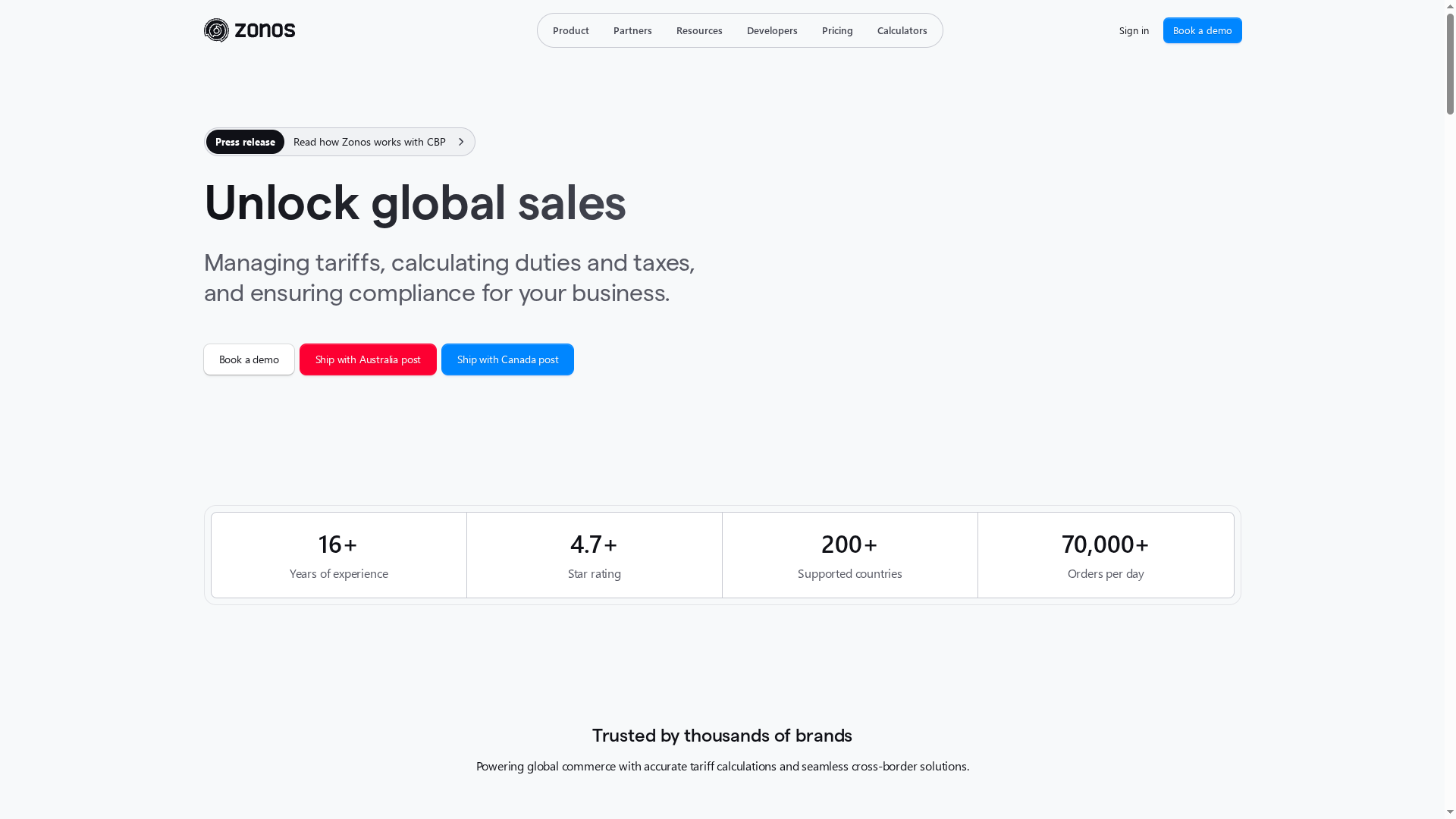
- Extensive global reach: Zonos supports over 200 countries and processes more than 70,000 orders daily, which demonstrates scale and operational maturity.
- Fewer disputes and complaints: Implementations report large reductions in customer service complaints and chargebacks tied to international shipping.
- Fast onboarding and usable dashboard: The product is described as easy to set up with a user-friendly dashboard, minimizing ramp time for teams.
- Accurate duties and taxes: Zonos provides guaranteed accuracy in duties and taxes calculation, reducing unexpected charges for customers at delivery.
- Enables global expansion: By automating compliance and pricing localization, Zonos helps businesses expand into new markets efficiently.
Cons
- Integration requirements may need technical support: The platform requires integration and setup that can demand developer time or vendor assistance.
- Per-shipment pricing adds variability: There’s no subscription fee; charges are per shipment and vary by carrier and service, which can complicate budgeting.
- Limited detail on advanced customization: The provided description offers limited information about deep customization or advanced features available to enterprise users.
Who It’s For
Zonos is ideal for medium to large ecommerce businesses and retailers that sell internationally and need to automate logistics, compliance, and localized pricing. If you handle significant international volume and need reliable duty/tax accuracy at checkout, Zonos fits well. Smaller sellers with minimal cross-border sales may find the integration and per-shipment pricing less attractive.
Unique Value Proposition
Zonos stands out by combining guaranteed duty and tax accuracy with broad carrier and platform integrations and localized checkout. That mix reduces surprise fees at delivery and lowers post-sale service work—turning complex customs rules into a predictable part of your checkout experience.
Real World Use Case
A retailer used Zonos to manage international tariffs, duties, and taxes and saw a 70% reduction in customer service complaints. The implementation simplified shipping processes, expanded international reach, and improved overall customer satisfaction by making costs transparent at purchase.
Pricing
No subscription fee; you only pay per shipment. Fees vary by carrier and service and are visible in the dashboard under Billing > Fees, which means costs scale with volume but require active monitoring for forecasting.
Website: https://zonos.com
ShipStation
At a Glance
ShipStation is a purpose-built shipping platform that helps e-commerce teams automate order fulfillment, print labels, and lower carrier costs. It excels at rate shopping and multi-carrier integration, making it particularly strong for merchants who sell across multiple channels. Setup can be involved for newcomers, and costs rise with volume, but its automation and scalability deliver real operational savings for growing sellers.
Core Features
ShipStation centralizes order management and fulfillment: rate shopping for the lowest shipping rates, buy and print labels, inventory and warehouse management, branded returns portals, tracking and analytics, and wide carrier and store integrations. It also provides automation rules and branded tracking pages so you can streamline repetitive tasks while preserving a consistent customer experience across channels.
Pros
- Automates repetitive tasks and reduces human error, freeing teams to focus on exceptions rather than manual label entry.
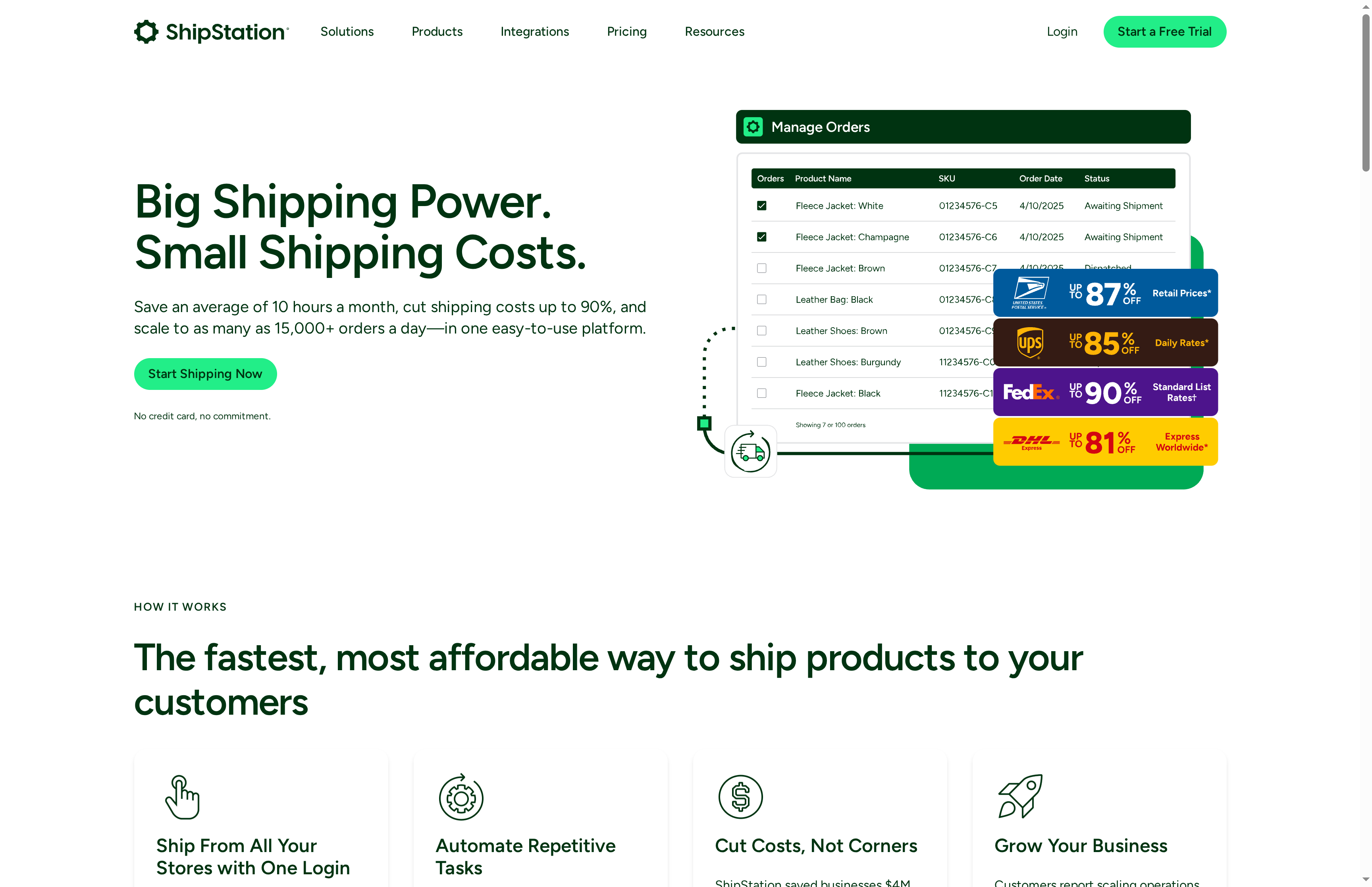
- Surfaces the best shipping rates from top carriers, which the vendor cites can save businesses up to 90% on shipping costs in some scenarios.
- Supports integration with over 400 store and carrier options, enabling unified fulfillment across marketplaces and couriers.
- Highly scalable to handle high-volume operations, with documented support for businesses processing 15,000+ orders per day.
- Provides a wide range of automation and branding tools that improve customer communications and help maintain a professional post-purchase experience.
Cons
- The platform can be complex to set up for new users because of the breadth of features and integration options.
- Pricing tiers can escalate quickly for larger volumes or when advanced features are required, increasing total fulfillment spend.
- Some users may find the interface and the breadth of options overwhelming at first, which can slow initial onboarding and adoption.
Who It’s For
ShipStation is aimed at small to large e-commerce retailers, marketplaces, and brands that need centralized shipping management across multiple sales channels. If you handle multiple carriers, require branded tracking and returns, or expect order volumes to scale, ShipStation is designed to grow with you. If you prefer a minimal, out-of-the-box experience with low setup time, expect a learning curve.
Unique Value Proposition
ShipStation’s strength is its combination of deep carrier connections, extensive integrations, and automation rules that convert manual fulfillment work into repeatable workflows. That mix delivers both immediate cost-savings through rate shopping and long-term operational efficiency through automation and centralized order orchestration.
Real World Use Case
An online retailer uses ShipStation to aggregate orders from marketplaces and direct channels, automatically apply shipping rules, print discounted labels in batch, and publish branded tracking pages to customers. The result: fewer shipping errors, faster fulfillment cycles, and a simpler returns experience that protects brand perception.
Pricing
ShipStation offers a free plan with limited features, and paid plans start at $14.99 per month. Higher tiers go up to $349.99 per month depending on volume and feature needs, so costs should be evaluated against expected order volume and the value of automation for your team.
Website: https://shipstation.com
Logistics and Fulfillment Platforms Comparison
This table provides a comparison of logistics and fulfillment platforms, highlighting their core features, pros, cons, pricing, and target users. Use this to find the best fit for your e-commerce logistics needs.
| Platform | Key Features | Pros | Cons | Pricing |
|---|---|---|---|---|
| orner | End-to-end logistics, real-time tracking, global warehouses | Comprehensive services, global coverage, automation, industry support | No public pricing; customized solutions only | Customized pricing |
| ShipBob | Flat-rate fulfillment, large warehouse network, API integrations | Transparent pricing, fast delivery, scalable support | Consultation required for pricing, extra fees for advanced services | Customized pricing |
| Flexport | Ocean and air freight, SKU-level tracking, customs brokerage | Comprehensive approach, SKU visibility, strong tech focus | No pricing transparency, requires coordination | Not specified |
| Easyship | 550+ courier services, discounted labels, calculated duties and taxes | Significant shipping cost savings, automated workflows, global fulfillment network | Cost structure not detailed, free plan limitations | Free plan, paid plans not detailed |
| Shippo | Multi-carrier shipping, real-time tracking, returns management | Scalable carrier access, clear tiering, automation | Costly for micro-sellers, technical setup for APIs | Free & paid plans (from $17) |
| Zonos | Duty and tax automation, compliance management, localized checkout | Extensive global reach, reduced customer disputes, accurate duties and taxes | Requires technical setup, per-shipment pricing variability | Per shipment |
| ShipStation | Rate shopping, label printing, order management automation | Automation reduces errors, scalable, extensive integrations | Complex setup, rising costs with volume | Free & paid plans ($14.99+) |
Discover Reliable Courier Services for Seamless Cross-Border Shipping
Navigating the complexities of cross-border shipping can be overwhelming. Issues like fragmented platforms, unclear shipment tracking, customs delays, and high costs create real challenges for ecommerce sellers striving to deliver fast and reliable service. This article highlights top tools designed to tackle these pain points, emphasizing real-time visibility, automation, and end-to-end logistics management to simplify international operations.
At orner, we understand these challenges deeply. Our platform offers an all-in-one solution crafted for ecommerce businesses needing reliable courier services with integrated freight booking, customs clearance, and fulfillment solutions. Enjoy streamlined workflows, global warehouse networks, and data-driven decision support that reduce surprises and keep your supply chain running smoothly.
Explore expert insights and FAQs about optimizing your logistics strategy in our QA Archives – ORNER.[NULL]
Ready to transform your cross-border shipping experience with a trusted partner? Visit orner.com today to learn how our comprehensive logistics platform can empower your ecommerce growth and turn complex shipping challenges into reliable, scalable operations.
Frequently Asked Questions
What are cross-border shipping tools?
Cross-border shipping tools are platforms designed to facilitate the movement of goods across international borders. They streamline processes such as label creation, duty calculation, customs clearance, and tracking. To get started, assess your shipping needs and explore various tools that match your requirements.
How do I choose the best cross-border shipping tool for my business?
To choose the best cross-border shipping tool, consider factors like pricing, ease of use, integration capabilities, and customer support. Evaluate your shipping volume and select tools that can scale with your needs. Perform a cost-benefit analysis to make an informed decision.
What features should I look for in a cross-border shipping tool?
Key features to look for in a cross-border shipping tool include real-time tracking, automated customs documentation, multi-carrier support, and cost transparency. Ensure the tool provides accurate duty and tax calculations to avoid unexpected fees. Create a checklist of these features to assess different options effectively.
How can I integrate a cross-border shipping tool with my online store?
Most cross-border shipping tools offer integrations through APIs, plugins, or app-store options for popular ecommerce platforms. Follow the setup instructions provided by your shipping tool to connect it with your store seamlessly. Test the integration to confirm proper functionality.
What are the common challenges of cross-border shipping, and how can tools help?
Common challenges include customs delays, unexpected tariffs, and tracking issues. Cross-border shipping tools alleviate these problems by automating documentation, providing duty calculations, and offering real-time updates on shipments. Implement a tool that addresses these challenges to enhance your shipping efficiency.
How can I reduce shipping costs using cross-border shipping tools?
You can reduce shipping costs by using cross-border shipping tools that offer rate comparisons across multiple carriers. Select the most cost-effective shipping options based on speed and value. Monitor your shipping metrics regularly to identify patterns and make adjustments that can lead to savings up to 20%.